
Kehao Chemical supplies building-grade HPS (hydroxypropyl starch ether) as a dry powder for gypsum plaster, tile adhesive, wall putty and cement- or lime-based mortar. HPS is normally formulated together with a cellulose ether such as HPMC or MHEC, so what it does to consistency, sag resistance and workability is confirmed in your own trial mix rather than assumed from a supplier page.

HPS powder, grade marked KH-301 on the sample label.
Hydroxypropyl starch ether is produced by modifying a starch backbone with hydroxypropyl groups. It arrives at the mixer as a dry powder and is pre-blended into the dry-mix system at a low level relative to the cellulose ether.
HPS is not a water-retention agent and not a replacement for a cellulose ether. HPMC or MHEC keeps water in the fresh mortar and provides most of the thickening; the starch ether changes how the fresh mortar behaves — how it stands up, how it flows and how it responds to the trowel. Because both act on the same rheology, the practical result depends on the whole formulation: cellulose ether type and dosage, filler and sand grading, the binder system and water demand.
Related product lines: HPMC · MHEC / HEMC · RDP / VAE · PVA 2488 · all products
Hydroxypropyl starch ether: a starch backbone modified with hydroxypropyl groups, also described as etherified starch. Supplied as a dry powder for pre-blended construction systems.
A white, free-flowing powder that disperses in water. Colour and handling behaviour of the grade you buy are confirmed on the current TDS.
A rheology modifier for the fresh mortar. It is used to adjust consistency and stand-up, alongside a cellulose ether rather than on its own.
Only properties that hold for our HPS grade are stated on this page. Everything else is grade- and batch-dependent, so it is confirmed on the current TDS for the grade you buy instead of being published here as a fixed number.
| Property | What this page states |
|---|---|
| Product name | Hydroxypropyl starch ether (HPS); starch ether; etherified starch |
| Grade reference | KH-301, as marked on the sample photographed on this page — confirm the grade supplied for your order |
| Physical form | White powder (see photo on this page) |
| Moisture content | Confirm on current TDS |
| Bulk density | Confirm on current TDS |
| pH (aqueous dispersion) | Confirm on current TDS |
| Viscosity / rheological profile | Confirm on current TDS |
| Behaviour in water | Dispersible in water; dissolution behaviour confirmed on current TDS |
| Packaging | Packing form and nominal weight confirmed with sales before ordering |
| Storage and shelf life | Store sealed, cool and dry, away from moisture and direct sunlight; shelf life confirmed on current TDS |
This page does not publish dosage rates, viscosity or pH figures, certification claims, MOQ or lead times. Ask for the current HPS TDS and the batch data for the grade you intend to use.
HPS from Kehao Chemical is supplied for construction dry-mix systems. The applications below are the ones we quote for this product line; suitability in a specific formula is still established by trial in your own mix.
Used to support consistency and stand-up in gypsum plasters and gypsum skim coats, where the mix has to stay workable while it is applied and levelled.
Can help a fresh adhesive hold its shape on a vertical substrate when it is used together with a cellulose ether. Open time and adhesion still depend on the complete adhesive formula.
Contributes to a smooth, non-slumping paste for hand or trowel application when the starch ether level is balanced against the cellulose ether level.
Used in cement- and lime-based render and repair mortars to adjust trowel feel and resistance to sagging on the wall.
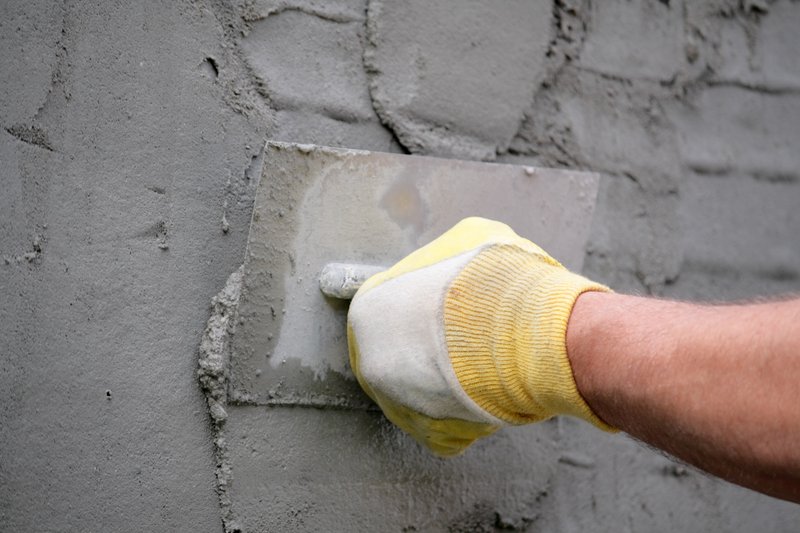
Illustrative application photo of dry-mix mortar work — not a photograph of HPS itself.
Outside our current HPS supply scope: food, paper sizing and textile sizing. Earlier versions of this page listed those uses. They are not part of the HPS grade range we supply, and we do not quote HPS for them. If you need a starch ether for a non-construction application, tell us the application and we will say whether a suitable grade is actually available.
HPS is almost always used as part of a pair. The cellulose ether — HPMC or MHEC / HEMC — provides water retention and the main thickening effect. The starch ether changes how the fresh mortar behaves under the trowel. Because the two act on different parts of the rheology, changing the cellulose ether grade or dosage changes what the same HPS level does.
In practice HPS is selected together with the cellulose ether, not in isolation. If you already run an HPMC or MHEC grade, send us the current formula and we will tell you which HPS grade is worth testing with it.
A starch ether can help build a firmer, shorter consistency in the fresh mortar. How much depends on the cellulose ether already in the formula, so the effect has to be measured, not assumed.
Used with HPMC or MHEC, HPS can help the wet mortar resist flowing off a vertical substrate during application. It is a contribution to the rheology, not a guarantee against slip.
HPS can help trowel glide and stand-up in gypsum and mortar systems. Formulators usually judge this by hand application rather than by a single laboratory number.
Where the effect stops. HPS is not a water-retention agent, not a defoamer, not a retarder, and not a substitute for adhesion or site testing. A mix that sags, stiffens or dries too fast is diagnosed across the whole formula — cellulose ether level, starch ether level, sand grading, water demand and mixing time — not by changing the starch ether alone. We confirm which grade to test; the site result is established by your trial.
HPS is a small part of a dry-mix formula, so the trial is the real specification step. The sequence below is the one we run with new buyers.
Send the application, the substrate, the cellulose ether you use now and the behaviour you want to change.
We confirm which HPS grade fits the request and send the current TDS for that grade.
Test the sample against your current material at the same cellulose ether level, then compare consistency, sag and trowel feel.
Once the trial result is accepted, we confirm packing and the batch test data for your order.
Packaging, QC and storage. HPS is shipped in sealed industrial packing. Keep bags closed and store the material in a cool, dry place away from moisture and direct sunlight. Packing size and shelf life are confirmed on the TDS and on your order documents; production batches are tested before delivery and the results for your order are available on request.
Short answers to the questions we receive most often about HPS in dry-mix mortar.
No. HPS is a starch ether used alongside a cellulose ether. HPMC or MHEC provides water retention and most of the thickening; HPS modifies the fresh-mortar rheology. If you replace the cellulose ether with HPS, water retention will not be maintained.
We do not publish a dosage figure for HPS, because the useful level depends on your cellulose ether, filler and sand grading and on the application. Send your current formula and we will confirm the grade to test; the starting level is then set in your own trial.
No. Our HPS is supplied for construction dry-mix systems such as gypsum plaster, tile adhesive, wall putty and render mortar. Food, paper sizing and textile sizing are outside our current HPS supply scope.
The sample photographed on this page is marked KH-301. Confirm the grade offered for your order with our sales team and read the current TDS for that grade instead of relying on this page.
Yes. Request the current TDS and a sample through the form on this page. Samples are sent so you can test the material in your own mix before committing to a bulk order.
A mix with too much starch ether can become short and stiff, which is often misread as a cellulose ether problem. Reduce the HPS level step by step and keep the cellulose ether constant while you compare.
It is supplied in sealed industrial packing. Store it closed in a cool, dry place away from moisture and direct sunlight. Packing size and shelf life are confirmed on the TDS and on your order documents.
Send the application, the substrate, the cellulose ether grade you use now and the behaviour you want HPS to change. We reply with the grade we recommend, the current TDS and the data we can support it with.
Existing buyers can use the same form for batch test data and packing questions.
Cellulose Ether Manufacturer
Typically replies within minutes
Any questions related to HPS?

Nancy
🟢 Online | Privacy policy
Chat for quality HPMC & factory prices!
Please tell us what you need and we will contact you as soon as we receive it!