MHEC / HEMC cellulose ether · Kehao Chemical
Kehao Chemical supplies methyl hydroxyethyl cellulose (MHEC) and hydroxyethyl methyl cellulose (HEMC) for tile adhesive, wall putty, render and gypsum plaster. Send the application and the grade you use today, and we will confirm which viscosity grade fits the formulation you are working to.
Appearance: white or off-white powder · Packing: 25 kg net bags · Viscosity: 30–200000 cps, made to order
This page covers one product category. MHEC and HEMC are two naming orders for the same type of non-ionic cellulose ether, so buyers searching either term land in the same place.
MHEC stands for methyl hydroxyethyl cellulose; HEMC stands for hydroxyethyl methyl cellulose. Different markets, suppliers and data sheets put the two substituents in a different order, and both terms describe the same family of water-soluble cellulose ether. Kehao Chemical prints HEMC on the bag and sells the product under both names. This page therefore treats MHEC and HEMC as one search intent, not as two different products.
One category does not mean every grade behaves alike. Substitution level, viscosity and dissolution behaviour are set per grade, and a grade qualified for one formulation is not automatically interchangeable with another. The grade marking KHS-100 appears on the Kehao HEMC sample label shown here; the values that apply to your grade are the ones printed on its current TDS.
The product is a white or off-white powder used in dry-mix mortars as a water-retention and thickening agent. It is dosed into the dry blend at a low percentage and works in the mixing water: it slows the loss of water to the substrate and builds the consistency the trowel feels.
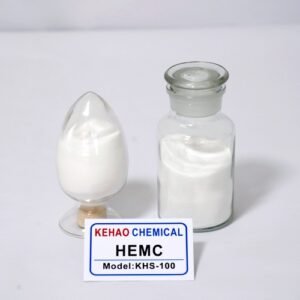
Kehao HEMC sample: white powder in a labelled bottle. The label carries the grade marking KHS-100; the properties of each grade are stated on the current TDS.
The values below are the ones printed on the MHEC specification sheet for this product. They are specification limits for the category, not a batch certificate, and not every limit applies unchanged to every grade.
| Property | Specification | Confirmed on |
|---|---|---|
| Appearance | White or off-white powder | Specification sheet |
| Particle size | Min. 90% passing 100 mesh | Specification sheet |
| pH | 5.0 – 8.0 | Specification sheet |
| Ash content | Max. 5.0 % | Specification sheet |
| Moisture | Max. 5.0 % | Specification sheet |
| Viscosity | 30 – 200000 cps, can be customised | Grade-dependent — current TDS |
| Substitution level | Grade-dependent | Current TDS |
| Gel temperature | Grade-dependent | Current TDS |
| Packing | 25 kg net bag | Printed on the bag |
Source: MHEC specification sheet supplied with this product, converted here into an HTML table so the values can be read and indexed; the original sheet image is kept as a file with this page update. Viscosity is quoted as the range the plant can customise, not as a single grade value.
Substitution level, the viscosity measured at your test method, gel temperature and dissolution behaviour are set per grade. The category limits on this page are not a specification for a specific grade, so ask for the current TDS of the grade you are evaluating before you write it into your own specification.
MHEC/HEMC is used where a fresh mortar has to hold water and hold its shape. These are the four systems this product is normally quoted into; a grade and a dosage are chosen inside each one.
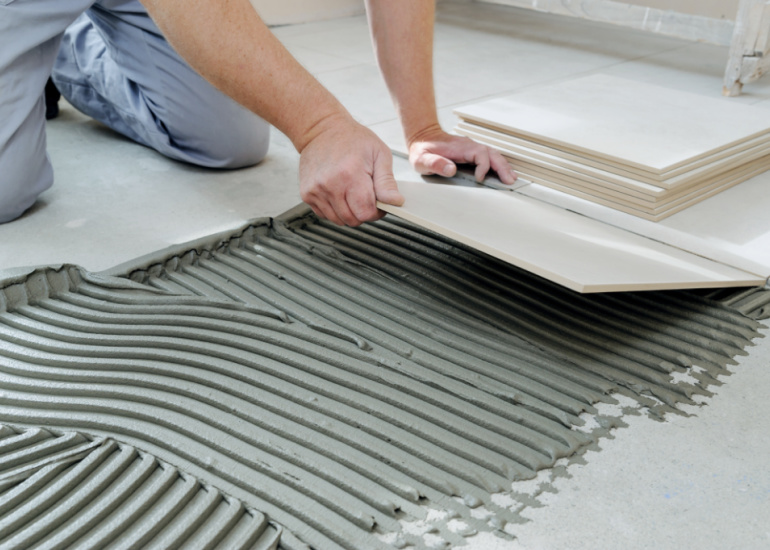
Cement-based thin-bed adhesives for ceramic and large-format tiles. The ether keeps mixing water in the adhesive so the combed ribs stay open long enough to lay the tile, and the bond is not lost to a dry substrate.

Dry powder putty and skim coats for interior walls. Water retention and thickening give a paste that stays on the trowel, levels out and can be sanded back to a flat surface.
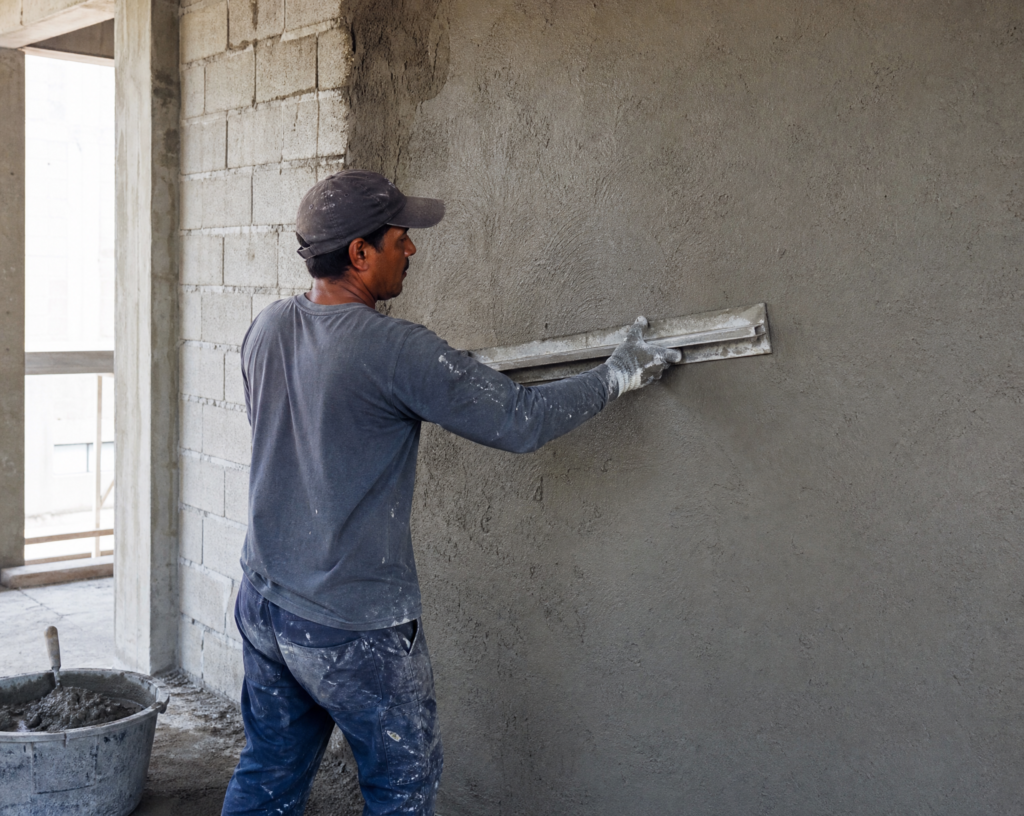
Cement-based render, repair and bedding mortars applied by trowel or machine. Water retention matters most on absorbent blockwork; consistency and sag resistance matter most on vertical work.
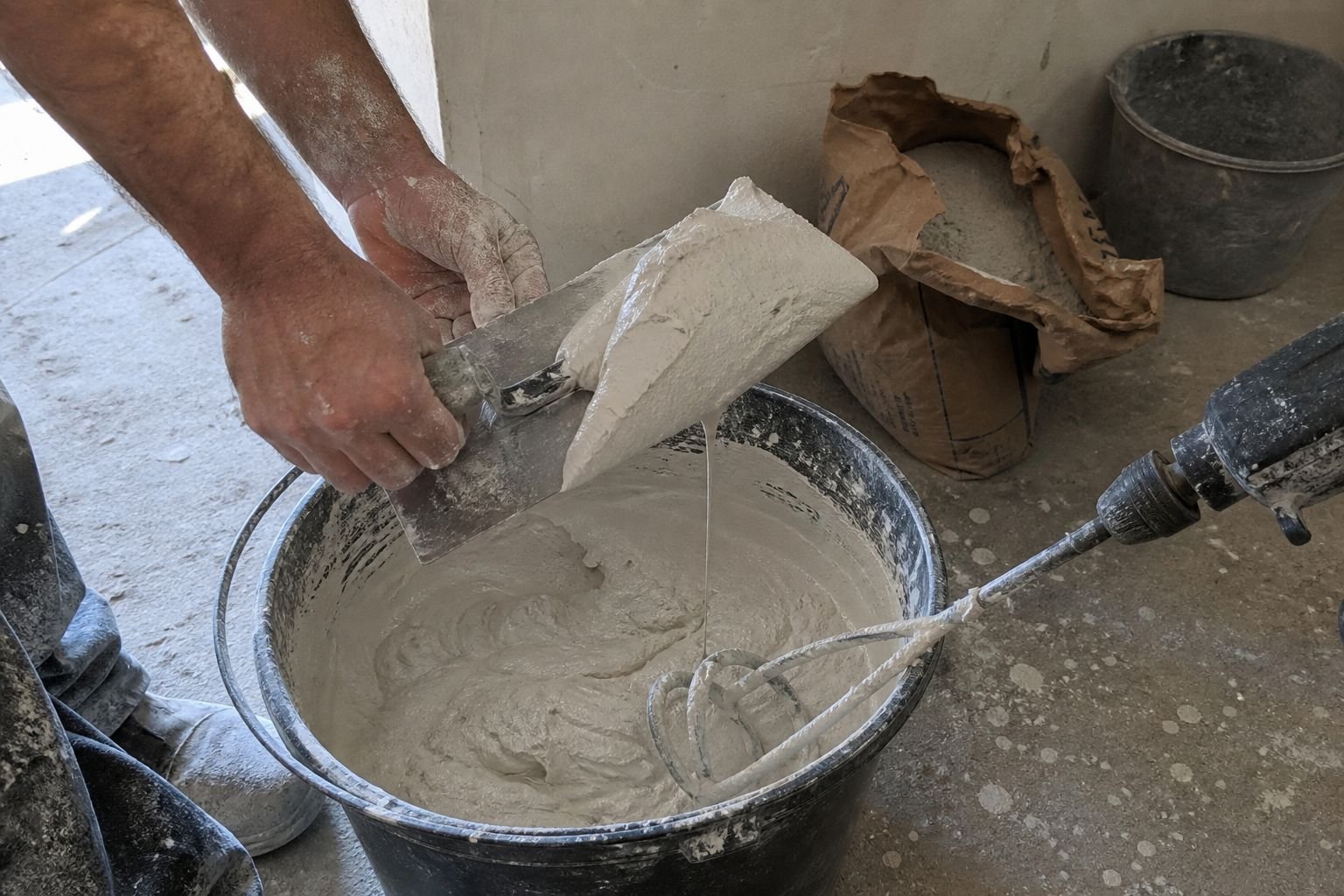
Gypsum-based plasters and joint compounds: water retention keeps the mix workable for the working time the site needs, and the ether controls how the paste sets up under the trowel.
The grade and the dosage that suit each system are formulation-dependent. They are confirmed in a trial on your own mix, not from a category table.
In a dry-mix mortar the ether does two jobs: it holds water in the mix and it builds consistency. Open time, trowel feel and sag resistance follow from those two, together with the rest of the formulation.
The dissolved ether raises the viscosity of the mixing water and slows its loss to the substrate and to evaporation, so the cement or gypsum has water available for hydration for longer.
The same polymer chains build consistency in the fresh mix. How much consistency you get depends on the grade, the dosage, the shear rate and the temperature.
A mortar that holds its water stays workable for longer. Open time also depends on the substrate, the ambient conditions and the rest of the admixture package.
On vertical work, consistency at low shear is what keeps the mortar from sliding. It is a property of the formulation, not a single number on a data sheet.
No grade removes the need for a trial: performance depends on the formulation, the substrate, the viscosity grade and the dosage.
Start from the system: tile adhesive, putty, render or gypsum. Absorbent substrates and thin-bed work put the priority on water retention; thick vertical work puts it on sag resistance.
Compare viscosity at the same method, concentration, temperature and spindle speed. A number without its method cannot be compared with another supplier’s number.
Temperature, wind and substrate suction change how quickly water leaves the mix. Ask for the grade that was qualified under conditions close to yours.
Fix a starting dosage from the TDS, then move it in steps in your own formulation and record workability, open time, sag and adhesion at each step.
Both are non-ionic cellulose ethers used for water retention and thickening in dry-mix mortar. The purchase decision should be made from the data sheet, the test method and a trial, not from a general claim about which chemistry performs better.
| Point to compare | MHEC / HEMC | HPMC |
|---|---|---|
| Chemical name | Methyl hydroxyethyl cellulose, also written hydroxyethyl methyl cellulose | Hydroxypropyl methyl cellulose |
| Substituent groups | Methyl and hydroxyethyl | Methyl and hydroxypropyl |
| Viscosity | Grade-dependent. Compare only at the same test method, concentration and temperature | Grade-dependent. The same rule applies |
| Solution behaviour | Non-ionic, dissolves in water. Gel point and dissolution rate differ by grade — read the TDS | Non-ionic, dissolves in water. Gel point and dissolution rate differ by grade — read the TDS |
| Use in dry-mix mortar | Water retention and thickening in tile adhesive, putty, render and gypsum systems | Water retention and thickening in the same systems |
| How to choose | Set the requirement, compare both TDS at the same method, then trial both in your formulation | The same sequence applies |
This page does not claim that one chemistry is more water-retentive, more heat-stable or more suitable than the other. Where a difference exists it comes from the grade and the formulation, and it has to be shown in your own trial at your own dosage.
What is printed on the product, and what is checked against the specification sheet.
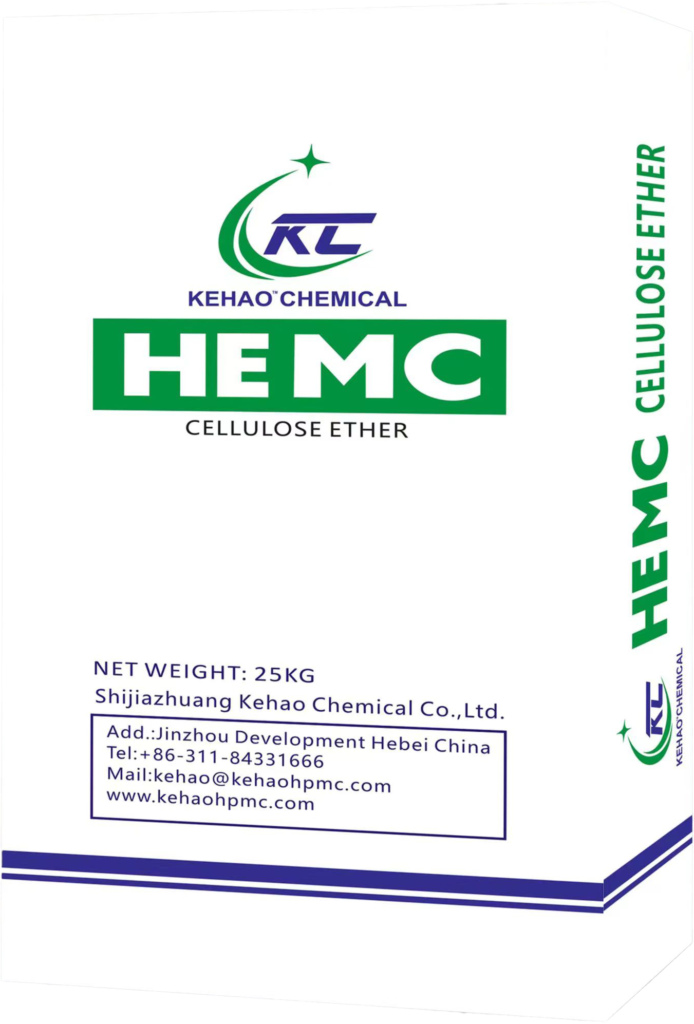
The 25 kg bag is printed with the Kehao Chemical brand, the product name HEMC Cellulose Ether and the net weight, with the manufacturer address in Jinzhou, Hebei. The reverse carries the precaution text and the transport and storage instruction reproduced in the image.
Appearance, particle size, pH, ash content, moisture and viscosity are the properties listed on the specification sheet, and the ones to check on incoming goods. Ask for the current TDS and the lot documents with your order, so the limits you test against are the ones that apply to the grade you bought.
Store the bags in a dry place, away from sunlight and rain moisture, as printed on the bag. Keeping opened bags closed limits moisture pickup. The bag also advises avoiding contact with skin and eyes and using normal protective gloves, a coat and respiratory protection during handling.
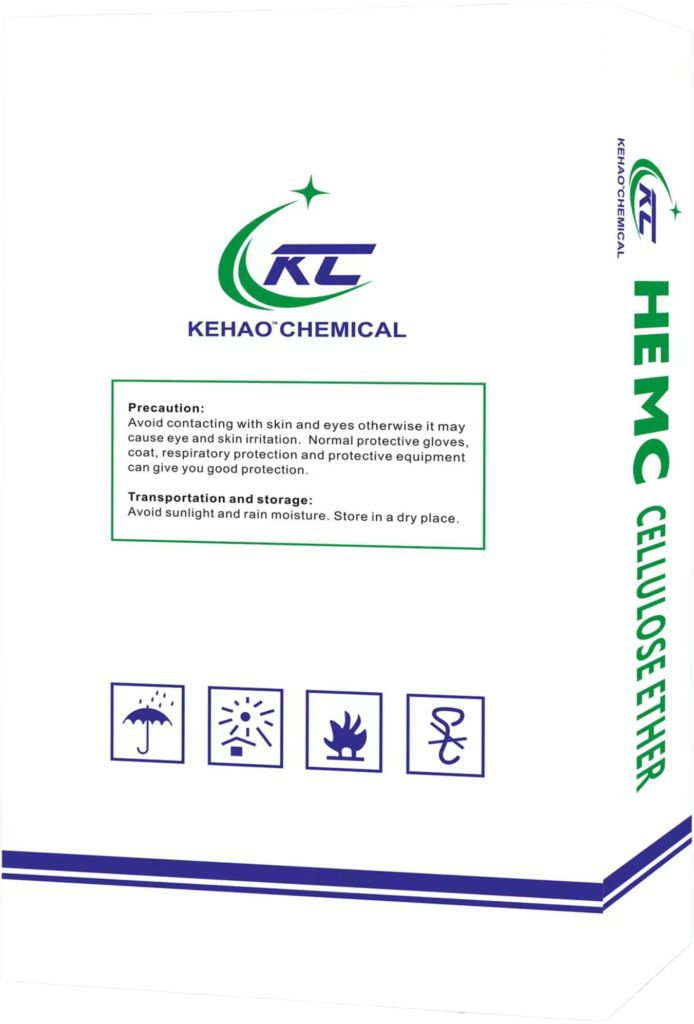
Reverse of the HEMC 25 kg bag: precaution, transport and storage notice.
A sample is sent so the grade can be checked in your own formulation, at your dosage, against the material you use today.
STEP 1
Application, substrate, current grade and dosage, cement or gypsum system, and the property you are not satisfied with.
STEP 2
A starting grade, a dosage window and the points to watch during the trial.
STEP 3
Mix, apply and test at your own dosage; record water demand, open time, sag and adhesion.
STEP 4
Once the trial is accepted, the grade, the packing and the TDS revision you are buying against are fixed in writing.
Questions that come up before a first order. If yours is not here, send it with the form at the end of this page.
They are two naming orders for the same non-ionic cellulose ether: MHEC is methyl hydroxyethyl cellulose and HEMC is hydroxyethyl methyl cellulose. Kehao Chemical prints HEMC on the bag and sells the product under both names. Individual grades still differ, so the grade is what has to be confirmed.
It can be trialled, but not assumed. Compare both TDS at the same test method, then run both materials in your own formulation and check water demand, open time, sag and adhesion at your dosage. A substitution usually needs a dosage adjustment.
Start from the grade you use now, or from the TDS value measured at your test method, then move the dosage in steps. The specification sheet gives a range of 30 to 200000 cps that can be customised, so the grade has to be named, not just the product category.
Substitution level, viscosity at a defined method, gel temperature, dissolution behaviour and particle size distribution. These are stated per grade on the current TDS; the category limits on this page are not a substitute for them.
25 kg net bags, printed with the product name, the net weight and the manufacturer address. Store the bags in a dry place, away from sunlight and rain moisture, as printed on the bag.
Use the form on this page or write to kehao@kehaohpmc.com. Tell us the application, the system you produce and the grade or TDS you are comparing against.
Tell us the application, the system you produce and the grade you are using now. We will answer with the grade and the dosage window we would start from, and the TDS revision behind it.
Useful to include: application and substrate, current grade and dosage, cement or gypsum system, and the property you want to improve.
Prefer email? Write to kehao@kehaohpmc.com.
Cellulose Ether Manufacturer
Typically replies within minutes
Any questions related to MHEC?

Nancy
🟢 Online | Privacy policy
Chat for quality HPMC & factory prices!
Please tell us what you need and we will contact you as soon as we receive it!