How HPMC Improves Tile Adhesive Performance: A Complete Guide
Choosing the right thickening agent can transform your tile adhesive’s performance and customer satisfaction. I learned this the hard way when I first started formulating tile adhesives.
In today’s competitive construction market, tile adhesive performance directly impacts everything from installation speed to long-term durability. The right adhesive becomes your competitive advantage, not just a commodity product. This comprehensive guide will help you understand how HPMC works, how to select the right grade for your application, and how to optimize your formulation for superior performance.
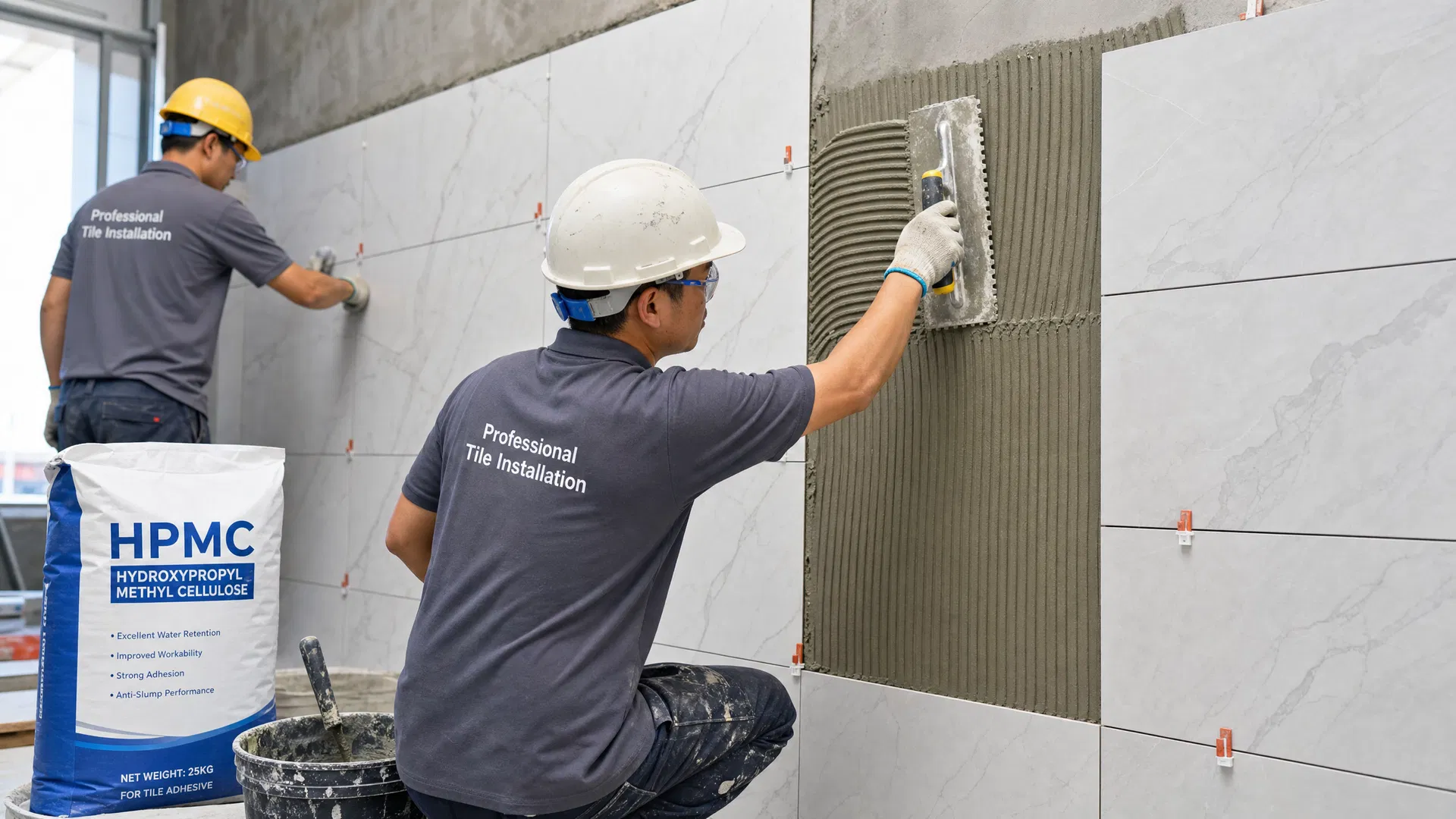
I’ve spent years formulating tile adhesives with manufacturers across Asia, Europe, and North America. Through this experience, I’ve discovered that HPMC isn’t just a thickener—it’s a performance enabler that directly impacts every critical adhesive property. This guide shares what I’ve learned to help you create superior tile adhesive formulations.
Why HPMC is Essential for Tile Adhesive Performance
What makes HPMC the industry standard for tile adhesive? HPMC provides multiple critical performance benefits that alternative thickeners cannot match. Water retention prevents premature drying. Initial tack prevents tile slippage. Sag resistance maintains consistent thickness on vertical surfaces. Extended open time allows for tile adjustment. These benefits directly translate to faster installation, fewer failures, and higher customer satisfaction.
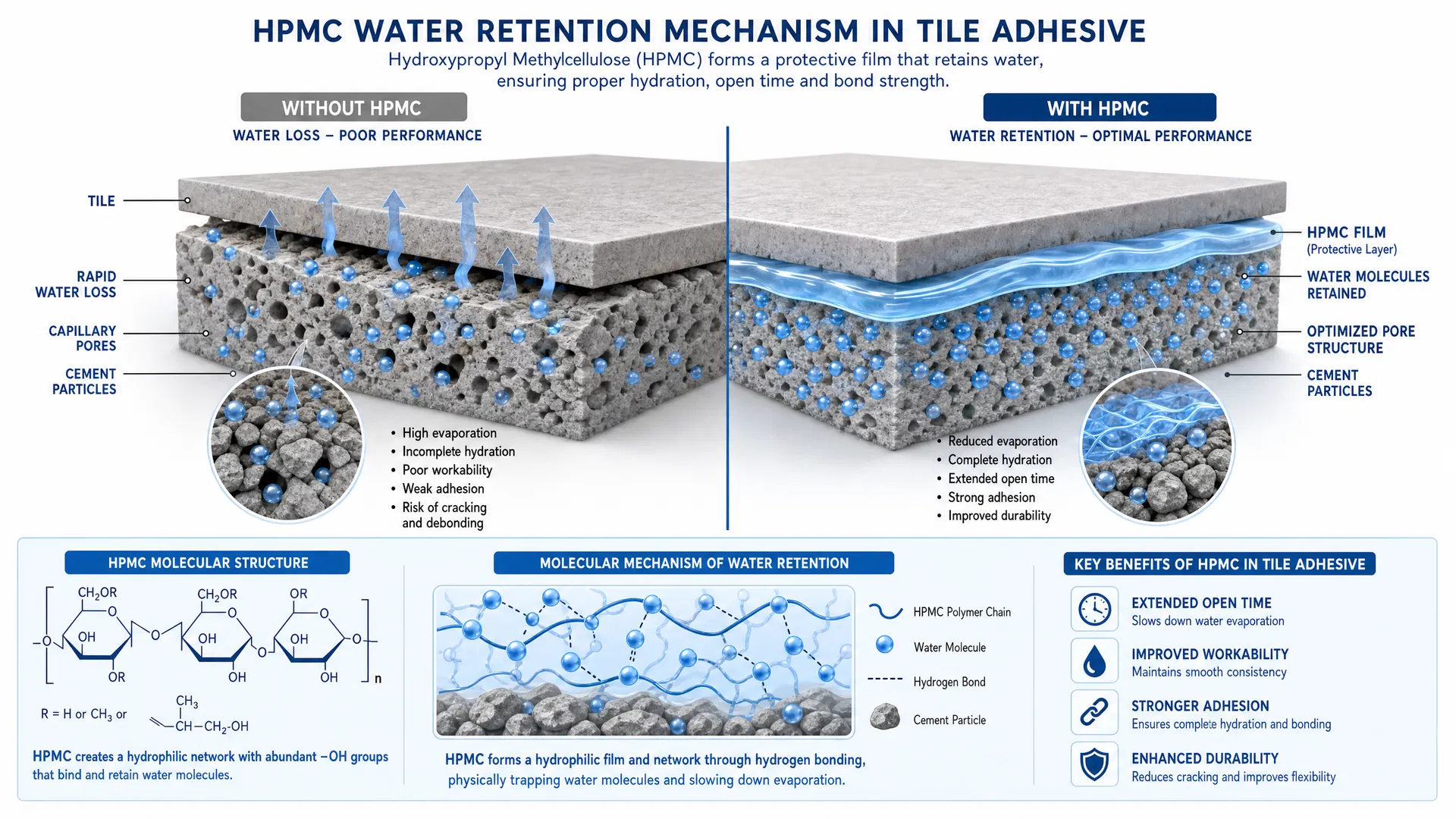
HPMC works through film formation. When water is added to the dry adhesive mix, HPMC particles hydrate and form a continuous film throughout the adhesive. This film serves multiple critical functions: it reduces water migration into the tile and substrate, maintains workability by slowing evaporation, improves adhesion by creating a mechanical bond with the substrate, and provides flexibility to accommodate substrate movement and thermal expansion. For detailed information about HPMC products and their specifications, consult the ISO 13007 standard for tile adhesives.
I’ve worked with tile adhesive manufacturers who initially resisted using HPMC because of cost concerns. But once they understood the performance benefits and the reduction in waste due to fewer failed installations, they realized that HPMC actually reduces their total cost of ownership. The key is understanding exactly how HPMC contributes to performance.
The primary performance benefits of HPMC in tile adhesive include: (1) Water Retention – HPMC film reduces water loss by 30-50%, maintaining workability for longer application windows and improving adhesion to porous substrates; (2) Initial Tack – HPMC provides immediate grab to prevent tile slippage, with performance maintained even on vertical surfaces; (3) Sag Resistance – HPMC prevents adhesive from sagging on vertical applications, maintaining consistent thickness; (4) Extended Open Time – HPMC slows evaporation, extending the time window for tile adjustment; (5) Improved Adhesion – HPMC film formation improves mechanical bonding to both tile and substrate surfaces.
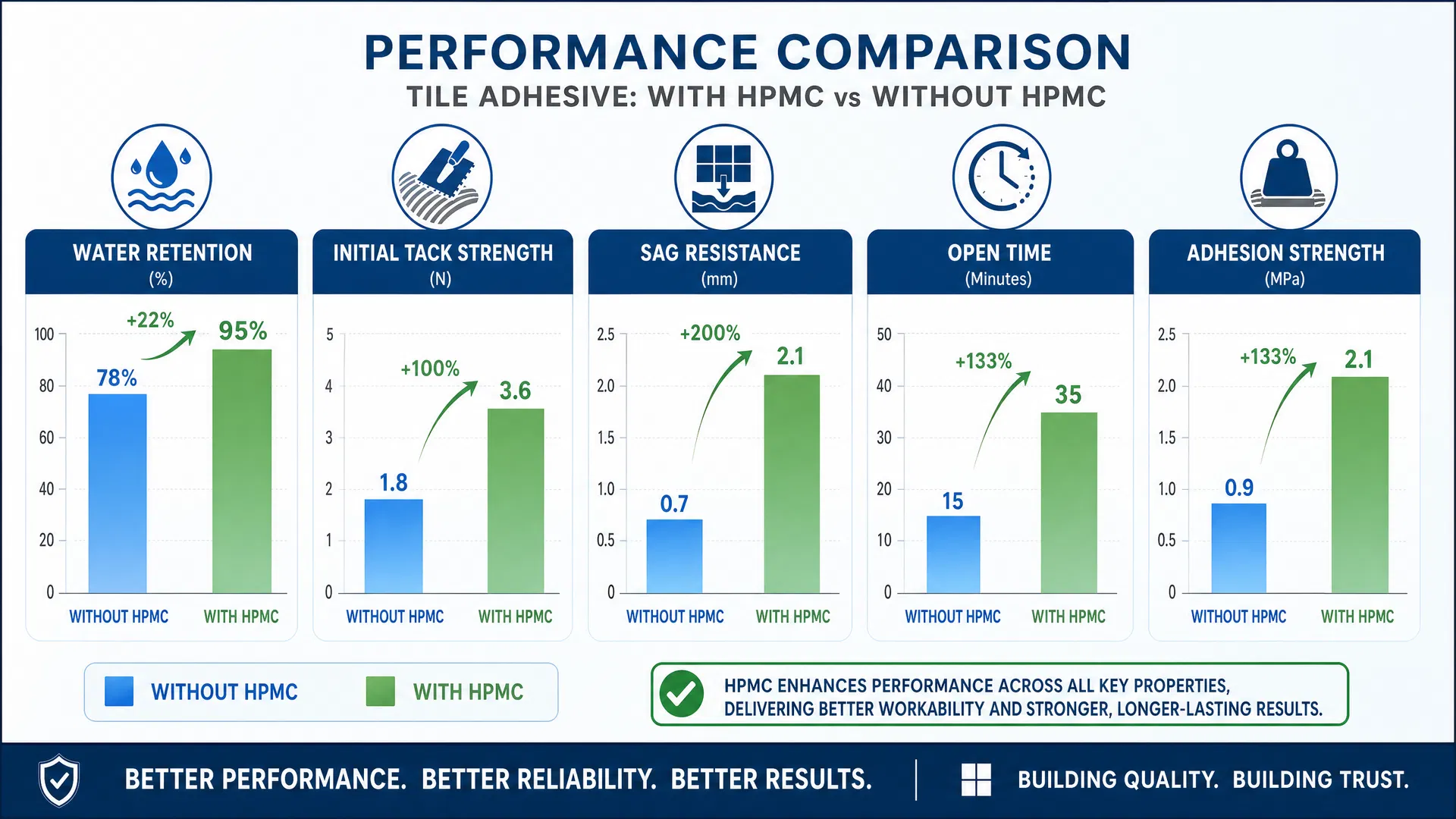
I’ve tested countless tile adhesive formulations, and the performance difference with proper HPMC selection is dramatic. HPMC is widely used in tile adhesive solutions where water retention and initial tack are critical performance factors. Adhesives without HPMC typically fail within 2-3 hours of application, especially in hot or dry conditions. With HPMC, the same formulation remains workable for 6-8 hours or longer, depending on environmental conditions.
Water retention is perhaps the most critical benefit. When you apply tile adhesive to a porous substrate like concrete or brick, water from the adhesive is rapidly absorbed into the substrate. Without HPMC, this water loss causes the adhesive to dry prematurely, reducing adhesion strength and increasing the risk of tile failure. HPMC film formation slows this water loss, maintaining the adhesive’s strength and workability.
Initial tack is equally important. Tiles are heavy, and gravity constantly tries to pull them downward. Without sufficient initial tack, tiles will slip during installation, creating voids beneath the tile that lead to failure under load. HPMC provides immediate grab that holds the tile in place while the adhesive cures. This is especially critical for large-format tiles, which are increasingly popular in modern construction.
| HPMC Benefit | Impact on Performance | Why It Matters |
|---|---|---|
| Water Retention | Reduces water loss by 30-50% | Maintains workability and adhesion strength |
| Initial Tack | Prevents tile slippage | Eliminates voids and failures |
| Sag Resistance | Maintains consistent thickness | Ensures uniform adhesive layer |
| Extended Open Time | Allows 6-8+ hour workability | Improves installation efficiency |
| Improved Adhesion | Enhances mechanical bonding | Increases long-term durability |
How to Select the Right HPMC Grade for Your Application
What HPMC grades are available, and how do you choose the right one? HPMC grades are specified by viscosity and gelation temperature. Viscosity affects water retention and workability. Gelation temperature affects performance in different climate conditions. Selecting the right grade requires understanding your specific application requirements.
HPMC grades for tile adhesive are typically specified by viscosity (measured in mPa·s at 2% solution) and gelation temperature. Common grades include: (1) Low Viscosity (50-100 mPa·s) – faster dissolution, better flow, suitable for self-leveling adhesives; (2) Medium Viscosity (100-400 mPa·s) – balanced performance, suitable for standard thin-set adhesives; (3) High Viscosity (400-1000+ mPa·s) – maximum water retention, suitable for vertical applications and thick-set adhesives. Additionally, HPMC is available with different gelation temperatures (50°C, 60°C, 70°C) to optimize performance in different climate conditions. Understanding quality standards is essential when selecting HPMC grades. For technical guidance, contact our technical support team.
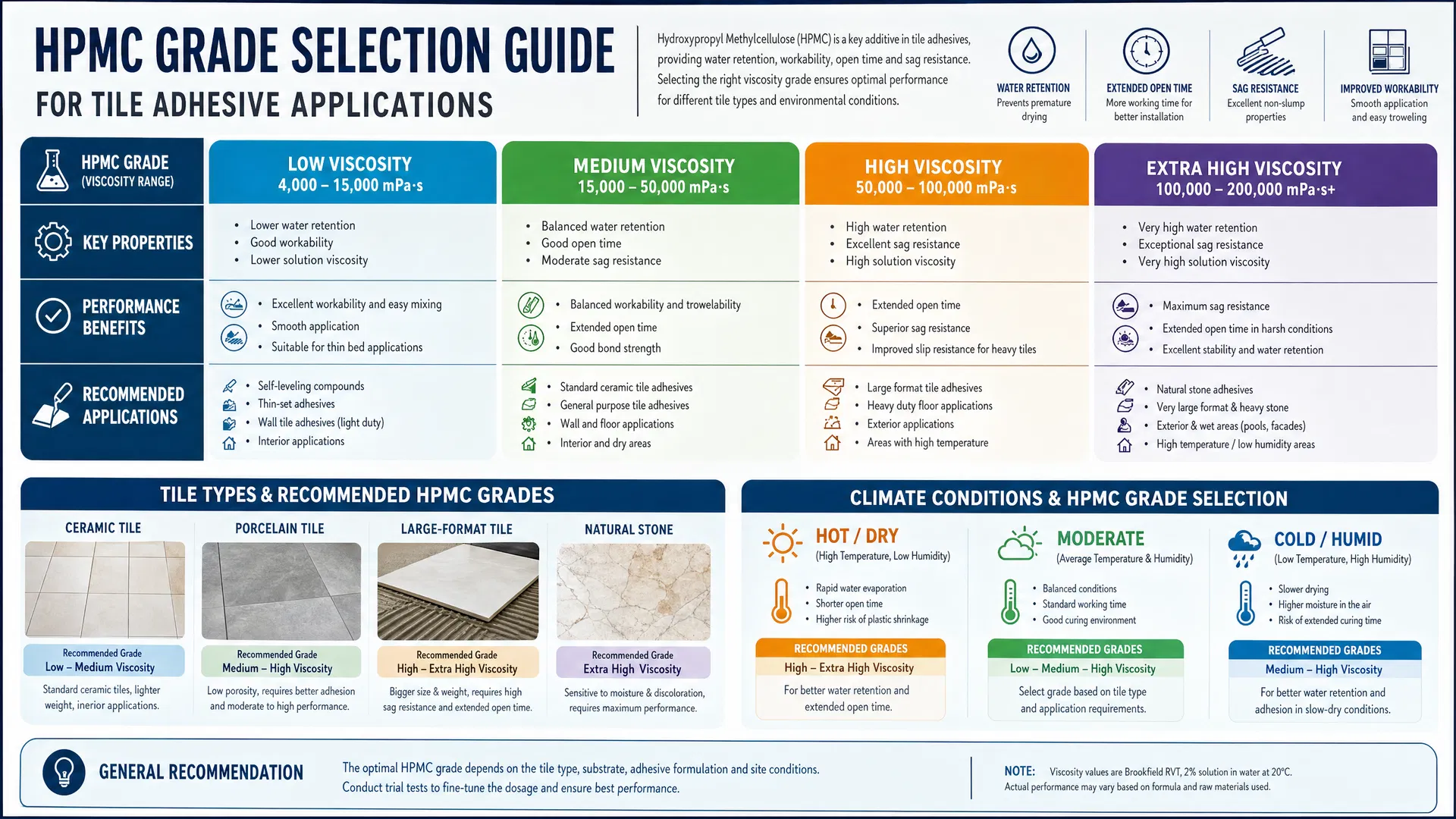
I’ve learned that HPMC grade selection is the most critical decision in tile adhesive formulation. The right grade can make the difference between a product that installers love and one that creates problems on the job site. I always start by understanding the application requirements: What tile type will be used? What substrate will the tile be applied to? What climate conditions will the adhesive experience? What performance requirements must be met?
For ceramic tiles on concrete in moderate climates, medium viscosity HPMC (100-400 mPa·s) with 60°C gelation temperature typically provides excellent performance. For large-format porcelain tiles on vertical surfaces, high viscosity HPMC (400-1000+ mPa·s) with 70°C gelation temperature provides superior sag resistance. For natural stone tiles in hot climates, high viscosity HPMC with 50°C gelation temperature provides faster hydration and extended workability.
| Application | Tile Type | Substrate | Climate | Recommended HPMC Grade |
|---|---|---|---|---|
| Standard Thin-Set | Ceramic | Concrete | Moderate | Medium Viscosity, 60°C |
| Large Format | Porcelain | Drywall | Moderate | High Viscosity, 60°C |
| Vertical Installation | Mixed | Concrete | Hot/Dry | High Viscosity, 50°C |
| Self-Leveling | Ceramic | Concrete | Moderate | Low Viscosity, 60°C |
| Exterior | Porcelain | Concrete | Cold/Wet | High Viscosity, 70°C |
The performance of HPMC in tile adhesive depends on several factors: the molecular weight of the HPMC (which affects viscosity and water retention), the degree of substitution (which affects gelation temperature and film formation), the particle size (which affects dissolution rate and workability), and the concentration used in the formulation (which affects all performance parameters).
I’ve encountered every one of these challenges in my work with tile adhesive manufacturers. For more information about HPMC compliance and quality standards, see our compliance guide. The key to overcoming them is understanding that HPMC is not a simple additive—it’s a critical component that requires proper handling and quality control.
Best Practices for HPMC Tile Adhesive Formulation
How do you formulate high-performance tile adhesive with HPMC? The starting point is always HPMC grade selection based on your specific application requirements. Next, optimize HPMC concentration—typically 0.5-1.0% by weight of dry adhesive. Then implement proper mixing procedures, quality control, and testing to ensure consistent performance across different conditions.
Best practices for HPMC-based tile adhesive formulation include: (1) Start with the right HPMC grade – select based on your specific application requirements, not just cost; (2) Optimize HPMC concentration – typically 0.5-1.0% by weight of dry adhesive; (3) Use quality cement – Portland cement quality directly affects adhesive performance; (4) Control water content – maintain consistent water-to-powder ratios for consistent performance; (5) Implement proper mixing procedures – use low-shear mixing to avoid bubble entrapment; (6) Test extensively – verify performance across different temperatures, substrates, and tile types; (7) Establish quality control – test each batch to ensure consistency; (8) Train installers – proper installation technique is essential for achieving design performance. For comprehensive information about construction applications, review our case studies. For environmental and safety compliance information, refer to ECHA guidelines and EPA regulations.
![Tile Adhesive Formulation Guide with HPMC]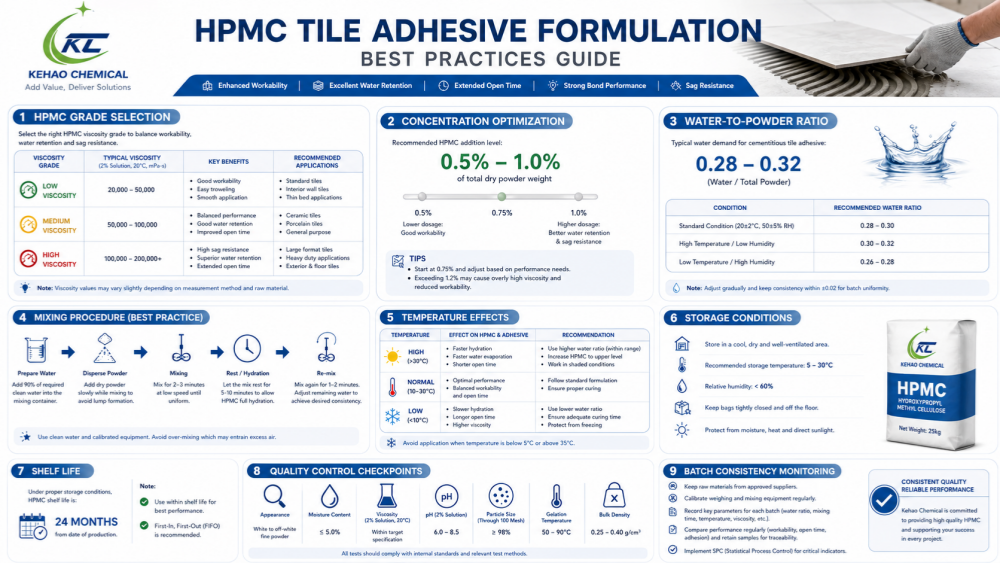
I’ve developed dozens of tile adhesive formulations with HPMC, and I’ve learned that there’s no universal "best" formulation. Instead, the best formulation is the one that meets your specific performance requirements at the lowest cost. This requires understanding your application requirements and testing systematically to optimize performance.
The starting point is always HPMC grade selection. Don’t just buy the cheapest HPMC available. Instead, work with your HPMC supplier to identify the grade that provides the best performance for your specific application. A slightly higher-cost HPMC grade might provide such superior performance that you can reduce cement content, resulting in lower total cost.
HPMC concentration is the next critical parameter. Too little HPMC, and you won’t get adequate water retention or initial tack. Too much HPMC, and the adhesive becomes too viscous and difficult to apply. The optimal concentration is typically 0.5-1.0% by weight of dry adhesive. Start with 0.7% and adjust based on performance testing.
Water content is critical for consistent performance. Always use the same water-to-powder ratio to ensure consistent performance. In hot, dry climates, you might need slightly more water to compensate for faster evaporation. In cold, humid climates, you might need slightly less water to prevent excessive workability.
A typical high-performance tile adhesive formulation with HPMC includes: Portland cement (60-70%), sand (25-35%), HPMC (0.5-1.0%), other additives (pigments, air entrainment, accelerators, retarders) (2-5%), and water (added during application). The exact formulation depends on your specific performance requirements, climate, and substrate types.
Conclusion
HPMC has become the industry standard for tile adhesive because it delivers superior performance across every critical parameter: water retention, initial tack, sag resistance, open time, and adhesion strength. By understanding how HPMC works, selecting the right grade for your specific application, and implementing best practices in formulation and quality control, you can create tile adhesives that deliver superior performance and customer satisfaction.
The key to success is moving beyond viewing HPMC as just another additive. Instead, recognize it as a critical component that requires proper selection, handling, and quality control. Work with your HPMC supplier to understand your options, test systematically to optimize performance, and implement rigorous quality control to ensure consistency.
Ready to optimize your tile adhesive formulation with premium HPMC? Kehao Chemical offers a complete range of HPMC grades specifically formulated for tile adhesive applications. Our technical team can help you select the right grade for your specific requirements and provide ongoing support to optimize your formulation.
Contact Kehao Chemical – Email: kehao@kehaohpmc.com | WhatsApp: +86 157 3315 6958
Request HPMC Samples – Get technical support and samples for your specific application
For more information about cellulose ether solutions, explore our complete product range.
For additional information, see our cellulose ether manufacturers guide and HPMC and RDP compliance guide.
Frequently Asked Questions About HPMC in Tile Adhesive
Q: What’s the difference between HPMC and other thickeners like starch or natural gums?
A: HPMC provides superior water retention (30-50% vs 15-25% for starch), better initial tack, superior batch-to-batch consistency, and longer shelf life (12-24 months vs 6-12 months for starch). HPMC is the clear choice for modern, high-performance tile adhesives.
Q: How much HPMC should I add to my tile adhesive formulation?
A: Typical HPMC concentration is 0.5-1.0% by weight of dry adhesive. Start with 0.7% and adjust based on performance testing. Too little HPMC reduces water retention and initial tack. Too much HPMC increases viscosity and reduces workability.
Q: How do I know which HPMC grade to use?
A: HPMC grade selection depends on your specific application: tile type, substrate type, climate conditions, and performance requirements. Consult with your HPMC supplier to identify the optimal grade for your specific application.
Q: Can I use HPMC with other additives like air entrainment agents or accelerators?
A: Yes, HPMC is compatible with most standard tile adhesive additives. However, always test new formulations to ensure that additives don’t negatively interact with HPMC or reduce performance.
Q: How should I store HPMC to maintain its effectiveness?
A: Store HPMC in cool, dry conditions with low humidity. HPMC is hygroscopic and absorbs moisture from the air. Proper storage can extend HPMC shelf life from 12 months to 24 months or longer.
Q: What’s the typical shelf life of HPMC tile adhesive?
A: Under proper storage conditions (cool, dry environment), HPMC tile adhesive typically maintains performance for 12-24 months. Always follow the manufacturer’s recommendations and test older batches before use.