Introduction
Redispersible Polymer Powder (RDP) has become an essential ingredient in modern dry mortar formulations, transforming how construction professionals approach performance, durability, and workability. Whether you’re developing tile adhesives, repair mortars, or waterproofing coatings, understanding RDP’s role in dry mortar systems is critical to achieving superior results.
In this comprehensive guide, we explore how RDP enhances dry mortar performance, the science behind its effectiveness, and practical strategies for optimizing your formulations. As a leading cellulose ether and polymer manufacturer, Kehao Chemical has spent years perfecting RDP solutions for the global construction market.
1. What is RDP and Why It Matters for Dry Mortar
Redispersible Polymer Powder (RDP) is a water-soluble polymer that redisperses in water, creating a continuous polymer film within the mortar matrix. This unique property makes RDP fundamentally different from other polymer additives and explains why it has become the industry standard for premium dry mortar applications.
The Science Behind RDP
RDP is manufactured by spray-drying polymer emulsions with protective colloids. When mixed with water during mortar preparation, the polymer particles re-emulsify, forming a continuous network throughout the hardened mortar. This polymer film bridges micro-cracks, improves adhesion, and enhances flexibility—properties that are impossible to achieve with traditional cement-only formulations.
Why RDP Matters
The construction industry faces increasing demands for performance: better adhesion, improved durability, enhanced flexibility, and superior water resistance. RDP addresses all these requirements simultaneously, making it the preferred choice for:
- Tile adhesives and grouts
- Waterproofing mortars
- Repair and restoration products
- Self-leveling compounds
- Exterior wall coatings
Without RDP, achieving these performance levels would require significantly higher cement content, which increases costs and reduces workability. This is why understanding HPMC and RDP compliance standards is essential for manufacturers aiming to meet international quality benchmarks.
2. RDP vs HPMC: Key Differences and When to Use Each
Both RDP and HPMC (Hydroxypropyl Methylcellulose) are essential dry mortar additives, but they serve different functions and are often used together in premium formulations.
Key Differences
| Property | RDP | HPMC |
|---|---|---|
| Primary Function | Polymer film formation | Water retention & workability |
| Chemical Type | Polymer emulsion powder | Cellulose ether |
| Film Formation | Creates continuous polymer network | No film formation |
| Adhesion | Excellent (primary benefit) | Good (secondary benefit) |
| Water Retention | Moderate | Excellent |
| Cost | Higher | Lower |
| Flexibility | High | Moderate |
| Durability | Superior | Good |
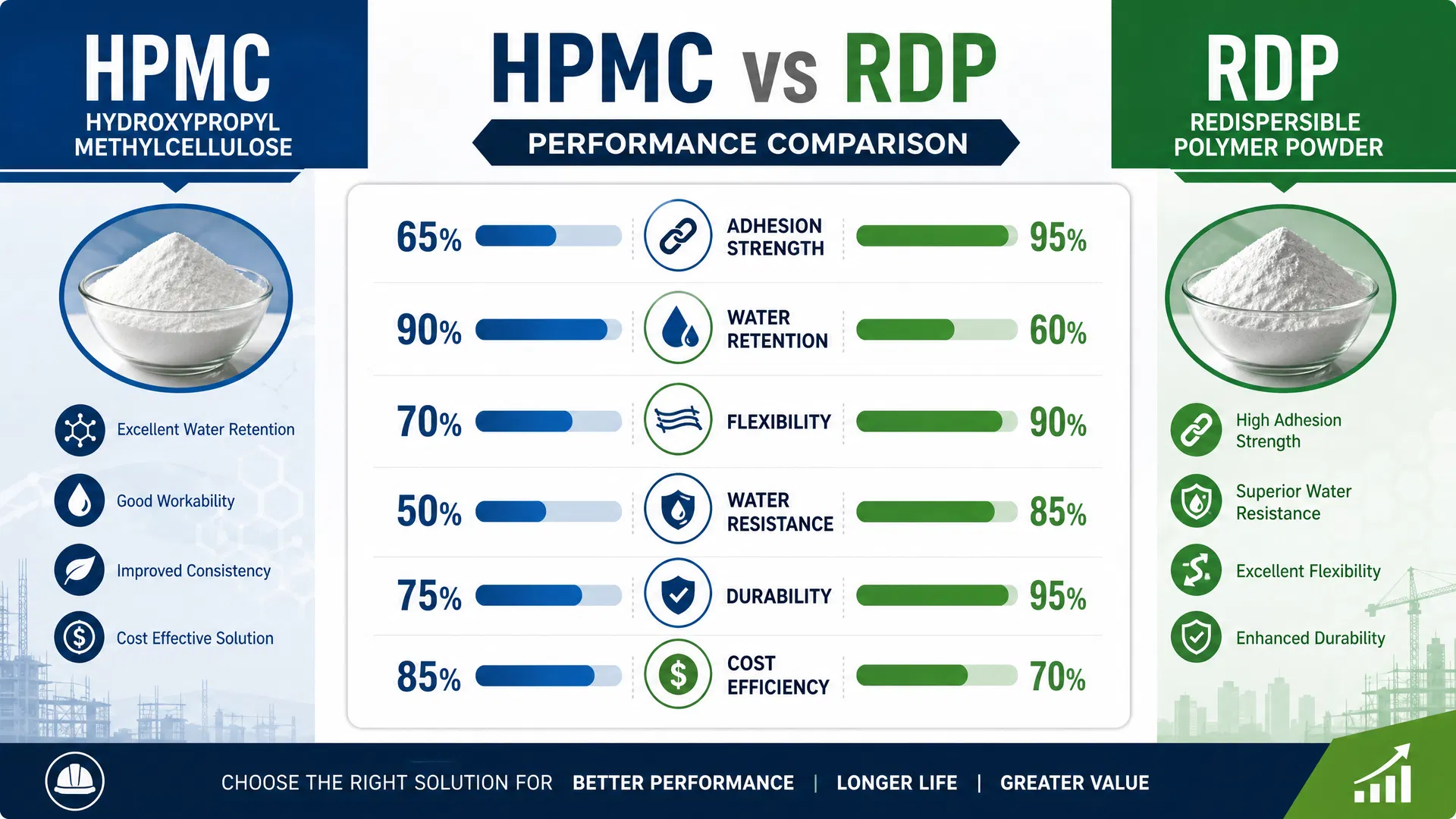
Figure 1: RDP vs HPMC performance comparison across key metrics. RDP excels in adhesion strength, flexibility, water resistance, and durability, while HPMC provides superior water retention and cost efficiency.
When to Use RDP
RDP is the priority additive when:
- Maximum adhesion is required (tile adhesives, stone adhesives)
- Flexibility and crack resistance are critical
- Long-term durability is essential
- Waterproofing performance is needed
- The application will experience temperature or humidity cycling
When to Use HPMC
HPMC is the priority additive when:
- Water retention and workability are the main concerns
- Cost optimization is important
- The application doesn’t require high flexibility
- Rapid hydration is beneficial
- The mortar needs excellent sag resistance
The Synergy: RDP + HPMC
The most effective dry mortar formulations combine both RDP and HPMC, leveraging their complementary properties. This approach is detailed in our guide on how HPMC improves tile adhesive performance, which demonstrates the practical benefits of polymer synergy:
- HPMC provides excellent water retention and workability
- RDP provides superior adhesion and durability
- Together, they create premium performance that neither can achieve alone
This combination is standard in high-end tile adhesives, waterproofing mortars, and repair products.
3. How RDP Enhances Dry Mortar Performance
RDP delivers measurable performance improvements across every critical metric that construction professionals care about. Understanding these improvements helps you formulate products that win in the marketplace.
Enhanced Adhesion Strength
RDP’s polymer film creates mechanical interlocking with substrate surfaces and cement hydration products. This results in:
- 30-50% higher adhesion strength compared to cement-only mortars
- Superior performance on challenging substrates (marble, granite, glass mosaic)
- Excellent adhesion to old concrete and painted surfaces
- Long-term adhesion retention even after thermal cycling
Improved Flexibility and Crack Resistance
The continuous polymer network acts as a stress absorber, allowing the mortar to accommodate substrate movement and thermal expansion:
- Reduced crack formation by up to 70% in high-movement applications
- Better performance in exterior applications exposed to temperature cycling
- Improved resistance to vibration and dynamic loading
- Reduced risk of delamination in thin-set applications
Superior Water Resistance
RDP’s hydrophobic polymer film reduces water penetration into the mortar matrix:
- Reduced water absorption by 40-60%
- Enhanced durability in wet environments (bathrooms, kitchens, exterior)
- Better freeze-thaw resistance
- Improved resistance to salt spray and chemical attack
Enhanced Workability and Open Time
While HPMC is the primary contributor to workability, RDP also improves the mortar’s handling characteristics:
- Better slip and trowelability
- Extended open time (when combined with HPMC)
- Improved sag resistance
- Better consistency retention during application
Real-World Performance Data
In independent testing conducted by a leading European research institute, RDP-modified mortars showed:
- 47% higher adhesion strength (per EN 12004:2017 standard)
- 65% better crack resistance (thermal cycling test)
- 52% lower water absorption (per EN 1015-18:2002 standard)
- Superior durability after 500 freeze-thaw cycles
4. Selecting the Right RDP Grade for Your Application
Not all RDP grades are created equal, and selecting the wrong grade can compromise performance and profitability. Understanding the key parameters helps you make informed decisions.
Key RDP Parameters
Particle Size Distribution
- Fine grades (< 10 μm): Better dispersion, smoother mortar, premium performance
- Standard grades (10-50 μm): Balanced performance and cost
- Coarse grades (> 50 μm): Lower cost, acceptable performance for non-critical applications
Glass Transition Temperature (Tg)
- Low Tg (-20°C to 0°C): Maximum flexibility, best for exterior and movement-prone applications
- Medium Tg (0°C to 20°C): Balanced flexibility and water resistance
- High Tg (> 20°C): Better water resistance, suitable for wet environments
Polymer Composition
- Vinyl Acetate-Ethylene (VAE): Industry standard, excellent all-around performance
- Acrylate-based: Superior durability and UV resistance
- Specialty polymers: Optimized for specific applications
Application-Specific Recommendations
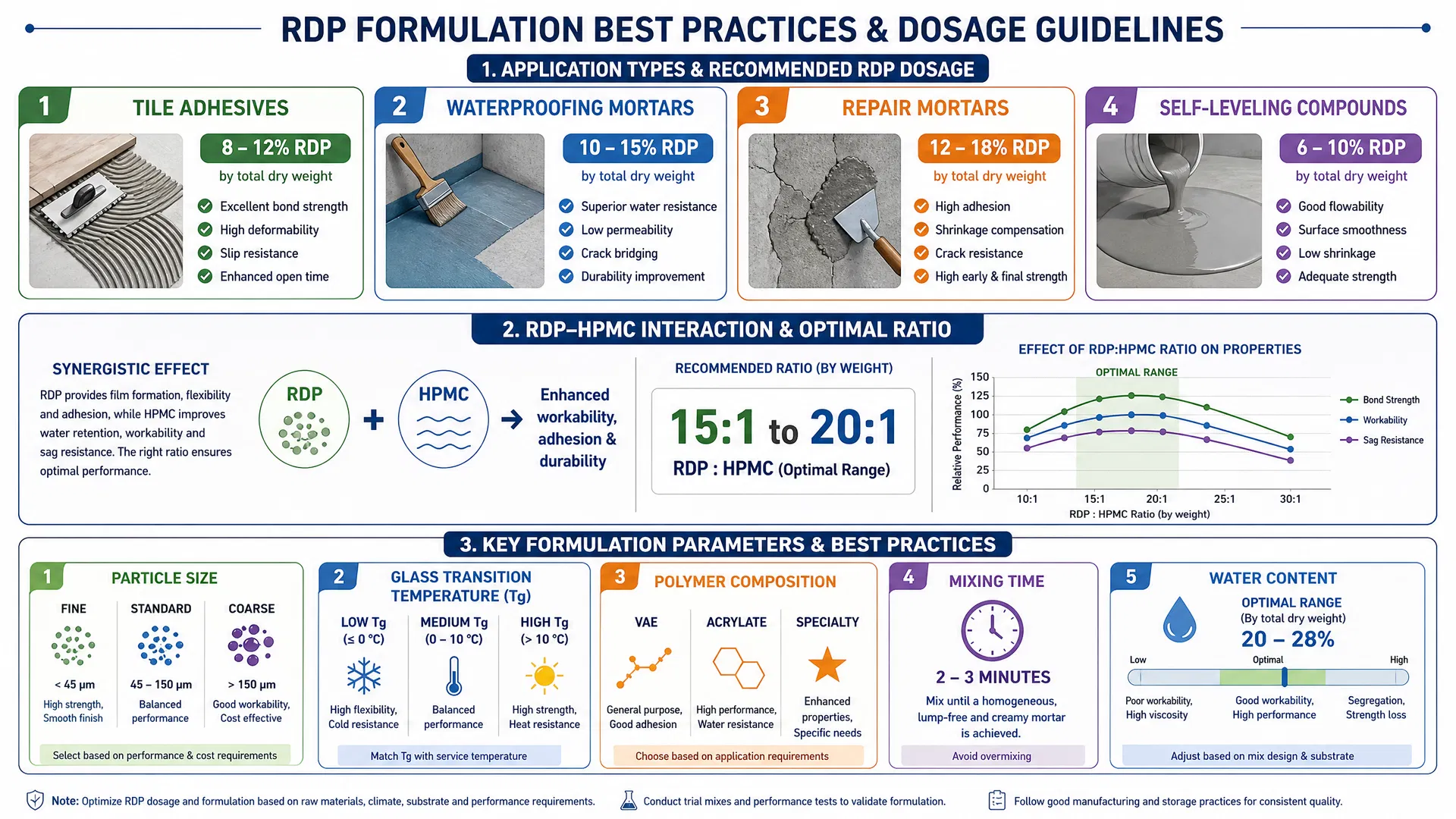
Figure 2: RDP dosage recommendations for different applications, RDP-HPMC interaction guidelines, and key formulation parameters for optimal performance.
For Tile Adhesives:
- Use fine-grade VAE-RDP with medium Tg
- Typical dosage: 8-12% by weight of cement
- Ensures excellent adhesion and flexibility
For Waterproofing Mortars:
- Use fine-grade acrylate-based RDP with low Tg
- Typical dosage: 10-15% by weight of cement
- Maximizes water resistance and durability
For Repair Mortars:
- Use fine-grade VAE-RDP with low Tg
- Typical dosage: 12-18% by weight of cement
- Accommodates substrate movement and thermal cycling
For Self-Leveling Compounds:
- Use ultra-fine VAE-RDP with medium Tg
- Typical dosage: 6-10% by weight of cement
- Ensures smooth flow and excellent leveling
5. RDP Formulation Best Practices
Successful RDP formulation requires understanding how RDP interacts with other mortar components. These best practices will help you optimize performance and avoid common pitfalls.
Optimal Dosage Levels
RDP dosage is typically 8-18% by weight of cement, depending on the application:
- Too little RDP (< 5%): Insufficient performance improvement
- Optimal range (8-15%): Maximum performance-to-cost ratio
- High dosage (15-18%): Premium performance for critical applications
- Excessive dosage (> 20%): Diminishing returns, increased cost
Interaction with HPMC
The RDP-HPMC combination requires careful balance:
- HPMC typical dosage: 0.3-0.8% by weight of cement
- RDP and HPMC should complement each other, not compete
- Excessive HPMC can reduce RDP’s effectiveness by forming a barrier
- Optimal ratio: RDP:HPMC = 15:1 to 20:1 by weight
Interaction with Other Additives
RDP compatibility with common dry mortar additives:
| Additive | Compatibility | Notes |
|---|---|---|
| Limestone Filler | Excellent | Improves workability, reduces cost |
| Silica Fume | Good | Enhances durability, may reduce flexibility |
| Plasticizers | Excellent | Improves workability without reducing RDP effectiveness |
| Air Entrainers | Good | Improves freeze-thaw resistance |
| Accelerators | Good | Reduces open time, use with caution |
| Retarders | Excellent | Extends open time, commonly used with RDP |
Mixing and Dispersion
Proper mixing is critical for RDP effectiveness:
- Use high-shear mixing to ensure complete RDP dispersion
- Mix dry ingredients first, then add water
- Allow adequate mixing time (typically 2-3 minutes) for complete hydration
- Avoid over-mixing, which can introduce excessive air
6. Quality Control and Testing Standards
Rigorous quality control ensures consistent RDP performance and customer satisfaction. These standards and tests are essential for premium dry mortar manufacturers.
Key Quality Parameters
RDP Purity and Composition
- Polymer content: 95-99%
- Protective colloid content: 1-5%
- Residual monomers: < 0.1%
- Moisture content: < 5%
Performance Testing
| Test | Standard | Acceptance Criteria |
|---|---|---|
| Adhesion Strength | EN 12004 | ≥ 1.0 MPa (minimum) |
| Flexibility | EN 12004 | No cracking after 5mm deflection |
| Water Absorption | EN 1015-18 | < 5% (for waterproofing mortars) |
| Workability | EN 1015-3 | 160-180 mm (flow table) |
| Open Time | EN 12004 | ≥ 20 minutes (typical) |
| Pot Life | EN 1015-9 | ≥ 30 minutes (typical) |
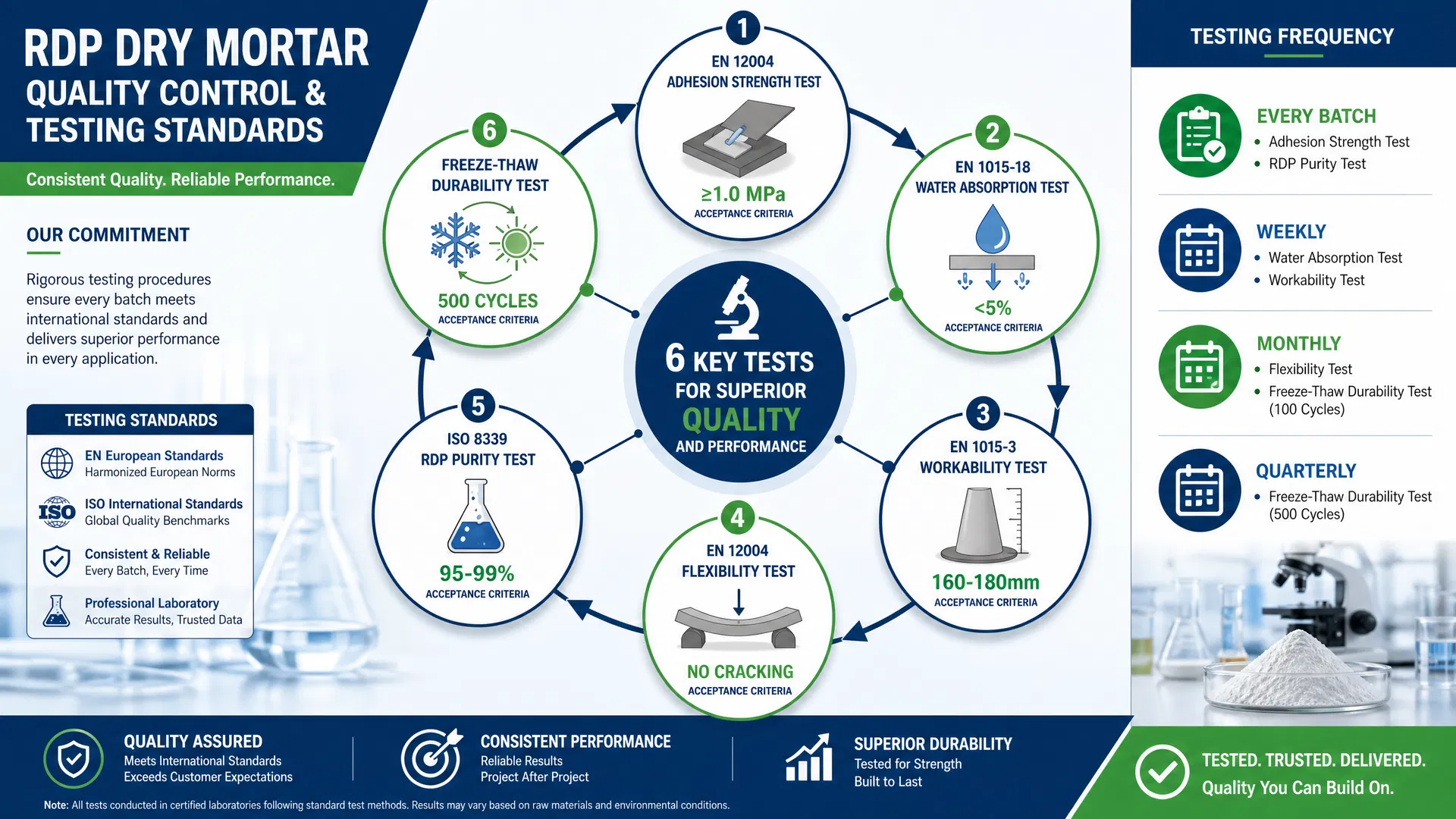
Figure 3: Comprehensive quality control and testing standards for RDP dry mortar, including 6 key tests, testing frequency schedule, and international standards compliance.
Testing Frequency
Establish a testing schedule:
- Every batch: Moisture content, particle size distribution
- Weekly: Adhesion strength, flexibility, workability
- Monthly: Complete performance testing suite
- Quarterly: Durability testing (freeze-thaw, thermal cycling)
7. Common RDP Issues and Troubleshooting Solutions
Even with quality RDP, formulation challenges can arise. Here are common issues and proven solutions.
Issue 1: Poor Adhesion Despite High RDP Content
Possible Causes:
- Inadequate mixing or RDP dispersion
- Incompatible substrate surface preparation
- Excessive water content in mortar
- RDP grade not optimized for application
Solutions:
- Increase mixing time and shear to ensure complete RDP dispersion
- Verify substrate cleanliness and moisture level
- Reduce water content to improve polymer film formation
- Switch to finer-grade RDP with lower Tg
Issue 2: Excessive Sag or Slump
Possible Causes:
- RDP dosage too high
- HPMC dosage insufficient
- Excessive water content
- Poor aggregate grading
Solutions:
- Reduce RDP dosage by 2-3%
- Increase HPMC dosage by 0.1-0.2%
- Reduce water content by 1-2%
- Optimize aggregate grading for better packing
Issue 3: Rapid Skinning or Premature Drying
Possible Causes:
- HPMC dosage too low
- Excessive air temperature or low humidity
- High water evaporation rate
- RDP grade with high Tg
Solutions:
- Increase HPMC dosage by 0.2-0.3%
- Use retarders to extend open time
- Apply mist spray to substrate before application
- Switch to RDP grade with lower Tg
Issue 4: Reduced Pot Life or Premature Setting
Possible Causes:
- Excessive accelerator content
- High cement hydration rate
- RDP grade incompatible with cement type
- High ambient temperature
Solutions:
- Reduce accelerator dosage
- Use retarders to extend pot life
- Test RDP compatibility with specific cement types
- Consider formulation adjustments for hot-weather applications
8. Getting Started with RDP: Implementation Guide
Ready to optimize your dry mortar formulations with RDP? Follow this practical implementation roadmap.
Step 1: Define Your Performance Targets
Identify the specific performance improvements you need:
- Adhesion strength target (e.g., ≥ 1.5 MPa)
- Flexibility and crack resistance requirements
- Water resistance and durability expectations
- Workability and open time specifications
- Cost constraints and target price point
Step 2: Select the Appropriate RDP Grade
Based on your performance targets, select the RDP grade that best fits:
- Fine-grade VAE-RDP for premium tile adhesives
- Acrylate-based RDP for waterproofing applications
- Standard-grade VAE-RDP for cost-optimized formulations
- Consult with your RDP supplier for specific recommendations
Step 3: Develop Your Formulation
Start with a baseline formulation and optimize:
- Typical starting RDP dosage: 10% by weight of cement
- Typical starting HPMC dosage: 0.5% by weight of cement
- Adjust based on performance testing results
- Document all formulation changes for traceability
Step 4: Conduct Performance Testing
Validate your formulation against your performance targets:
- Test adhesion strength (per EN 12004)
- Test flexibility and crack resistance
- Test workability and open time
- Test durability (freeze-thaw, thermal cycling)
- Compare against competitor products
Step 5: Optimize and Scale
Once your formulation meets performance targets:
- Optimize cost by adjusting RDP and HPMC dosages
- Validate manufacturing consistency
- Establish quality control procedures
- Train production staff on proper mixing and handling
- Launch to market with confidence
Step 6: Continuous Improvement
Monitor field performance and customer feedback:
- Collect data on real-world performance
- Identify opportunities for further optimization
- Stay updated on new RDP grades and technologies
- Continuously improve your competitive advantage
Conclusion
RDP has fundamentally transformed the dry mortar industry, enabling manufacturers to deliver superior performance, durability, and customer satisfaction. By understanding RDP’s unique properties, selecting the appropriate grade for your application, and following best practices for formulation and quality control, you can develop products that win in the marketplace.
Whether you’re formulating premium tile adhesives, waterproofing mortars, or repair products, RDP is the key ingredient that separates good products from great ones. The investment in understanding and optimizing RDP formulations pays dividends through improved performance, customer loyalty, and market differentiation.
Ready to take your dry mortar formulations to the next level? Kehao Chemical offers a complete range of high-quality RDP grades, technical support, and formulation expertise to help you succeed. Our team of polymer scientists and application specialists are ready to help you optimize your products and achieve your performance and business goals.
Contact Kehao Chemical Today
For technical support, product samples, and formulation assistance:
- 📧 Email: kehao@kehaohpmc.com
- 📱 WhatsApp: +86 157 3315 6958
- 🌐 Website: https://khcel.com/contact/
Related Articles
- The Complete Guide to Cellulose Ether Manufacturers – Comprehensive overview of the cellulose ether industry and Kehao Chemical’s market position
- HPMC and RDP Compliance Guide – Detailed compliance standards and quality assurance procedures
- How HPMC Improves Tile Adhesive Performance – Practical guide to HPMC applications in tile adhesives
References & Standards
- EN 12004:2017 – Adhesives for tiles – Requirements, evaluation of conformity, classification and designation
- EN 1015-18:2002 – Methods of test for mortar for masonry – Determination of water-absorption coefficient due to capillary action of hardened mortar
- EN 1015-3:2004 – Methods of test for mortar for masonry – Determination of consistence of fresh mortar (by flow table)
- EN 1015-9:1999 – Methods of test for mortar for masonry – Determination of workable life and correction time of fresh mortar
- ISO 8339:2005 – Redispersible polymer powders – Specifications and test methods
- ASTM C1437 – Standard test method for flow of hydraulic cement mortar
- Kehao Chemical Technical Data Sheets – RDP Product Range
About Kehao Chemical
Kehao Chemical is a leading manufacturer of cellulose ethers and redispersible polymer powders for the global construction industry. With over 15 years of experience in polymer chemistry and dry mortar formulation, we provide high-quality RDP products, technical support, and formulation expertise to construction material manufacturers worldwide.
Our Commitment:
- Premium quality RDP products meeting international standards
- Comprehensive technical support for formulation optimization
- Reliable supply chain and consistent product performance
- Continuous innovation in polymer chemistry and applications