
Dry-mix mortar failures often tempt producers to increase HPMC, polymer powder, or cement before they identify the real cause. That shortcut can raise cost while creating new defects. I prefer a controlled diagnosis that separates formulation imbalance, raw-material variation, production errors, additive incompatibility, and jobsite conditions before anyone changes a grade or dosage.
The 10 most common dry-mix mortar failures are weak adhesion, hollowing or detachment, cracking or shrinkage, powdering, sagging, poor workability, short open time, rapid skinning, bleeding or separation, and foaming or abnormal flow.1 Their causes usually overlap, so manufacturers should verify water addition, batch consistency, raw materials, additive compatibility, and application conditions in that order.
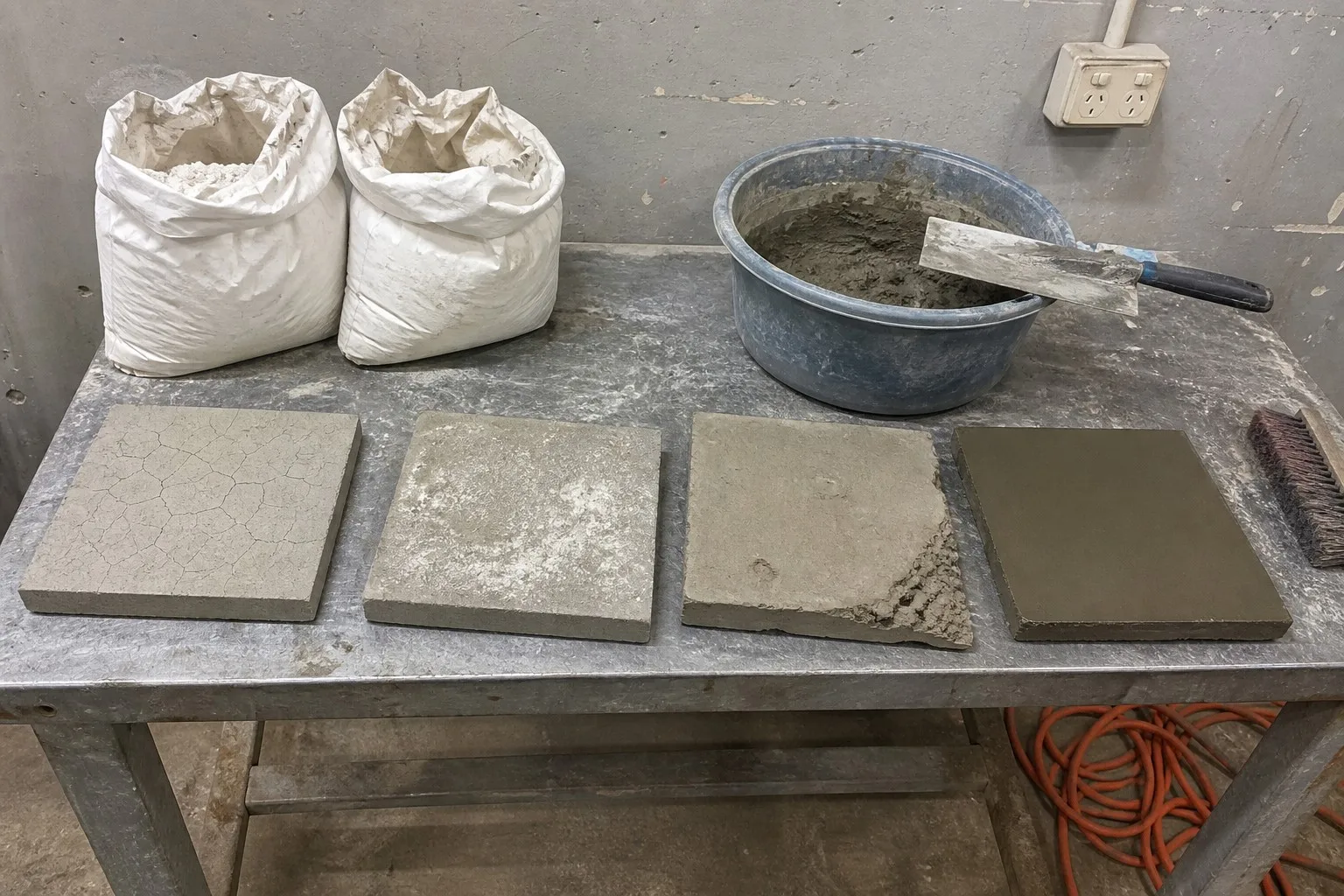
In our comparative mortar tests, visually similar defects do not always respond to the same correction. A useful investigation must therefore rank the possible causes, isolate one variable at a time, and compare the revised mortar against a retained control before production resumes.
Which Dry-Mix Mortar Failures Cause Poor Adhesion, Hollowing, or Detachment?
Weak adhesion may appear as low pull-off strength, hollow areas, edge lifting, or complete detachment. The visible damage often leads buyers to blame the polymer or cellulose ether immediately. However, the defect can also begin with the substrate, sand grading, cement condition, water addition, open time, or curing environment.
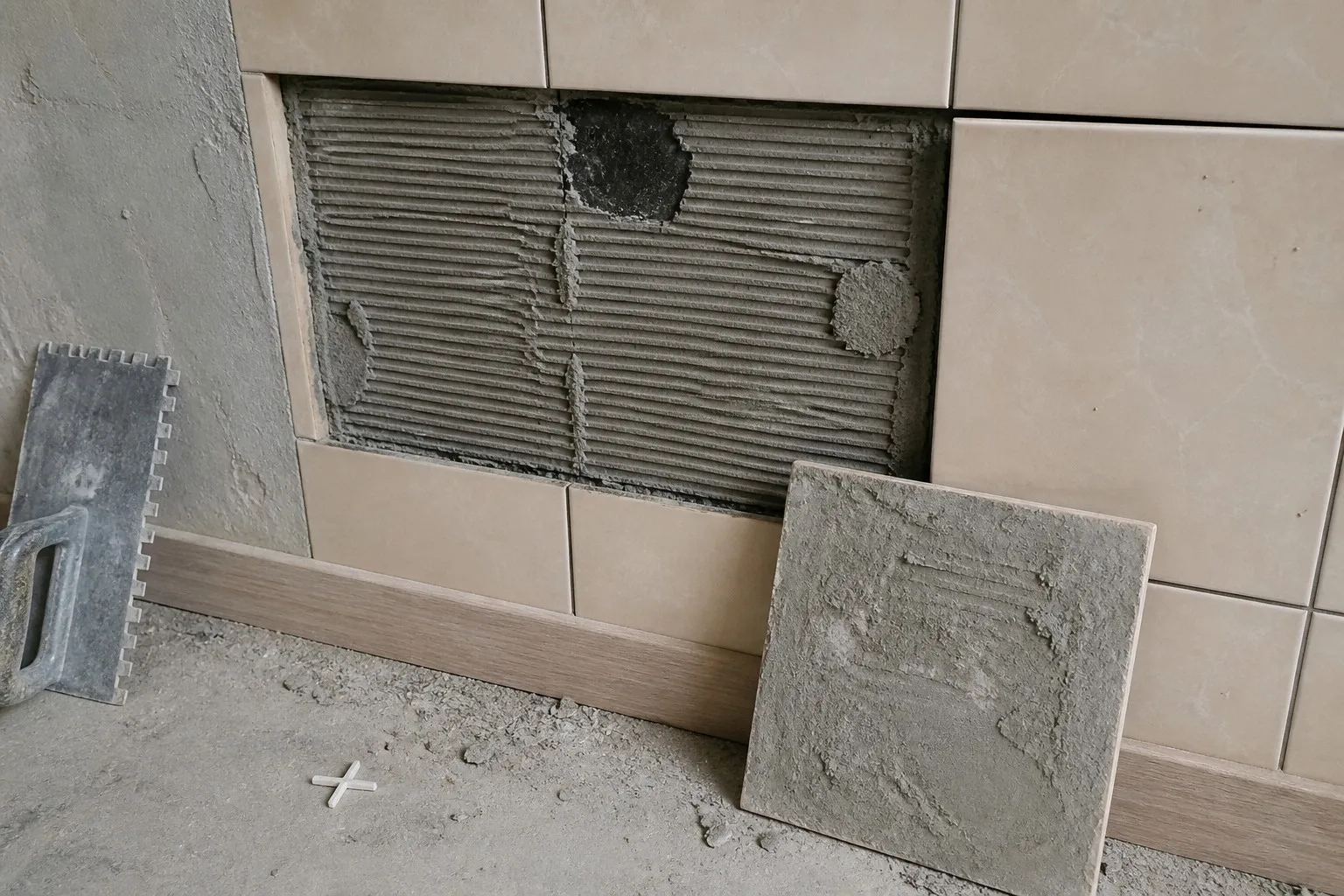
Weak adhesion is commonly associated with insufficient binder or polymer contribution, excessive water, poor substrate preparation, premature skin formation, incompatible additives, or application after the workable bonding window has closed. Hollowing and detachment also require checks for coverage, bed thickness, substrate absorption, curing conditions, and mechanical movement.
Failure 1: Weak adhesion
I first distinguish initial wet adhesion from hardened bond performance. A mortar may feel sticky during application but still develop weak final adhesion. Conversely, a mix with moderate tack may perform well after proper curing.
Plausible formulation causes include:
- An inadequate binder-to-aggregate balance
- Insufficient polymer modification for the specified application
- Excessive water that increases porosity after drying
- Poorly graded or contaminated sand
- Excessive air entrainment
- A cellulose ether grade that does not provide the required water retention under the actual substrate and climate conditions
- Incompatibility among cement, RDP, cellulose ether, defoamer, starch ether, and other modifiers
- An unsuitable setting or hydration profile
Application conditions can produce the same outcome. A dusty substrate creates a weak interface. A highly absorbent block can remove water before sufficient cement hydration occurs.2 A tile installed after the adhesive has skinned may contact a dry surface rather than fresh mortar.3
Failure 2: Hollowing or detachment
Hollowing does not prove that one chemical additive failed. It can result from incomplete mortar coverage, thick-bed shrinkage, insufficient pressing, differential movement, or rapid drying. Detachment may occur at different interfaces:
- Mortar-to-substrate interface
- Mortar-to-tile interface
- Within the mortar layer
- Within a weak substrate or tile backing
The failure plane provides an important diagnostic clue. If clean adhesive remains on the wall while the tile back is almost bare, open time, skinning, tile contamination, or poor transfer should be investigated. If mortar remains on both surfaces but breaks internally, the investigation should include binder strength, air content, water ratio, curing, and aggregate structure.
I do not treat higher HPMC viscosity as an automatic adhesion solution. Viscosity is only one specification. Water retention, rheology, modification level, dissolution behavior, and compatibility can differ between products carrying similar viscosity labels.
How should buyers verify the cause?
I recommend the following sequence:
- Confirm the actual water added per bag or batch.
- Check retained raw-material and finished-product samples.
- Record substrate absorption, temperature, humidity, wind, bed thickness, and waiting time.
- Inspect the failure interface.
- Repeat the test with a standard substrate and controlled water addition.
- Change only one variable, such as the RDP level or cellulose ether grade.
- Test adhesion and coverage after the required curing period.
- Validate the revision at pilot scale before full production.
Application-specific bond testing should follow the relevant market standard and be reviewed by a qualified laboratory or technical professional. Internal comparison tests are useful for screening, but they are not substitutes for independent certification.
Why Do Cracking, Shrinkage, and Powdering Become Dry-Mix Mortar Failures?
Cracks and weak surfaces often trigger a simple response: add more binder or polymer. That response can miss the source of the stress. Excess water, very fine aggregate, high binder demand, rapid drying, excessive layer thickness, and incompatible setting control can all change shrinkage and surface strength.
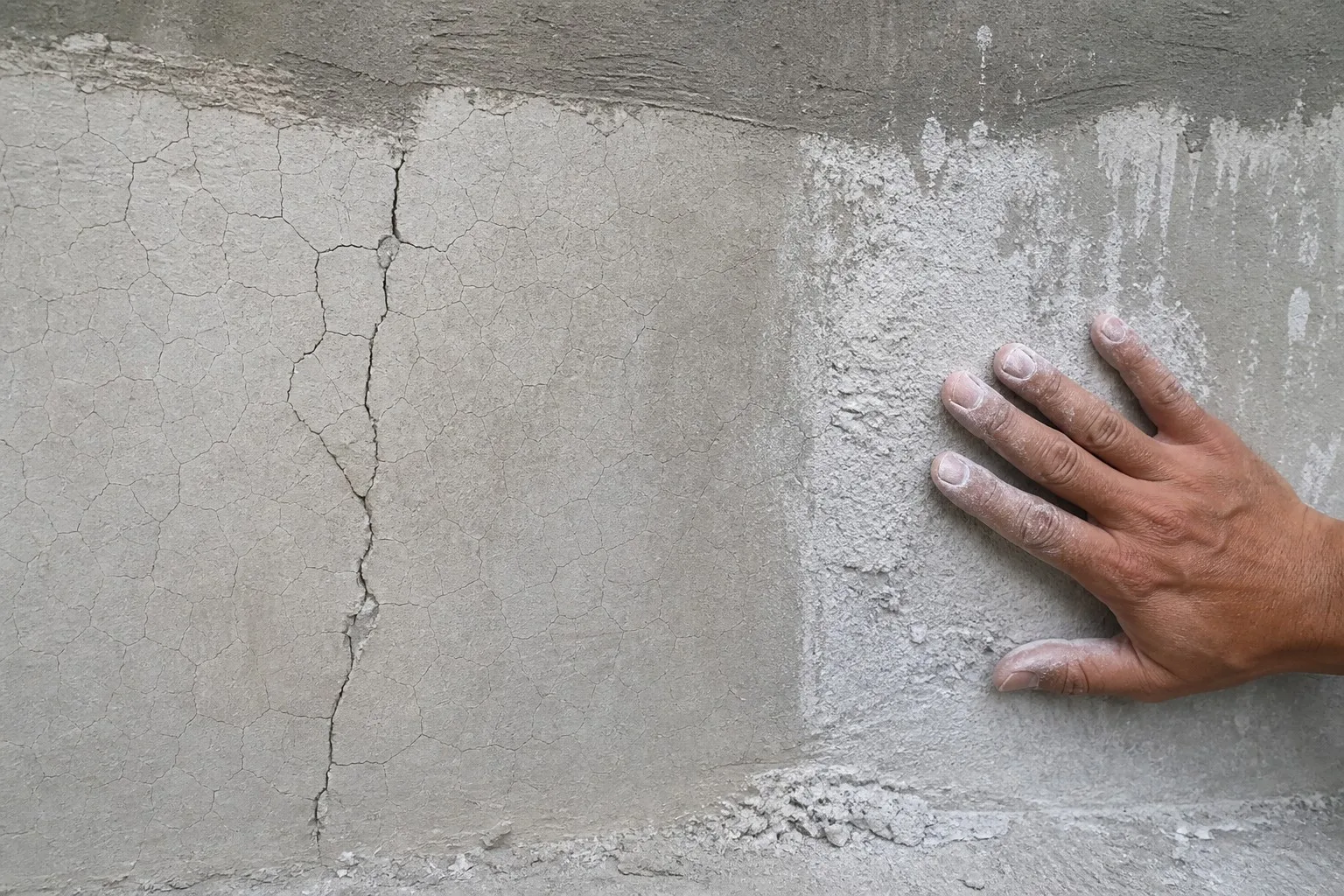
Cracking or shrinkage usually reflects an imbalance between deformation, moisture loss, restraint, layer thickness, and developing strength. Powdering is more closely linked to inadequate hydration, weak binder content, excessive filler, poor curing, segregation, or high water demand. Producers should compare both fresh and hardened properties before changing the formulation.
Failure 3: Cracking or excessive shrinkage
Cracks vary in pattern and timing. Their appearance can help narrow the investigation:
| Observation | Possible causes to investigate |
|---|---|
| Fine surface crazing soon after application | Rapid drying, excessive water, high fines, hot or windy conditions |
| Deep cracks through the full layer | Excessive thickness, high shrinkage, substrate movement, poor joint design |
| Cracks at corners or material transitions | Stress concentration, incompatible substrates, missing reinforcement |
| Regular cracks over a large area | Substrate joints, structural movement, curing or formulation imbalance |
| Edge cracking in repair mortar | Poor bonding, rapid moisture loss, restraint, unsuitable layer geometry |
A high cement level does not always reduce cracking. It may raise shrinkage or heat generation in some systems.4 Likewise, adding more cellulose ether can alter water demand, air content, hydration, and drying behavior. The net result depends on the complete formulation.
Sand structure deserves close attention. Excessive fine particles increase surface area and water demand.5 A narrow particle-size distribution can produce poor packing. A well-designed aggregate curve can reduce paste demand while supporting application and hardened performance.
Failure 4: Powdering or weak surfaces
Powdering can originate from the dry mix, production process, or jobsite. Common possibilities include:
- Too little effective binder for the filler and aggregate load
- Excessive water addition
- Inadequate mixing or poor additive distribution
- Cement exposed to moisture during storage
- Rapid loss of water to the substrate or air
- Excessive inert filler
- Segregation during transport or handling
- Incorrect retarder or accelerator balance
- Surface reworking after the mortar begins to set
- Low curing temperature or unsuitable curing conditions
When I assess a powdering complaint, I ask whether the weakness is limited to the surface or extends through the layer. Surface-only dusting often points toward curing, finishing, or rapid moisture loss. Weakness throughout the section suggests a broader binder, water, mixing, or raw-material problem.
Which checks should the plant run?
The plant should compare the complaint batch with retained samples and recent accepted production. Useful checks include:
- Moisture content of sand and powders
- Cement age and storage condition
- Particle-size distribution of aggregate
- Dry-mix uniformity
- Actual water demand
- Fresh density and air content
- Setting behavior
- Hardened density and strength
- Water retention under a defined internal method
- Layer thickness and curing conditions
Any strength or shrinkage criterion should match the relevant product standard and end-use specification. I would not approve a formulation change based only on a hand-feel test.
Which Formulation Errors Produce Sagging and Poor Workability?
Sagging and poor workability can occur in the same mortar. A mix may resist slip but feel sticky, heavy, or difficult to spread. Another mix may move smoothly under the trowel but lack sufficient structure on a vertical surface. Increasing viscosity alone rarely balances every requirement.
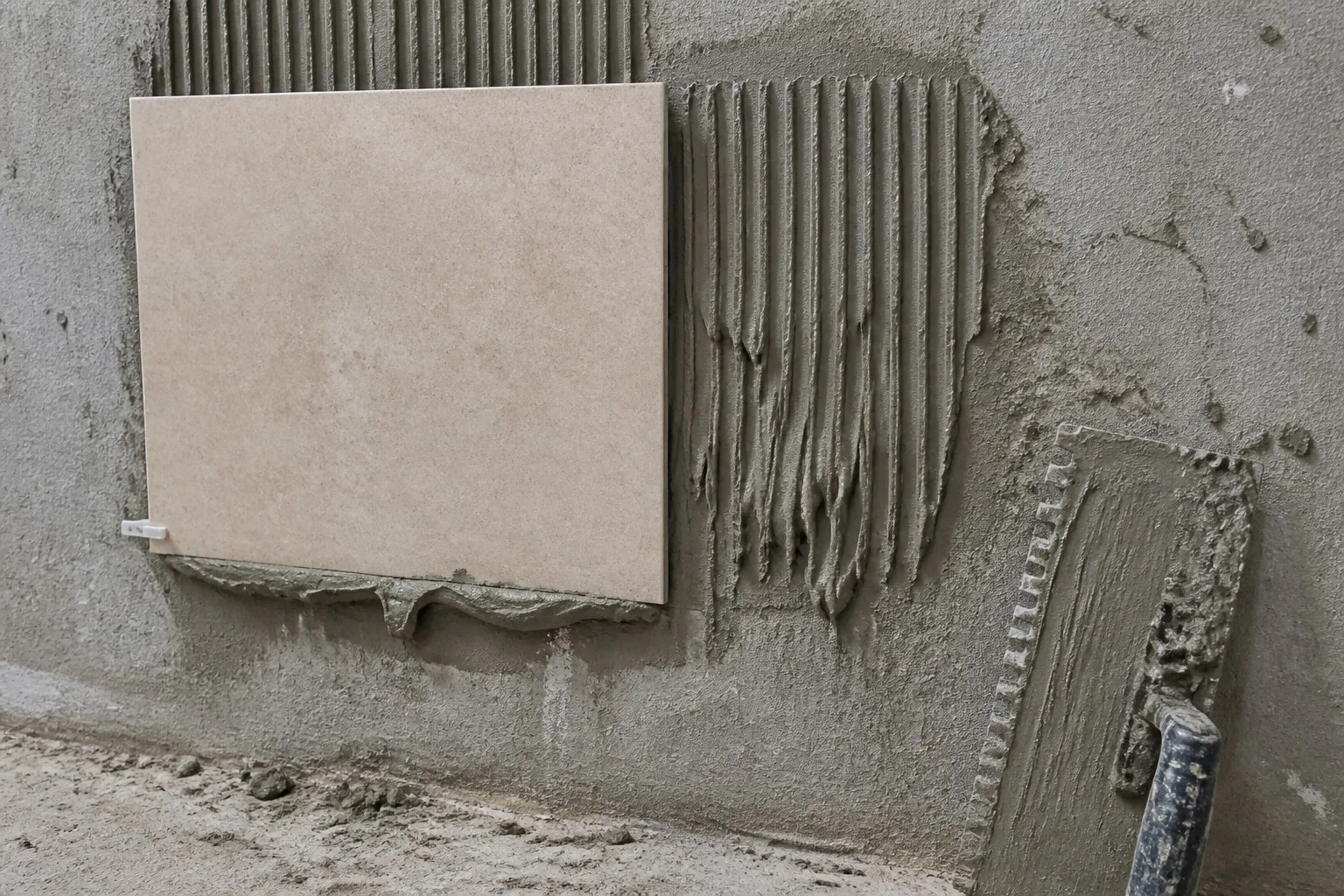
Sagging is usually linked to insufficient yield stress, excessive water, unsuitable particle packing, or an unbalanced cellulose ether and starch ether system.6 Poor workability may result from high water demand, excessive viscosity, poor wetting, air imbalance, angular sand, rapid hydration, or incompatible additives. The correct target is balanced rheology, not maximum thickness.
Failure 5: Sagging or tile slip
Vertical stability depends on more than a viscosity value measured for the additive in solution. The mortar’s behavior also depends on cement chemistry, sand grading, fillers, water, polymer, air, starch ether, cellulose ether, and mixing energy.
The following conditions can increase sag:
- Excessive mixing water
- Low structural viscosity or yield stress
- Insufficient fine-particle structure
- Poor cellulose ether compatibility
- Inadequate or unsuitable starch ether modification
- Heavy tile or excessive adhesive thickness
- Incorrect notch size or application method
- Delayed tile placement
- Vibration or substrate movement
A starch ether may improve anti-sag behavior at a relatively low addition level, but the result depends on the formulation. Excessive use can harm spreading, wetting, or open time. Plants should determine the appropriate level through controlled trials rather than copying a dosage from another recipe.
Failure 6: Poor workability
“Poor workability” is too broad to diagnose without a more exact description. Operators may mean:
- High trowel resistance
- Sticky mortar that clings to tools
- A dry, tearing texture
- Weak body or watery consistency
- Rapid thickening in the bucket
- Poor wetting of the substrate
- Excessive air or foam
- Difficult remixing after rest
I ask the operator to describe the mortar at several points: immediately after mixing, after the standard maturation period, after remixing, and near the expected end of pot life. This timeline often separates poor initial wetting from rapid hydration or progressive thickening.
Why does the “higher viscosity” shortcut fail?
Cellulose ether viscosity values are meaningful only when the test concentration, temperature, instrument, spindle, speed, and solution preparation method are comparable. Two HPMC or MHEC products with the same nominal viscosity can produce different mortar behavior because of:
- Different chemical modification
- Different substitution distribution
- Different particle size and dissolution rate
- Different moisture or ash content
- Different air entrainment
- Different compatibility with local cement and fillers
- Different water-retention and rheological behavior
At KEHAO Chemical, our in-house laboratory checks production batches for viscosity, water retention, moisture, ash content, and consistency against internal specifications. These checks support batch control, but buyers should still conduct application tests with their own cement, sand, filler, water, and target formulation.
A practical acceptance test should compare the candidate additive with an approved reference in the same base mortar. The operator should keep water, mixing time, rest time, temperature, and application thickness constant.
Why Do Short Open Time and Rapid Skinning Cause Dry-Mix Mortar Failures?
Short open time creates costly field complaints because the mortar can remain workable in the bucket while its exposed surface loses bonding ability. Operators may not notice the change until tiles detach or transfer coverage becomes poor. Hot substrates, wind, low humidity, water retention, and formulation balance all influence this behavior.
Short open time and rapid skinning commonly result from fast surface moisture loss, high substrate absorption, unsuitable cellulose ether performance, excessive air movement, elevated temperature, or a binder system that develops structure too quickly. Producers should evaluate tile transfer at timed intervals instead of relying only on bucket consistency.
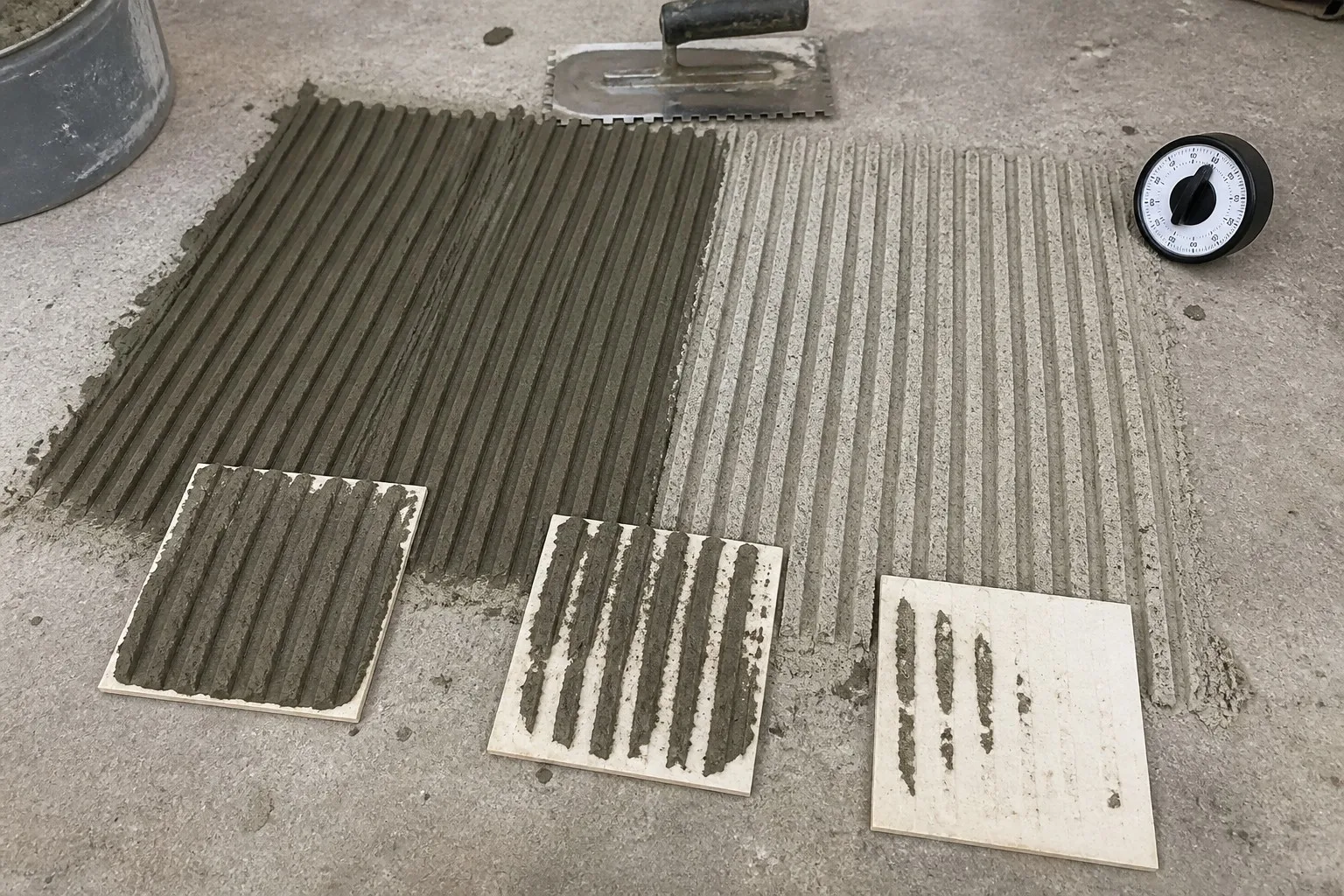
Failure 7: Short open time
Open time is not identical to pot life.7 Pot life concerns how long mixed mortar remains usable in the container. Open time concerns how long applied mortar can still form the required bond after exposure.
A tile adhesive can retain good bucket consistency while the combed ridges lose surface moisture. The installer may then place tiles on a skinned layer. The mortar looks normal, but contact and wetting are poor.
Possible causes include:
- Low effective water retention
- Highly absorbent substrate
- Hot, dry, or windy conditions
- Thin application or exposed ridges
- Excessive delay before tile placement
- Cement or accelerator variation
- Additive incompatibility
- An unsuitable cellulose ether grade
- Excessive water followed by faster surface drying
- Poor tile-transfer technique
RDP may support adhesion and flexibility, but it does not automatically correct rapid surface moisture loss. Cellulose ether strongly influences water management, yet increasing its dosage can also change air content, rheology, setting, and cost.
Failure 8: Rapid skinning
I use a simple comparative screen before commissioning a formal test. I apply equal mortar beds under controlled conditions, comb them with the same notched trowel, and place test tiles at defined intervals. I then inspect transfer coverage and resistance after the specified conditioning period.
The test must keep these variables constant:
- Water-to-dry-mix ratio
- Mixing and maturation time
- Mortar-bed thickness
- Trowel angle and notch size
- Substrate type and absorption
- Temperature, humidity, and air movement
- Tile type and pressing method
- Time between application and placement
A skin test performed by touching the ridge with a finger can provide a quick observation, but it is not a complete adhesion test. Formal open-time performance should be verified according to the applicable standard.
What should plants change first?
Plants should use this priority:
- Verify actual jobsite water and timing.
- Check substrate absorption and climate.
- Compare the complaint batch with a retained sample.
- Test the approved and suspect cellulose ether grades in one base formula.
- Review cement, accelerator, retarder, and polymer compatibility.
- Adjust one variable and repeat the timed transfer test.
- Confirm hardened adhesion before approving production.
This order prevents a plant from reformulating around a jobsite practice problem or accepting an additive change that only masks raw-material variation.
How Should Plants Diagnose Bleeding, Separation, Foaming, or Abnormal Flow?
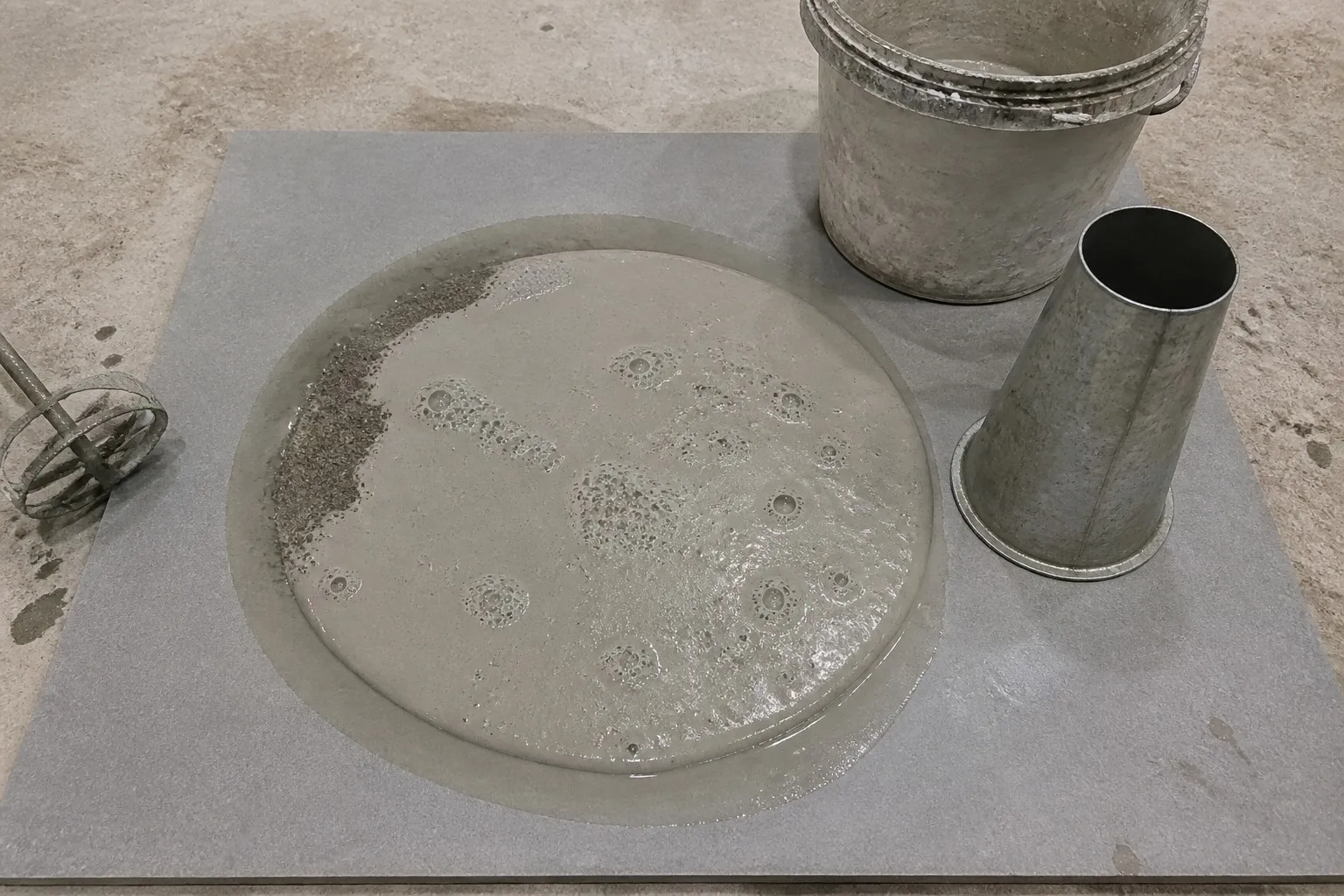
Self-leveling compounds, grouts, and fluid mortars must flow while remaining homogeneous. When a plant sees water on the surface, aggregate settlement, foam, or unstable flow, it may add thickener immediately. That correction can reduce flow, trap air, or disrupt leveling without removing the original compatibility problem.
Bleeding and separation generally indicate insufficient suspension, excess water, unsuitable grading, or binder–additive incompatibility. Foaming may involve surfactant balance, mixing energy, cellulose ether, polymer powder, or defoamer selection. Abnormal flow requires simultaneous checks of water, temperature, raw-material consistency, rheology, setting, and air content.
Failure 9: Bleeding or separation
Bleeding occurs when water migrates away from the solids. Separation occurs when particles settle or divide into layers.8 The two can appear together, but they are not always identical.
Likely factors include:
- Excessive water
- Poor aggregate grading
- Insufficient fines
- Inadequate suspension
- Delayed setting
- High-density aggregate settlement
- Improper mixing sequence
- Raw-material moisture variation
- Incompatibility between superplasticizer, cellulose ether, cement, and defoamer
- Excessive vibration or extended handling
For self-leveling mortar, a large spread is not automatically a good result. The material must maintain a stable, uniform composition. I examine the center and edge of the spread for water halos, aggregate accumulation, foam, color differences, and delayed setting.
Failure 10: Foaming or abnormal flow
Foam can reduce density and produce pinholes, craters, weak surfaces, or inconsistent strength.9 However, increasing defoamer blindly can create poor wetting or surface defects. The correct defoamer must be compatible with the complete powder system and expected mixing process.
Abnormal flow can mean either too much or too little movement:
| Observation | Variables to investigate |
|---|---|
| Flow is too low | Water error, high fines, excessive thickener, rapid reaction, low temperature |
| Flow is too high | Excess water, overdosed dispersant, insufficient structure, grading changes |
| Flow drops rapidly | Cement reaction, additive incompatibility, temperature, mixing delay |
| Foam persists | Mixing energy, surfactants, RDP, cellulose ether, unsuitable defoamer |
| Pinholes appear | Entrapped air, substrate outgassing, viscosity, defoaming balance |
| Edge segregation occurs | Poor suspension, excess water, delayed setting, coarse particles |
I recommend recording initial flow and flow retention at defined times. Plants should also record fresh density because two mixes with similar spread can contain different volumes of entrained air.
What Is the Correct Troubleshooting Priority for Dry-Mix Mortar Failures?
A plant should not begin by purchasing a higher-viscosity additive or increasing every modifier. I use this priority order:
- Production and water control: Confirm weighing accuracy, mixing time, sequence, and actual water addition.
- Raw-material consistency: Check cement, sand, filler, moisture, particle size, and retained samples.
- Jobsite conditions: Record substrate, temperature, humidity, wind, layer thickness, and application timing.
- Additive identity and batch quality: Verify COA values, batch numbers, storage, packaging, and internal acceptance tests.
- Compatibility testing: Compare the complete additive package in the plant’s own base formulation.
- Single-variable adjustment: Change one grade or dosage at a time.
- Pilot validation: Confirm fresh and hardened properties before full production.
This priority is more reliable than assuming the latest additive delivery caused the problem. It also prevents plants from approving a supplier based only on a product name or a single viscosity result.
Which materials need incoming acceptance tests?
A mortar plant buys a basket of raw materials. Every critical component needs an acceptance plan.
| Material | Key acceptance indicators | Practical sampling or test method |
|---|---|---|
| Cement or gypsum binder | Setting behavior, strength, moisture exposure, batch identity | Sample each delivery or defined lot; compare paste or reference mortar with retained material |
| Sand | Moisture, particle-size distribution, clay or contamination, bulk density | Take increments from multiple locations; sieve a composite sample and check moisture |
| Mineral filler | Fineness, moisture, purity, consistency | Composite sampling; sieve or particle-size check and compare water demand |
| HPMC, MHEC, or HEC | Identity, viscosity under a defined method, moisture, ash, water retention, mortar behavior | Sample sealed bags across the lot; run solution and reference-mortar comparisons |
| RDP/VAE powder | Moisture, ash where relevant, bulk condition, dispersion, application performance | Check multiple bags; compare adhesion, flexibility, water demand, and air effects |
| Starch ether | Identity, flow condition, rheological effect, compatibility | Use a controlled anti-sag or rheology comparison in the approved base formula |
| PVA | Grade identity, dissolution behavior, moisture, application performance | Verify documents and conduct a controlled dissolution or mortar comparison |
| Defoamer | Free-flowing condition, compatibility, density or air reduction performance | Compare fresh density, foam persistence, surface finish, and flow |
| Accelerator or retarder | Setting-time effect and storage stability | Run controlled setting comparisons at the approved addition level |
| Dispersant or superplasticizer | Flow, flow retention, segregation, setting interaction | Test initial spread, timed spread, fresh density, and visual stability |
Plants should define lot-based sampling using their quality system and the applicable standard. A single top-of-bag sample may not represent a shipment.10 Buyers should also verify that supplier COAs, REACH-related documents, and other declarations match the manufacturer, product, batch, and destination requirements. These documents are evidence to review, not automatic proof of application suitability.
Frequently Asked Questions
Can increasing HPMC dosage fix most dry-mix mortar failures?
No. More HPMC may improve water retention or consistency in some formulations, but it can also increase water demand, air entrainment, stickiness, setting effects, or cost. I recommend testing one controlled adjustment against an approved reference and measuring both fresh and hardened properties.
Does a higher cellulose ether viscosity always improve water retention?
No. Nominal viscosity does not describe every performance factor. Water retention also depends on chemical modification, dosage, dissolution, temperature, cement chemistry, sand grading, water ratio, and the test method. Products with similar viscosity labels are not necessarily interchangeable.
How can a plant distinguish a formulation problem from a jobsite problem?
The plant should recreate the complaint with retained material under controlled laboratory or pilot conditions. If the batch performs normally under controlled conditions, the team should investigate water addition, substrate absorption, temperature, humidity, wind, timing, and application technique at the jobsite.
Should buyers approve dry-mix mortar additives using the COA alone?
No. A COA helps buyers verify batch data against an agreed specification, but it cannot confirm performance in every mortar.11 Buyers should combine document review with identity checks, lot sampling, reference-formulation testing, pilot production, and application-specific performance evaluation.
How should manufacturers evaluate a replacement additive supplier?
Manufacturers should compare the candidate and approved materials in the same formulation, at the same water level, under the same mixing and curing conditions. They should evaluate batch consistency, rheology, water retention, open time, air content, adhesion, strength, and other properties relevant to the intended mortar.
Conclusion
The 10 most common dry-mix mortar failures are diagnostic signals, not proof that one ingredient is defective. I recommend checking water and production records first, raw-material consistency second, jobsite conditions third, and additive compatibility fourth. Plants should then isolate one variable and validate the revised formulation before full-scale use. KEHAO Chemical can provide free samples with a COA, viscosity-grade selection support, and comparative formulation guidance for HPMC, MHEC, HEC, RDP, PVA, and HPS. Contact us at kehao@kehaohpmc.com or WhatsApp +86 157 3315 6958 to arrange a controlled sample evaluation.
"[PDF] Preservation Brief 2: Repointing Mortar Joints in Historic Masonry ...", https://www.nps.gov/orgs/1739/upload/preservation-brief-02-repointing.pdf. Published reviews of cementitious-mortar failures identify cracking, debonding, inadequate surface strength, and fresh-mix instability among recurring defect categories, although the relative frequency of individual defects varies by product type, climate, and application practice. Evidence role: general_support; source type: paper. Supports: A review or field-investigation study identifying recurring failure modes in cementitious mortars or tile-adhesive systems, including cracking, debonding, weak surfaces, and fresh-state instability.. Scope note: A general review may not establish a universal top-ten ranking for all dry-mix mortar markets. ↩
"[PDF] Rheological, Chemical and Mechanical Properties of Cementitious ...", https://academiccommons.columbia.edu/doi/10.7916/D87S95CJ/download. Studies of cementitious mortars on absorptive substrates show that substrate suction can remove water from fresh mortar and thereby affect early hydration and bond development at the interface. Evidence role: mechanism; source type: paper. Supports: Research showing that absorptive substrates draw mixing water from cementitious mortar and that early moisture loss can alter hydration and interface development.. ↩
"Comprehensive review of tile adhesives: Slip, bond ...", https://www.sciencedirect.com/science/article/pii/S2214509525004322. Tile-adhesive standards define open time through the ability of an exposed adhesive bed to achieve specified tensile adhesion after tile placement, reflecting the loss of effective contact that can occur as the surface dries or skins. Evidence role: definition; source type: institution. Supports: The standard definition and test concept of open time for ceramic tile adhesives, which evaluates bond performance after the adhesive has been exposed for specified intervals.. Scope note: The standardized test measures performance under prescribed conditions and does not reproduce every jobsite temperature, wind, substrate, or installation method. ↩
""Shrinkage and shrinkage cracking behavior of cement systems ...", https://docs.lib.purdue.edu/dissertations/AAI1476093/. Cementitious-material research recognizes that binder content and paste volume influence hydration heat and shrinkage; under restraint, these volume and temperature changes can contribute to cracking rather than necessarily preventing it. Evidence role: mechanism; source type: research. Supports: Authoritative technical literature explaining that cement content and paste volume influence hydration heat and drying or autogenous shrinkage, both of which can contribute to cracking when restrained.. Scope note: The direction and magnitude of the effect depend on water-to-binder ratio, supplementary materials, aggregate content, curing, geometry, and restraint. ↩
"The strength of concrete, its relation to the cement aggregates and ...", https://www.ideals.illinois.edu/items/5096. Mortar and concrete studies generally report that increasing the fine fraction and total particle surface area raises the water required to achieve a given consistency, unless compensated by changes in packing or admixture use. Evidence role: mechanism; source type: paper. Supports: Experimental evidence that finer aggregate fractions or higher specific surface area increase the water demand needed to obtain comparable mortar workability.. Scope note: Particle shape, mineralogy, clay content, packing density, and admixtures can modify the measured water-demand response. ↩
"Effect of Cellulose Ether and Starch Ether on Hydration ... - PMC", https://pmc.ncbi.nlm.nih.gov/articles/PMC9782582/. Fresh-mortar rheology studies link resistance to gravity-driven deformation with yield stress and structural build-up, both of which are affected by water content, particle packing, and rheology-modifying admixtures. Evidence role: mechanism; source type: paper. Supports: Research linking the yield stress and rheological structure of fresh cementitious mortars to resistance against deformation under gravity in vertical applications.. Scope note: Specific effects of cellulose ether and starch ether depend on their chemistry, dosage, binder system, and mixing procedure. ↩
"prEN 12004-3 - Tile Adhesives Terminology Specifications ...", https://standards.iteh.ai/catalog/standards/cen/05d2b6da-f31f-47b7-81fe-da6b6b000129/pren-12004-3?srsltid=AfmBOoom-VSZkFfJw5Vpw4SSn4SISOjDax-fcOLeTrB6TPDGg4n0yNM1. Ceramic-tile adhesive standards treat pot life and open time as separate fresh-state properties: pot life concerns usability after mixing, whereas open time evaluates bond performance after the adhesive has been spread and exposed. Evidence role: definition; source type: institution. Supports: Standard terminology distinguishing pot life of mixed adhesive in a container from open time of adhesive spread on a substrate before tile placement.. ↩
"Simulation of Prepackaged Grout Bleed under Field ...", https://rosap.ntl.bts.gov/view/dot/27335/dot_27335_DS1.pdf. Concrete and grout terminology defines bleeding as the migration of water toward the surface of fresh material, while segregation denotes a non-uniform distribution or separation of constituent particles and paste. Evidence role: definition; source type: institution. Supports: Authoritative definitions of bleeding as upward water migration in fresh cementitious material and segregation as non-uniform separation of constituents.. Scope note: The visible manifestations of bleeding and segregation can overlap in complex dry-mix formulations. ↩
"Both Plasticizing and Air-Entraining Effect on Cement-Based ...", https://pmc.ncbi.nlm.nih.gov/articles/PMC9267631/. Research on air-containing cementitious materials shows that increased air-void volume lowers fresh density and can reduce strength; near-surface bubbles may also manifest as pinholes or other finishing defects. Evidence role: mechanism; source type: research. Supports: Evidence that increased air or void content changes fresh density and can reduce mechanical properties or cause visible surface voids in cementitious materials.. Scope note: Controlled entrained air can be beneficial in some applications, so the effect depends on air volume, bubble system, curing, and the required performance property. ↩
"Chapter 6: Sampling and Testing, Section 1 - Caltrans - CA.gov", https://dot.ca.gov/programs/construction/construction-manual/section-6-1-sample-types-and-frequencies. Material-sampling guidance emphasizes collecting increments from multiple locations within a lot because a single grab sample may not represent variability across containers, storage positions, or a shipment. Evidence role: general_support; source type: institution. Supports: Sampling guidance requiring increments from multiple locations or containers to form representative samples of heterogeneous material lots.. Scope note: The required number and location of increments should be determined by the material, lot size, handling method, and applicable quality standard. ↩
"Part 46 - Quality Assurance", https://www.acquisition.gov/far/part-46. A certificate of analysis records results for identified batch tests against stated specifications, but quality-management practice treats it as supplier documentation rather than proof that the material will meet performance requirements in every downstream formulation or application. Evidence role: general_support; source type: institution. Supports: Quality-management principles distinguishing supplier test documentation from verification that a material is fit for a specific downstream formulation and use.. Scope note: The value of a COA depends on the relevance of its test methods, sampling plan, specification limits, traceability, and verification procedures. ↩