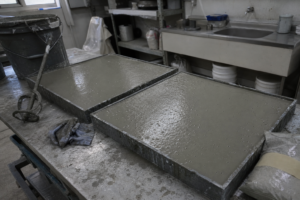
Problem. A pallet of C2 tile adhesive leaves the plant with a clean test report, spends a season in a distributor’s warehouse, and reaches site stiff, lumpy and short of bond. Nothing on the bag changed. The number on the certificate still looks fine.
Agitation. By the time a trowel finds the problem, the material has already been paid for, shipped, stored and re-sold, and the argument about who owns the loss starts with no evidence on either side. Most plants cannot even say which pallet the failing bags came off, because nothing in the release record describes where the stock sat or for how long.
Solution. Strength loss in storage is a measurable, traceable process rather than a mystery, and it can be interrupted at four points: moisture ingress, packaging integrity, warehouse conditions and release discipline. This article walks through each one and shows what to sample, what to compare and what to write down, so that a stored batch is judged on evidence instead of on the production date.
Water Vapour, Not the Calendar, Is What Ages the Cement Fraction
Problem. A bag that looks and feels intact can still gain moisture slowly enough that no single inspection catches it, and the loss only becomes visible months later as poor bond and short open time.
Agitation / Answer: Water vapour crosses packaging material and seams faster than buyers assume, and once it reaches the cement fraction it begins a slow surface hydration. NIST researchers showed ordinary Portland cement prehydrates during storage in moist environments, forming hydration products on and near particle surfaces and reducing reactivity. Less reactive clinker means less strength at the same mixing water.
Solution. Prehydration is a surface phenomenon, which is exactly why it hides so well. A cement grain does not need to be soaked to lose part of its reactivity; a thin skin of hydration product is enough to interfere with dissolution when the adhesive is finally mixed. Because that skin builds up progressively, the damage is cumulative and it does not reverse. You cannot dry a bag back into specification, and you cannot buy the strength back with extra mixing water without paying for it in porosity, shrinkage and weaker bond.
This is also why a printed production date is a poor predictor on its own. Two pallets filled on the same shift can behave completely differently after one humid season, because one sat under a leaking roof line and the other stayed on a ventilated pallet in a dry aisle. Time is the clock, but moisture is what the clock is counting.
Practically, that changes what you measure. Instead of asking how old a batch is, ask what moisture it has been exposed to and for how long. Sample the bottom third of a pallet, the bags that faced an outside wall, and any unit where the wrap was torn. Mix those samples at your production water ratio and compare flow, open time and tensile adhesion against a retained reference sample, using the comparison logic in our guide to dry mortar quality control testing. If stored material needs noticeably more water for the same workability, moisture has already done work inside the bag. Our note on testing water retention before a bulk order covers the sample handling that keeps those comparisons honest [1].

The Bag and the Pallet Are Part of the Formula
Problem. Most storage audits look at the pallet as a unit and never examine the bag as a component, yet the bag is the only barrier between a hygroscopic powder and the air around it.
Agitation / Answer: A bag is a moisture barrier with seams, folds and a finite transmission rate. ISO 2528 exists specifically to measure how much water vapour passes through sheet materials, and it includes a separate procedure for creased specimens because folding changes transmission. Creases, seam gaps and pinholes are therefore not cosmetic defects; they are local changes in the barrier.
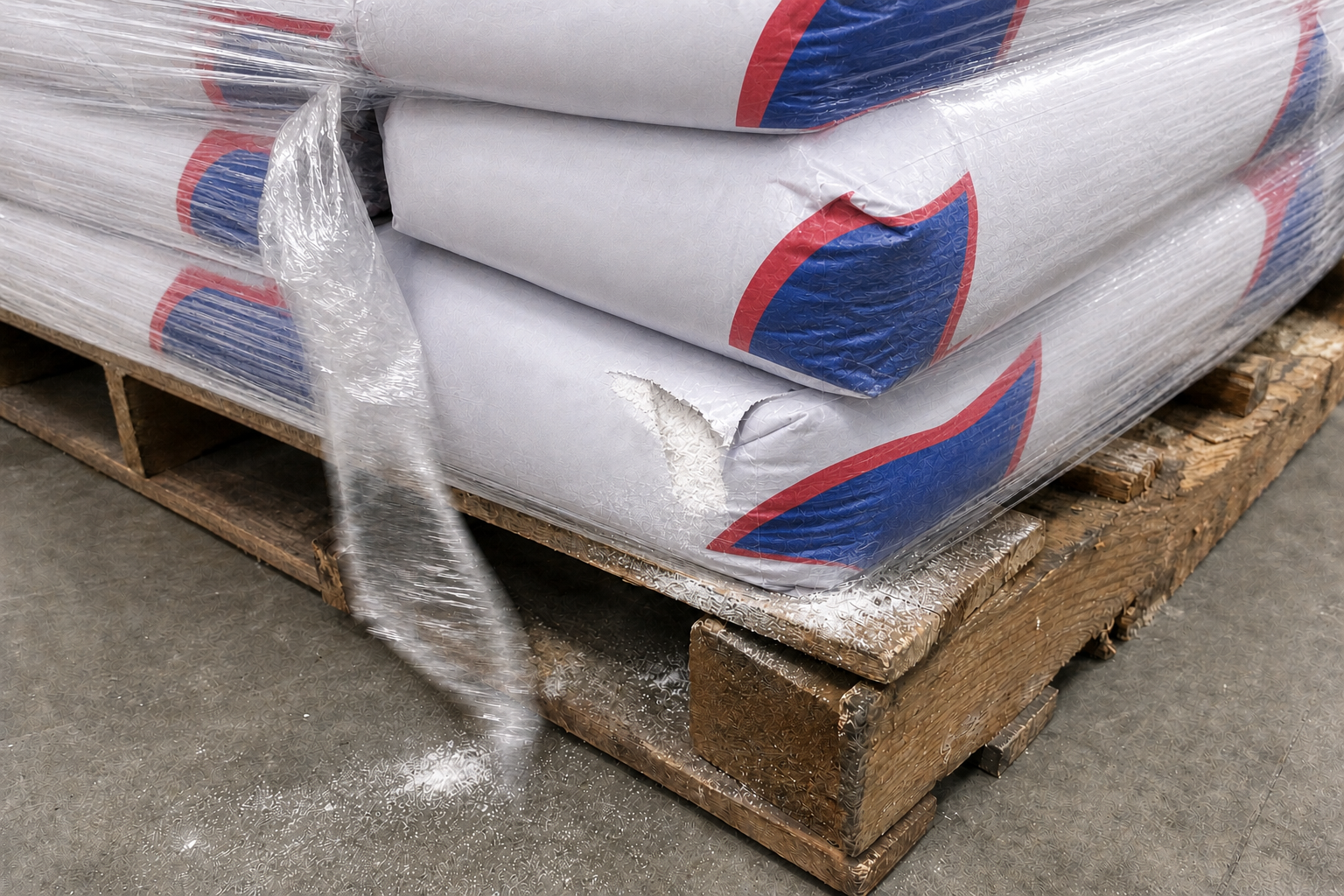
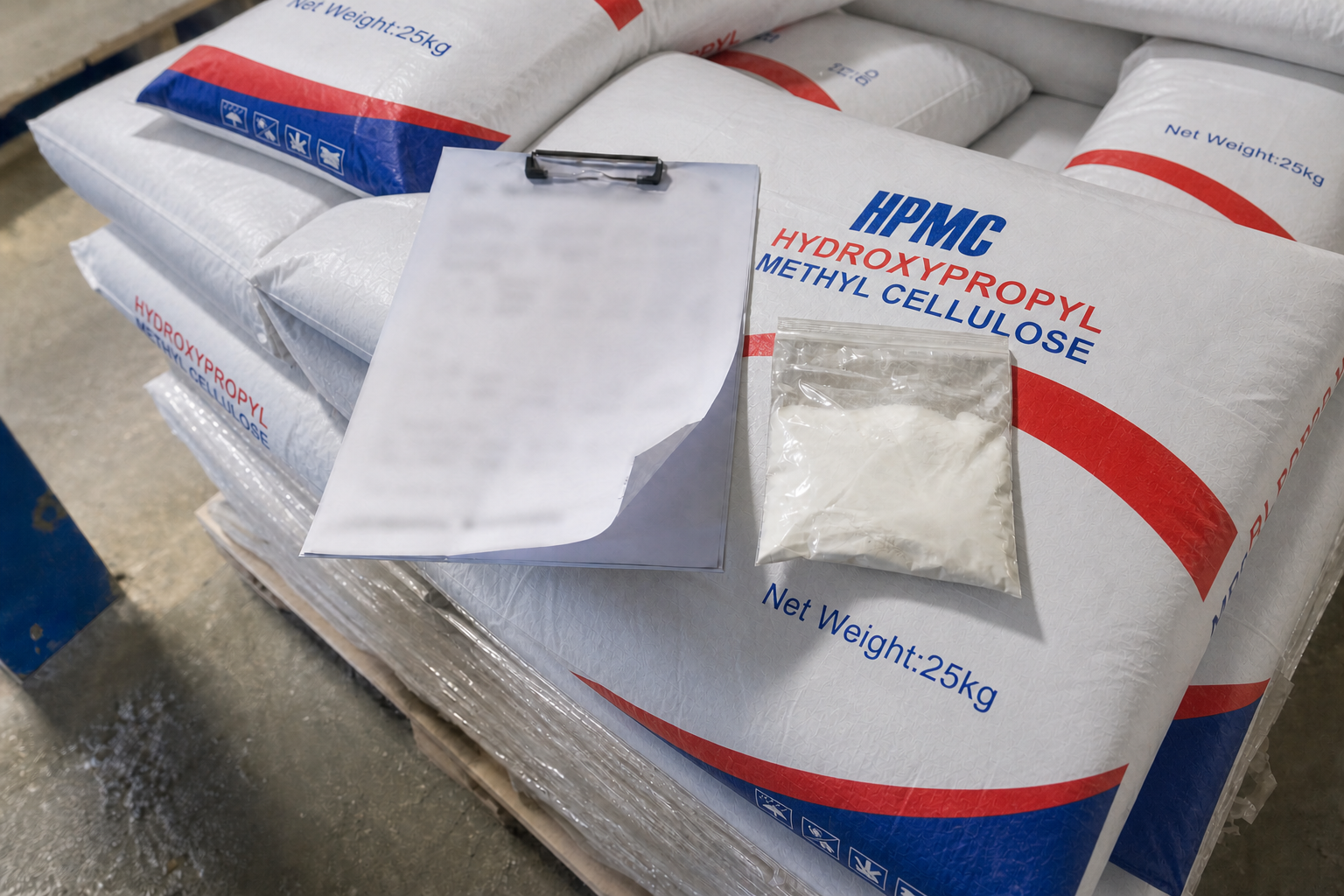
Solution. Once you accept that the bag is a functional component, incoming inspection stops being a formality. A white industrial bag is built from panels, seams and closures, each of which can be within drawing tolerance and still leak at a fold. A bag compressed by the pallet above it develops fine creases along the shoulders, and those creases are exactly where vapour transmission rises. A fork pocket punched through the outer wall does the same job faster.
The audit is mostly visual, and it has to be done at the pallet. Check the top and bottom layers of every stack for split seams and powder staining along the folds, the signature of a bag that has been breathing. Look at pallet corners, where stretch wrap is thinnest and handling damage concentrates, and confirm corner boards are used rather than only ordered.
There is a quieter issue: the mismatch between what the bag was designed for and how long it is asked to perform. A specification written for a short domestic delivery does not automatically suit a container that waits on a quay and then in an unlined store, the profile we describe in our guide to shipping HPMC to Southeast Asia. Ask your packaging supplier what the construction resists, and whether a heavier build is available for the longer route.
Finally, record what you saw: photograph damaged pallets at receiving, note pallet position and batch code, and file the images with the stock record. Repeated failures at the same pallet position point straight at a packaging fix, and without photographs the observation looks like an opinion [2].
Storage Conditions Set the Rate of the Clock
Problem. Two warehouses in the same city can age the same batch at very different rates, and neither of them will describe itself as badly managed.
Agitation / Answer: Service life is not a fixed property of a product; it is a product-and-environment pair. ISO 15686-1 sets out the general principles and framework for service life planning on exactly that basis, which is why no responsible supplier can quote one shelf life that holds for a humid coastal yard and a dry inland store alike.
Solution. The framework in ISO 15686 is written for buildings, but the logic transfers to a pallet of mortar. A reference service life is only meaningful together with the conditions it was assessed under; once those conditions change, the estimate is re-examined rather than defended. That is the honest answer to a buyer asking for one number: it belongs to a defined environment.
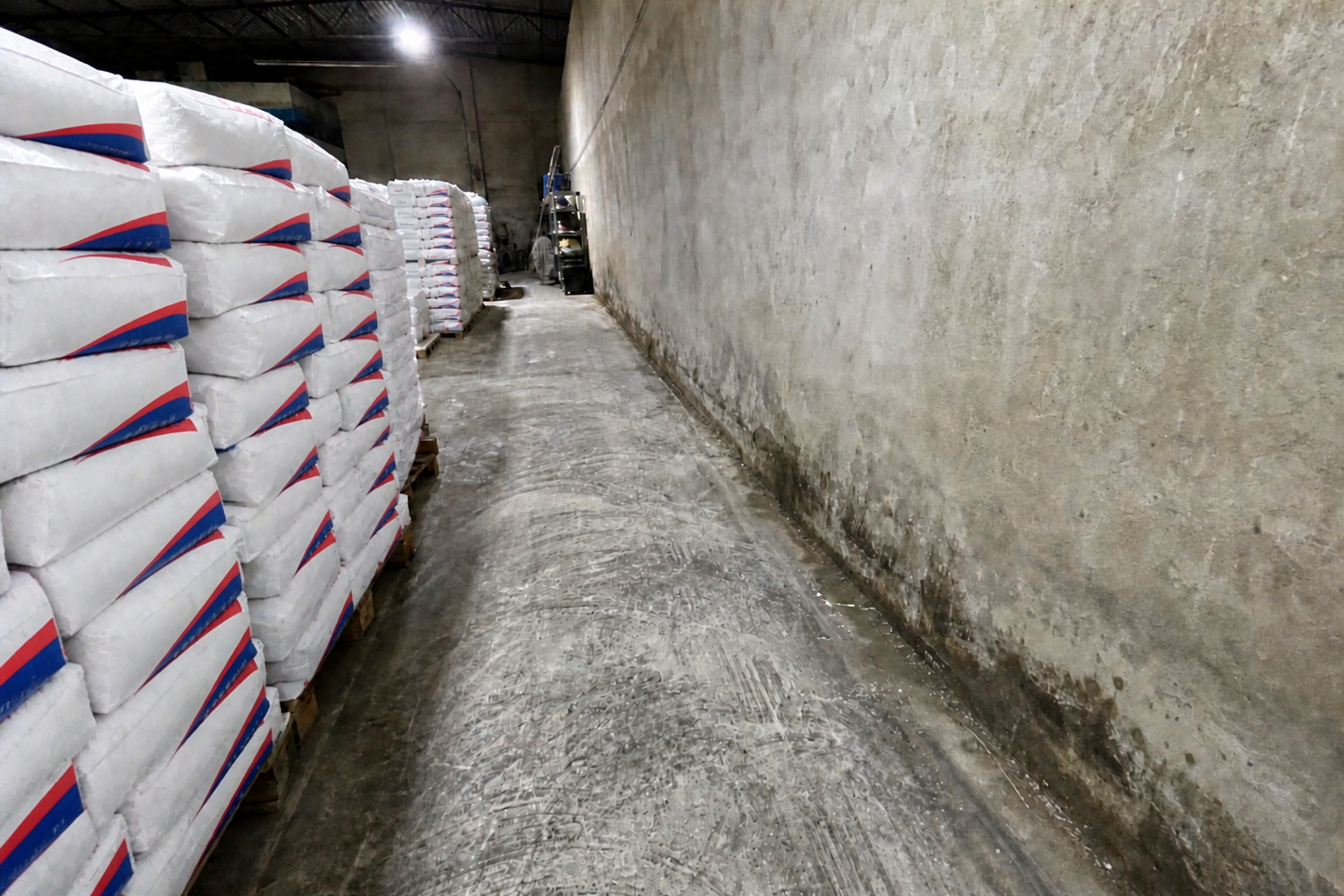
In a warehouse, that environment is built from a few facts. The first is the floor: a slab in a humid climate stays cooler than the air above, so a pallet sitting on it sees higher humidity in the bottom bags than one on a ventilated deck. The second is stack height, since every extra layer compresses the bags below, creasing the bag wall and closing the air gap that would let a damp bag dry. The third is clearance, as bags against an outside wall inherit its temperature swing and any rain penetration.
Ventilation cuts both ways: still air lets moisture accumulate around the stock, while strong air movement carries humid outdoor air into a store that was dry an hour earlier. A warehouse opened wide on a cool morning after a warm humid night condenses water on every cool surface inside it, and each dew-point cycle moves a little vapour inwards. Seasonal cycles do the same on a larger scale, which is why stock can survive one dry season and fail after one wet one with an identical production date.
Audit in the worst week of the year, not the best. Note deck type, stack height, wall clearance and roof condition above each bay, check the bays against the failure modes in dry-mix mortar failures, then rotate first-in, first-out with the batch code visible from the aisle [3].
Additives Age Too, and Each One Fails Differently
Problem. When a stored batch underperforms, the first instinct is to blame one additive, usually the cellulose ether, and that instinct sends the investigation in the wrong direction.
Agitation / Answer: Cellulose ether, redispersible polymer and starch ether do not age in the same way, and none of them is the single cause. HPMC can take up moisture and lose dispersibility, polymer powders can block under pressure, and filler moisture shifts water demand. A strength drop is usually the sum of several small drifts, not one additive failing.
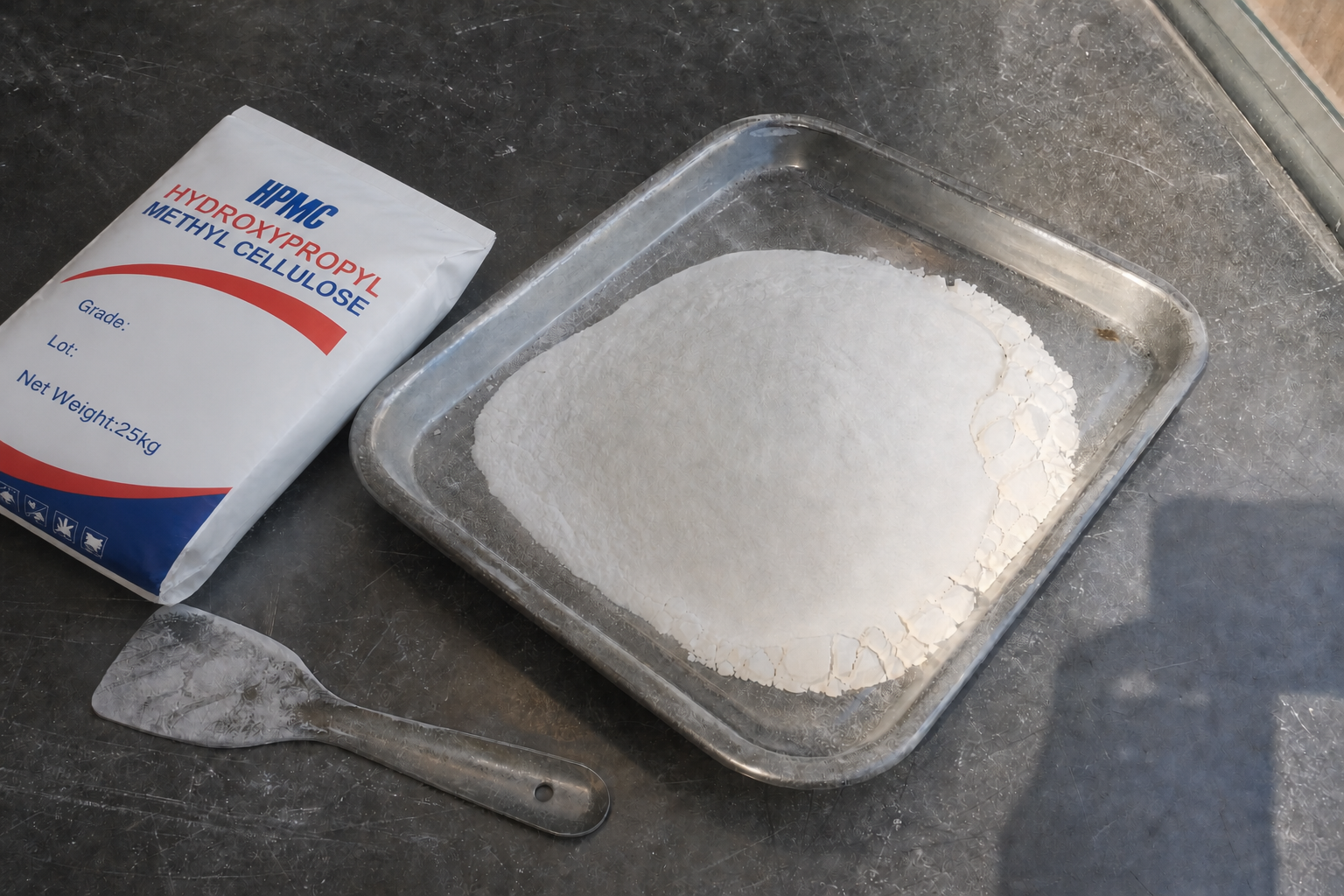
Solution. Start with the cellulose ether, the component most sensitive to handling. An HPMC granule that has absorbed moisture does not simply become wet; it can swell at the surface and dissolve slowly, so the same dosage delivers less viscosity and less water retention than on the day of filling. On site the adhesive feels drier under the trowel, grabs early and gives a short open time. Our note on HPMC lumps during dry mixing covers the mixing-stage version of that behaviour.
The polymer component behaves differently. A redispersible powder is a spray-dried particle with a protective colloid skin, and under sustained stack pressure with moisture that skin can soften enough for particles to stick together. The result is blocky material that disperses poorly, and poorly dispersed polymer never forms the continuous film that delivers flexibility and adhesion. That is a different mechanism from raw polymer powder caking in its own bag, treated separately in why RDP powder cakes in storage.
Starch ether drifts too: starches are hygroscopic and can lose some of the rheology they were added for, while set regulators in a damp bag migrate and produce uneven batches. No single effect is large alone; together they explain why a stored batch fails in ways no raw material test predicts. Fillers belong here too, since damp limestone brings water into the mixer and shifts both the demand for cellulose ether and the effective water-to-binder ratio, which is why the raw materials chosen for a tile adhesive plant must be specified with incoming moisture in mind.
Test the finished product, not suspect additives. Compare a retained sample against the warehouse sample on water retention, air content and tensile adhesion, using the method in our mortar air content tests [4].
Release Rules Decide Whether Aged Stock Reaches a Trowel
Problem. Some aged stock ships anyway, not because nobody noticed, but because nobody had a rule that said what to do with it.
Agitation / Answer: A batch should be released on evidence, not on appearance. ISO 13007-1 defines the declared performance classes for cementitious tile adhesives and the requirements a product must meet, so the only defensible question is whether a stored sample still satisfies the class printed on the bag, tested under the conditions that class implies.
Solution. The release decision is where the earlier observations become useful or are wasted. An audit with no disposition rule changes nothing, and what a plant needs is a short, repeatable sequence anyone on the quality team can run.
It starts with identity. Every pallet should carry a batch code readable from the aisle, mapped to a record holding the date, shift, raw material lots and reference sample location. A pallet that cannot be identified cannot be released on evidence and should be held, not shipped on the assumption that it is fine. The second step is a written storage history: where the pallet sat, for how long, on what deck, against which wall, and whether the wrap was intact at each inspection.
The third step is a retest that mirrors the claim on the bag. If the product is sold as a C2 adhesive, the stored sample is evaluated against the characteristics that class covers, not a general feel test. Retained reference samples separate a storage effect from a batch that was marginal when made; where none exists, a fresh batch of the same formula is a weaker but workable comparator, the same logic behind our lab-to-production workability checks.
The fourth step is disposition, decided in advance rather than negotiated under delivery pressure. Acceptable stock ships with its original class claim. Marginal stock goes to a less demanding declared use only if the class claim is formally changed and the customer is told. Stock that fails every declared class is rejected, not blended into a good batch, because blending hides the failure and spreads it. Keep the audit record, photographs, retest data and disposition together, filed against the batch, so a complaint becomes a review rather than an argument [1][4].
Frequently Asked Questions
Does bagged tile adhesive have a fixed shelf life?
No single number applies across markets. Performance in storage depends on the moisture the bag has been exposed to, the condition of the packaging and the conditions in the store, so the same product can hold its declared class far longer in a dry, ventilated warehouse than in a humid one. Treat any quoted period as a statement about a defined storage environment, and verify it with a retest rather than a calendar.
Can I still use adhesive that has formed hard lumps if I sieve it?
Sieving changes the appearance, not the chemistry. Hard lumps usually indicate that moisture has reached the cement or the polymer and started a reaction that cannot be reversed, and the material around the lumps has often been affected even when it still looks free-flowing. Sieving also separates the batch into fractions with different composition, which makes consistent mixing impossible. Reject the batch rather than reworking it.
Does a cooler store always preserve strength better?
Not automatically. Cooler air holds less moisture, which helps, but a cool floor combined with warm humid air produces condensation on bag surfaces and pallet boards, and repeated condensation cycles move water into the powder. What matters is whether the store stays dry, not whether it stays cold. A well-ventilated store that tracks outdoor humidity is usually a better bet than a sealed cold room with a damp slab.
My bags are still soft, so is the adhesive fine?
Softness only tells you that the powder has not caked. It says nothing about surface prehydration of the cement or about loss of dispersibility in the cellulose ether, both of which can progress while the bag still feels normal. Soft bags are a reason to sample, not a reason to release. The only reliable check is a comparative test against a retained reference sample.
How do I show that a batch lost strength in storage rather than on site?
You need three things: a retained sample of the batch as filled, a sample recovered from the stored pallet, and a record of the storage conditions in between. Test both under the same conditions and compare. If the stored sample is worse, the storage history is the explanation, and the record tells you which part of it mattered. Without the retained sample, the comparison collapses into opinion.
If you are facing a pallet that has been through a humid season and you are not sure whether it still meets its declared class, send us the batch details and the storage history. Our technical team will help you design a retest that matches the class on your bag and interpret the result before you decide to ship, rework or reject.
Footnotes
- Stoian, J., Oey, T., Bullard, J., Huang, J., Kumar, A., Balonis, M., Terrill, J., Neithalath, N., Sant, G. New Insights into the Prehydration of Cement and Its Mitigation. Cement and Concrete Research, Vol. 70, 2015. National Institute of Standards and Technology. https://www.nist.gov/publications/new-insights-prehydration-cement-and-its-mitigation
- International Organization for Standardization. ISO 2528:2017 — Sheet materials: Determination of water vapour transmission rate (WVTR) — Gravimetric (dish) method. https://www.iso.org/standard/72382.html
- International Organization for Standardization. ISO 15686-1:2011 — Buildings and constructed assets: Service life planning — Part 1: General principles and framework. https://www.iso.org/standard/45798.html
- International Organization for Standardization. ISO 13007-1:2014 — Ceramic tiles: Grouts and adhesives — Part 1: Terms, definitions and specifications for adhesives. https://www.iso.org/standard/60880.html