
Starting a tile adhesive plant looks simple until purchasing begins. Cement, sand, and a few bags of additives can appear to be the whole answer, yet inconsistent minerals, unsuitable polymer grades, or an uncontrolled trial plan can turn every batch into a new experiment.
I would not start by asking for a “standard formula.” I would define the intended product, lock down measurable raw-material requirements, and then use controlled pilot work to build a dependable system. This guide follows that practical route from material roles to the first purchase.
Which Core Raw Materials Form a Tile Adhesive?

The first problem is treating every ingredient as interchangeable. Two materials with the same generic name may behave differently in water demand, consistency, workability, and adhesion development.
Agitation / Answer: A tile adhesive starts with a stable mineral skeleton—cement, graded sand, and selected fillers—then uses HPMC, redispersible polymer powder, and sometimes starch ether to manage application behavior. Each material has a distinct job, so reliable production depends on controlling the whole system rather than buying additives in isolation.
Cement provides the hydraulic binder. Its source and consistency matter because changes can alter setting behavior and interaction with polymers. Sand builds the aggregate framework; its particle-size distribution, moisture, cleanliness, and shape influence packing, mixing, troweling, and batch repeatability. Mineral fillers adjust packing and rheology, but they should not become an uncontrolled outlet for variable powders.
The additive package then makes the dry blend usable. HPMC supports water retention, consistency, and workable open handling. RDP based on VAE contributes polymer modification after redispersion and film formation. Starch ether can help tune rheology, sag behavior, and tool feel. These functions overlap at the edges, but the materials are not direct substitutes.
| Material group | Primary role | What I would control first |
|---|---|---|
| Cement | Hydraulic binding | Declared type, source consistency, storage condition |
| Graded sand | Structure and packing | Grading, moisture, cleanliness, particle shape |
| Mineral filler | Packing and rheology adjustment | Mineral identity, fineness consistency, moisture |
| HPMC | Water retention and workable consistency | Grade identity, viscosity method, solution behavior |
| RDP | Polymer modification | Polymer type, redispersibility, supplier consistency |
| Starch ether | Rheology refinement | Grade identity, dispersion, compatibility |
This role map is the minimum bill-of-material logic I would approve before sourcing begins.
How Should You Select HPMC, RDP, and Starch Ether Grades?
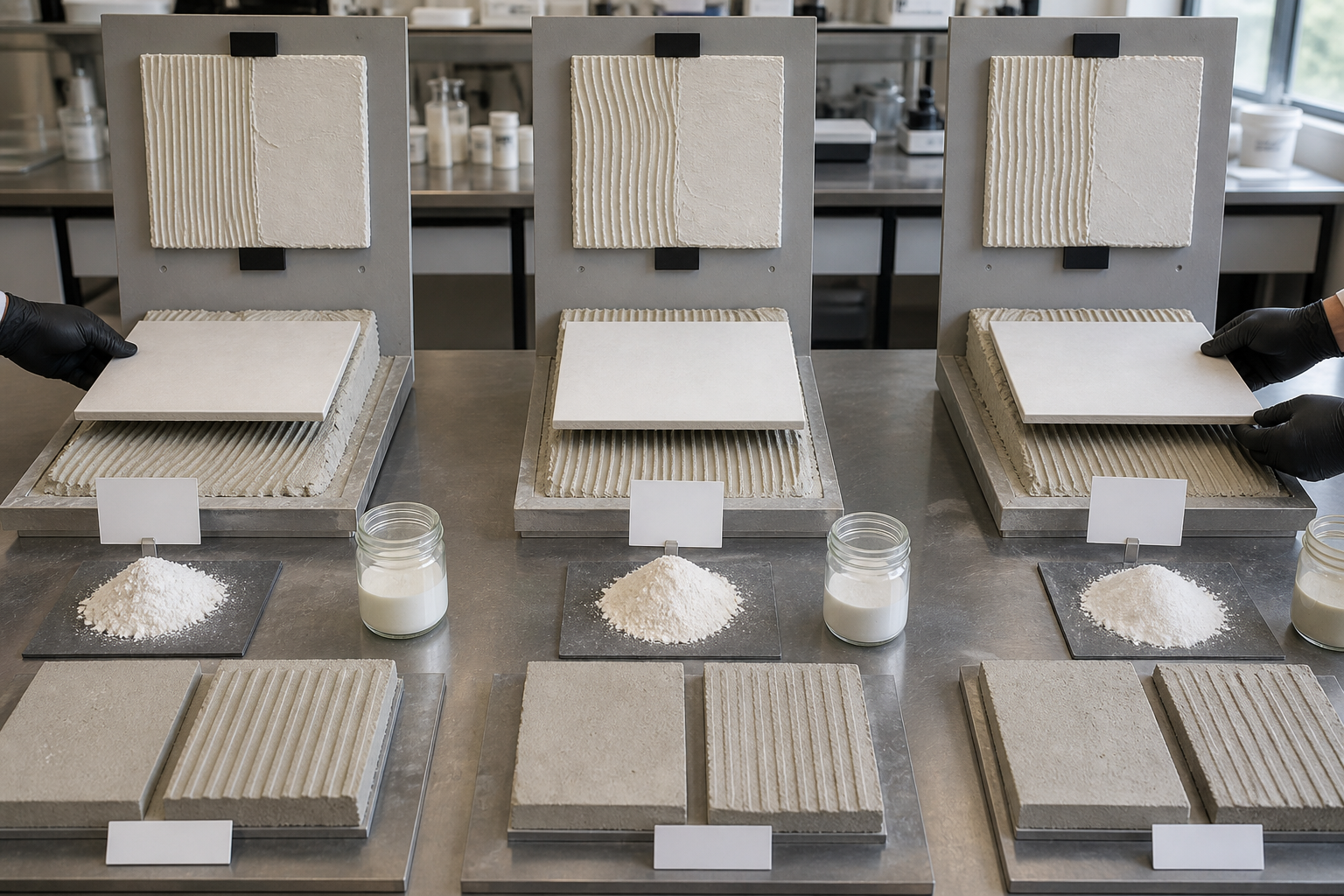
A common startup mistake is choosing additives from a product name alone. “HPMC” or “RDP” identifies a family, not a guaranteed fit for the desired tile adhesive or local mineral base.
Agitation / Answer: Select additive grades against the target product class, substrate and tile conditions, climate, application feel, and the fixed cement–sand–filler baseline. Compare candidates through controlled trials using the same mixing and conditioning procedure; otherwise, supplier labels and isolated data-sheet values can create false confidence rather than a reproducible formulation decision.
For HPMC, I review the test method behind viscosity, substitution-related behavior where supplied, moisture, dissolution, and performance in the actual mortar. This HPMC grade selection guide explains why the application target must lead the decision. For RDP, I confirm the polymer family, redispersion behavior, compatibility with the binder, and the balance sought in handling and cured behavior. For starch ether, I test whether rheology improves without creating an unwanted penalty elsewhere.
A useful decision brief contains:
- intended product level and claimed use conditions;
- tile type, substrate, climate, and application method;
- fixed cement, sand, and filler references;
- required wet-mortar handling observations;
- relevant cured-property test plan;
- supplier document and retained-sample requirements.
I also separate “grade selection” from “dose optimization.” First screen genuinely different grades under one consistent method. Then refine the preferred system through controlled formulation work. The relationship between cellulose ether and starch ether is especially important: one should not be used to hide instability caused by the other or by the mineral base.
My rule is straightforward: accept a grade because the complete mortar behaves predictably, not because a single powder specification looks impressive.
What Incoming Specifications Should Purchasing Control?
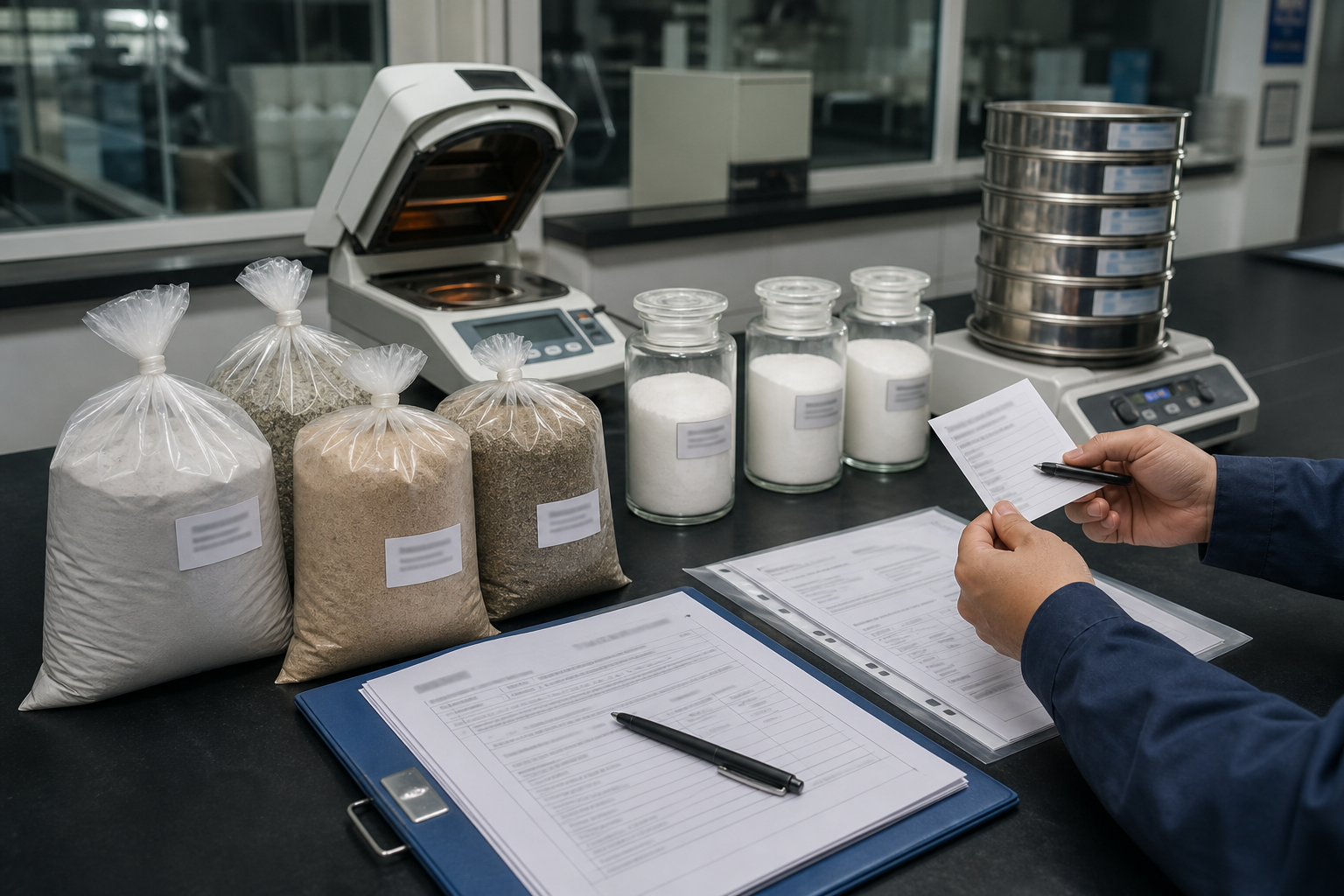
Even a sound pilot formula can drift when purchasing accepts changing sources or vague certificates. Without agreed incoming checks, the laboratory ends up diagnosing supply variation after production has already consumed it.
Agitation / Answer: An incoming specification should connect identity, condition, supplier documentation, sampling, and application-relevant checks to a clear disposition process. Control cement, sand, fillers, HPMC, RDP, and starch ether by lot, retain representative samples, and investigate change before use; a certificate alone does not prove compatibility in your mortar.
I start with a written material specification and an approved reference sample for each critical input. The document should name the test method, acceptance logic, sampling point, responsible role, record location, and response to deviation. Limits must come from supplier agreement, process capability, product design, and applicable local requirements—not copied blindly from another plant.
| Incoming item | Document review | Practical check |
|---|---|---|
| Cement | Product identity and lot traceability | Appearance, storage condition, agreed binder checks |
| Sand | Source and grading declaration | Moisture, sieve profile, contamination |
| Filler | Mineral identity and lot record | Moisture, fineness consistency, foreign matter |
| HPMC | Grade, lot, test-method declaration | Appearance, solution preparation, comparison with reference |
| RDP | Grade, lot, polymer information | Appearance, dispersion, comparison with reference |
| Starch ether | Grade and lot identity | Appearance, dispersion, mortar compatibility |
Supplier change control belongs in the same system. A changed mine, binder source, manufacturing site, test method, or grade designation should trigger review before routine use. Retained samples make later comparisons far more useful, while calibrated equipment and controlled records support credible decisions. ISO/IEC 17025 addresses laboratory competence and valid results; it can guide how you assess an outside laboratory without implying that your plant or product is certified.[3]
For additive troubleshooting, I prefer application tests over paper-only approval because polymer additives affect several dry-mortar behaviors at once.
How Do Pilot Batches and Quality-Control Tests Reduce Risk?
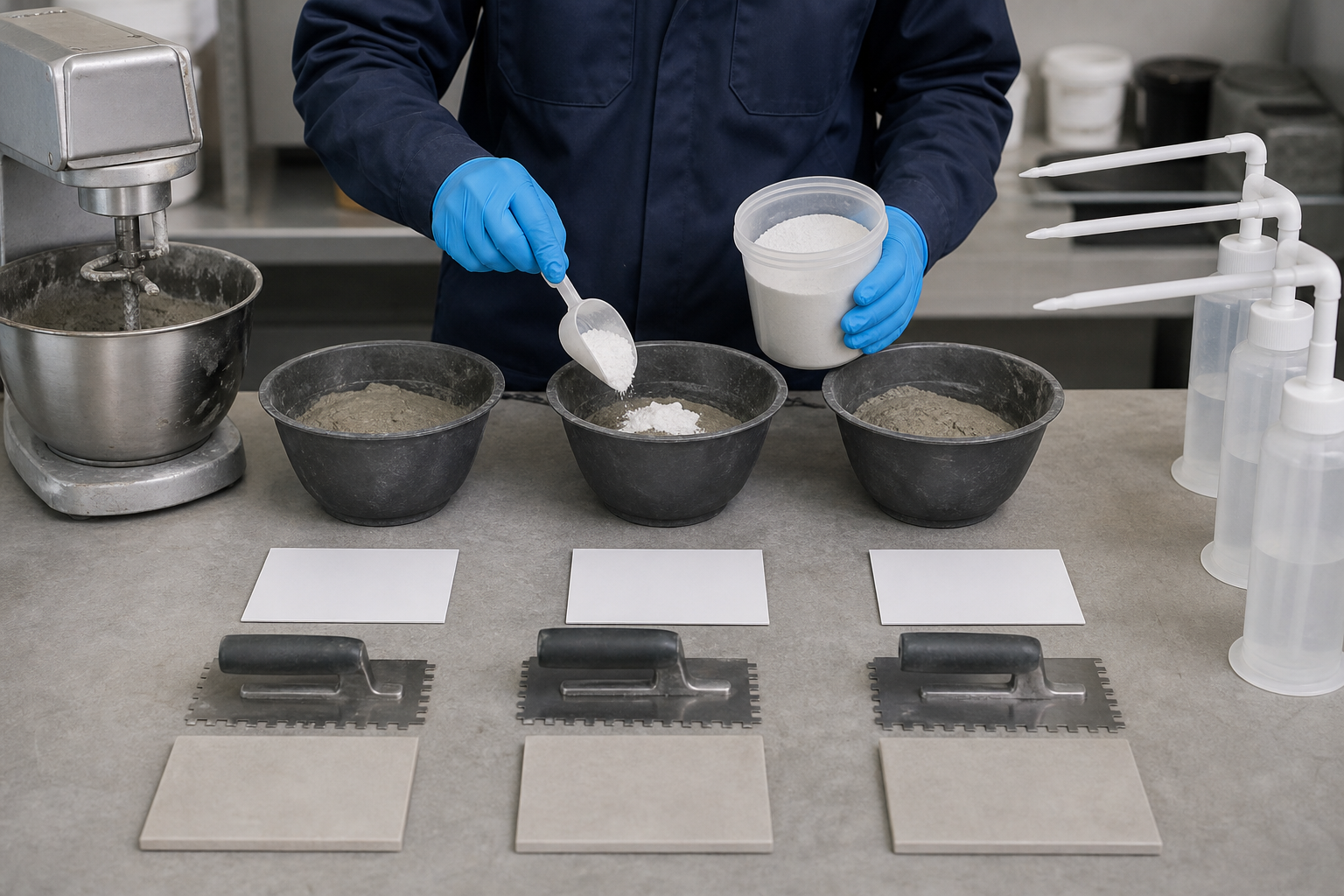
Rushing from a supplier sample to full production creates ambiguous failures. If minerals, additive grades, mixing procedure, and water adjustment all move together, no one can identify the cause.
Agitation / Answer: Pilot batching reduces risk when the mineral baseline, conditioning, mixing sequence, water basis, and test timing stay fixed while one planned variable changes. Record fresh-mortar observations and relevant cured tests, compare against an internal reference, and repeat promising trials before approving a grade or transferring the formulation to routine production.
My pilot sheet records raw-material lot IDs, sample conditioning, equipment, sequence, mixing procedure, resting and remixing steps, operator observations, specimen preparation, and test timing. ASTM C305 covers mechanical mixing of hydraulic cement pastes and mortars of plastic consistency; it is a useful method reference where applicable, not a product certification.[2]
A practical test matrix may include:
- dry-blend appearance and homogeneity;
- water demand under the defined laboratory procedure;
- mixing response, wetting, lumps, and consistency;
- trowel feel, rib stability, sag tendency, and transfer;
- open-time, slip, adhesion, and deformation-related methods when relevant to the intended product;
- retained-sample comparison and repeatability review.
ISO 13007-2 describes test-method scope for characteristics such as open time, slip, shear or tensile adhesion, transverse deformation, and chemical resistance.[1] Citing that scope does not establish compliance or certification; the applicable edition and market requirements still need review.
An anonymized formulation-planning inquiry: A new plant initially wanted to purchase only HPMC and RDP. After technical review, the team first fixed the cement, sand, and filler baseline, defined the target product level, and then planned single-variable additive trials. No customer name, country, quantity, or result is disclosed.
When screening HPMC, a sample-based water-retention test plan can help structure comparison before bulk purchasing. The real goal is not a spectacular trial; it is a repeatable decision trail.
What Should Your First Procurement Plan Include?

The final risk is buying “everything needed” before the formula, suppliers, storage rules, and release process are aligned. That approach ties purchasing to assumptions rather than evidence.
Agitation / Answer: Build the first procurement plan in gates: secure representative mineral sources, obtain documented additive candidates, complete incoming checks and pilot trials, approve one baseline system, and only then release routine purchasing. The plan should assign ownership for specifications, samples, change control, storage, testing, and nonconforming material—not merely list product names.
I divide the plan into qualification materials and routine materials. Qualification purchases support laboratory and pilot comparison; routine purchasing begins only after technical approval. Every line item needs a current specification, approved supplier and grade identity, required documents, sampling instruction, storage condition, shelf-management rule, and disposition owner.
| Procurement gate | Evidence required | Decision owner |
|---|---|---|
| Product definition | Intended use and test plan | Product and technical team |
| Mineral baseline | Approved cement, sand, filler references | Technical and quality teams |
| Additive screening | Comparable trial records and retained samples | Laboratory or formulation lead |
| Supplier qualification | Agreed specification and change-notice process | Purchasing and quality teams |
| Routine release | Incoming check and traceable approval | Quality function |
Before issuing the first routine order, I check that the team can answer these questions:
- Is the target product and applicable market requirement defined?
- Are all raw materials tied to approved identities and test methods?
- Can incoming lots be quarantined, sampled, released, or rejected?
- Are storage conditions and contamination controls documented?
- Can a formulation or supplier change be traced and re-evaluated?
- Are reference samples and pilot records retrievable?
This staged approach keeps cash decisions connected to technical evidence without pretending that a universal formula or purchasing shortcut exists.
Frequently Asked Questions
1. What are the essential tile adhesive raw materials?
The usual system includes cement, graded sand, mineral filler, HPMC, RDP, and, where formulation needs justify it, starch ether. Exact material selection depends on the intended product, local minerals, application conditions, and verified test results.
2. Can I start a tile adhesive plant with one standard formula?
I would not. A formula must be validated against your cement, sand, filler, additive grades, process, climate, and target market requirements. Start with a controlled baseline and documented trials rather than copying an unverified recipe.
3. Is HPMC the same as RDP in tile adhesive?
No. HPMC mainly supports water retention, consistency, and application handling, while RDP provides polymer modification after redispersion. Their effects interact, but one cannot simply replace the other.
4. Which quality-control tests should a startup prioritize?
Begin with raw-material identity and condition, controlled mixing observations, wet-mortar handling, and tests relevant to the intended product, such as open time, slip, and adhesion methods. Define procedures and acceptance logic before routine production.
5. How should I approach suppliers before my first order?
Share the target application, mineral baseline, test method, document requirements, and change-control expectations. Ask for suitable grade options and representative samples, then compare them under one controlled pilot plan.
Ready to turn your raw-material brief into a controlled trial plan? Contact KHCellulose to discuss HPMC, RDP, starch ether, and sample evaluation for your intended tile adhesive system.
References
[1] International Organization for Standardization, “ISO 13007-2:2010, Ceramic tiles — Grouts and adhesives — Part 2: Test methods for adhesives,” scope covering methods for open time, slip, adhesion, transverse deformation, and chemical resistance. The linked edition is withdrawn and points to a newer edition; verify the applicable edition. https://www.iso.org/standard/54599.html
[2] ASTM International, “ASTM C305-20, Standard Practice for Mechanical Mixing of Hydraulic Cement Pastes and Mortars of Plastic Consistency,” scope covering mechanical mixing for hydraulic cement pastes and mortars. https://www.astm.org/c0305-20.html
[3] International Organization for Standardization, “ISO/IEC 17025 — Testing and calibration laboratories,” overview of laboratory competence and valid results. https://www.iso.org/ISO-IEC-17025-testing-and-calibration-laboratories.html