
Buying dry mix mortar additives for a new line can feel backward. Suppliers present long catalogs, while the plant still needs to answer a simpler question: which material solves the most important performance problem in the first saleable product?
The risk is not merely buying an unnecessary bag. If the first additive set is too broad, purchasing creates more incoming checks, storage controls, supplier records and trial combinations than the laboratory can manage. If it is too narrow, the mortar may mix poorly, lose water too fast, slip, feel sticky or miss the intended adhesion and flexibility target. Either way, a rushed decision can hide the real cause of a failed trial.
I prefer to start with the finished product, not the additive catalog. Define the application, substrate, climate, workability target and required test method. Then assign each additive a job, qualify it with controlled trials, and buy only what the evidence supports. This guide follows that sequence for HPMC, redispersible polymer powder (RDP), starch ether, hydroxypropyl starch (HPS) and selected supporting polymers.
1. Start With Functions, Not a Long Additive Shopping List
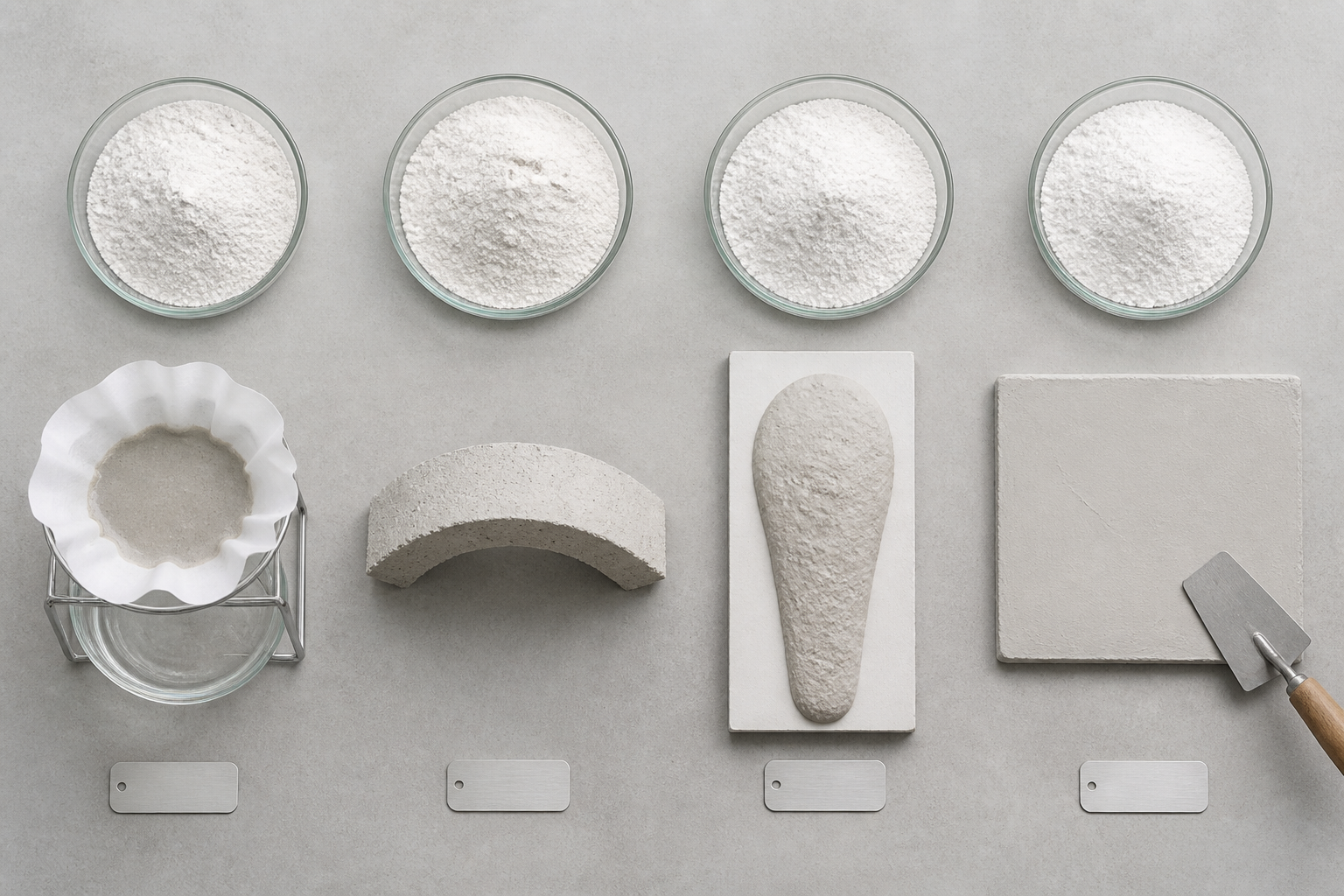
Problem. A first-time buyer may treat HPMC, RDP, starch ether and HPS as interchangeable “performance boosters.” They are not. That assumption makes troubleshooting expensive because a change in water retention, rheology or polymer modification can affect several measured and application properties at once.
Answer: Buy the fewest additives that cover the product’s essential control points. In most cement-based dry-mix lines, screen HPMC for water retention and workability, add RDP when adhesion or flexibility requires polymer modification, and evaluate starch ether or HPS only when rheology, sag, slip or application feel still needs targeted adjustment.
Solution. I map the candidate materials to functions before asking for samples:
| Additive | Primary purchasing reason | What I verify in the mortar |
|---|---|---|
| HPMC | Water retention, consistency and workable application | Water demand, wet consistency, open-time behavior, sag/slip tendency and application feel |
| RDP (VAE) | Polymer modification for adhesion, flexibility and cohesion | Relevant adhesion, deformation or durability tests after specified conditioning |
| Starch ether / HPS | Rheology tuning and sag/slip control | Trowel feel, build, stickiness, stability and practical application behavior |
| PVA 2488 | A supporting binder or film-forming option in selected systems | Compatibility, dissolution/dispersion behavior and its effect on the complete formulation |
HPMC and RDP should both arrive as white or near-white fine powders, but similar appearance does not imply similar function. I also avoid making starch ether or HPS an automatic purchase: sometimes the selected cellulose ether and mineral design already provide acceptable handling. A concise overview of how these polymers interact is available in this guide to dry-mortar additives and polymer performance.
2. Decide What to Buy First for Each Product Line
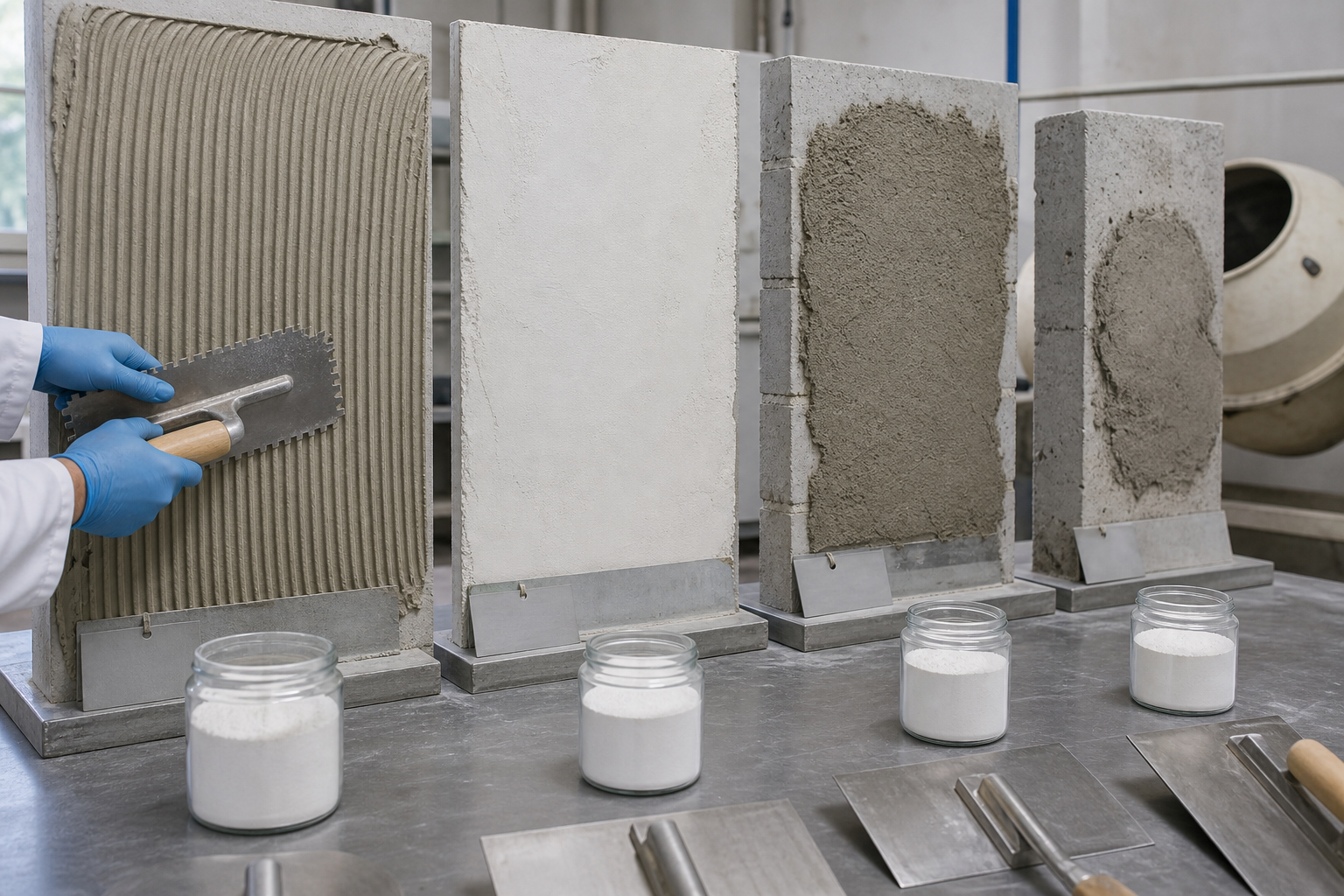
Problem. “What should I buy first?” has no responsible universal answer. A masonry mortar, skim coat, tile adhesive and repair mortar face different application stresses. Buying the same additive package for every line can create inventory convenience while producing weak product-market fit.
Answer: Let the product line set the buying sequence. Start with the additive tied to its dominant failure mode, then add the second material only when a defined test or application target justifies it. HPMC is often an early screening priority; RDP moves forward where adhesion or flexibility matters; rheology modifiers follow observed handling needs.
Solution. I use a priority matrix rather than a fixed recipe:
| Product line | First screening priority | Conditional next purchase | Decision trigger |
|---|---|---|---|
| Cement-based tile adhesive | HPMC and RDP | Starch ether or HPS | Water retention/open time, slip, adhesion and deformation targets |
| Wall putty or skim coat | HPMC | RDP or a rheology modifier | Smoothness, water retention, sanding/application behavior and substrate demand |
| Plaster/render | HPMC | Starch ether/HPS; RDP for specified enhanced performance | Pumping or hand application, sag, water retention, cohesion and required durability |
| Masonry mortar | HPMC | Rheology modifier or RDP only if the specification requires it | Workability, water retention, consistency and bond-related requirements |
| Repair or specialty mortar | HPMC and/or RDP based on the repair class | HPS, starch ether or another compatible modifier | Bond, shrinkage control strategy, build, deformation and exposure conditions |
For tile adhesives, product definitions and performance requirements should be tied to the market’s applicable standard. ISO 13007-1:2010 covers terms and performance requirements, but ISO marks that edition as withdrawn and points to a newer version.[^1] ISO 13007-2:2013 describes test methods including open time, slip, shear and tensile adhesion, and transverse deformation.[^2] I therefore confirm the currently adopted edition and local requirements rather than copying a competitor’s additive list.
3. Turn Incoming Specifications Into a Usable Control Plan

Problem. A supplier data sheet can help compare candidates, but it does not automatically become an incoming specification. If purchasing accepts a product name and appearance alone, batch variation may enter production before the laboratory has agreed on identity, test method or acceptance rules.
Answer: Build an incoming specification around identity, handling and formulation-relevant consistency. Record the supplier’s declared grade, chemistry, appearance, moisture-related parameter, viscosity method and other agreed characteristics, but accept materials only against documented methods and mutually approved limits. Pair certificates of analysis with periodic verification and retain samples for traceability.
Solution. My first specification meeting includes purchasing, quality and formulation staff. Together we agree what is meaningful for that grade—not what is easiest to copy from a generic sheet.
A practical checklist is:
- Exact commercial grade and chemical description.
- White or near-white fine-powder appearance for HPMC and RDP, plus checks for contamination, caking or abnormal odor.
- The viscosity method in full: solution concentration, temperature, instrument, spindle or geometry, speed and preparation procedure.
- Moisture or loss-on-drying method, where relevant.
- Ash or residue, pH, bulk density or particle-size information only when it is relevant to identification, feeding or proven process control.
- RDP-specific supplier data appropriate to the polymer grade, supported by performance testing in the buyer’s mortar.
- Lot number, manufacture or traceability information, storage instructions, safety documentation and certificate of analysis.
- Agreed sampling, retention, nonconformance and change-notification procedures.
A number without a method is not a specification. Two viscosity values, for example, are not comparable when sample preparation or instrumentation differs. I also separate incoming release tests from formulation qualification: identity and consistency can release a shipment, but the mortar trial determines whether the additive actually works in the intended product.
4. Design Sample Trials That Produce a Buying Decision
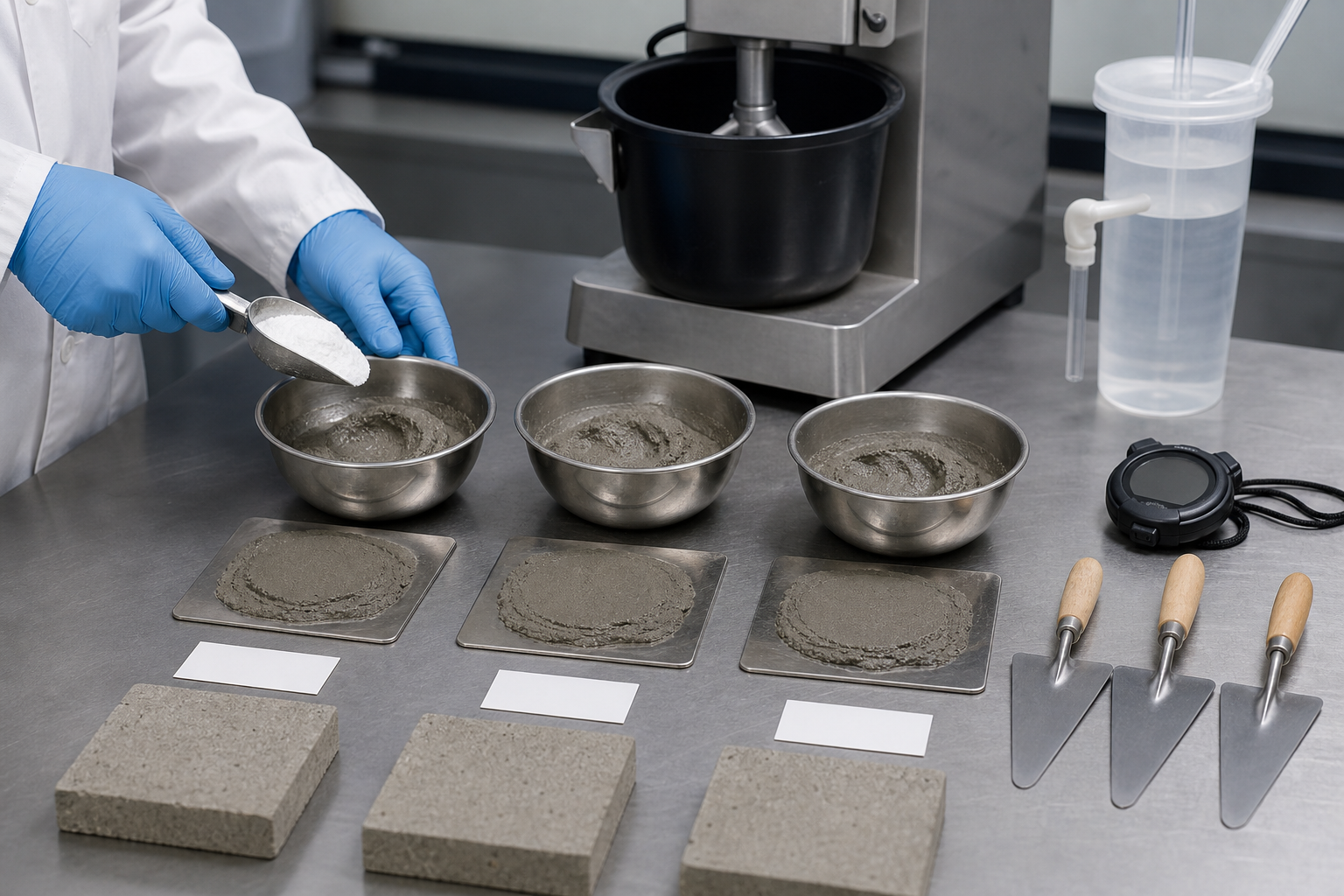
Problem. Unstructured sampling creates attractive demonstrations but weak evidence. When water, sand grading, mixing time and several additives all change together, the team cannot tell whether HPMC, RDP or the base formulation caused the result—or whether the result will repeat on the plant mixer.
Answer: Use a controlled reference, change one decision variable at a time, randomize or rotate test order where practical, and repeat critical measurements. Keep raw materials, water, conditioning and mixing procedure fixed. Compare fresh behavior first, then test hardened performance at the required ages and exposures before selecting a grade for scale-up.
Solution. I turn every sample request into a short protocol:
- Define the claim. State whether the trial is screening water retention, open time, slip resistance, adhesion, flexibility, sag control or application feel.
- Lock the reference. Record binder, fillers, aggregate grading, water, mixing sequence, rest time, remixing and environmental conditions.
- Create a small comparison set. Include the current control, the candidate and only the necessary level or grade comparisons. Do not treat a supplier suggestion as a fixed formula.
- Measure fresh properties. Observe wetting, lumping, consistency, water demand, workability over time, trowel response and sag/slip as applicable.
- Measure hardened performance. Use the product’s relevant methods, conditioning and acceptance criteria. For ceramic tile adhesives, align applicable testing with recognized methods such as those described in ISO 13007-2.[^2]
- Repeat the finalists. Confirm reproducibility, then run a pilot or plant-scale check before commercial release.
For a focused starting point, this free HPMC sample and water-retention testing guide explains why a sample should be linked to a test plan. I also record negative observations; stickiness, delayed wetting or poor application feel can be as useful as a passing headline result.
5. Place the First Bulk Order Without Locking In Too Early
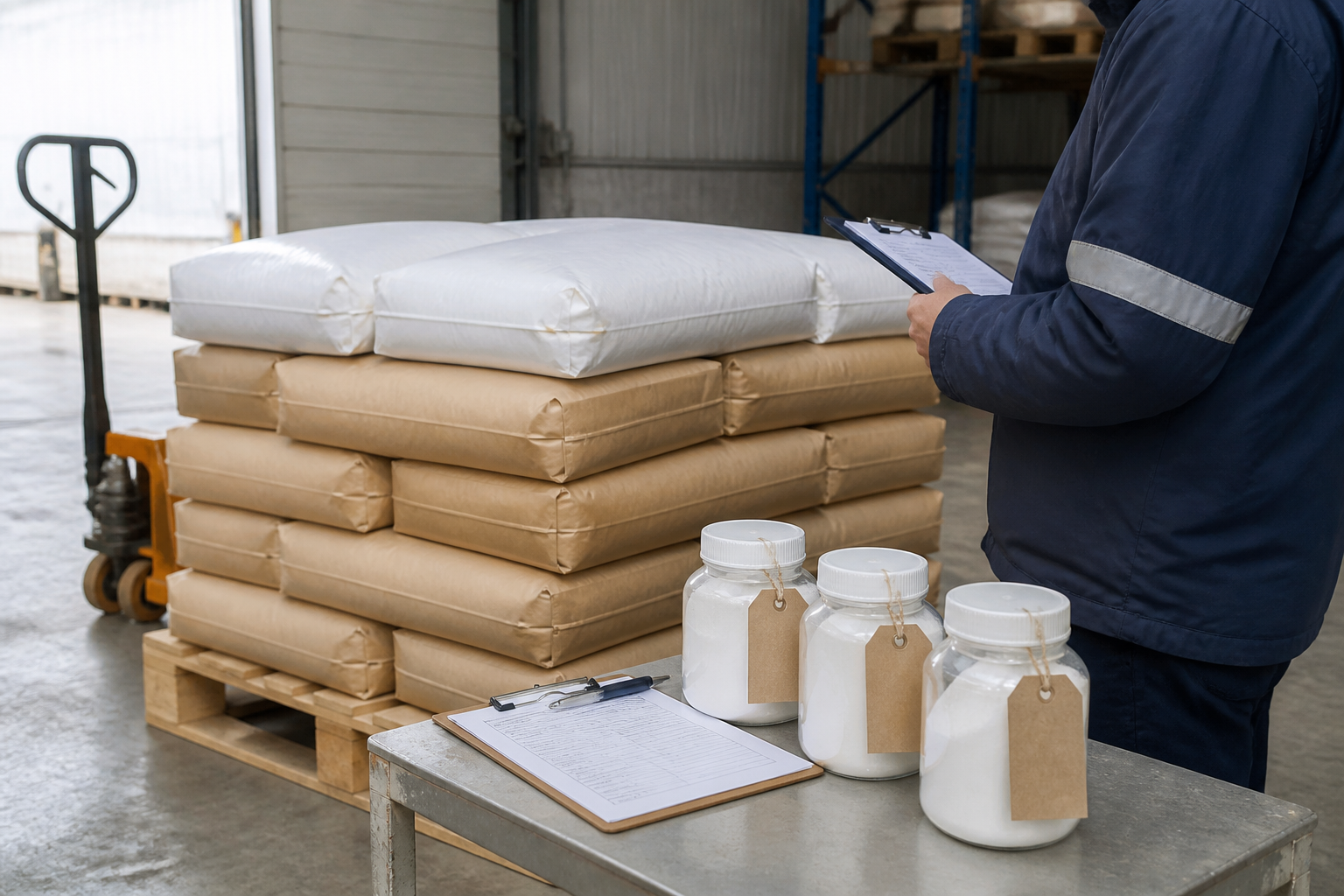
Problem. After a successful bench trial, teams often jump directly to a broad supplier consolidation plan. Yet scale, storage, feeder behavior, plant mixing and lot-to-lot consistency have not been demonstrated. An early single-source decision can turn one promising sample into an avoidable supply or quality risk.
Answer: Make the first bulk order a controlled scale-up, not a permanent sourcing decision. Buy only the approved grades, preserve lot traceability, define receiving checks, and compare plant output with the laboratory reference. Consolidate suppliers later, after technical fit, quality consistency, documentation, responsiveness and continuity planning have been evaluated together.
Solution. Before release, I require a compact handover pack:
- Approved grade and supplier documents.
- Sample, pilot and plant-trial records linked to the same formulation version.
- Incoming specification, test methods and retained-reference procedure.
- Storage, handling, dust-control and stock-rotation instructions.
- A change-control route covering source, grade, process or specification changes.
- A response plan for an out-of-specification shipment or unexpected mortar result.
Representative buyer scenario (anonymous): A plant preparing multiple mortar lines shortlists an HPMC grade for water retention and handling, while an RDP candidate is reserved for the line with a defined polymer-performance requirement. The team trials each against its own control, holds starch ether/HPS as a conditional rheology option, and releases a first bulk purchase only after the plant-scale comparison. Supplier consolidation is reviewed later using quality and service evidence, not catalog breadth alone.
This approach keeps commercial leverage without confusing “fewer suppliers” with “lower risk.” One capable supplier may simplify communication and documentation, but contingency planning still matters. I would request written alignment on specifications, test methods and change notification through the KHCellulose contact team before treating any grade as a production standard.
Conclusion. The first purchase should be a short, testable additive system built around the mortar line’s dominant needs. HPMC, RDP, starch ether and HPS earn their place through defined functions and repeatable evidence—not because they appear together in a standard package.
Frequently Asked Questions
Is HPMC always the first dry-mix mortar additive to buy?
Not always, but it is commonly screened early in cement-based products where water retention, consistency and workable application are central. The correct first purchase depends on the product, substrate, process and acceptance tests. Specialty systems may make polymer modification or another control mechanism equally urgent.
Do I need both HPMC and RDP in every mortar?
No. HPMC mainly supports water management and rheology, while RDP is selected for polymer-related performance such as adhesion, cohesion or flexibility. A product should include both only when its specification and controlled trials justify both functions.
Are starch ether and HPS the same as HPMC?
No. They may all influence application behavior, but they do not perform identical jobs. Starch ether or HPS is generally evaluated as a targeted rheology modifier, while HPMC is commonly selected for water retention and consistency alongside its rheological effects.
Can a certificate of analysis replace an application trial?
No. A certificate reports agreed batch characteristics; it does not prove performance in your cement, fillers, aggregates, water conditions or mixing process. Use it for traceability and incoming control, then qualify performance in the complete mortar.
When should I consolidate additive suppliers?
After shortlisted grades have passed repeat trials, plant-scale verification and incoming-quality review. Compare technical fit, lot consistency, documentation, communication, change control and supply continuity. Consolidation should reduce complexity without removing a sensible contingency plan.
CTA: Ready to turn your product targets into a focused sample and qualification plan? Contact KHCellulose with your mortar type, application conditions and test priorities.
References
- [^1]: International Organization for Standardization, ISO 13007-1:2010 — Ceramic tiles — Grouts and adhesives — Part 1: Terms, definitions and specifications for adhesives. ISO lists this edition as withdrawn and identifies a newer version.
- [^2]: International Organization for Standardization, ISO 13007-2:2013 — Ceramic tiles — Grouts and adhesives — Part 2: Test methods for adhesives. ISO lists the standard as published and confirmed in 2024.