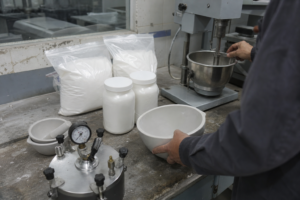
When a water-based paint looks right in the mixer but behaves differently in the can or on the wall, the thickener is an obvious suspect. The harder question is whether HEC or HPMC is the better correction. I would not answer from chemistry alone. I would treat HEC vs HPMC for water-based paint as a coating thickener selection exercise tied to a specific binder, pigment package, process, and application target.
The risk is choosing from one viscosity number. That can create acceptable in-can consistency yet poor flow, weak sag resistance, unstable tint response, or avoidable processing trouble. My practical approach is to define the rheology job, screen compatibility, age the complete paint, verify incorporation, and then translate the winning sample into a purchasing specification.
Start With the Rheology Job, Not the Polymer Name
A buyer may ask for “the higher-viscosity grade,” while the formulator actually needs a balance across mixing, storage, brushing, rolling, leveling, and sag control. A single supplier viscosity label cannot describe that full shear history.
Agitation / Answer: Neither polymer wins by name alone. I compare the whole rheology target: KU consistency, low-shear structure, application feel, leveling, sag control, and recovery after shear. HEC is often the first screening candidate in latex paint, while HPMC deserves a controlled trial when its hydration and rheology profile better fit the system.
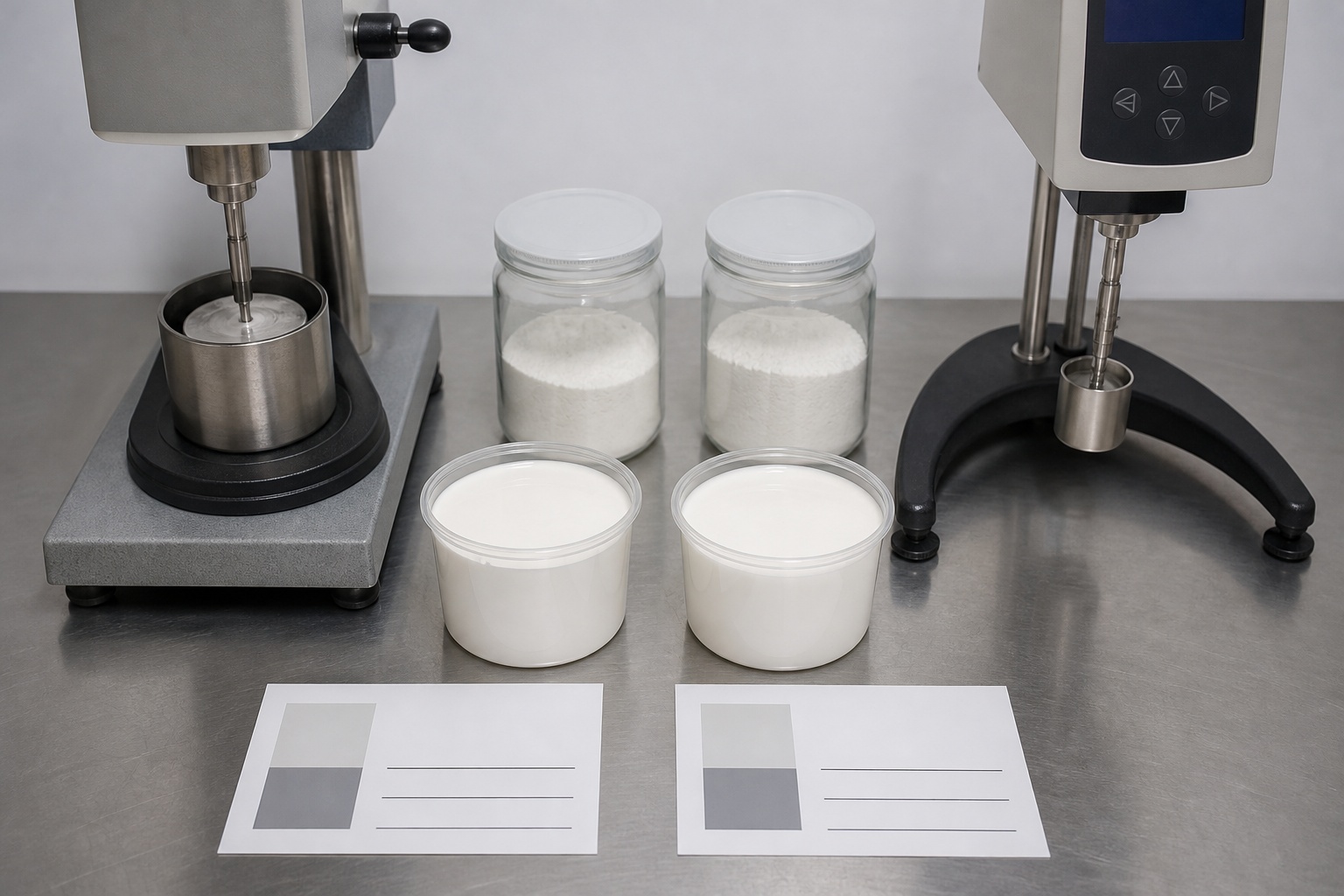
For initial screening, I start with the functional role. The HEC product overview is useful for identifying candidate hydroxyethyl cellulose grades, while the HPMC product overview frames the alternative chemistry. Those pages begin the conversation; they do not replace testing in the finished coating.
I then build a small, repeatable matrix:
| Check | What it tells me | Control to record |
|---|---|---|
| KU viscosity | Mid-shear paint consistency | Temperature, instrument, conditioning time |
| Rotational viscosity at defined speeds | Low-to-moderate shear response | Spindle/geometry, speed, sample history |
| Up/down speed sequence | Shear thinning and recovery | Sequence and dwell time |
| Drawdown/application observation | Leveling, drag, sag tendency | Substrate, film applicator, environment |
KU testing can follow ASTM D562 as the method reference for Stormer-type measurements.[1] Rotational work can use ASTM D2196 as a reference for apparent viscosity, shear thinning, and thixotropic behavior.[2] I do not compare numbers produced with different spindles, speeds, temperatures, or conditioning histories. A coating thickener selection is defensible only when the method and the formulation remain constant.
Check Pigment Compatibility and Color Acceptance
A thickener can hydrate cleanly in water and still behave poorly after pigments, dispersants, surfactants, extenders, latex, and colorants enter the system. That interaction may show up as seediness, flocculation, gloss change, rub-up difference, or inconsistent tint strength.
Agitation / Answer: Color acceptance is not proven by a smooth base paint. I compare HEC and HPMC in the same complete formula, then inspect fineness, drawdowns, tint development, rub-up, gloss, and visible separation. Any difference must be repeated before I blame the cellulose ether or approve a supplier sample.

I keep the pigment grind and letdown conditions identical, including order of addition and energy input. If the base is intended for tinting, I test representative colorants rather than assuming one universal response. The relevant question is not simply “Does it thicken?” but “Does it preserve dispersion quality and deliver consistent color?”
My compatibility screen includes:
- inspect the wet paint for grains, foam retention, or localized gel;
- confirm fineness with the plant’s established method;
- prepare controlled white and tinted drawdowns;
- compare full-area appearance and a rub-up area after the same interval;
- measure color and gloss only with the same instruments and settings;
- repeat any unexpected observation from a fresh batch.
I also review whether a concern belongs to cellulose ether selection or to a broader additive interaction. The discussion of HEC and HPMC behavior in liquid systems is not a paint recipe, but it reinforces why hydration and compatibility must be considered in the actual aqueous matrix. For communication with suppliers, I describe the pigment type, binder family, pH window, dispersant system, and tinting requirement without disclosing unnecessary proprietary detail. That gives technical teams enough context to suggest a sample while keeping the final color-acceptance decision in our laboratory.
Test Storage Stability as a Time-Dependent System
Fresh viscosity is easy to overvalue. A paint can pass immediately after manufacture yet drift during storage through delayed hydration, microbial effects, settling, syneresis, pH movement, or interactions among the thickener, surfactants, binder, and pigments.
Agitation / Answer: I never approve HEC or HPMC from day-zero viscosity alone. Storage stability requires sealed, clearly identified samples, planned checkpoints, controlled conditioning, and the same test sequence each time. I track viscosity, separation, settling, redispersibility, pH, odor, appearance, and application behavior before making a material decision.

The stability plan should reflect the product’s intended storage and distribution conditions. I include an ambient control and any accelerated condition already justified by the company’s internal method. I do not convert accelerated exposure into a shelf-life claim unless the organization has validated that correlation.
A useful checkpoint record is simple:
| Observation | Why it matters |
|---|---|
| KU and rotational viscosity | Reveals drift across more than one shear condition |
| Surface liquid or syneresis | Signals structural weakness or incompatibility |
| Settling and redispersibility | Separates reversible settling from hard pack |
| pH, odor, visible change | Flags system changes needing investigation |
| Repeat drawdown | Confirms whether stored paint still applies acceptably |
Sampling discipline matters as much as measurement. ISO 15528 describes procedures for sampling paints, varnishes, and their raw materials; I use it as a method reference and align it with the site’s approved procedure.[3] Containers, fill level, headspace, sealing, and sample disturbance should be consistent.
Cross-industry comparisons can sharpen questions without supplying paint conclusions. For example, the article comparing HPMC, MHEC, and HEC in construction applications shows why cellulose ether choice is application-specific. In coatings, only the complete paint stability program can establish suitability.
Match the Incorporation Method to Plant Reality
A laboratory may produce a lump-free sample with careful hand feeding, while the plant has a short addition window, different impeller geometry, variable water temperature, and limited premix capacity. That gap can make a suitable polymer appear unreliable.
Agitation / Answer: The better thickener is the one the plant can disperse and hydrate consistently without creating fish-eyes, dusting, or long cycle times. I document addition point, liquid temperature, agitation state, feed rate, pH sequence, hold time, and visual hydration endpoint for every HEC or HPMC trial.
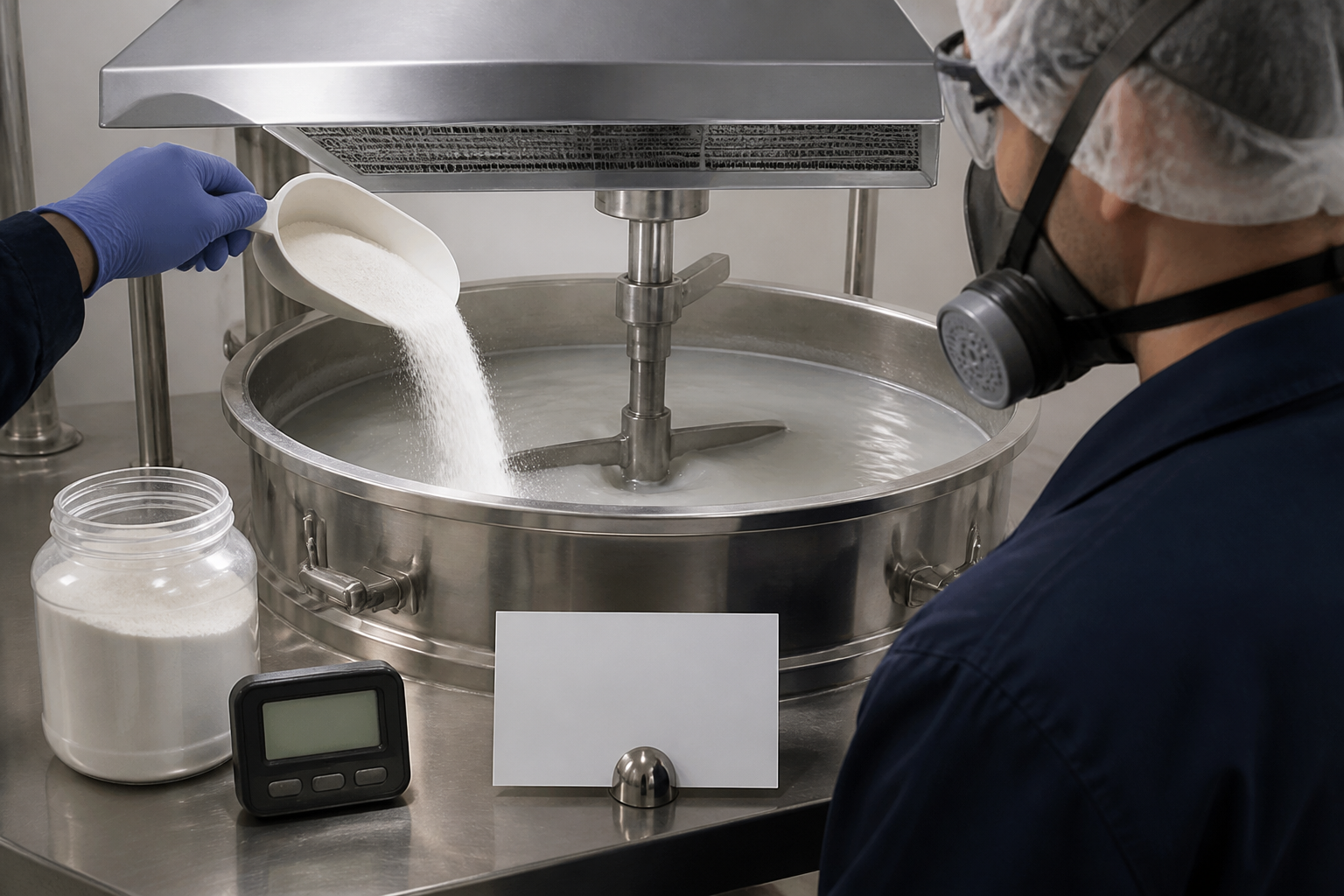
I ask the supplier for its recommended incorporation route for the exact grade, then adapt that guidance through controlled trials. I do not assume all HEC grades or all HPMC grades share the same dissolution behavior. Grade treatment, particle characteristics, and the surrounding formulation can change what operators observe.
Before scale-up, I write a one-page process record:
- identify the vessel, impeller, batch mass, and starting liquid condition;
- record where and how the powder enters the vortex or bulk liquid;
- log addition duration without turning it into a universal recipe;
- note pH adjustments and other additives added before or after the thickener;
- define how hydration completion is judged;
- inspect for fisheyes, wall build-up, foam, and undispersed powder;
- recheck viscosity after the agreed conditioning period.
If two candidates reach similar final rheology, the cleaner and more repeatable plant process may decide the winner. I also include operators in the review because dust behavior, bag handling, and cleaning burden rarely appear on a technical data sheet.
For a fair incorporation comparison, every intentional difference should be named in advance. Changing polymer, addition order, and mixing energy simultaneously produces an ambiguous result. One controlled change at a time gives the formulation team a usable explanation and gives procurement a requirement it can preserve during future sourcing.
Validate Supplier Samples and Lock the Procurement Specification
A sample marked “HEC” or “HPMC” is not a purchasing specification. If procurement switches only by chemistry name or nominal viscosity, the next lot may differ in hydration behavior, moisture condition, particle handling, or viscosity under the supplier’s own test method.
Agitation / Answer: I approve a supplier sample through a coded, side-by-side protocol in the target paint, then convert the accepted material into measurable purchasing controls. The specification should identify chemistry, grade, supplier test method, viscosity basis, sample documentation, packaging, traceability, change notification, and incoming verification—not merely HEC or HPMC.

My sample validation workflow avoids invented success stories. It is a process, not a promised result:
- receive representative samples with technical and safety documents;
- record lot identity, packaging condition, and sample date;
- code samples so evaluators can compare them consistently;
- run the same incorporation, rheology, color, drawdown, and stability checks;
- repeat critical findings before technical approval;
- retain reference material under defined conditions;
- document who can authorize a specification or supplier change.
The procurement specification should state the test method behind every acceptance item. A viscosity value without concentration, medium, temperature, instrument, spindle/geometry, speed, and conditioning procedure is not comparable. Where raw-material sampling is part of incoming control, ISO 15528 can support method discussions, while the company’s approved procedure governs execution.[3]
I also separate certificate review from performance validation. A certificate can confirm reported lot data; it cannot prove behavior in our binder and pigment package. Likewise, a laboratory sample does not automatically represent routine supply unless traceability and change control are addressed.
For the final technical exchange, use one consolidated brief covering the target paint, test methods, sample quantity, documentation, and evaluation timeline. The single next step is to request a matched HEC or HPMC sample and technical review from KHCELLULOSE.
Frequently Asked Questions
1. Is HEC always better than HPMC in water-based paint?
No. HEC is a common screening choice, but the better grade is the one that meets the defined rheology, compatibility, stability, processing, and procurement requirements in the target formula.
2. Can KU viscosity alone determine coating thickener selection?
No. KU is valuable for consistency control, but rotational viscosity at defined conditions and application observations help describe low-shear structure, shear thinning, recovery, leveling, and sag behavior.
3. How should I compare color acceptance?
Use the same base, colorant, addition procedure, conditioning time, drawdown method, lighting or instrument settings, and rub-up procedure. Repeat unexpected differences before assigning a cause.
4. What should supplier sample validation include?
Include identity and document review, controlled incorporation, KU and rotational measurements, pigment and color checks, drawdowns, planned storage observations, repeat testing, and retained reference material.
5. What belongs in a cellulose ether procurement specification?
State chemistry and grade, the full viscosity test basis, packaging and traceability requirements, required documents, incoming checks, approved reference sample where applicable, and formal change-notification expectations.
Method References
- ASTM International, ASTM D562-10(2023), Standard Test Method for Consistency of Paints Measuring Krebs Unit (KU) Viscosity Using a Stormer-Type Viscometer. Official standard page; use the current purchased text and laboratory procedure for execution.
- ASTM International, ASTM D2196-20(2026), Standard Test Methods for Rheological Properties of Non-Newtonian Materials by Rotational Viscometer. Official standard page; cited as a method reference for rotational rheology.
- International Organization for Standardization, ISO 15528:2020, Paints, varnishes and raw materials for paints and varnishes — Sampling. Official ISO page; cited as a sampling-method reference.