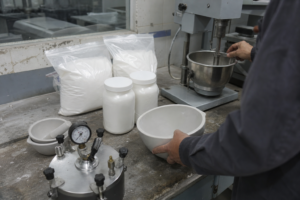
A bag opens and the powder is no longer uniformly free-flowing. Purchasing worries about supply continuity, warehouse QC sees a possible handling deviation, and the mortar laboratory needs an answer before production starts. This is the real problem behind RDP powder caking: a visual symptom can trigger either a needless rejection or a risky release.
I do not treat a lump as a verdict. Polymer powder blocking may reflect moisture ingress, package damage, pallet compression, transport vibration, or a combination of events. A lump may break apart, yet that does not prove the polymer still redistributes properly or delivers the required mortar performance. Conversely, caking alone does not prove the material is unusable.
The practical answer is a controlled PAS workflow: contain the uncertainty, reconstruct the history, take representative samples, compare by the same laboratory method, and confirm performance in the intended formulation. For background on grades and uses, see our RDP/VAE overview and guide to what RDP powder is used for.
1. Is It Soft Agglomeration or Hard Caking?
Problem: Teams often squeeze one lump, call it “soft” or “hard,” and jump directly to a use decision. That shortcut confuses a descriptive observation with evidence of fitness for use.
Agitation / Answer: Soft agglomerates may separate under gentle handling, while hard cakes remain coherent or form resistant blocks. Record both conditions, but do not release RDP from appearance alone. A free-looking powder can still have altered redispersion or application performance; acceptance must follow supplier documentation, same-method laboratory comparison, and an application trial.
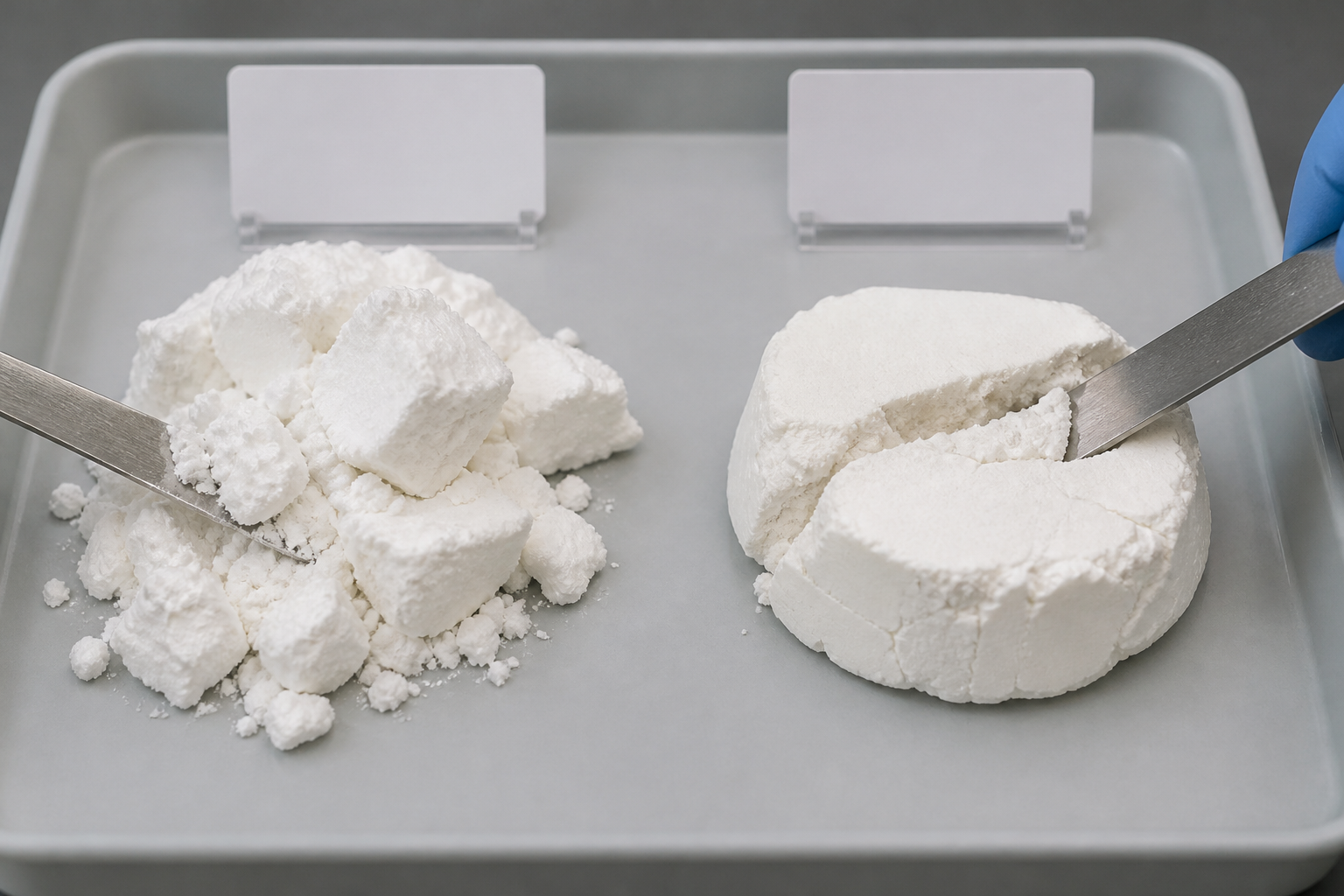
Solution: I begin with a non-destructive examination of sealed units, labels, seams, liners, corners, and visible staining. After opening under the site’s approved procedure, I describe—not interpret—the powder: location of lumps, proportion observed, friability under the documented method, flow behavior, color, odor, and any foreign material. Photos should include the package ID and scale reference without obscuring the condition.
| Observation | What it may suggest | What it cannot prove |
|---|---|---|
| Loose, friable agglomerates | Compression or limited moisture exposure | Conformity or acceptable end-use performance |
| Dense block near a damaged area | Localized moisture ingress or impact | That every part of the bag is affected equally |
| Broad compacted layer | Pallet compression or prolonged load | Polymer integrity or redispersibility |
| Apparently free-flowing powder | No obvious gross blocking | That key properties remain within requirements |
Keep language neutral: “breaks under the approved observation method” is more useful than “good.” Do not improvise a sieve size, force, drop test, or pass limit. Use the supplier’s current technical documents and your approved incoming-control plan. The physical comparison is only the first branch in the investigation, not the release gate.
2. What Happened During Packaging, Storage, and Handling?
Problem: Without a traceable history, caking is easily blamed on “bad material” or “warehouse humidity,” while the decisive event may have occurred at a seam, during transport, or under pallet load.
Agitation / Answer: Reconstruct the lot journey before disturbing more bags: supplier lot, manufacture and dispatch references, packaging configuration, receipt inspection, transport events, pallet position, stacking changes, storage records, and handling incidents. Moisture ingress, package damage, and pallet compression often leave patterns; traceability turns those patterns into testable hypotheses, not assumptions.
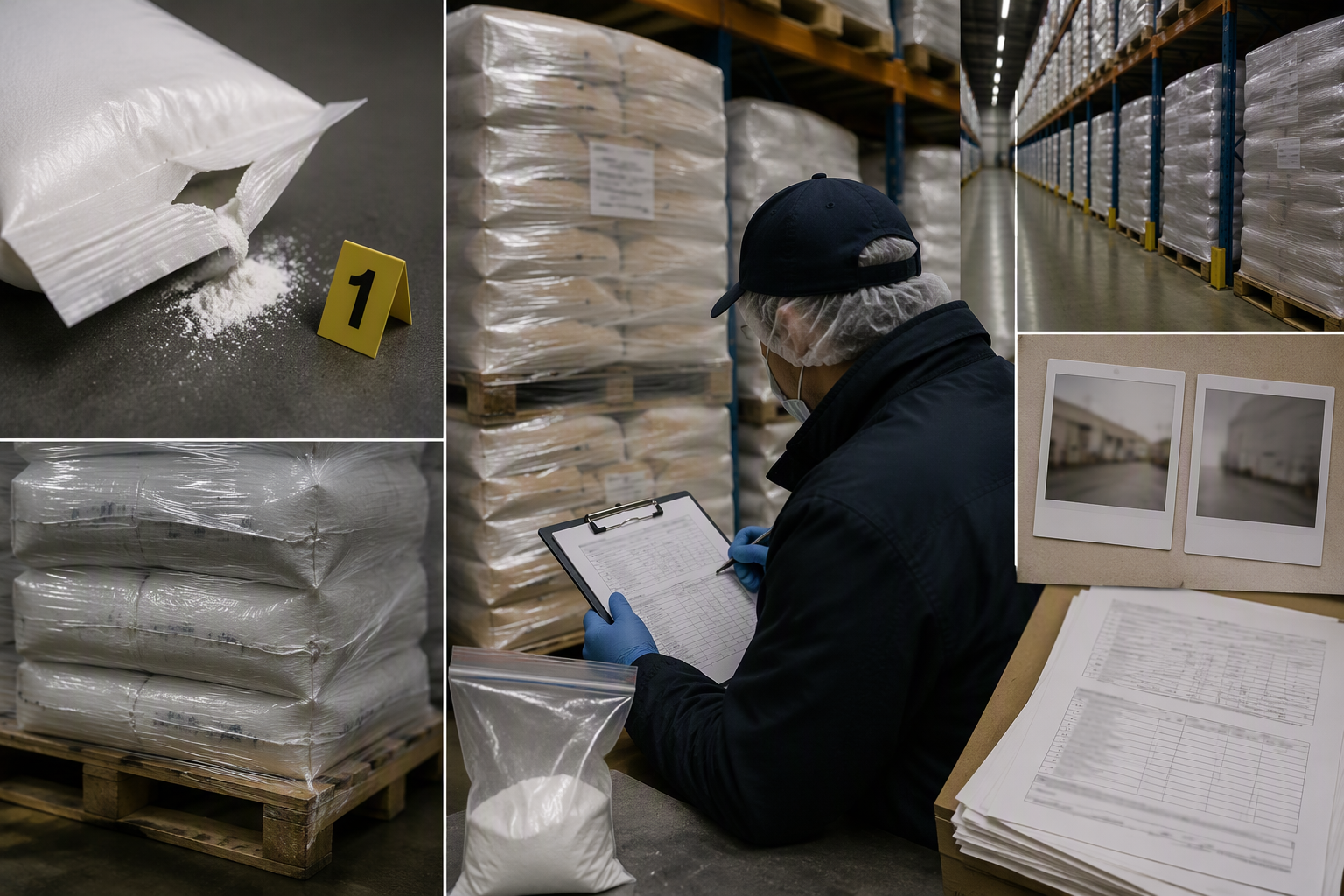
Solution: I freeze the relevant records and map affected units against unaffected units from the same delivery. The investigation should connect purchase order, certificate and label data to warehouse location and sampling IDs. Review environmental records only against the supplier’s stated storage conditions; do not invent a universal temperature or humidity ceiling. Also check whether liners were punctured, seals opened, packages dragged, pallets deformed, or loads concentrated unevenly.
- Photograph all sides of suspect packaging before movement.
- Record pallet level, edge/center position, neighboring condition, and overwrap status.
- Preserve transport notes, receiving exceptions, moves, and repacking activity.
- Check whether the issue is isolated, patterned, or widespread across traceable units.
- Ask the supplier for grade-specific handling and packaging guidance.
| Evidence pattern | Investigation lead |
|---|---|
| Caking next to a tear or wet mark | Local barrier failure or moisture ingress |
| More blocking in lower pallet layers | Pallet compression and load history |
| Similar condition across separated pallets | Common transport, packaging, or material factor |
| Only opened or repacked units affected | Post-receipt handling exposure |
For procurement context, compositional differences among RDP varieties can explain why one grade should not be judged by another grade’s behavior. WACKER’s polymer-powder portfolio likewise shows that dispersible powders are application-specific products rather than one interchangeable material.[1]
3. How Should QC Sample and Compare Caked RDP?
Problem: A scoop from the easiest corner can miss a moisture-affected zone or overrepresent one hard block. Once the sample is unrepresentative, polished laboratory data still answer the wrong question.
Agitation / Answer: Use a documented, representative sampling plan tied to package and location IDs. Sample suspect and apparently normal zones as the plan requires, prevent contamination or moisture change, and compare with retained or reference material of known status. Apply the same preparation, conditioning, method, equipment, and reporting basis to every comparison.
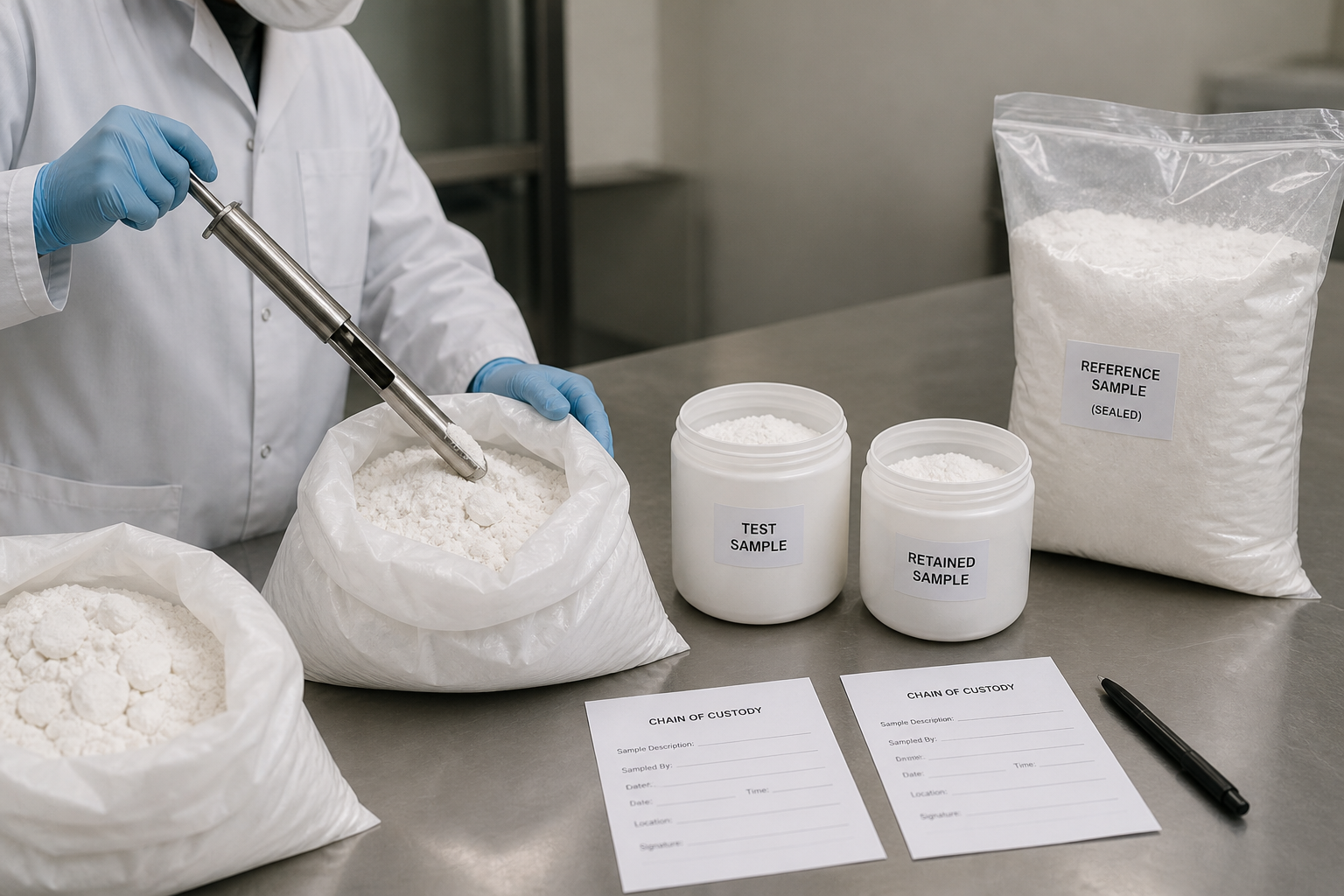
Solution: The plan should define the decision unit—bag, pallet, or traceable lot—according to the supplier agreement and internal quality system. Select units across the observed pattern, then collect increments from relevant positions rather than chasing only visible lumps. Seal, label, and preserve each sample promptly. Maintain chain of custody and reserve enough material for confirmation or supplier review. Never silently grind or force a caked portion through a screen unless the approved method explicitly requires that preparation.
| Sample set | Purpose | Key control |
|---|---|---|
| Suspect-area increments | Characterize the observed condition | Preserve original state and location identity |
| Apparently normal-area increments | Check within-unit variation | Do not call them conforming before testing |
| Retained sample | Compare with known historical material | Verify identity and storage integrity |
| Current reference material | Support same-method comparison | Match grade and documented status |
| Sealed reserve | Enable repeat or supplier work | Maintain custody and protection |
Record sieve/flow observation using the approved apparatus and supplier or internal method; the screen and criterion must come from those documents, not this article. If particle-size data are generated, ISO 9276 addresses ways to represent particle-size-analysis results, but it does not establish an RDP release limit.[2] Likewise, ISO/IEC 17025 concerns laboratory competence, impartiality, and consistent operation; it does not decide whether a caked RDP lot passes.[3] A disciplined comparison reduces method noise so the disposition team can focus on material evidence.
4. Which Tests Support Release Before Production?
Problem: Passing a flow observation or seeing a lump disappear in water can create false confidence. Physical breakup is not the same as polymer redispersion, and redispersion alone does not guarantee mortar performance.
Agitation / Answer: Release evidence should progress from controlled powder observation to a same-method redispersion check and then an application trial in the intended formulation. Compare suspect material with retained or approved reference material under matched conditions. Use only preapproved criteria from supplier documents and the plant quality plan; no single visual check is sufficient.
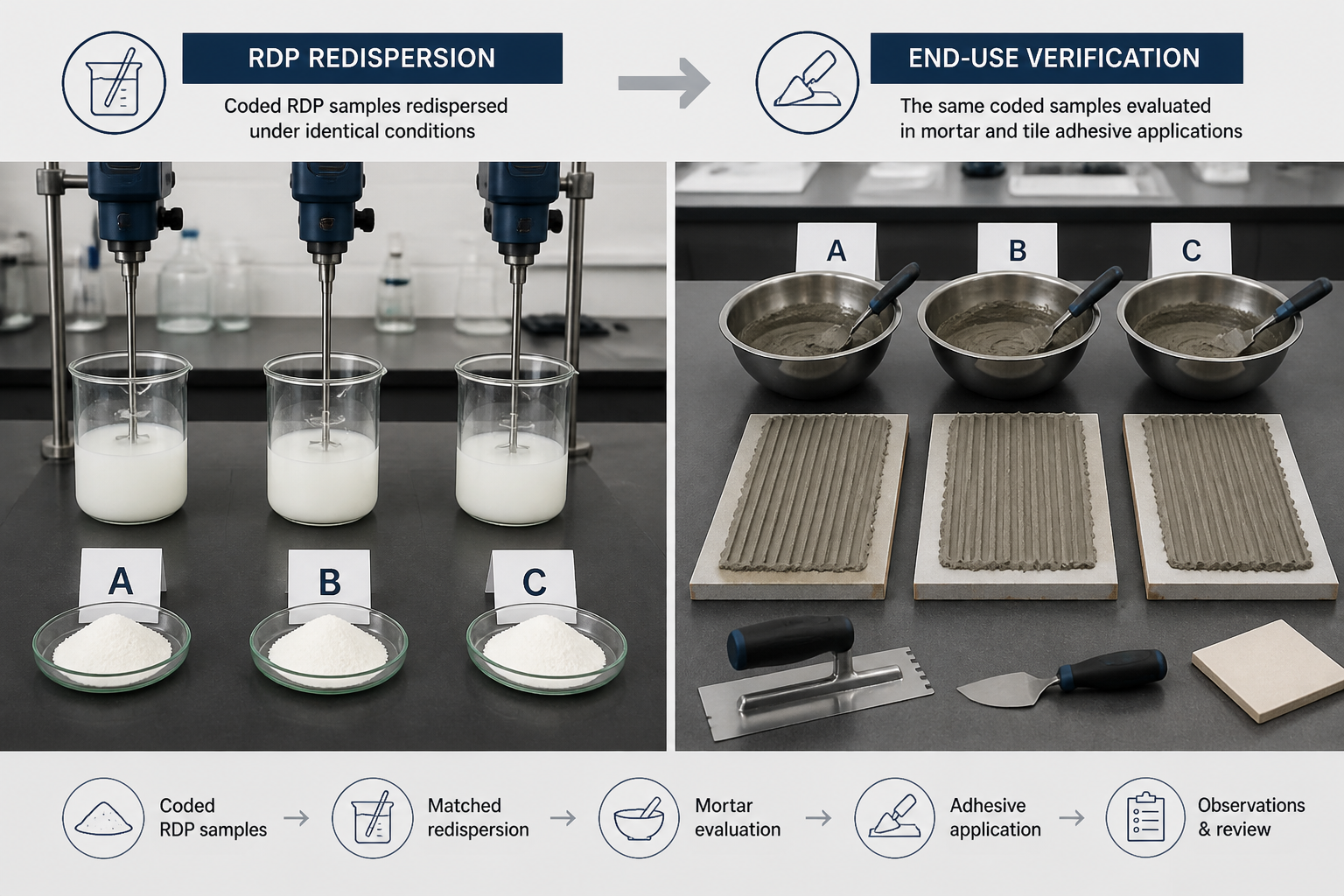
Solution: Start with identity and relevant incoming-control checks, then run the supplier-aligned redispersion method. Document wetting, mixing sequence, dispersion appearance, persistent particles or film, and any method-defined measurements. Do not “help” the suspect sample with extra mixing unless the same treatment is applied to the reference and allowed by the procedure.
Next, dose the suspect RDP into the plant’s representative dry-mix formulation. Hold raw materials, mixing, curing, specimen preparation, and test timing consistent. Choose performance endpoints already tied to the product specification and intended application. Depending on the mortar system, these may include workability observations, adhesion-related performance, flexibility-related behavior, water response, or other approved characteristics; the governing documents decide which ones matter.
| Verification stage | Core question | Decision value |
|---|---|---|
| Powder observation | Is blocking/flow behavior different? | Screens and documents the symptom |
| Redispersion check | Does the powder redisperse comparably by the same method? | Detects dispersion-related change |
| Application trial | Does the intended mortar meet approved requirements? | Provides end-use evidence |
| Review of all data | Are identity, history, and results coherent? | Supports controlled release or disposition |
Do not average away a meaningful localized failure without a documented rationale. If results conflict, expand the investigation or consult the supplier rather than choosing the most favorable test. For broader supplier controls, see our guide to finding a reliable RDP supplier.
5. Who Decides Quarantine, Release, or Disposition?
Problem: Production pressure can turn an unresolved bag into an informal trial, while a blanket rejection can discard material before facts are reviewed. Both outcomes bypass change control and accountability.
Agitation / Answer: Quarantine affected units immediately under clear status control, notify procurement, warehouse, laboratory, quality, and the supplier, then assemble one evidence package. Release requires authorized approval against applicable documents and successful verification. If evidence is incomplete, contradictory, or outside requirements, keep material blocked and follow the approved disposition process.
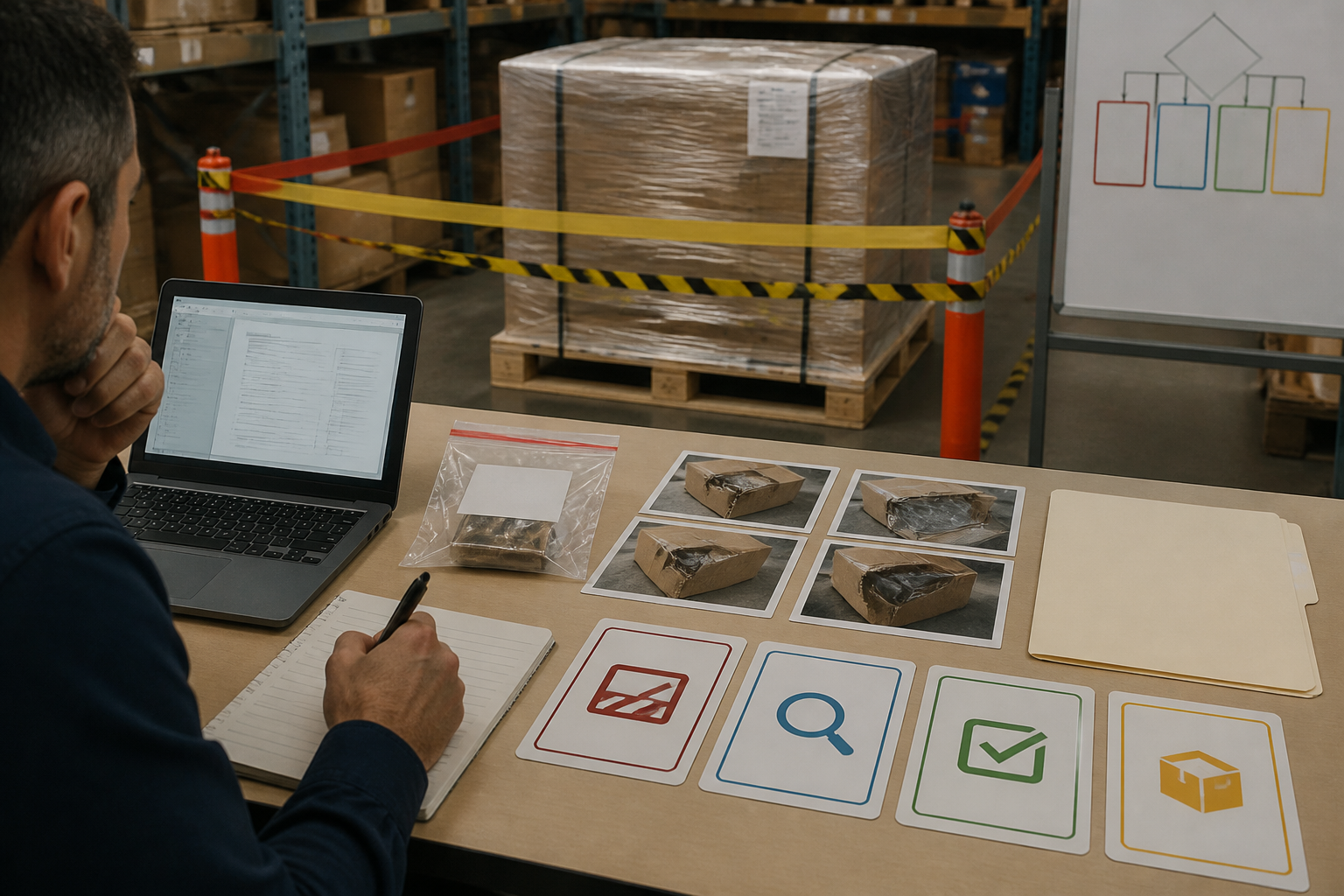
Solution: The quarantine boundary must match traceability evidence. Separate suspect units physically or electronically, prevent picking, and retain original packaging wherever feasible. Supplier communication should include grade, lot and package IDs, chronology, photographs, storage and handling records, sampling map, methods, raw observations, comparison results, and reserve-sample availability. Ask for a written technical assessment; do not treat an informal message as a specification change.
| Status | Minimum governance question | Possible next step |
|---|---|---|
| Quarantine | Is identity and access controlled? | Investigate and sample |
| Conditional review | Is an approved protocol defined? | Run comparison and application trial |
| Release | Do authorized reviewers find all requirements met? | Document scope and approval |
| Continued hold | Is evidence incomplete or conflicting? | Seek supplier input or further work |
| Disposition | Does the approved system allow return, rework evaluation, downgrade, or rejection? | Execute with authorization and records |
An anonymized review I use as a model stops at process, not outcome: warehouse maps package condition; QC preserves samples; the lab performs same-method comparisons and an application trial; procurement obtains supplier input; quality records the final authorized disposition. No customer identity, quantity, or claimed result is needed to make the lesson useful.
Close the record with the rationale, approvers, affected unit IDs, test reports, supplier correspondence, and preventive actions. Never state that caked powder is automatically usable. Even if it loosens visibly, use still depends on supplier documentation, comparable laboratory evidence, and verified application performance.
Frequently Asked Questions
1. Does RDP powder caking always mean moisture ingress?
No. Moisture ingress is one credible cause, but package damage, pallet compression, transport vibration, storage history, and grade-specific behavior may contribute. Review the evidence pattern and supplier guidance before assigning cause.
2. Can workers break the lumps and feed the powder into production?
Not as an informal fix. Breaking a lump changes appearance but does not establish redispersion or end-use performance. Keep the material quarantined until the approved evaluation and authorization are complete.
3. Is a sieve or flow observation enough to release the lot?
No. It can describe blocking and handling behavior, but it cannot by itself establish polymer function. Use the approved method and combine it with history, representative comparison, redispersion evaluation, and an application trial.
4. What should be sent to the RDP supplier?
Send traceable package and lot information, photographs, receipt and storage history, sampling map, method references, raw observations, comparison data, application-trial records, and the questions requiring written technical response.
5. Can material be used after its labeled storage period?
Do not apply a universal rule. Follow the product label, supplier documents, purchasing agreement, and your quality system. If evaluation is permitted, it still requires controlled sampling, valid comparison, application verification, and authorized disposition.
CTA: Need a grade-specific review plan for a blocked shipment? Contact KHCELL with the label data, package photos, and your intended mortar application so we can help structure the supplier-document and verification discussion.
References
[1] WACKER, “Polymer Powders,” official product-group page: https://www.wacker.com/cms/en-us/products/product-groups/polymer-powders/polymer-powders.html
[2] ISO, “ISO 9276-1 — Representation of results of particle size analysis — Part 1: Graphical representation,” official standards record: https://committee.iso.org/standard/16926.html
[3] ISO, “ISO/IEC 17025 — General requirements for the competence of testing and calibration laboratories,” official overview: https://www.iso.org/obp/ui#!iso:pub:PUB100424