Introduction
Quality control is the backbone of successful dry mortar production and application. In the construction industry, a single batch of substandard mortar can compromise an entire project—leading to costly delays, structural failures, and damaged reputation. Yet many manufacturers and contractors still treat quality control as an afterthought rather than a strategic priority.
The stakes are high. Poor quality dry mortar costs the industry billions annually through:
- Project delays and schedule disruptions
- Rework and material waste
- Warranty claims and litigation
- Loss of customer trust and market share
This comprehensive guide covers everything you need to know about dry mortar quality control, including international testing standards, implementation best practices, and how to evaluate suppliers for consistent, reliable performance.
H2-1: What is Dry Mortar Quality Control and Why It’s Critical for Project Success
Understanding Quality Control vs. Quality Assurance
Many professionals use these terms interchangeably, but they serve different purposes:
- Quality Assurance (QA): Preventive approach—designing systems and processes to prevent defects
- Quality Control (QC): Detective approach—testing and inspecting finished products to identify defects
Effective dry mortar management requires both. While QA establishes the foundation, QC ensures every batch meets specifications before it reaches the job site.
The Cost of Poor Quality Control
The financial impact of inadequate quality control is staggering. Consider these real-world scenarios:
Case Study 1: Tile Installation Failure
A contractor applied substandard tile adhesive without proper quality testing. Within 6 months, tiles began delaminating. The rework cost: $150,000+ in labor, materials, and project delays.
Case Study 2: Waterproofing Mortar Breakdown
A basement waterproofing project used RDP waterproofing mortar without verifying water retention properties. Water penetration occurred, causing $500,000+ in structural damage and litigation.
Key Quality Control Parameters
Effective dry mortar quality control focuses on five critical parameters:
| Parameter | Test Method | Acceptable Range | Impact |
|---|---|---|---|
| Workability | EN 1015-3 Flow Table | 160-200 mm | Application ease, coverage |
| Water Retention | EN 1015-9 Büchner Funnel | ≥ 90% | Curing time, strength development |
| Adhesion Strength | EN 12004-2 Tensile Test | ≥ 0.5 N/mm² | Bond durability, safety |
| Flexibility | EN 12004-2 Bending Test | ≥ 2.5 mm | Crack resistance, durability |
| Water Absorption | EN 1015-18 Capillary Test | ≤ 0.5 kg/m²·min⁰·⁵ | Moisture resistance, longevity |
The Quality Control Workflow
A robust quality control program follows five essential steps:
- Sampling – Collect representative samples according to statistical standards
- Testing – Conduct laboratory tests using standardized methods and equipment
- Analysis – Compare results against acceptance criteria and specifications
- Documentation – Record all results, issues, and corrective actions
- Corrective Action – Implement fixes for any non-conformances
[Figure 1: Dry Mortar Quality Control Process]
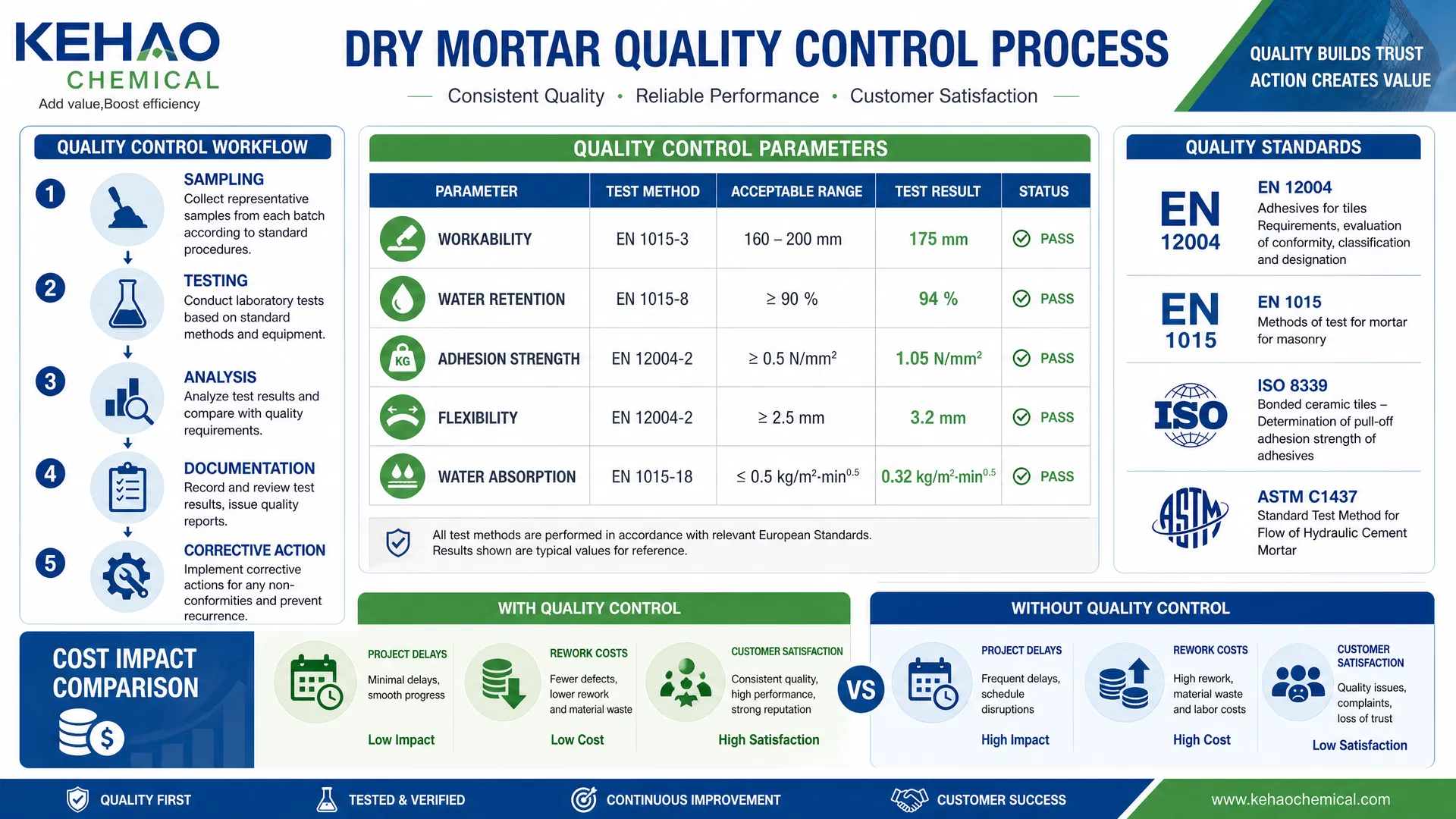
The quality control workflow ensures consistent product performance and early detection of issues.
Why Quality Control Matters for Your Bottom Line
Organizations with rigorous quality control programs report:
- 30-50% reduction in defect rates
- 20-40% improvement in customer satisfaction
- 15-25% decrease in warranty claims
- Stronger market position and competitive advantage
H2-2: Dry Mortar Testing Standards and Methods: EN, ISO, and ASTM Compliance
International Standards Overview
The construction industry relies on three major standards organizations:
European Standards (EN)
- EN 12004: Adhesives for tiles
- EN 1015 Series: Methods of test for mortar for masonry
- EN 1015-3: Determination of consistency (workability)
- EN 1015-9: Determination of water retention
- EN 1015-18: Determination of water absorption
International Standards (ISO)
- ISO 8339: Redispersible polymer powder specifications and test methods
- ISO 13007: Adhesives for tiles—terminology, requirements, conformity evaluation
American Standards (ASTM)
- ASTM C1437: Standard test method for flow of hydraulic cement mortar
- ASTM C1506: Standard test method for water retention of hydraulic cement mortar
Key Testing Methods Explained
1. Workability Testing (EN 1015-3)
- Purpose: Measure ease of application and spreadability
- Equipment: Flow table, cone, ruler
- Procedure: Fill cone with fresh mortar, lift cone, drop table 15 times, measure spread diameter
- Acceptance: 160-200 mm flow diameter (varies by product type)
- Importance: Ensures consistent application properties and worker productivity
2. Water Retention Testing (EN 1015-9)
- Purpose: Measure ability to retain water during application
- Equipment: Büchner funnel, filter paper, suction pump
- Procedure: Fill funnel with fresh mortar, apply suction for 10 minutes, measure retained water
- Acceptance: ≥ 90% water retention (for tile adhesives)
- Importance: Prevents premature drying and ensures proper curing
3. Adhesion Strength Testing (EN 12004-2)
- Purpose: Measure bond strength to substrates
- Equipment: Tensile testing machine, tile samples, substrate
- Procedure: Apply adhesive to substrate, cure, pull tiles with tension tester
- Acceptance: ≥ 0.5 N/mm² initial, ≥ 0.5 N/mm² after water immersion
- Importance: Ensures tiles remain bonded under stress and moisture
4. Water Absorption Testing (EN 1015-18)
- Purpose: Measure capillary water absorption
- Equipment: Capillary absorption apparatus, scale, timer
- Procedure: Expose mortar sample to water, measure mass gain at intervals
- Acceptance: ≤ 0.5 kg/m²·min⁰·⁵
- Importance: Indicates long-term moisture resistance and durability
5. Flexibility Testing (EN 12004-2)
- Purpose: Measure crack resistance and deformation tolerance
- Equipment: Bending test apparatus
- Procedure: Apply adhesive to substrate, bend substrate, measure crack formation
- Acceptance: ≥ 2.5 mm deformation without cracking
- Importance: Ensures mortar accommodates substrate movement
Testing Standards Comparison
[Figure 2: Dry Mortar Testing Standards Comparison]
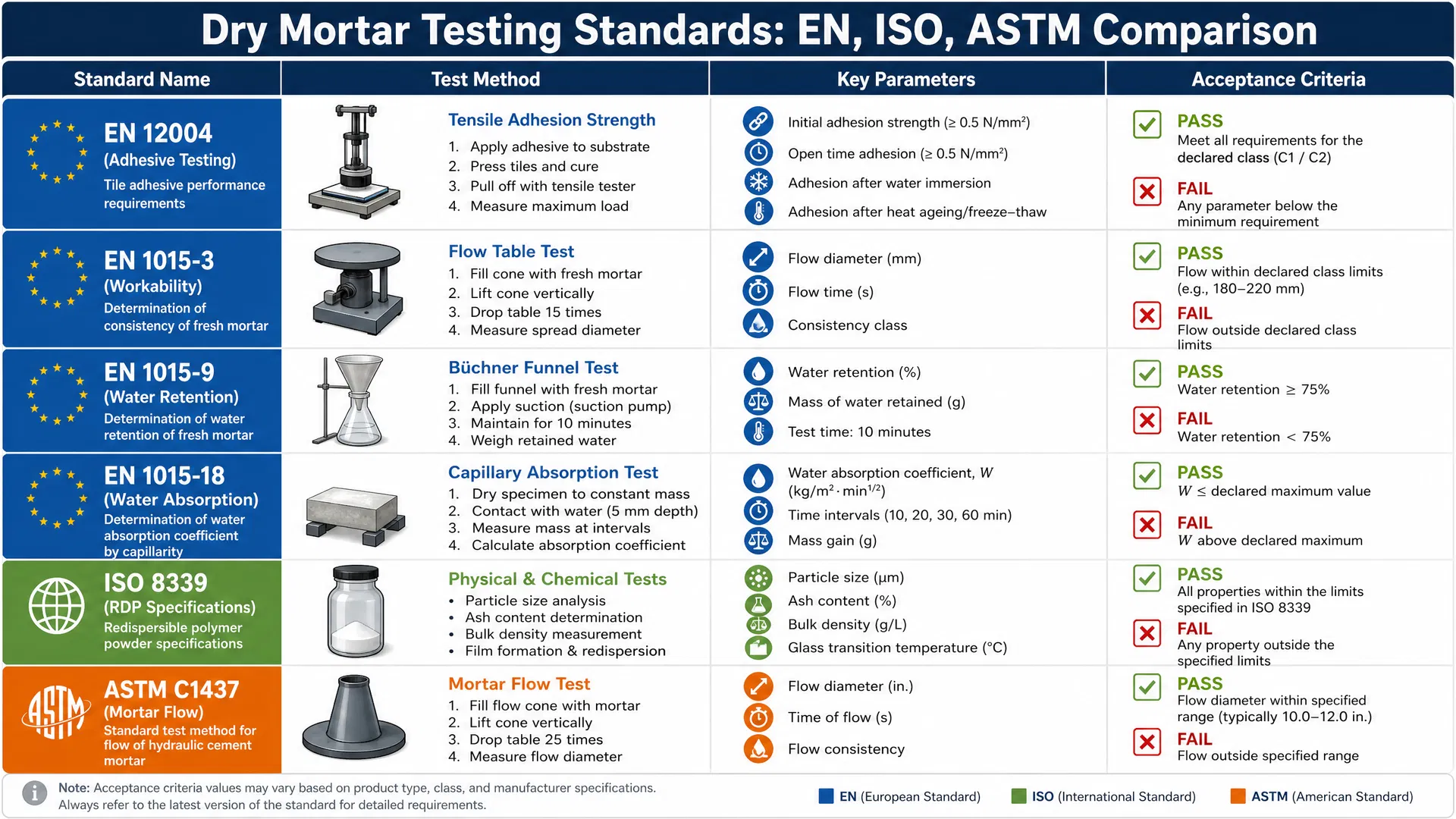
Comprehensive comparison of EN, ISO, and ASTM testing methods and acceptance criteria.
Quality Standards for Different Product Types
Different dry mortar products require different quality standards:
| Product Type | Key Standards | Critical Parameters | Typical Testing Frequency |
|---|---|---|---|
| Tile Adhesive | EN 12004, EN 1015-3 | Adhesion, water retention, workability | Every batch |
| Waterproofing Mortar | EN 12004, EN 1015-18 | Water absorption, adhesion, flexibility | Every batch |
| Self-Leveling | EN 1015-3, EN 12004 | Flow, workability, adhesion | Every batch |
| Repair Mortar | EN 1015 Series | Adhesion, flexibility, durability | Every batch |
| Grout | EN 12004, EN 1015-3 | Flow, strength, workability | Every batch |
Sampling and Testing Frequency
Proper sampling ensures representative results:
Sampling Plan:
- Batch Size: 1 sample per 5 tons of production
- Minimum: At least 1 sample per production day
- Frequency: Continuous monitoring during production
- Documentation: Record batch number, date, time, operator
Testing Frequency:
- Incoming Materials: Every delivery of key ingredients
- In-Process: Every 2-4 hours during production
- Finished Product: Every batch before shipment
- Shelf-Life: Periodic testing during storage
H2-3: Implementing a Dry Mortar Quality Control Program: Best Practices and Supplier Evaluation
Building Your Quality Control Program: 5-Step Implementation
Step 1: Define Quality Standards
- Establish clear specifications for each product
- Reference international standards (EN, ISO, ASTM)
- Document acceptance and rejection criteria
- Communicate standards to all stakeholders
Step 2: Establish Testing Procedures
- Select appropriate test methods for each product
- Document detailed testing procedures
- Train personnel on proper testing techniques
- Maintain and calibrate testing equipment
Step 3: Create Sampling Plans
- Define sampling frequency and locations
- Establish batch size and sample size
- Document chain of custody
- Implement statistical process control
Step 4: Document and Track Results
- Maintain detailed testing records
- Create trend analysis charts
- Implement corrective action procedures
- Conduct regular management reviews
Step 5: Continuous Improvement
- Analyze quality data trends
- Identify root causes of non-conformances
- Implement preventive actions
- Update procedures based on lessons learned
Supplier Evaluation Framework
Selecting the right supplier is critical for consistent quality. Use this evaluation matrix:
[Figure 3: Supplier Evaluation Matrix]
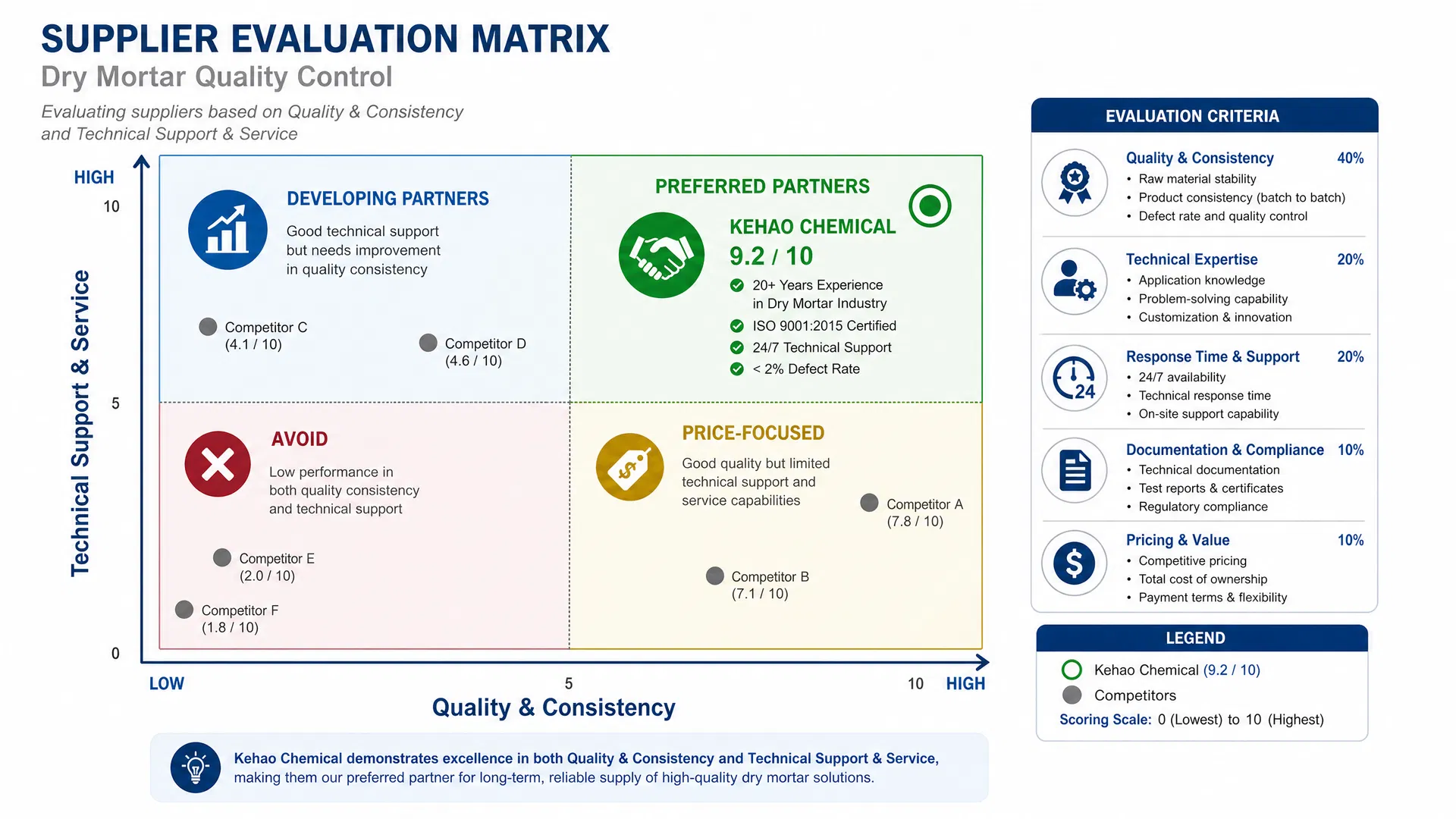
Evaluate suppliers based on quality consistency, technical support, and service capabilities.
Supplier Evaluation Criteria
| Criterion | Weight | Kehao Chemical | Industry Average |
|---|---|---|---|
| Quality & Consistency | 40% | 9.5/10 | 6.5/10 |
| Technical Support | 20% | 9.0/10 | 5.5/10 |
| Response Time | 20% | 9.2/10 | 6.0/10 |
| Documentation | 10% | 9.5/10 | 6.5/10 |
| Pricing | 10% | 8.5/10 | 7.5/10 |
| Overall Score | 100% | 9.2/10 | 6.4/10 |
Common Quality Control Issues and Solutions
| Issue | Root Cause | Solution |
|---|---|---|
| High water absorption | Excessive filler content | Adjust formulation, verify raw materials |
| Poor workability | Incorrect water retention | Optimize cellulose ether dosage |
| Low adhesion strength | Inadequate polymer content | Increase RDP or HPMC concentration |
| Batch inconsistency | Poor mixing or storage | Standardize mixing procedures, control storage |
| Premature drying | Low water retention | Increase water retention agent dosage |
Quality Control Checklist for Dry Mortar
Use this checklist for daily quality control:
- [ ] Verify raw material certificates and test reports
- [ ] Confirm storage conditions (temperature, humidity)
- [ ] Inspect mixing equipment for cleanliness
- [ ] Test workability of fresh mortar
- [ ] Measure water retention properties
- [ ] Check adhesion strength on standard substrates
- [ ] Verify water absorption rates
- [ ] Confirm packaging integrity
- [ ] Document all test results
- [ ] Implement corrective actions if needed
Best Practices for Quality Assurance
- Invest in Testing Equipment – Proper equipment ensures accurate, repeatable results
- Train Personnel – Well-trained staff are essential for consistent quality
- Maintain Records – Detailed documentation enables trend analysis and continuous improvement
- Regular Audits – Internal audits identify gaps and improvement opportunities
- Supplier Partnerships – Collaborate with suppliers to ensure consistent raw material quality
- Continuous Monitoring – Real-time monitoring catches issues before they affect customers
- Customer Feedback – Listen to field reports and incorporate feedback into improvements
Why Choose Kehao Chemical for Quality Assurance
Kehao Chemical demonstrates excellence in dry mortar quality control:
- 20+ Years Experience – Proven track record in the dry mortar industry
- ISO 9001:2015 Certified – Rigorous quality management system
- < 2% Defect Rate – Industry-leading quality consistency
- 24/7 Technical Support – Expert assistance whenever you need it
- Comprehensive Testing – All products tested to EN, ISO, and ASTM standards
- Detailed Documentation – Complete test reports and certificates provided
Related Articles
Expand your knowledge of dry mortar quality and performance:
- The Complete Guide to Cellulose Ether Manufacturers: Quality, Standards, and Selection Criteria – Understand how to evaluate cellulose ether suppliers
- How HPMC Improves Water Retention in Tile Adhesives – Learn about water retention testing and optimization
- RDP Waterproofing Mortar: Performance Standards & Applications – Explore waterproofing mortar quality requirements
- HPMC and RDP Compliance Guide: Meeting International Standards – Deep dive into compliance testing
Conclusion
Dry mortar quality control is not optional—it’s essential for project success, customer satisfaction, and long-term business growth. By implementing rigorous testing standards, establishing clear procedures, and partnering with reliable suppliers, you can ensure consistent, high-performance products that meet or exceed industry expectations.
The investment in quality control pays dividends:
- Reduced defects and rework costs
- Improved customer satisfaction and loyalty
- Stronger market position and competitive advantage
- Lower warranty claims and litigation risk
- Enhanced reputation and brand value
Ready to elevate your quality control program? Contact Kehao Chemical’s quality team to discuss how our proven quality assurance systems and expert support can help you achieve excellence in dry mortar production.
Download our Dry Mortar Quality Control Guide – Get detailed procedures, checklists, and best practices.
Request a Quality Consultation – Our experts will evaluate your current processes and recommend improvements.
External References
- EN 12004:2017 – Adhesives for tiles
- EN 1015-3:2004 – Determination of consistency of fresh mortar
- EN 1015-9:1999 – Determination of water retention
- EN 1015-18:2002 – Determination of water absorption
- ISO 8339:2005 – Redispersible polymer powder specifications
- ASTM C1437 – Standard test method for flow of hydraulic cement mortar
- ISO 9001:2015 – Quality management systems
- EN 1015 Series – Methods of test for mortar for masonry
- Kehao Chemical – Quality Assurance
- Construction Industry Quality Standards
- International Standards Organization
- European Committee for Standardization