When an exterior tile adhesive fails, the damage never stays hidden. Tiles hollow, crack, or detach after one hard winter, and the claims land back on your desk. I have watched that chain cost manufacturers real money. The good news: once you understand how HPMC and RDP work inside your formulation, you can start breaking it.
HPMC and RDP protect exterior tile adhesive in different but complementary ways. HPMC supports water retention, workable time, and early cement hydration. RDP improves adhesion and deformation tolerance. Neither additive makes an adhesive freeze-thaw-proof on its own.1 Real weather resistance comes from the complete formulation, correct installation, and system-level testing that matches the actual exposure on site.
So where exactly does each additive help — and where does its help stop? Below I walk through the failure chain, the separate jobs of HPMC and RDP, and the selection and validation steps I recommend before you commit to a formula.
Why Do Exterior Tile Installations Fail During Freeze-Thaw Cycles?
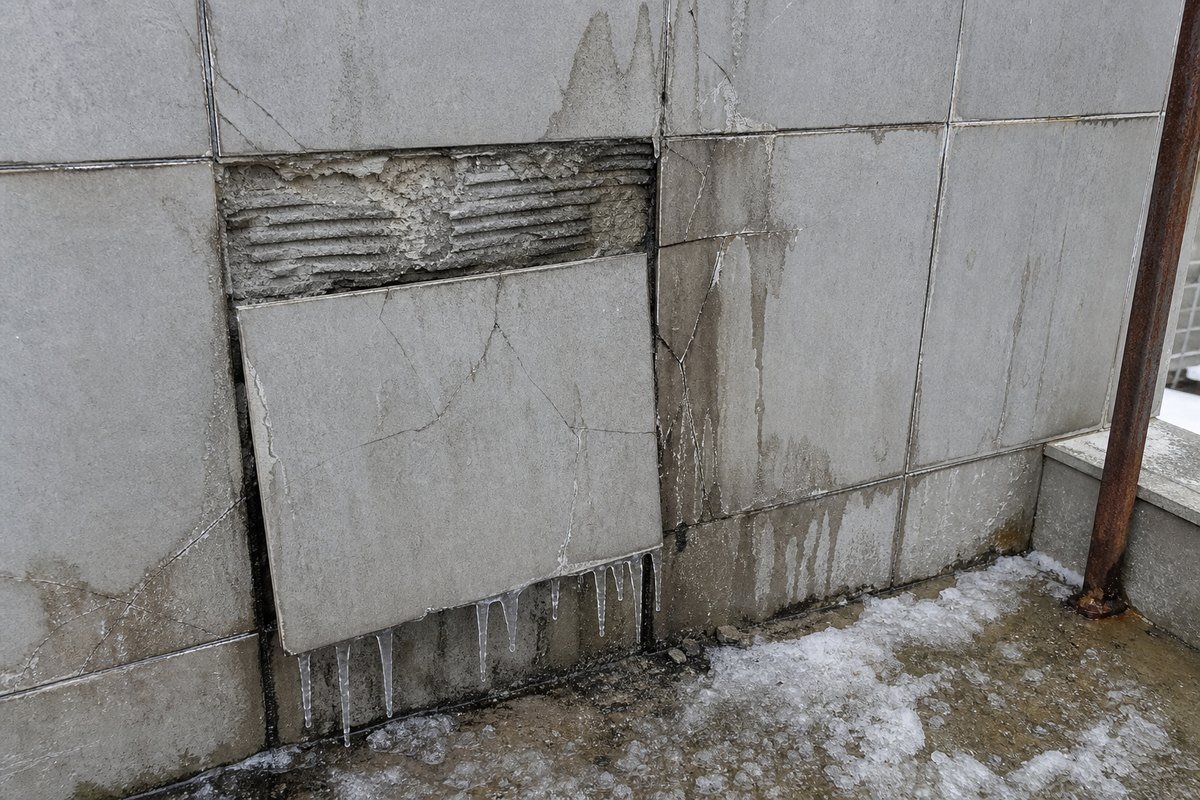
Most buyers I speak with have already lived through a winter failure. Water enters the adhesive bed or the tile interface. Temperatures drop. The trapped water turns to ice and expands2, and the bond line absorbs stress it was never designed to carry. Then spring arrives, and the pattern repeats.
The typical failure chain runs in a predictable order: moisture ingress, freezing expansion, repeated interface stress, and gradual loss of adhesion. Each freeze-thaw cycle widens microcracks and weakens the contact between tile, adhesive, and substrate. Given enough cycles, the result is hollowing, cracking, or full detachment.
Where the Water Comes From
Moisture has several entry paths into an exterior tile adhesive bed:
- Grout joints, which are rarely fully waterproof in practice
- Unsealed perimeters and penetrations around balconies and façades
- Capillary absorption from a damp substrate
- Wind-driven rain on exposed elevations
- Condensation behind tiles on cold walls
Here is the physics that matters: water expands by roughly 9 percent when it freezes3. That expansion generates pressure inside pores, capillaries, and at the tile-adhesive interface. A dense, well-cured adhesive bed with fewer connected pores holds less freezable water4, so it absorbs that pressure with less damage.
Why Repeated Cycles Matter More Than One Freeze
A single freeze rarely kills a tile installation. The real enemy is repetition. Continental climates can deliver dozens of freeze-thaw cycles in one season, and each cycle acts like a small lever prying at the interface. Stress concentrators make this worse:
- Large-format, low-absorption porcelain tiles with minimal forgiveness
- Rigid substrates that cannot move with thermal swings
- Poor drainage that keeps the adhesive wet going into winter
Where Additives Fit — and Where They Stop
Additives reduce particular vulnerabilities in this chain. Better water retention produces more complete cement hydration and a denser matrix.5 Better polymer flexibility absorbs part of the interface stress. But I want to be direct here:
Additives reduce specific vulnerabilities. They do not correct system-level defects like blocked drainage, missing movement joints, or spot-bonding with poor coverage.
What Role Does HPMC Play in Exterior Tile Adhesive Performance?
Formulators often ask me for "the strongest HPMC grade." I understand the instinct, but strength is not what this additive delivers. HPMC controls two variables — water and time. Those two variables decide whether the cement in your exterior tile adhesive ever reaches its designed performance.
HPMC, or hydroxypropyl methylcellulose, is a water-retention and rheology additive.6 In exterior tile adhesive, it holds mixing water inside the fresh mortar, extends open time, improves trowelability, and supports complete cement hydration during early curing. A denser, fully hydrated adhesive bed weathers better — that is HPMC's indirect contribution to durability.
Water Retention on Demanding Jobsites
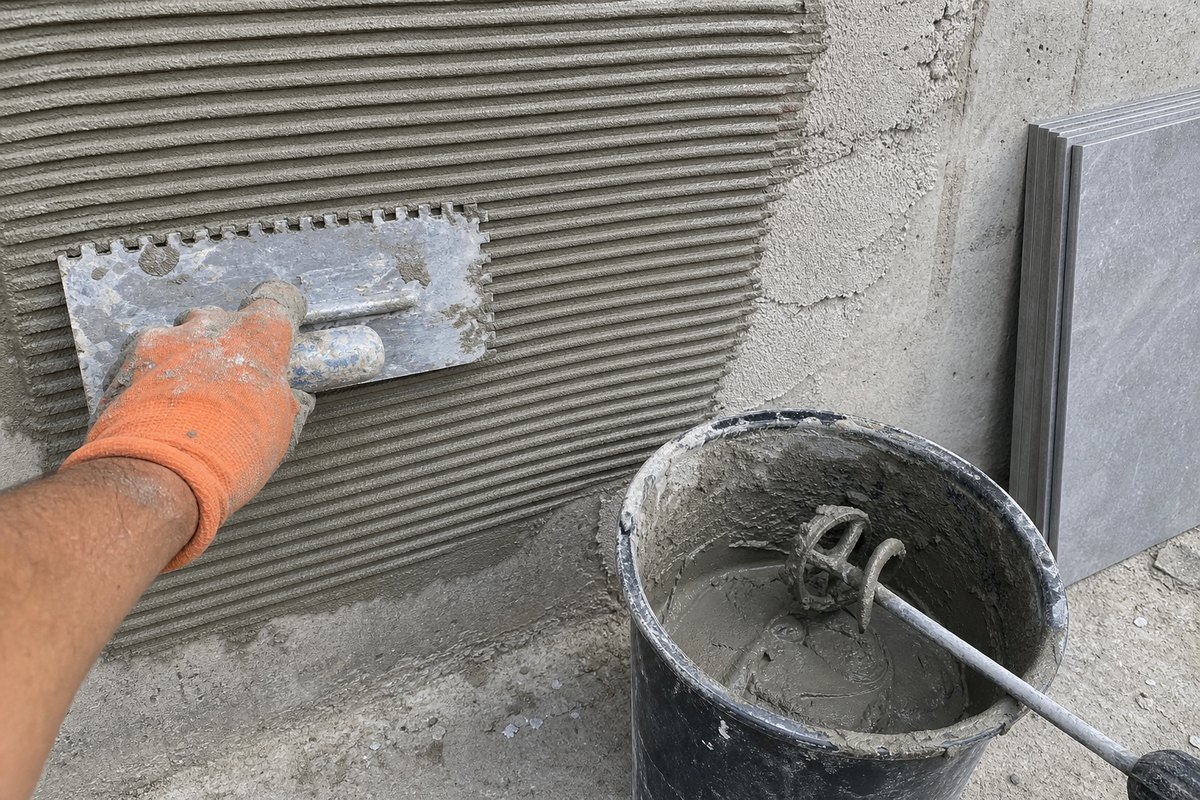
Exterior substrates are often thirsty, and wind and sun pull water out of fresh mortar fast. When the adhesive loses water too early, cement hydration stalls.7 The result is a weak, porous matrix that absorbs more moisture later — exactly what an outdoor tile adhesive cannot afford in a freezing climate. HPMC's water retention curve matters more here than its viscosity number alone.
Open Time and Workability in Real Weather
Open time shrinks on hot, windy sites. A grade that performs well in a climate-controlled lab may give your customer's crew ten uncomfortable minutes on a real façade. HPMC grade selection shifts these fresh-mortar properties, so I always ask about installation conditions before recommending anything.
A Practical Example from My Sample Work
A mortar producer in a hot, windy coastal market once asked us to compare two viscosity grades in their base formula. The higher-viscosity HPMC improved water retention and anti-slip behavior, but the crew found it heavy on the trowel. After field feedback, they settled on a mid-range grade that balanced retention with workability. That is supplier-side selection experience, not a universal rule — your formula and climate will write their own version of this story.
One more boundary, stated clearly: HPMC is not an antifreeze, not an air-entraining agent, and not a waterproofing agent. It sets up good curing conditions. It does not fight ice directly.
What Role Does RDP Play in Exterior Tile Adhesive Performance?
If HPMC manages water, then RDP manages the bond itself. Still, I meet buyers who treat redispersible polymer powder as a universal waterproofing switch. That misconception leads to over-dosing, inflated cost, and exterior tile adhesive formulas that still fail on site.
RDP, or redispersible polymer powder, is a polymer modifier for cement mortars. In exterior tile adhesive, it improves adhesion to difficult tiles and substrates, raises cohesion, and adds flexibility so the bond tolerates movement and temperature swings. RDP is the main formulation lever for deformation tolerance8 — but it is not a waterproofing or anti-freeze additive.
How the Polymer Works Inside the Mortar
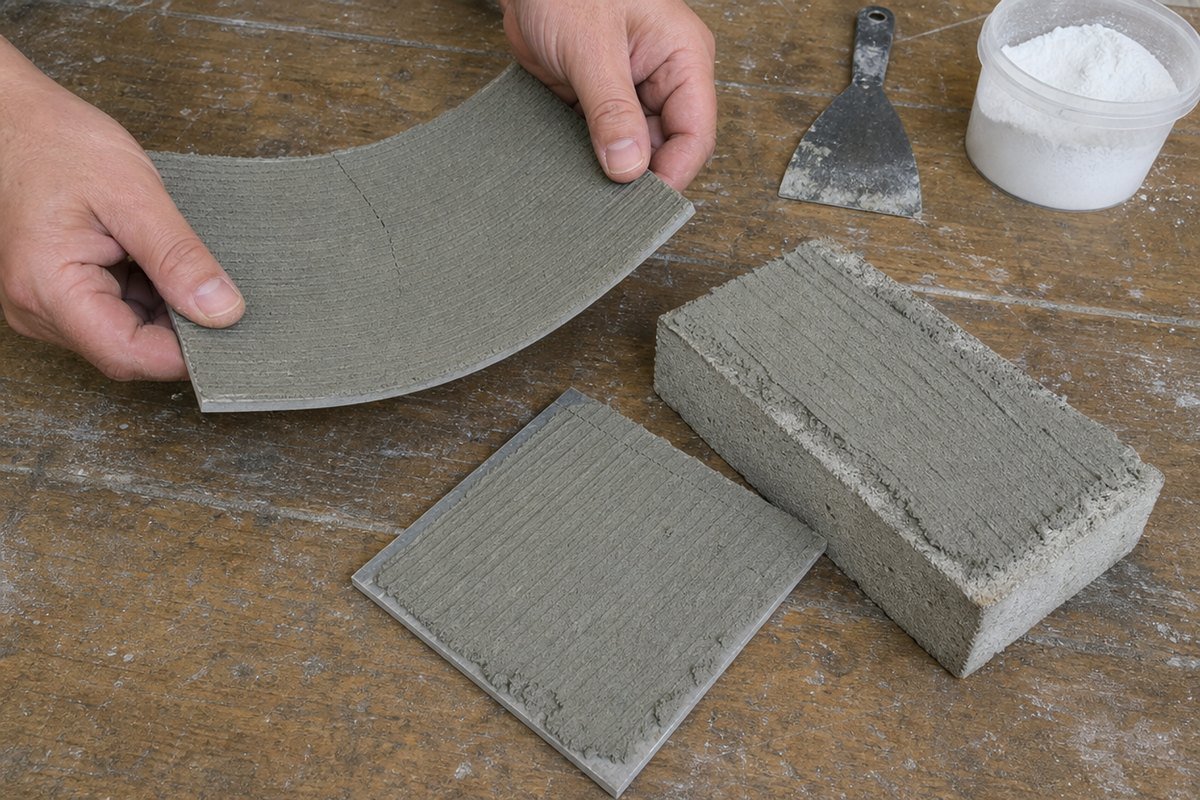
RDP particles redisperse when you add mixing water.9 As the mortar dries and cures, the polymer particles coalesce into films and bridges throughout the cement matrix10. This polymer network does two things buyers care about:
- Higher adhesion, especially on low-absorption porcelain tiles and dense substrates
- Better cohesion and deformability, so the adhesive bed bends slightly instead of cracking
Flexibility vs. Freeze-Thaw Stress
Ice expansion and thermal movement both load the tile-adhesive interface. A more deformable adhesive absorbs part of that stress instead of fracturing. Commonly referenced tile adhesive standards, such as EN 12004 and its international counterpart ISO 1300711, describe deformable adhesive classifications that some exterior applications target. I recommend confirming the current edition and its applicability with your testing laboratory before designing toward any classification.
Choosing Between RDP Grades
A distributor I work with once compared two of our RDP grades side by side. The more flexible grade suited their façade adhesive line; the stiffer grade suited an interior floor adhesive where cost efficiency mattered more. Both choices were correct — for different jobs. Grade-to-application fit is the goal, not the highest specification on the datasheet.
Also keep the economics in view. RDP is usually the most expensive component per kilogram in a polymer-modified tile adhesive. Dose toward the performance you have validated in testing, not toward a datasheet maximum.
HPMC vs. RDP in Exterior Tile Adhesive: How Do Their Roles Differ?
Because both additives appear on the same datasheet, buyers sometimes assume they overlap. They do not. Confusing the two is the fastest route to an exterior tile adhesive that looks fine in the lab and disappoints in January.
HPMC controls the fresh mortar: water retention, open time, workability, and curing conditions. RDP modifies the hardened mortar: adhesion, cohesion, and flexibility. The two are complementary, never interchangeable. Raising one cannot compensate for removing the other.
| Aspect | HPMC | RDP |
|---|---|---|
| Primary role | Water retention and rheology | Adhesion and flexibility |
| Main stage of influence | Fresh mortar and early curing | Hardened adhesive bed |
| Typical contribution | Open time, workability, hydration support | Bond strength, deformability, cohesion |
| What it does not do | No meaningful adhesion boost, no waterproofing | No meaningful water retention, no workability control |
| Selection focus | Viscosity, substitution type, retention behavior | Polymer type, flexibility, film-forming behavior |
I learned this lesson alongside a customer who tried to cut cost by removing HPMC and raising the RDP dosage. The logic seemed tidy on paper — fewer additives, simpler purchasing. In the mixer, the formula collapsed: the mortar dried out on the wall, open time vanished, and crews complained within days. They returned to a balanced formulation, and the complaint calls stopped.
The takeaway is simple. Each additive owns a job the other cannot do. When you evaluate an exterior tile adhesive formulation, evaluate the pair — and never treat a dosage increase in one as a substitute for the absence of the other.
How Should You Select HPMC and RDP Grades for Exterior Tile Adhesive?
Price sheets push buyers toward the wrong first question: "What does it cost per kilogram?" I prefer a different first question: "What will this adhesive face in service?" Grade selection for exterior tile adhesive starts with exposure, not with viscosity numbers or unit price.
Start with the application conditions: **climate and freeze-thaw exposure, installation season, tile size and absorption, substrate condition, cement and filler system,
<h3>Related technical guides</h3> <ul> <li><a href="https://khcel.com/rdp-vae/">RDP/VAE</a></li> <li><a href="https://khcel.com/what-are-the-key-compositional-differences-among-rdp-varieties/">What Are the Key Compositional Differences Among RDP Varieties?</a></li> <li><a href="https://khcel.com/which-types-of-rdp-should-you-choose-for-tile-adhesives-vs-eifs/">Which Types of RDP Should You Choose for Tile Adhesives vs EIFS?</a></li> </ul>
"Redispersible polymer powder modified cementitious tile ...", https://pmc.ncbi.nlm.nih.gov/articles/PMC8606344/. Research on cement-based mortars indicates that freeze-thaw resistance is governed by the combined effects of pore structure, moisture condition, binder formulation, curing, and exposure, rather than by any single polymeric or cellulosic additive. Evidence role: general_support; source type: research. Supports: Freeze-thaw durability of cementitious adhesive systems depends on mixture design, pore structure, water exposure, curing, and installation conditions rather than on a single additive.. Scope note: The source should support the general mechanism; it may not directly test every HPMC and RDP grade used in tile adhesives. ↩
"Water Density | U.S. Geological Survey", https://www.usgs.gov/water-science-school/science/water-density. Water expands on freezing, and freeze-thaw research on porous cementitious materials identifies ice formation and associated moisture-pressure processes as important causes of internal damage. Evidence role: mechanism; source type: government. Supports: Water undergoes volumetric expansion on freezing, and ice formation in saturated or partially saturated porous cementitious materials can contribute to freeze-thaw damage.. Scope note: Actual stress development depends on pore geometry, saturation, cooling rate, and the material's ability to relieve pressure. ↩
"Water Density | U.S. Geological Survey", https://www.usgs.gov/water-science-school/science/water-density. The density difference between liquid water and ice corresponds to a volume increase of about 9% when water freezes. Evidence role: statistic; source type: government. Supports: The density change between liquid water near the freezing point and ice corresponds to an approximately 9% increase in volume upon freezing.. ↩
"Research on mechanical properties and pore structure ... - PMC", https://pmc.ncbi.nlm.nih.gov/articles/PMC11554666/. Studies of cementitious materials associate lower connected porosity and more complete curing with reduced water ingress and improved resistance to freeze-thaw deterioration. Evidence role: mechanism; source type: paper. Supports: Lower connected porosity and improved curing can reduce liquid-water transport and are associated with improved resistance to freeze-thaw deterioration in cementitious materials.. Scope note: Reduced porosity does not by itself establish freeze-thaw durability, because air-void structure, saturation level, and exposure conditions also affect performance. ↩
"4. Microstructure Development of Cement Paste Phases", https://www.nist.gov/el/4-microstructure-development-cement-paste-phases. Cement-hydration research shows that adequate moisture during early curing supports continued hydration and can reduce capillary porosity compared with premature drying. Evidence role: mechanism; source type: research. Supports: Adequate curing moisture enables continued cement hydration and can reduce capillary porosity relative to mortar that dries prematurely.. Scope note: The magnitude of the effect depends on cement composition, water-to-binder ratio, curing conditions, and the other constituents of the mortar. ↩
"Water Retention Mechanism of HPMC in Cement Mortar - PMC - NIH", https://pmc.ncbi.nlm.nih.gov/articles/PMC7372461/. Studies of cellulose ethers in cement mortars identify hydroxypropyl methylcellulose as a rheology-modifying, water-retaining admixture that affects fresh-state workability and water transport. Evidence role: definition; source type: paper. Supports: Hydroxypropyl methylcellulose is used in cement-based mortars to modify rheology and reduce water loss from fresh mortar.. Scope note: Effects vary substantially with molecular characteristics, dosage, cement chemistry, and the complete dry-mix formulation. ↩
"Improving the Early Age Strength of Eco-Efficient Mortar with ...", https://pmc.ncbi.nlm.nih.gov/articles/PMC11432842/. Cement-curing literature explains that insufficient available water can limit continued hydration, with consequent effects on the hardened material's microstructure and strength. Evidence role: mechanism; source type: education. Supports: Loss of curing water from fresh cementitious material can reduce the extent of hydration and adversely affect strength and durability-related properties.. Scope note: Hydration may be reduced rather than completely stopped, and the result depends on the timing and severity of drying. ↩
"Redispersible polymer powder modified cementitious tile ...", https://pmc.ncbi.nlm.nih.gov/articles/PMC8606344/. Research on polymer-modified cementitious mortars generally finds that redispersible polymer additions can improve deformability and crack-tolerance-related properties relative to unmodified mortars. Evidence role: general_support; source type: research. Supports: Polymer modification, including redispersible polymer powder use, is associated with increased deformability and improved crack-tolerance behavior in cementitious tile adhesives.. Scope note: RDP is not the only determinant of deformability; aggregate grading, binder content, fillers, water demand, and curing conditions also influence test results. ↩
"Redispersible polymer powder modified cementitious tile adhesive ...", https://pmc.ncbi.nlm.nih.gov/articles/PMC8606344/. Research on polymer-modified mortars describes redispersible polymer powders as dried dispersions that redisperse in mixing water and subsequently contribute polymeric material to the hardening matrix. Evidence role: mechanism; source type: paper. Supports: Redispersible polymer powders are designed to form polymer dispersions again upon mixing with water before cementitious mortar hardens.. Scope note: Redispersion quality and particle behavior depend on polymer chemistry, protective colloid, storage condition, and mixing procedure. ↩
"Redispersible Acrylic Ester Polymers - PMC - NIH", https://pmc.ncbi.nlm.nih.gov/articles/PMC11595522/. Microscopic studies of polymer-modified cement mortars report the formation of polymer film phases within the cementitious matrix, which can alter cohesion, crack bridging, and interfacial behavior. Evidence role: mechanism; source type: paper. Supports: During drying and hardening of polymer-modified cement mortar, dispersed polymer particles can form film-like phases within the cementitious microstructure.. Scope note: Film continuity and its contribution to performance depend on polymer type, minimum film-forming temperature, curing history, and cement-polymer ratio. ↩
"EN 12004-1:2017 - Adhesives for Ceramic Tiles ...", https://standards.iteh.ai/catalog/standards/cen/48998e72-43b4-4ab9-9385-a9399c2c4689/en-12004-1-2017?srsltid. EN 12004 and the ISO 13007 series set out requirements and test methods for ceramic-tile adhesives; the applicable parts include classifications and testing relevant to deformation behavior. Evidence role: definition; source type: institution. Supports: EN 12004 and the ISO 13007 series specify terminology, requirements, and test methods for ceramic-tile adhesives, including classifications relevant to adhesive deformation behavior.. Scope note: The exact classification, test method, and edition applicable to a project must be verified against the current adopted national or regional standard. ↩