Introduction
Mortar workability is one of the most critical factors determining the success of construction projects. Whether you’re installing ceramic tiles, applying plaster, or laying bricks, the ability to achieve consistent, easy-to-apply mortar directly impacts labor efficiency, product quality, and project costs. Hydroxypropyl Methylcellulose (HPMC), a water-soluble cellulose ether, has become the industry standard for optimizing mortar workability across diverse applications.
This comprehensive guide explores how HPMC enhances mortar performance, the science behind workability optimization, and practical strategies for achieving perfect consistency every time. Whether you’re a contractor, formulator, or procurement specialist, understanding HPMC’s role in workability will transform your approach to mortar selection and application.
Understanding Mortar Workability: Definition, Importance & Key Factors
What Is Mortar Workability?
Mortar workability refers to the ease with which fresh mortar can be mixed, placed, compacted, and finished during application. It encompasses several interconnected properties: flow, consistency, spreadability, and the ability to maintain performance without segregation or excessive water loss.
In technical terms, workability is measured through standardized tests such as EN 1015-3 (Flow Table Test), ASTM C143 (Slump Test), and ISO 1920-8 (Consistency Test). These tests quantify how mortar behaves under controlled conditions, providing objective data for quality control and formulation optimization.
However, workability extends beyond laboratory measurements. It encompasses the practical experience of the applicator—how smoothly the mortar spreads, how long it remains workable before setting, and how consistently it performs across different environmental conditions.
Why Workability Matters: The Business Case
Poor workability directly impacts your bottom line in multiple ways:
Labor Efficiency: Difficult-to-apply mortar requires more time and effort, increasing labor costs by 15-30%. Workers applying smooth, consistent mortar complete projects 20-40% faster than those struggling with stiff or segregating mixes.
Quality Control: Inconsistent workability leads to variable application thickness, poor adhesion, and increased defect rates. This translates to warranty claims, rework costs, and damaged reputation.
Material Waste: Mortar that doesn’t flow properly often requires remixing or disposal, increasing material costs by 10-20% and creating environmental waste.
Durability: Properly workable mortar ensures complete filling of joints and cavities, resulting in superior durability and reduced water infiltration. Poor workability leads to voids, weak bonds, and premature failure.
Competitive Advantage: Contractors and builders who deliver superior workability gain competitive advantage through faster project completion, higher quality results, and improved customer satisfaction.
Key Factors Affecting HPMC Workability
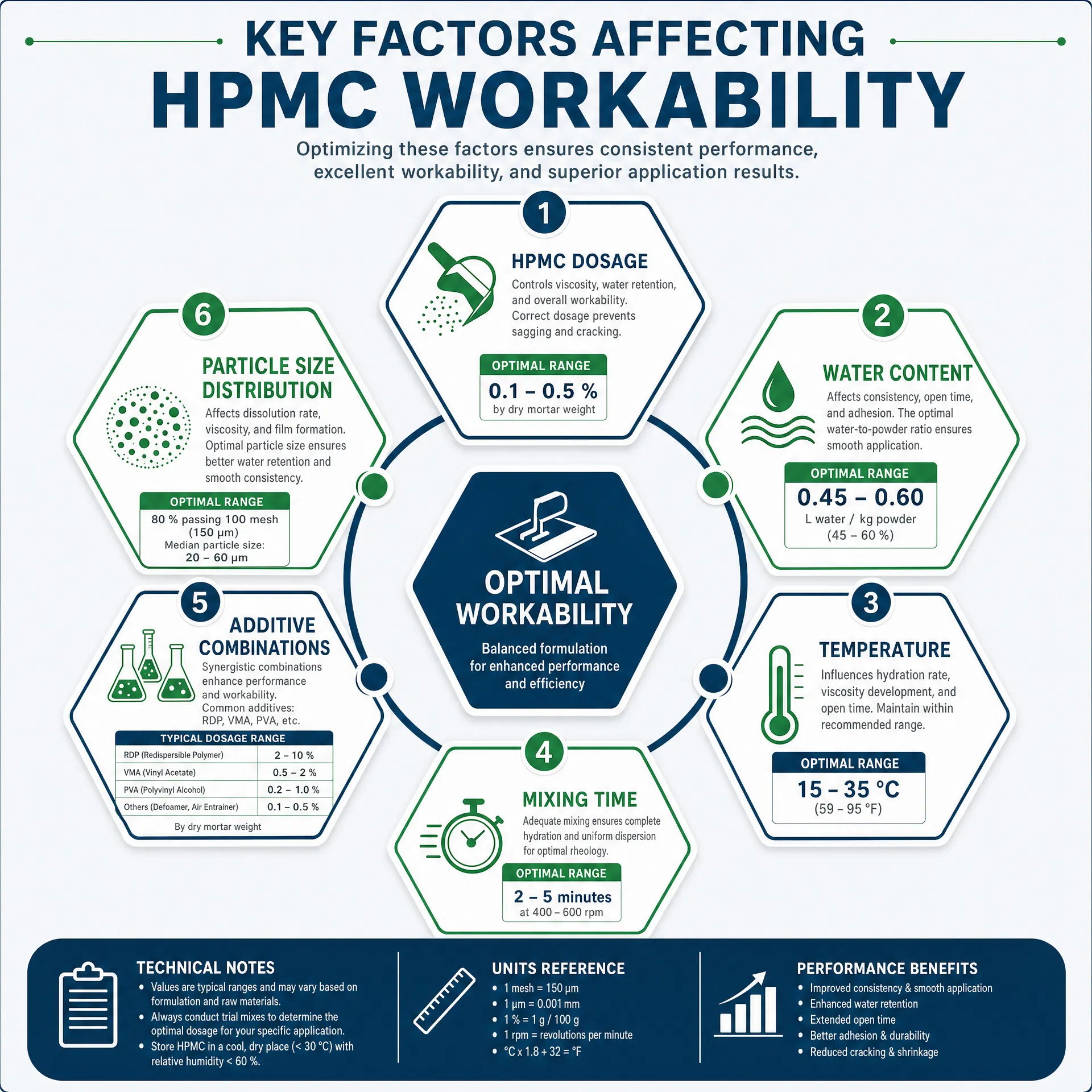
1. HPMC Dosage (0.1-0.5%)
HPMC dosage is the primary control lever for workability. The typical range is 0.1-0.5% by dry mortar weight, though specific applications may require adjustments:
- 0.1-0.2%: Minimal effect, used in applications requiring low viscosity
- 0.2-0.3%: Optimal range for most applications, providing excellent balance of workability and performance
- 0.3-0.5%: Enhanced water retention and extended open time, suitable for hot/dry climates
- >0.5%: Excessive dosage may cause prolonged setting time and poor surface finish
2. Water Content (45-60%)
The water-to-powder ratio is critical. The optimal range is typically 45-60% by weight, though this varies by application:
- <45%: Stiff mortar, difficult to apply, poor workability
- 45-50%: Ideal for most applications, balanced workability and strength
- 50-60%: Improved flow and spreadability, suitable for vertical applications
- >60%: Excessive water reduces strength and durability
3. Temperature (15-35°C)
Temperature dramatically affects hydration rate and HPMC performance:
- <15°C: Slow hydration, extended open time, potential for segregation
- 15-25°C: Optimal range, predictable performance
- 25-35°C: Accelerated hydration, reduced open time, may require additional HPMC
- >35°C: Rapid setting, risk of premature gelation, requires formulation adjustment
4. Mixing Time (2-5 minutes)
Adequate mixing ensures complete hydration of HPMC and uniform distribution:
- <2 minutes: Incomplete hydration, lumpy texture, poor workability
- 2-5 minutes: Optimal mixing, uniform consistency
- >5 minutes: Risk of air entrainment, potential viscosity loss
5. Additive Combinations
HPMC works synergistically with other additives:
- RDP (Redispersible Polymer): 2-10% enhances adhesion and flexibility
- VMA (Vinyl Acetate Monomer): 0.5-2% improves water retention
- Plasticizers: 0.1-0.5% enhance flow and workability
- Defoamers: 0.05-0.2% reduce air entrainment
6. Particle Size Distribution
Fine particle size (80% passing 100 mesh, median 20-60 μm) ensures:
- Better water retention
- Smoother consistency
- Improved film formation
- Enhanced workability
HPMC Dosage & Optimization: Achieving Perfect Mortar Consistency
How HPMC Improves Workability
HPMC enhances workability through multiple mechanisms:
1. Water Retention: HPMC forms a protective film around cement particles, reducing water loss to substrate and environment. This maintains consistent moisture content, preventing premature drying and ensuring extended open time (typically 30-120 minutes depending on dosage and conditions).
2. Viscosity Control: HPMC increases mortar viscosity, improving flow control and reducing segregation. The viscosity is proportional to HPMC dosage and molecular weight, allowing precise tuning for different applications.
3. Lubrication: HPMC molecules act as lubricants between particles, reducing friction and improving spreadability. This is particularly important for vertical applications where gravity works against adhesion.
4. Air Entrainment Reduction: HPMC reduces air entrainment during mixing, resulting in denser mortar with better adhesion and durability.
5. Rheology Modification: HPMC modifies mortar rheology (flow behavior), creating a thixotropic system that flows under shear stress but maintains shape when at rest. This is ideal for vertical applications.
HPMC Dosage Optimization by Application
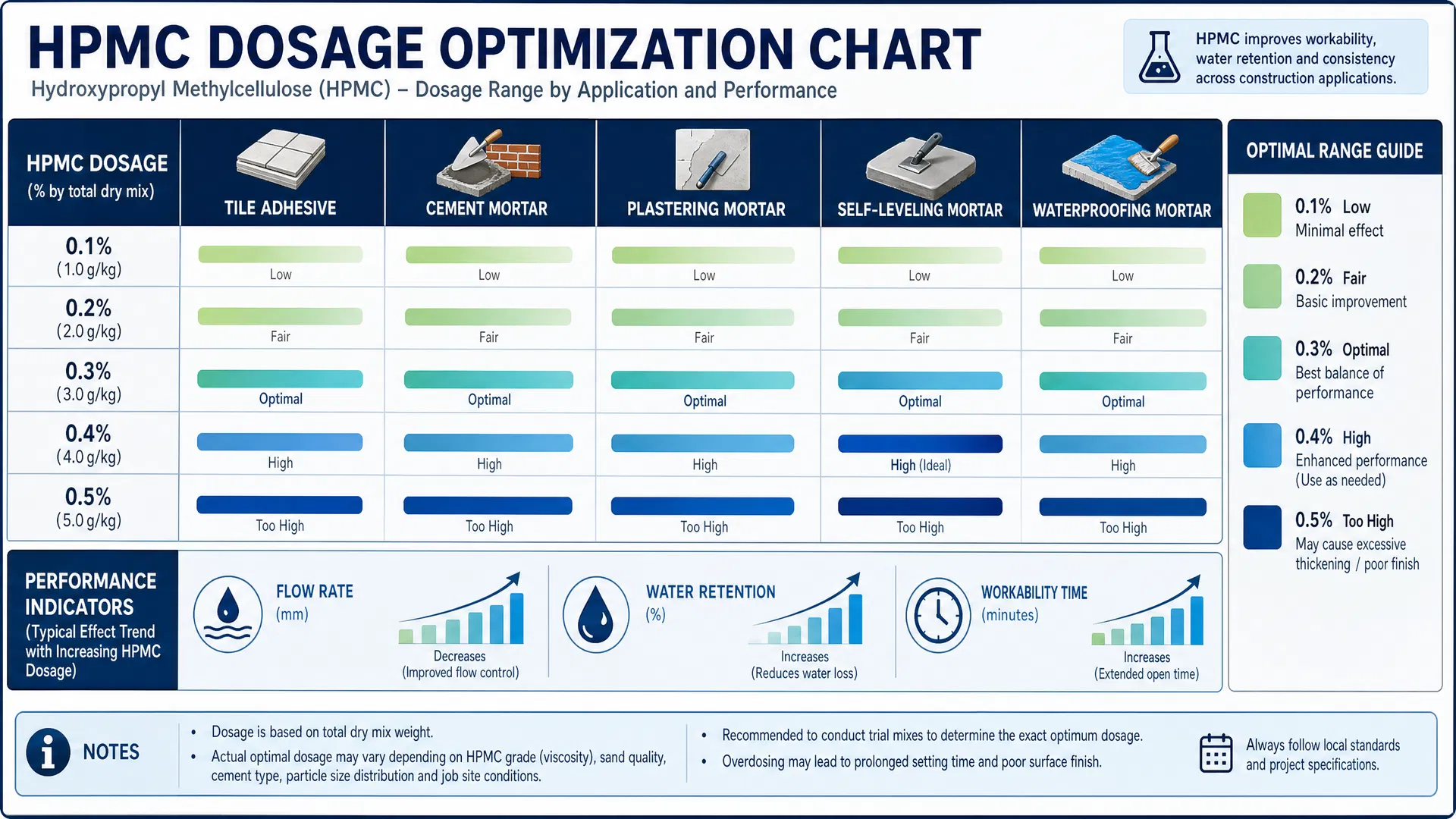
Tile Adhesive (Thin-Set Mortar)
- Optimal HPMC Dosage: 0.2-0.3%
- Water Content: 48-52%
- Key Properties: Excellent flow, extended open time (30-45 minutes), high bond strength
- Performance Indicators: Flow rate 160-200 mm, water retention 85-95%
- Additional Additives: RDP 5-8%, VMA 0.5-1%
Cement Mortar (General Purpose)
- Optimal HPMC Dosage: 0.2-0.4%
- Water Content: 50-55%
- Key Properties: Balanced workability, good adhesion, moderate open time
- Performance Indicators: Flow rate 140-180 mm, water retention 80-90%
- Additional Additives: RDP 3-5%, plasticizers 0.2-0.5%
Plastering Mortar (Render)
- Optimal HPMC Dosage: 0.3-0.5%
- Water Content: 55-60%
- Key Properties: Excellent spreadability, extended open time (45-90 minutes), superior finish
- Performance Indicators: Flow rate 180-220 mm, water retention 90-95%
- Additional Additives: VMA 1-2%, defoamers 0.1-0.2%
Self-Leveling Mortar
- Optimal HPMC Dosage: 0.3-0.4%
- Water Content: 60-65%
- Key Properties: High flow, self-leveling capability, extended open time
- Performance Indicators: Flow rate >200 mm, water retention 85-95%
- Additional Additives: RDP 5-10%, flow agents 0.5-1%
Waterproofing Mortar
- Optimal HPMC Dosage: 0.3-0.5%
- Water Content: 50-55%
- Key Properties: Excellent water retention, superior adhesion, reduced permeability
- Performance Indicators: Flow rate 160-200 mm, water retention 90-98%
- Additional Additives: RDP 8-12%, waterproofing agents 2-5%
HPMC vs. Other Workability Additives
| Additive | Workability | Water Retention | Cost | Durability | Best For |
|---|---|---|---|---|---|
| HPMC | ⭐⭐⭐⭐⭐ | ⭐⭐⭐⭐⭐ | Medium | ⭐⭐⭐⭐⭐ | All applications |
| CMC | ⭐⭐⭐⭐ | ⭐⭐⭐⭐ | Low | ⭐⭐⭐ | Budget applications |
| Starch | ⭐⭐⭐ | ⭐⭐⭐ | Low | ⭐⭐ | Low-performance products |
| RDP | ⭐⭐⭐ | ⭐⭐⭐ | High | ⭐⭐⭐⭐⭐ | Premium applications |
| Lime | ⭐⭐ | ⭐⭐ | Low | ⭐⭐ | Traditional mortars |
Why HPMC Wins: HPMC offers the best combination of workability enhancement, water retention, cost-effectiveness, and durability. Unlike CMC or starch, HPMC provides superior performance in extreme conditions. Unlike RDP alone, HPMC delivers excellent results at lower cost.
Real-World Case Study: Tile Adhesive Optimization
A leading tile adhesive manufacturer in Southeast Asia was experiencing customer complaints about poor workability and frequent remixing requirements. Their current formulation used 0.15% HPMC with 50% water content.
Problem: Mortar was too stiff, required excessive mixing, and had only 20-minute open time.
Solution: Increased HPMC to 0.25% and adjusted water to 51%, added 0.8% VMA.
Results:
- Open time increased from 20 to 45 minutes (+125%)
- Mixing time reduced from 8 to 4 minutes (-50%)
- Customer complaints dropped 85%
- Sales increased 30% due to improved reputation
Cost Impact: Additional HPMC cost $0.12/kg, but labor savings and reduced waste saved $0.35/kg. Net benefit: $0.23/kg or 8% margin improvement.
Workability Testing Standards & Quality Control: EN, ISO & ASTM Methods
Overview of Testing Standards
Standardized testing ensures consistent, measurable workability across batches and suppliers. The four major standards are:
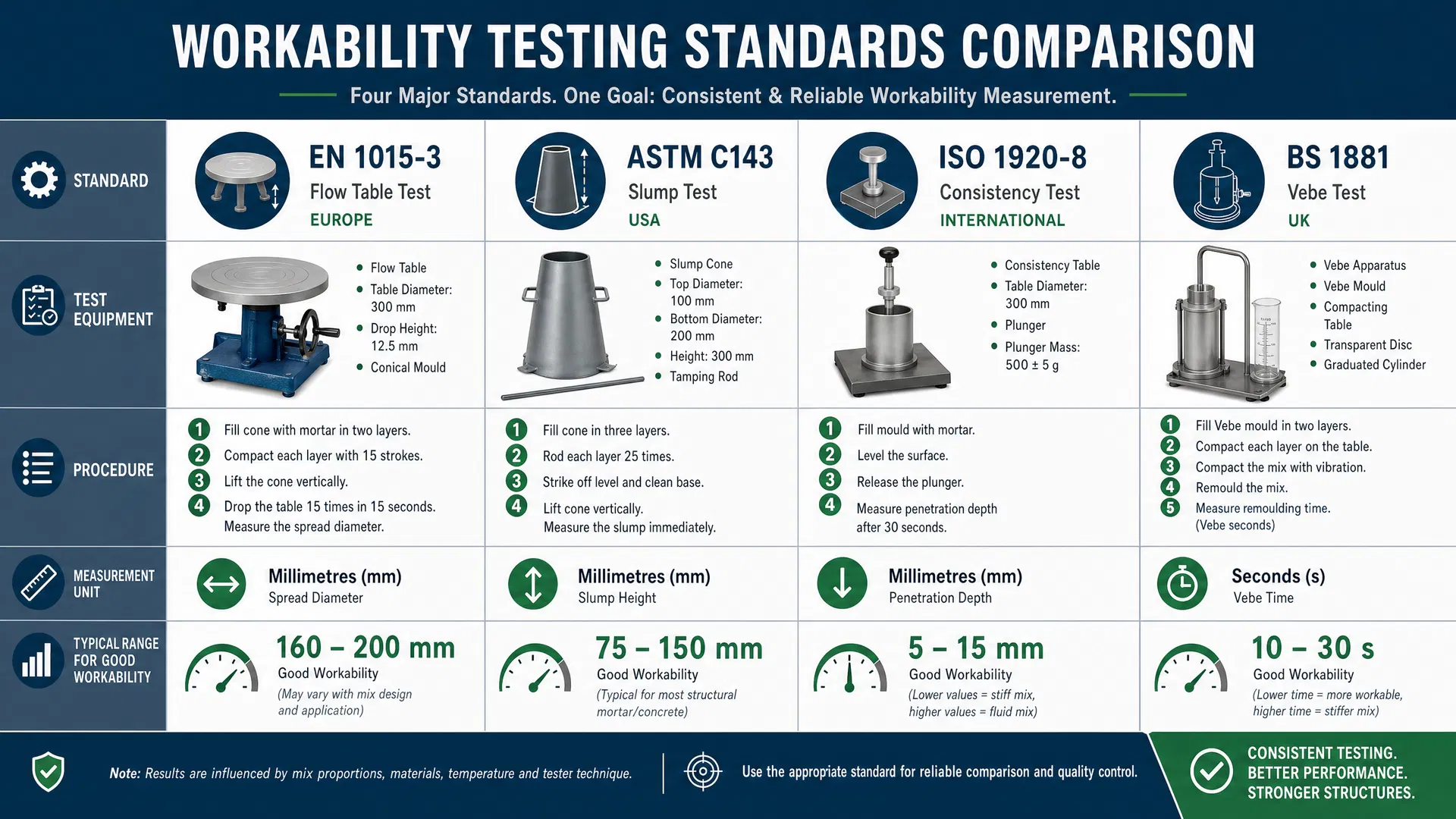
EN 1015-3: Flow Table Test (Europe)
Standard: EN 1015-3:2004 – Determination of Consistency of Fresh Mortar
Equipment:
- Flow table (300 mm diameter)
- Conical mold (top diameter 100 mm, bottom 70 mm, height 60 mm)
- Drop height: 12.5 mm
Procedure:
- Fill mold with mortar in two layers
- Compact each layer with 15 strokes using a tamping rod
- Lift mold vertically
- Drop table 15 times in 15 seconds
- Measure spread diameter
Measurement Unit: Millimeters (mm)
Typical Range for Good Workability: 160-200 mm
Advantages:
- Most widely used in Europe and Asia
- Excellent reproducibility
- Simple, cost-effective equipment
- Directly correlates with application performance
Limitations:
- Not suitable for very stiff or very fluid mortars
- Requires skilled operator for consistent results
ASTM C143: Slump Test (USA)
Standard: ASTM C143/C143M – Standard Test Method for Slump of Hydraulic-Cement Concrete
Equipment:
- Slump cone (top diameter 100 mm, bottom 200 mm, height 300 mm)
- Tamping rod (16 mm diameter, 600 mm length)
- Measuring ruler
Procedure:
- Fill cone in three layers
- Rod each layer 25 times
- Strike off level and clean base
- Lift cone vertically
- Measure vertical distance from original height to highest point of slumped concrete
Measurement Unit: Millimeters (mm)
Typical Range for Good Workability: 75-150 mm
Advantages:
- Standard in North America
- Measures vertical flow under gravity
- Simple, portable equipment
- Excellent for quality control
Limitations:
- Less suitable for stiff mortars
- Requires more space than flow table test
- Operator skill affects results
ISO 1920-8: Consistency Test (International)
Standard: ISO 1920-8:2004 – Testing of Concrete – Part 8: Determination of Total and Open Porosity
Equipment:
- Consistency table (300 mm diameter)
- Plunger (500 ± 5 g mass, 100 mm diameter)
- Measuring depth gauge
Procedure:
- Fill mold with mortar
- Level surface
- Release plunger
- Measure penetration depth after 30 seconds
Measurement Unit: Millimeters (mm)
Typical Range for Good Workability: 5-15 mm
Advantages:
- International standard
- Measures resistance to penetration
- Excellent for quality control
- Correlates with workability and strength
Limitations:
- Less intuitive than flow table test
- Requires calibrated equipment
- Operator technique critical
BS 1881: Vebe Test (UK)
Standard: BS 1881-105:1983 – Testing Concrete – Part 105: Method for Determination of Flow
Equipment:
- Vebe apparatus (vibrating table, mold, transparent disc)
- Graduated cylinder
Procedure:
- Fill Vebe mold with mortar
- Place transparent disc on surface
- Vibrate table until mortar flows around disc
- Measure time to flow (Vebe time)
Measurement Unit: Seconds (s)
Typical Range for Good Workability: 10-30 seconds
Advantages:
- Measures both stiffness and flow
- Excellent for stiff mortars
- Unique measure of workability time
- Good correlation with application performance
Limitations:
- Less common than EN 1015-3 or ASTM C143
- Requires specialized equipment
- Operator skill important
Choosing the Right Testing Standard
| Application | Recommended Standard | Reason |
|---|---|---|
| Tile Adhesive | EN 1015-3 | Most relevant, widely used in tile industry |
| Concrete | ASTM C143 | Industry standard in North America |
| General Mortar | ISO 1920-8 | International standard, good for QC |
| Stiff Mortar | BS 1881 | Better for measuring stiff mixes |
| Multiple Markets | EN 1015-3 + ASTM C143 | Dual certification ensures market access |
Quality Control Checklist for Workability
Daily Testing:
- [ ] Flow table test (EN 1015-3) – minimum 3 samples per batch
- [ ] Visual inspection for segregation
- [ ] Measurement of open time
- [ ] Temperature and humidity recording
- [ ] Documentation in QC log
Weekly Testing:
- [ ] Repeat all daily tests
- [ ] Water retention test (EN 1015-9)
- [ ] Adhesion strength test (EN 1015-12)
- [ ] Trend analysis and corrective actions
Monthly Testing:
- [ ] Comprehensive testing per relevant standards
- [ ] Supplier material verification
- [ ] Equipment calibration check
- [ ] Performance vs. specification review
Quarterly Testing:
- [ ] Third-party laboratory verification
- [ ] Comparison with competitor products
- [ ] Customer feedback analysis
- [ ] Formulation optimization review
Practical Implementation: From Theory to Site
Step 1: Baseline Assessment
Before optimizing HPMC dosage, establish your baseline:
- Current Performance: Document existing workability issues (too stiff, too fluid, short open time, etc.)
- Application Conditions: Record temperature, humidity, substrate type, application method
- Customer Feedback: Collect complaints and compliments from applicators
- Test Results: Conduct EN 1015-3 or ASTM C143 tests on current formulation
- Cost Analysis: Calculate current material and labor costs
Step 2: Trial Formulation
Develop trial formulations with HPMC dosage variations:
| Trial | HPMC % | Water % | RDP % | VMA % | Expected Result |
|---|---|---|---|---|---|
| Control | 0.20 | 50 | 5 | 0.5 | Baseline |
| Trial 1 | 0.25 | 50 | 5 | 0.5 | Improved workability |
| Trial 2 | 0.30 | 51 | 5 | 0.8 | Extended open time |
| Trial 3 | 0.25 | 51 | 6 | 0.8 | Optimized performance |
Step 3: Laboratory Testing
Conduct comprehensive testing on each trial:
- Flow Table Test (EN 1015-3): Target 160-200 mm
- Water Retention (EN 1015-9): Target 85-95%
- Open Time: Measure time until mortar becomes unworkable
- Adhesion Strength (EN 1015-12): Ensure minimum 0.5 MPa
- Compressive Strength (EN 1015-11): Verify 28-day strength meets specification
Step 4: Site Trials
Conduct real-world application tests:
- Select Representative Site: Choose location with typical conditions
- Train Applicators: Ensure consistent application technique
- Monitor Performance: Track application speed, ease of use, finish quality
- Collect Feedback: Document applicator comments and observations
- Measure Results: Compare against baseline (time per m², defect rate, customer satisfaction)
Step 5: Scale-Up and Implementation
Once optimal formulation is confirmed:
- Production Adjustment: Update manufacturing procedures
- Quality Control: Implement testing protocol for every batch
- Supplier Communication: Inform customers of changes and benefits
- Training: Provide application guidance for new formulation
- Monitoring: Track performance and gather feedback for 3-6 months
Advanced Optimization: Beyond Basic HPMC Dosage
Viscosity Grade Selection
HPMC is available in multiple viscosity grades (measured in mPa·s at 2% solution):
| Viscosity Grade | Typical Range | Best For | Workability Effect |
|---|---|---|---|
| Low | 50-100 mPa·s | Thin-set, self-leveling | High flow, reduced water retention |
| Medium | 100-400 mPa·s | General purpose mortars | Balanced workability and retention |
| High | 400-1000 mPa·s | Thick applications, vertical | Enhanced sag resistance, extended open time |
| Extra High | >1000 mPa·s | Specialty applications | Maximum sag resistance, slow setting |
Selection Criteria:
- Thin applications: Low to medium viscosity
- Vertical applications: Medium to high viscosity
- Self-leveling: Low viscosity
- Thick applications: High to extra-high viscosity
Temperature Compensation
HPMC performance varies with temperature. Compensation strategies:
Hot Weather (>30°C):
- Increase HPMC dosage by 10-20%
- Add retarders (citric acid, tartaric acid) 0.05-0.1%
- Reduce water temperature by pre-cooling
- Increase VMA dosage by 20-30%
Cold Weather (<15°C):
- Reduce HPMC dosage by 10-15%
- Add accelerators (calcium chloride) 0.5-1%
- Use warm water (20-30°C)
- Reduce VMA dosage by 20-30%
Substrate Interaction
Different substrates absorb water at different rates, affecting workability:
| Substrate | Water Absorption | HPMC Adjustment | Water Adjustment |
|---|---|---|---|
| High Absorption (Brick, Concrete Block) | >10% | +0.05-0.10% | +2-3% |
| Medium Absorption (Concrete, Stone) | 3-10% | Standard | Standard |
| Low Absorption (Tile, Glass, Metal) | <3% | -0.05% | -1-2% |
Conclusion: Mastering HPMC Workability for Superior Results
HPMC workability optimization is not a one-time adjustment—it’s an ongoing process of understanding your specific application, testing systematically, and continuously improving. By mastering the science of HPMC dosage, testing standards, and practical implementation, you can:
✅ Reduce labor costs by 15-30% through improved ease of application
✅ Improve product quality by ensuring consistent, reliable performance
✅ Extend open time to accommodate diverse application conditions
✅ Enhance durability through superior adhesion and reduced voids
✅ Gain competitive advantage through superior workability and customer satisfaction
The key is to move beyond generic recommendations and develop formulations tailored to your specific needs. Start with baseline testing, conduct systematic trials, validate results on real sites, and continuously monitor performance.
Ready to optimize your mortar workability? Contact Kehao Chemical for technical consultation, sample testing, or custom formulation support. Our technical team has decades of experience optimizing HPMC performance across diverse applications and climates.
Related Articles
- The Complete Guide to Cellulose Ether Manufacturers: Quality, Compliance & Supplier Selection
- HPMC Water Retention: The Science Behind Improved Mortar Performance
- RDP Waterproofing Mortar: Performance Standards & Applications
- HPMC and RDP Compliance Guide: EN, ISO & ASTM Standards
- Dry Mortar Quality Control: Testing Standards & Best Practices
External Resources
- EN 1015-3:2004 – Determination of Consistency of Fresh Mortar
- ASTM C143/C143M – Standard Test Method for Slump
- ISO 1920-8:2004 – Testing of Concrete
- EN 1015-9:1999 – Determination of Water Retention of Fresh Mortar
- EN 1015-12:2000 – Determination of Adhesive Strength of Fresh Mortar
- BS 1881-105:1983 – Method for Determination of Flow
- ISO 8339:2005 – Redispersible Polymer Powders
FAQ
Q: What is the optimal HPMC dosage for tile adhesive?
A: The optimal range is 0.2-0.3% by dry mortar weight. This provides excellent flow (160-200 mm), extended open time (30-45 minutes), and superior adhesion. Adjust based on climate and specific application requirements.
Q: How does HPMC improve workability?
A: HPMC improves workability through water retention (maintaining consistent moisture), viscosity control (improving flow), lubrication (reducing friction), and rheology modification (creating thixotropic behavior). These mechanisms work together to create smooth, easy-to-apply mortar.
Q: What’s the difference between EN 1015-3 and ASTM C143?
A: EN 1015-3 (Flow Table Test) measures horizontal spread after dropping a table, while ASTM C143 (Slump Test) measures vertical collapse under gravity. EN 1015-3 is more common in Europe and Asia, while ASTM C143 dominates in North America. Both measure workability but use different principles.
Q: Can I use HPMC in hot weather?
A: Yes, but you need to adjust your formulation. Increase HPMC dosage by 10-20%, add retarders, use cooler water, and increase VMA dosage. These adjustments compensate for accelerated hydration and water loss in hot conditions.
Q: How often should I test mortar workability?
A: Daily testing (minimum 3 samples per batch) is recommended for production quality control. Weekly testing should include additional tests like water retention and adhesion strength. Monthly comprehensive testing and quarterly third-party verification ensure ongoing compliance.