
Cellulose ether in cement-based grout can influence water retention, consistency, workability, and usable application time.1 However, formulators often select it by viscosity or price alone. That shortcut can create handling problems without identifying the real cause. I prefer to match the grade and dosage to performance targets, then verify the complete formulation through comparative testing.
Cellulose ether helps cement-based grout retain water and maintain practical consistency during mixing and application. However, the highest-viscosity grade or highest dosage is not automatically the best choice. Manufacturers should compare cellulose ether samples in the intended grout formulation and evaluate water retention, workability, open time, strength, shrinkage, and application behavior together.
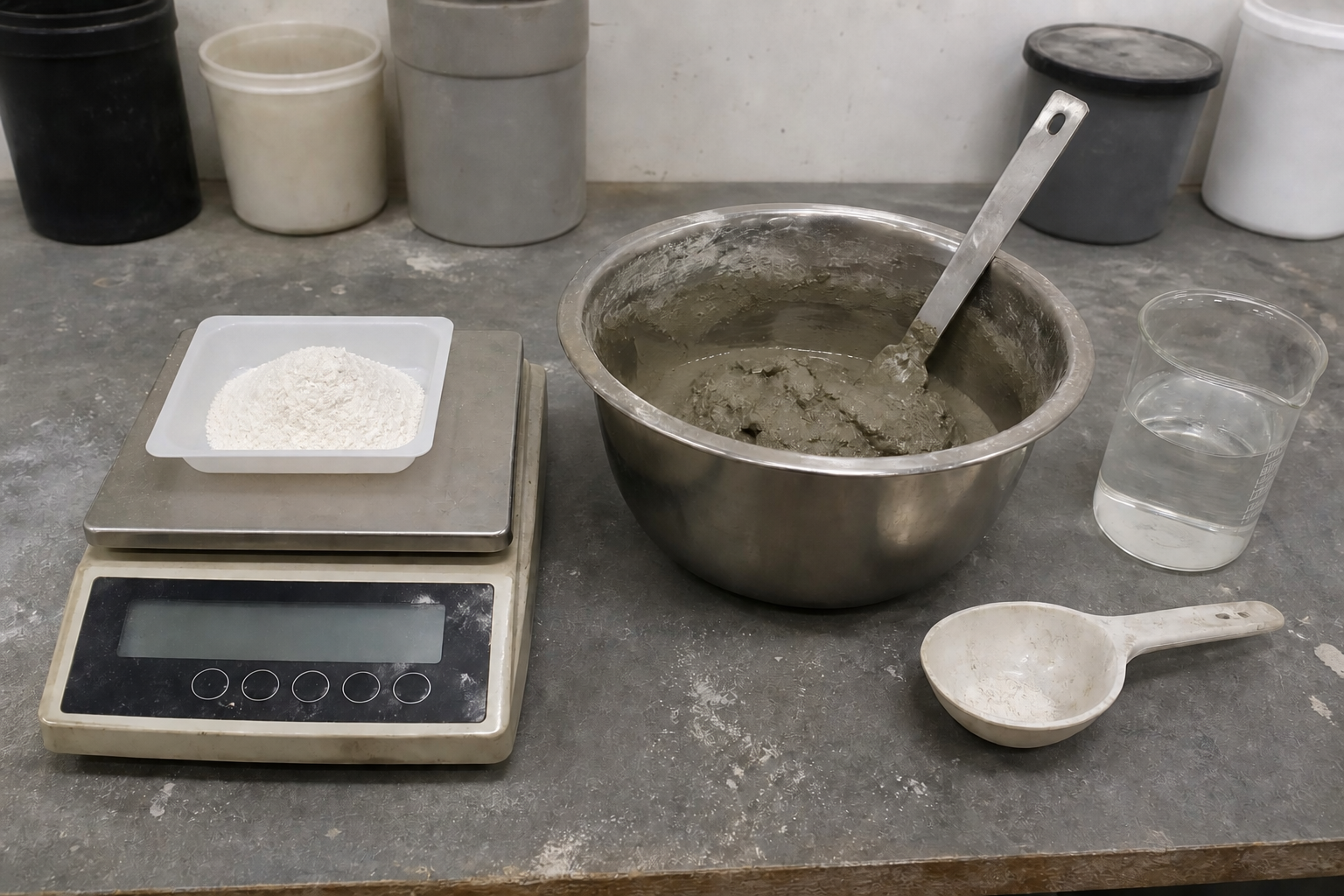
In my formulation work, I have learned that grout failures rarely point to one raw material alone. Cement properties, filler grading, water demand, additives, mixing, joint dimensions, and site conditions can all matter. A structured diagnosis helps us separate a cellulose ether mismatch from broader formulation or application problems.
How Does Cellulose Ether in Cement-Based Grout Affect Performance?
A grout can look acceptable in the mixer but become difficult to spread, clean, or finish during application. If we focus only on initial thickness, we may miss poor water management or rapid consistency loss. I therefore evaluate how cellulose ether supports the grout throughout its practical working period.
Cellulose ether in cement-based grout primarily supports water retention, consistency control, workability, and application time. Its actual effect depends on the polymer grade, dosage, cement chemistry, filler system, water level, other additives, and test conditions. I treat it as one part of the formulation rather than an independent guarantee of grout quality.
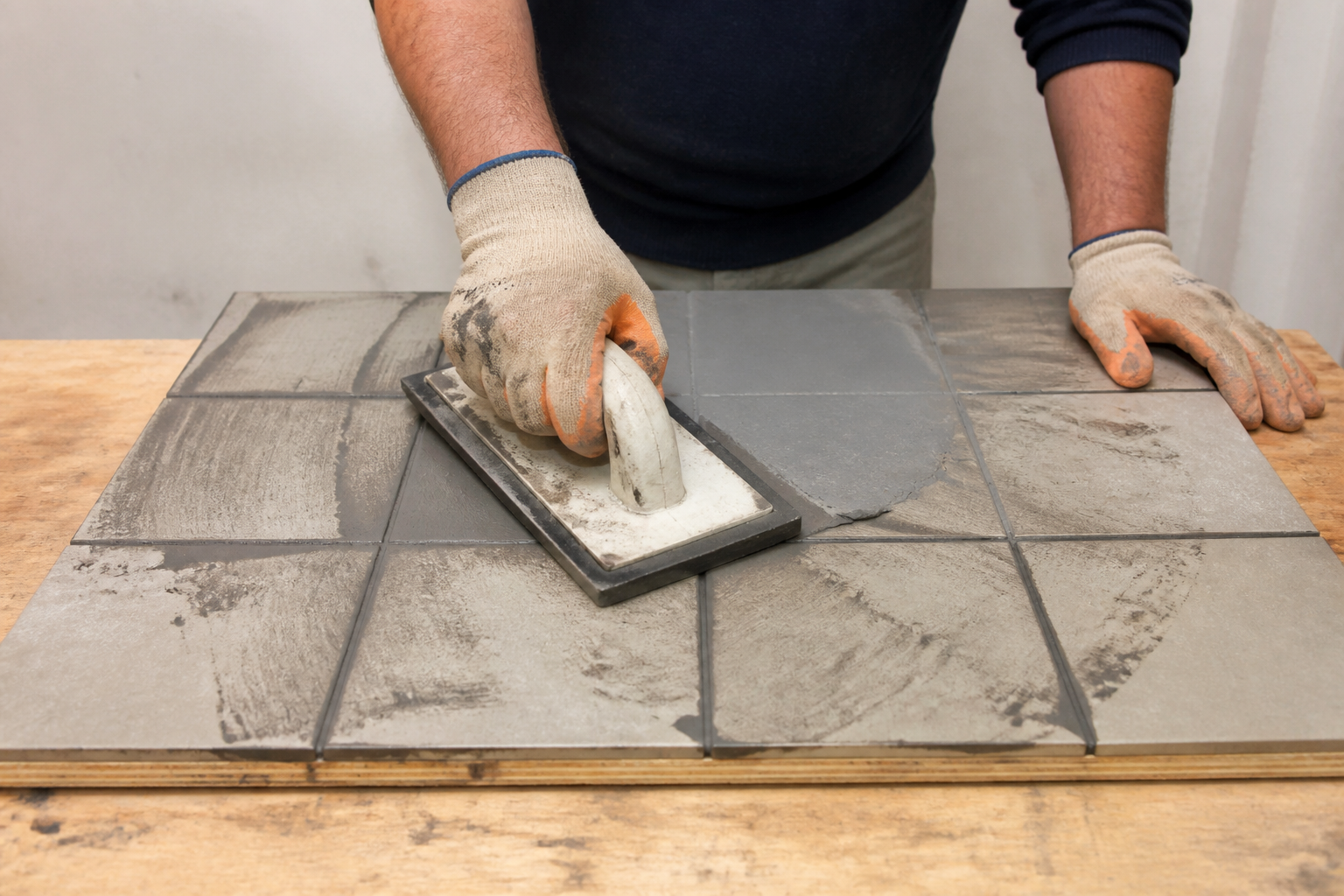
Water retention is important, but it is not the only target
A cement-based system needs enough available water to support hydration and practical application. Porous tile edges, absorbent substrates, heat, airflow, and low humidity can draw water from fresh grout.2 A suitable cellulose ether can help the wet mortar manage that water more effectively during placement.
However, I do not treat a general water-retention claim as proof that a grade will work in every grout. Suppliers may use different internal methods, substrates, mixing procedures, conditioning periods, and calculation methods. Procurement teams should therefore ask for the test method and test conditions, not only the reported percentage.
A comparison becomes more meaningful when we control:
- The cement type, source, and production lot
- The filler mineralogy and particle-size distribution
- The pigment type and dosage
- The powder-to-water ratio
- The mixing speed and mixing time
- The rest and remixing procedure
- The ambient temperature and relative humidity
- The substrate or suction medium
- The age of the dry-mix sample
Consistency should remain usable, not merely thick
A thick grout can still perform poorly. Excessive body may make joints harder to fill, increase application effort, or complicate surface cleaning. A thinner-looking mix can also fail if it loses water or consistency too quickly.
When I compare samples, I observe more than the initial visual appearance. I record how each mix changes after resting, remixing, spreading, joint filling, and cleaning. These observations are application-specific, but they often reveal differences that a viscosity certificate cannot predict.
| Evaluation point | What I observe | Why it matters |
|---|---|---|
| Initial mixing | Wetting, lump formation, and mixing resistance | It shows whether the powder disperses practically |
| Resting period | Thickening or consistency drift | It indicates how the grout may change before use |
| Remixing | Recovery without extra water | It helps reveal practical handling stability |
| Joint filling | Packing and edge contact | It affects installation efficiency |
| Cleaning | Residue and wiping effort | It influences finish quality and labor |
| Hardened testing | Strength, shrinkage, absorption, and appearance | It checks whether good handling also supports the final specification |
I never use improved application feel as proof of higher strength, lower shrinkage, or better long-term durability. I verify those properties separately under the relevant test program.
Why Is Viscosity Alone Insufficient for Choosing Cellulose Ether in Cement-Based Grout?
Purchasing teams often receive several cellulose ether samples with similar viscosity values. The products may appear interchangeable on their data sheets, yet the grout can respond differently during mixing and application. If we approve materials from viscosity alone, we risk buying a technically mismatched grade.
Viscosity is useful only when we know the test concentration, temperature, instrument, spindle, speed, solution preparation, moisture basis, and measurement method.3 Even when two products have comparable reported viscosity, they may produce different water retention, consistency development, application feel, and compatibility in the same cement-based grout formulation.4
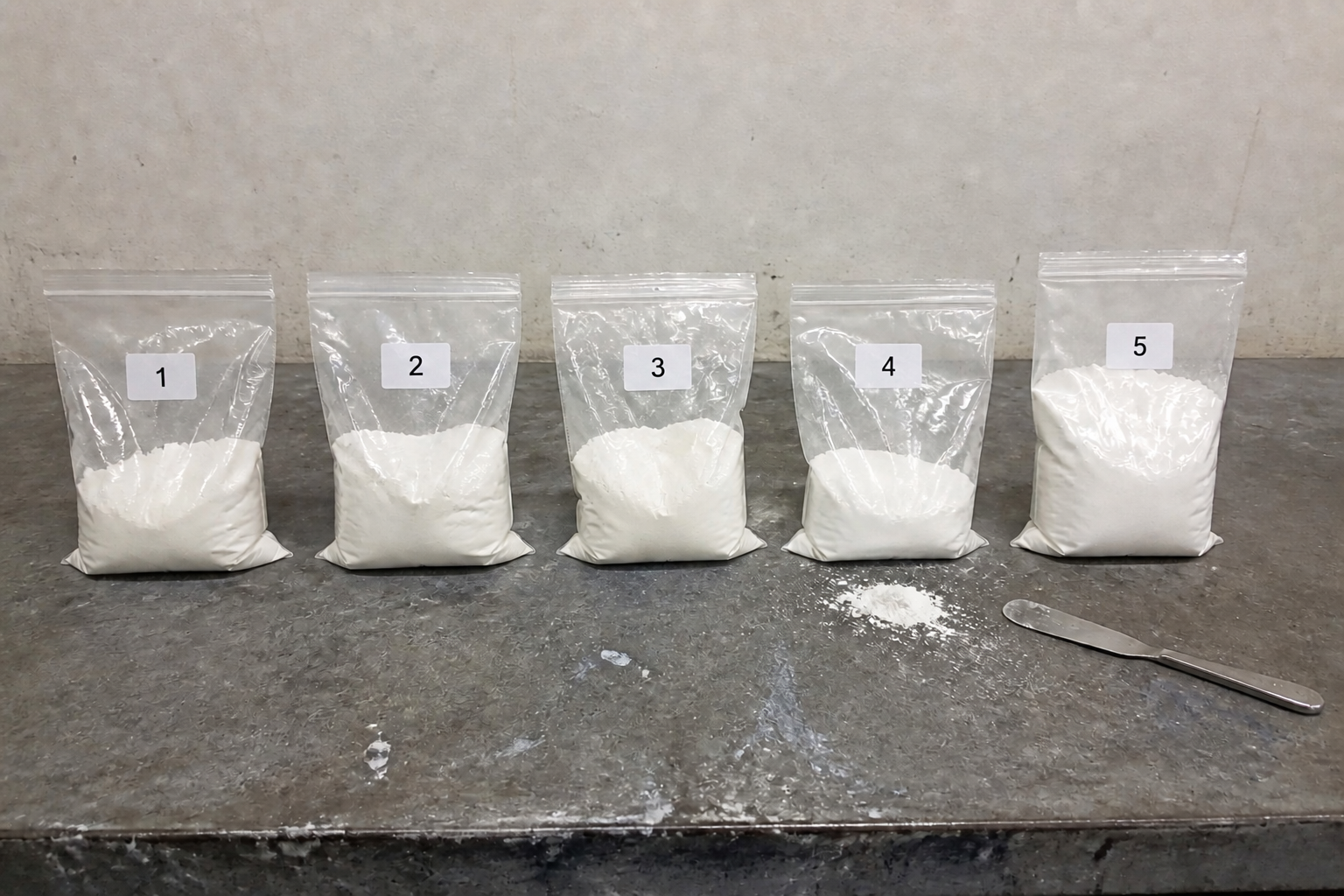
Viscosity values need a test context
A number such as “40,000 mPa·s” or “75,000 mPa·s” has limited purchasing value without its method. Different test conditions can produce different readings for the same material. A buyer should not assume that values from two suppliers are directly comparable.
I recommend requesting the following information:
- Cellulose ether type, such as HPMC or MHEC
- Solution concentration used for measurement
- Measurement temperature
- Viscometer and test configuration
- Spindle and rotational speed, where applicable
- Dry or as-received basis
- Solution preparation and conditioning procedure
- Typical range and specification limits
These details make the certificate more useful, but they still do not replace grout testing.
Similar-viscosity products may not feel the same
In comparative bench work, I have tested anonymized cellulose ether samples with broadly similar supplier-reported viscosity. I used the same base grout, water addition, mixing sequence, rest period, and application tools. I observed differences in consistency development, water retention behavior, and trowel or squeegee feel.
Those observations did not prove that one sample was universally superior. They only showed that the samples were not functionally identical in that formulation. A different cement source, filler blend, pigment, or water level could change the ranking.
For that reason, I use a performance-based comparison matrix rather than a single certificate value.
| Purchasing criterion | Useful role | Important limitation |
|---|---|---|
| Supplier viscosity | It supports lot and grade identification | It does not predict complete grout performance |
| Moisture content | It helps with incoming quality control | It does not show application behavior |
| Particle size | It may affect dispersion and handling | It does not establish water retention |
| Water-retention result | It supports screening | The method may not match the target application |
| Grout application test | It shows behavior in the actual recipe | It needs controlled and repeatable conditions |
| Hardened-property test | It verifies specification performance | It requires enough curing time and proper sampling |
I advise procurement teams to include both material specifications and application acceptance criteria in supplier approval. I also recommend retaining reference samples from approved lots. These controls help quality personnel investigate later changes without relying on memory or subjective descriptions.
Can Too Much Cellulose Ether Cause Problems in Cement-Based Grout?
When a grout feels thin or loses consistency, increasing cellulose ether can appear to be the easiest correction. That response may improve the mixer's first impression, but it may also change water demand, spreading behavior, joint filling, cleaning, and hardened performance. I prefer controlled dosage trials instead of automatic increases.
More cellulose ether is not automatically better for cement-based grout.5 The correct dosage is the lowest validated level that achieves the required handling and water-retention targets without compromising application efficiency or hardened properties. Manufacturers should test several controlled dosage levels while keeping the other formulation and processing variables constant.
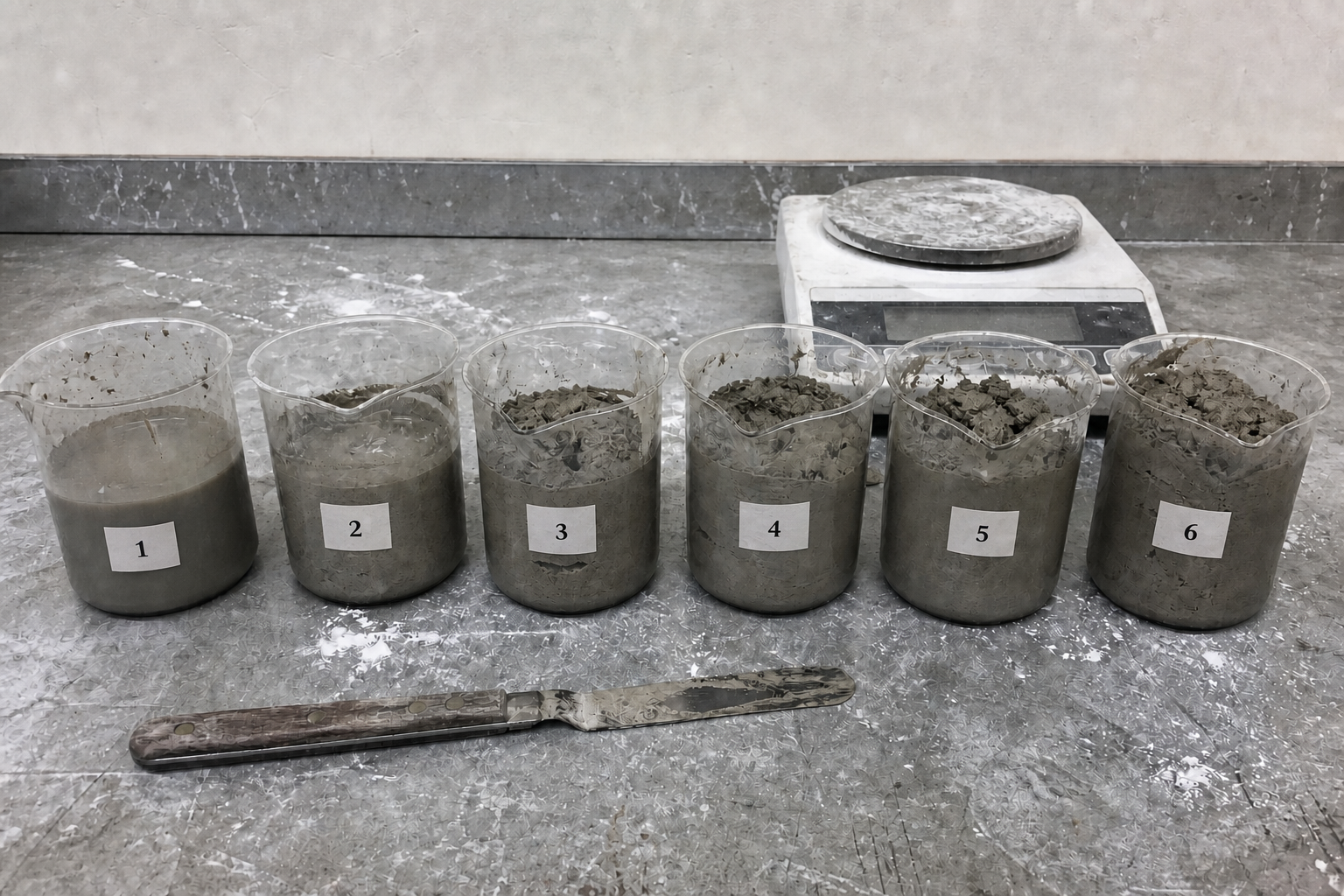
Dosage should solve a defined problem
I first define the symptom before I adjust the cellulose ether level. “The grout is not good” is not a useful technical target. A more actionable description might identify rapid consistency loss, difficult joint filling, poor wetting during mixing, excessive cleaning effort, or variation between production batches.
I then check whether another variable could explain the symptom:
- Has the cement supplier or cement lot changed?
- Has the filler grading shifted?
- Has the pigment level changed?
- Has the powder absorbed moisture during storage?
- Has the recommended water addition changed?
- Has the mixing procedure changed?
- Have the temperature, humidity, airflow, or substrate suction changed?
- Has another additive been replaced or adjusted?
- Has packaging or storage caused segregation?
Only after reviewing these variables do I treat cellulose ether dosage as the likely adjustment point.
A controlled dosage ladder provides better evidence
I commonly recommend a small, controlled series around the current dosage rather than one large change. I do not provide a universal dosage range because grout recipes and cellulose ether grades differ substantially. The supplier’s starting recommendation can guide screening, but the manufacturer should establish the final level through testing.
A practical trial can include:
- A control based on the current approved recipe
- A lower cellulose ether dosage
- The current dosage with a candidate grade
- A modestly higher dosage
- A benchmark product or retained approved lot
Every sample should use the same raw material lots, batch size, mixer, mixing sequence, water temperature, rest period, and test schedule. The team should also code the samples when possible. Blind or coded application checks can reduce brand and price bias.6
Handling and hardened performance need separate decisions
A higher dosage may make a fresh grout feel smoother or more cohesive under one set of conditions.7 However, that subjective improvement does not confirm better compressive strength, flexural strength, abrasion resistance, water absorption, shrinkage behavior, color uniformity, or durability.
Manufacturers should select test standards according to the target market and product claim. For tile grout, buyers may encounter the EN 13888 classification framework with related EN 12808 test methods, or relevant ANSI requirements in other markets.8 I recommend that each manufacturer confirm the applicable standard, edition, conditioning method, and acceptance limits with a qualified laboratory or technical professional.
How Should Manufacturers Diagnose Failure in Cement-Based Grout?
Grout cracking, powdering, color variation, shrinkage, or poor joint filling can lead teams to blame the cellulose ether immediately.9 That conclusion is often too narrow. I use a step-by-step review because several formulation, production, application, and environmental factors can create similar visible symptoms.
Manufacturers should diagnose cement-based grout failure by documenting the symptom, checking raw material and production records, reproducing the complaint, and changing one variable at a time. Cellulose ether should be investigated alongside cement, fillers, water addition, other additives, joint geometry, curing, cleaning, temperature, and substrate conditions.

I start with evidence from the failed batch
A useful complaint investigation needs more than photographs. I ask for the batch number, production date, packaging condition, water addition, mixing method, application time, tile type, joint width and depth, weather conditions, cleaning process, and curing history. I also request unopened material from the same batch when it remains available.
The investigation should distinguish among three stages:
- Dry-mix production: Raw material variation, weighing errors, poor dispersion, segregation, or moisture exposure may affect performance.
- Fresh application: Incorrect water addition, short mixing, missing rest time, repeated water addition, heat, airflow, and absorbent surfaces may change behavior.
- Hardening and service: Joint geometry, curing, movement, water exposure, substrate condition, and cleaning chemicals may influence the final result.
Common symptoms have several possible causes
I do not attribute cracking, powdering, or shrinkage directly to cellulose ether until the broader system has been reviewed.
| Observed symptom | Variables I would investigate | Useful checks |
|---|---|---|
| Rapid consistency loss | Water retention, temperature, suction, cement, and dosage | Controlled time-based consistency comparison |
| Difficult spreading | Water level, filler grading, polymer type, and mixing | Repeatable application panel |
| Hard joint filling | Consistency, joint dimensions, tool, and aggregate grading | Standardized joint mock-up |
| Excessive wiping effort | Polymer balance, water level, rest time, and cleaning timing | Timed cleaning trial |
| Cracking or shrinkage | Water addition, joint depth, binder system, curing, and movement | Dimensional and mechanical testing |
| Powdering | Water ratio, curing, binder content, contamination, and cleaning | Strength and surface evaluation |
| Color variation | Water variation, pigments, cleaning, moisture, and curing | Controlled panels and color measurement |
I reproduce the complaint before changing the recipe
In one troubleshooting pattern that I have encountered, a team wanted to replace its cellulose ether after installers reported rapid stiffening. A controlled repeat showed that the production sample behaved acceptably under stable indoor conditions. The more useful questions concerned application temperature, waiting time, surface suction, and water adjustment on site.
That observation did not clear the cellulose ether automatically. It showed why the team needed to reproduce both the factory conditions and the reported field conditions. A grade that works at moderate laboratory conditions may still need evaluation under the hotter, drier, or more absorbent conditions of the target market.
Supplier selection should include technical consistency
I encourage buyers to evaluate the supplier as well as the sample. A strong initial sample has limited value if later deliveries vary or technical records remain unavailable.
My supplier qualification checklist includes:
- A clear product specification and test method
- Lot-level certificates of analysis
- Retained sample procedures
- Batch traceability
- Change-notification practices
- Production and quality-control capacity
- Application testing support
- Complaint investigation procedures
- Sample availability before bulk approval
- Regulatory documents relevant to the destination market
At Shijiazhuang Kehao Chemical Co., Ltd., we manufacture HPMC, MHEC, and other construction additives using automated production lines. We offer samples and formulation guidance so buyers can compare candidate grades in their own dry-mix systems. Buyers should still verify our specifications, REACH-related test documentation, and application suitability as part of their normal approval process.
How Should Buyers Test Cellulose Ether in Cement-Based Grout Before Purchasing?
A low price can attract procurement teams, while a high viscosity can reassure formulation teams. Neither point confirms application suitability. If a shipment enters production before a representative trial, the cost of reformulation, complaints, and inconsistent batches may exceed the initial raw material saving.
Buyers should test cellulose ether in cement-based grout through a staged approval process. The process should compare supplier documents, powder properties, fresh-grout behavior, application performance, and hardened results. The final test should use the target recipe, local raw materials, intended packaging, and representative environmental and application conditions.
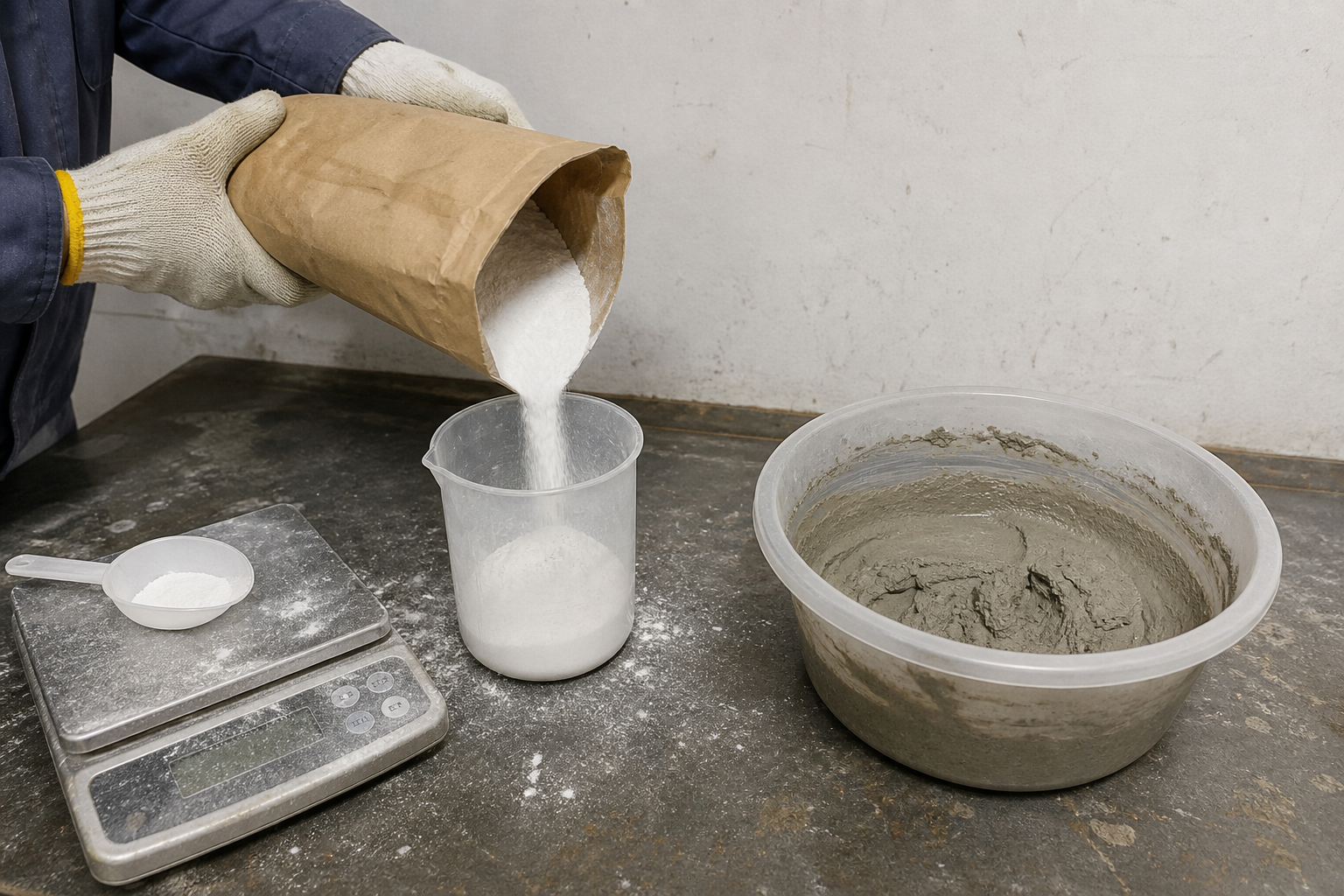
Stage 1: I review the documents
I begin with the technical data sheet, certificate format, safety data sheet, test methods, recommended storage, shelf life, and regulatory information. I treat certificates as documents to verify, not as substitutes for testing.
The specification should clearly identify:
- Product chemistry and intended application
- Viscosity range and test conditions
- Moisture or loss-on-drying limits
- Appearance and particle-size information
- Packaging and storage requirements
- Batch identification
- Relevant compliance or test documentation
Stage 2: I conduct a controlled laboratory screening
The first application comparison should use the same base formula and raw material lots. Each candidate should start at a technically justified dosage. A supplier may recommend a starting point, but the formulator should not assume that equal dosage creates an equal comparison in every case.
I document:
- Powder dispersion
- Mixing behavior
- Initial consistency
- Consistency after resting
- Water retention under a defined method
- Application feel
- Joint filling
- Cleaning behavior
- Visual finish
- Relevant hardened properties
Stage 3: I validate the candidate beyond the bench
A laboratory beaker or small mixer cannot reproduce every production and site condition.10 I therefore recommend a pilot batch before full supplier approval. The pilot should test scale-up, mixing uniformity, bag filling, storage stability, transport, and application with representative tools and substrates.
The buyer should also evaluate more than one production lot whenever the project risk or purchase volume justifies it. A single excellent sample may not demonstrate ongoing consistency.11
| Approval stage | Main question | Suggested decision |
|---|---|---|
| Document review | Can the supplier define and trace the product? | Reject incomplete or unclear documentation |
| Bench screening | Does the grade work in the target formula? | Shortlist technically suitable candidates |
| Dosage optimization | What level balances the required properties? | Set a controlled formulation target |
| Hardened testing | Does the grout meet its claimed specification? | Obtain qualified test evidence |
| Pilot production | Does performance transfer to manufacturing scale? | Confirm process suitability |
| Multi-lot review | Can the supplier deliver consistently? | Grant conditional or full approval |
I recommend that technical and procurement teams make the final decision together. The technical team should define the required performance window. The procurement team should then compare price, supply security, lead time, packaging, minimum order quantity, change control, and logistics among the products that pass.
<h3>Related technical guides</h3> <ul> <li><a href="https://khcel.com/mhec/">MHEC</a></li> <li><a href="https://khcel.com/cellulose-ether-and-starch-ether/">Cellulose Ether and Starch ether?</a></li> <li><a href="https://khcel.com/hec/">HEC</a></li> </ul>
Frequently Asked Questions
Does higher-viscosity cellulose ether always improve cement-based grout?
No. Higher supplier-reported viscosity may change consistency, but it does not automatically improve water retention, workability, strength, shrinkage, or durability.12 I recommend comparing grades under identical test conditions in the target grout formulation. The viscosity method should also be checked before values from different suppliers are compared.
Can cellulose ether be blamed for grout cracking?
Cellulose ether should not be blamed without a broader investigation. I would also check water addition, cement and filler properties, joint dimensions, curing, substrate movement, environmental conditions, mixing, and cleaning. Controlled reproduction and qualified hardened-property testing are necessary before drawing a causal conclusion.
Should two cellulose ether products with the same viscosity be interchangeable?
No. Similar viscosity values do not prove equivalent application performance. The grades may differ in test method, chemistry, modification, consistency development, and compatibility with the grout system. I require side-by-side testing with the same cement, fillers, additives, water level, mixing procedure, and environmental conditions.
How can procurement teams compare cellulose ether prices fairly?
I suggest comparing the validated cost in use, not only the price per kilogram. Buyers should consider the approved dosage, batch consistency, reject risk, technical support, lead time, documentation, and supply reliability. A lower-priced material offers little value if it requires reformulation or causes inconsistent production.
How many samples should a manufacturer test before approval?
No universal number fits every manufacturer. I recommend testing the candidate against a current benchmark, evaluating more than one dosage when needed, and confirming performance with pilot production. High-volume or high-risk purchases may justify multi-lot testing and independent verification by a qualified laboratory.
Conclusion
Cellulose ether in cement-based grout should be selected by verified application performance rather than viscosity, dosage, or price alone. I evaluate water retention, consistency, workability, application time, cleaning, and hardened properties as parts of one system. I also investigate cement, fillers, water, production, application, and environmental conditions before assigning blame. Shijiazhuang Kehao Chemical Co., Ltd. can provide HPMC or MHEC samples, technical documents, OEM support, and formulation guidance. Contact us to arrange a controlled sample comparison in your target grout formulation before bulk purchasing.
"Effect of Cellulose Ether and Starch Ether on Hydration ... - PMC", https://pmc.ncbi.nlm.nih.gov/articles/PMC9782582/. Studies of cellulose ethers in cementitious mortars report that these polymers can modify water retention and fresh-state rheology, thereby affecting workability and the practical time available for placement. Evidence role: general_support; source type: paper. Supports: Experimental and review literature showing that cellulose ether additions can alter water retention, rheology, workability, and setting or workability time in cement-based mortar systems.. Scope note: The magnitude and direction of these effects depend on ether chemistry, dosage, cement composition, aggregate system, and test method. ↩
"Increasing Water Absorptivity of an Aerogel-Based Coating ...", https://pmc.ncbi.nlm.nih.gov/articles/PMC9777926/. Guidance on cementitious-material placement identifies elevated temperature, low humidity, airflow, and absorptive contact surfaces as conditions that increase water loss from fresh mixes. Evidence role: mechanism; source type: institution. Supports: Technical guidance and research explaining that evaporation increases under high temperature, low relative humidity, and wind, while absorbent substrates can remove water from fresh cementitious materials.. Scope note: Most guidance is written for concrete or mortar generally; water-loss rates in a particular grout depend on its formulation, joint geometry, and installation conditions. ↩
"shear rate conversion, correction factors, and applicability ...", https://arxiv.org/html/2606.27524v1. Viscosity is a method-dependent measurement; authoritative test guidance requires the reporting of conditions such as temperature, instrument configuration, rotational speed, and sample preparation to interpret a reported value. Evidence role: definition; source type: institution. Supports: Viscosity measurements are method-dependent and require reporting of relevant conditions such as temperature, instrument geometry, rotational speed, and sample preparation.. Scope note: The exact reporting requirements vary with the selected viscometer, test standard, and whether the material is measured as a solution or dispersion. ↩
"Water Retention Mechanism of HPMC in Cement Mortar - PMC", https://pmc.ncbi.nlm.nih.gov/articles/PMC7372461/. Research on cellulose ethers in cementitious systems indicates that polymer structure and interaction with cement can influence fresh-mortar behavior beyond a nominal solution-viscosity classification. Evidence role: mechanism; source type: paper. Supports: Research showing that cellulose ether molecular characteristics, including substitution and molecular weight, can affect adsorption, rheology, water retention, and cement interactions beyond nominal solution viscosity.. Scope note: This evidence supports the plausibility of different performance among similar-viscosity grades but does not establish the ranking of any specific commercial products. ↩
"Effect of Cellulose Ether and Starch Ether on Hydration ... - PMC", https://pmc.ncbi.nlm.nih.gov/articles/PMC9782582/. Experimental studies show that cellulose ether dosage may improve selected fresh-state properties while also changing hydration and hardened-material properties, so higher dosage is not inherently optimal. Evidence role: general_support; source type: paper. Supports: Experimental findings that cellulose ether dosage can affect water retention and rheology while also changing hydration, air entrainment, setting, and hardened properties.. Scope note: Optimal dosage is formulation-specific and cannot be inferred from general literature without testing the intended grout system. ↩
"Blinding in Clinical Trials: Seeing the Big Picture - PMC - NIH", https://pmc.ncbi.nlm.nih.gov/articles/PMC8308085/. Research-methodology guidance recognizes blinding as a means of reducing bias that can occur when evaluators know the identity or expected value of the item being assessed. Evidence role: mechanism; source type: research. Supports: Methodological evidence that blinding assessors or participants can reduce expectancy-related performance and detection bias in comparative evaluations.. Scope note: Blinding cannot remove all variability in application trials, particularly where physical product differences are readily apparent. ↩
"Effect of Cellulose Ether and Starch Ether on Hydration ... - PMC", https://pmc.ncbi.nlm.nih.gov/articles/PMC9782582/. Fresh-state rheology studies report that cellulose ether additions can alter viscosity and yield stress in cementitious mortars, properties associated with cohesion and handling feel. Evidence role: mechanism; source type: paper. Supports: Rheological studies showing that cellulose ether content can modify viscosity, yield stress, cohesion, and related fresh-mortar handling characteristics.. Scope note: Perceived smoothness is application- and operator-dependent, so rheological measurements provide supporting context rather than a direct measure of user perception. ↩
"EN 13888-2:2022 - Grouts for Ceramic Tiles Test Methods ...", https://standards.iteh.ai/catalog/standards/cen/37cac2b3-bef6-4632-aaa9-fc824b3d702a/en-13888-2-2022?srsltid=AfmBOord9PQow05Mzy3YvVeb8aEYbn4f2ozUDmMugVpKKdFYs7xiHr3c. EN 13888 specifies classifications and requirements for grouts for ceramic tiles, with EN 12808 providing associated test methods; applicable ANSI documents define requirements for relevant tile-setting grout products in the United States. Evidence role: definition; source type: institution. Supports: The scope of EN 13888 for ceramic-tile grouts, the EN 12808 test-method series, and applicable ANSI grout specifications.. Scope note: The applicable edition and exact ANSI requirement depend on the product type, jurisdiction, and stated performance claim. ↩
"Bonding and Cracking Behavior and Related Properties of ...", https://www.nrc.gov/docs/ML1127/ML112700061.pdf. Technical literature on cementitious grouts and mortars identifies cracking, shrinkage, surface weakness, and color variation as outcomes that may arise from interacting material, water-content, curing, substrate, and installation factors. Evidence role: general_support; source type: research. Supports: Technical literature identifying multiple formulation, installation, curing, moisture, and substrate variables that can contribute to common cementitious grout defects.. Scope note: A general list of possible causes cannot determine the cause of an individual field failure without site-specific examination and controlled testing. ↩
"Construction and Materials (DC&M) Material Procedures - njdot", https://dot.nj.gov/transportation/eng/construction/CM.shtm. Materials-testing literature notes that laboratory results may not transfer fully to production or field performance because scale, equipment, processing, and environmental conditions can differ. Evidence role: general_support; source type: paper. Supports: Research and technical guidance describing how mixing energy, batch size, equipment, transport, environmental exposure, and installation practices can affect the transfer of laboratory results to production or field conditions.. Scope note: Pilot validation reduces but does not eliminate uncertainty because real installation conditions remain variable. ↩
"Process Validation: General Principles and Practices", https://www.fda.gov/files/drugs/published/Process-Validation--General-Principles-and-Practices.pdf. Quality-assurance principles distinguish acceptance of an individual sample or lot from evidence of sustained process capability, which requires appropriately designed sampling and ongoing control. Evidence role: general_support; source type: institution. Supports: Quality-management and sampling principles explaining that conformity evidence from a single sample or lot provides limited evidence about continuing process consistency.. Scope note: The number of lots and samples needed should be based on material variability, test uncertainty, purchase volume, and the consequences of failure. ↩
"Effect of Cellulose Ether and Starch Ether on Hydration ... - PMC", https://pmc.ncbi.nlm.nih.gov/articles/PMC9782582/. Studies of cellulose ethers in cementitious materials indicate that nominal viscosity grade alone does not determine water retention, workability, hydration behavior, or hardened performance. Evidence role: general_support; source type: paper. Supports: Research indicating that cellulose ether viscosity grade is only one material characteristic and that fresh and hardened cementitious properties depend on multiple polymer and formulation variables.. Scope note: The literature supports rejecting a universal higher-viscosity rule but does not replace direct comparative testing of specific grades in a target grout. ↩