Introduction
Choosing the right HPMC manufacturer is one of the most important decisions for dry mix mortar producers, construction material companies, and industrial formulators. Product quality depends not only on viscosity specifications, but also on manufacturing consistency, raw material quality, laboratory control, and technical support.
Hydroxypropyl Methylcellulose (HPMC) is widely used in tile adhesives, wall putty, skim coat, cement mortar, gypsum plaster, EIFS, self-leveling compounds, pharmaceuticals, and many other industrial applications. It improves water retention, workability, open time, sag resistance, and overall application performance.
However, HPMC from different suppliers can perform very differently even when the viscosity grade appears identical. Differences in production technology, substitution control, purification processes, and quality management often result in noticeable variations during application.
For purchasing managers and formulation engineers, selecting a reliable manufacturer means evaluating far more than price. Production capability, laboratory testing, quality assurance, batch consistency, and technical service all play a critical role in ensuring long-term product performance.
This guide explains how professional buyers assess HPMC manufacturers, what international quality standards matter most, and how to identify suppliers capable of delivering stable quality for global construction markets.
International Quality Standards Every HPMC Manufacturer Should Meet
Consistent product quality begins with standardized manufacturing and testing procedures.
Professional HPMC manufacturers operate under internationally recognized quality systems to ensure every production batch meets predefined technical specifications.
The most commonly referenced standards include:
| Standard | Application | Primary Focus |
|---|---|---|
| ASTM | Construction Materials | Viscosity, moisture, ash content |
| USP / NF | Pharmaceutical Grade | Purity and microbiological requirements |
| ISO 9001 | Manufacturing | Quality management system |
| ISO 14001 | Manufacturing | Environmental management |
| REACH | European Market | Chemical regulatory compliance |
These certifications alone are not enough. Buyers should also verify whether the manufacturer maintains documented production procedures, complete batch records, and independent laboratory testing for every shipment.
A professional supplier should be able to provide:
- Certificate of Analysis (COA)
- Technical Data Sheet (TDS)
- Material Safety Data Sheet (MSDS)
- Batch traceability records
- Routine laboratory inspection reports
Transparent documentation demonstrates that quality is controlled through measurable processes rather than final-product inspection alone.
![HPMC Research Laboratory | Kehao Chemical]
Why Batch Consistency Is More Important Than Viscosity Alone
Many buyers compare suppliers using only viscosity grades such as 40,000 or 75,000 mPa·s. In reality, viscosity is only one indicator of HPMC performance.
A high-quality manufacturer controls multiple properties simultaneously to ensure consistent application performance across every batch.
Key quality indicators include:
- Viscosity stability
- Water retention
- Moisture content
- Particle size distribution
- pH value
- Bulk density
- Methoxy content
- Hydroxypropyl content
Even small variations in these parameters can influence mortar workability, open time, sag resistance, and overall construction efficiency.
This is why leading manufacturers perform routine laboratory testing throughout production rather than relying solely on final inspections.
Brookfield Viscosity Testing: The Industry Benchmark
Viscosity remains one of the most important technical specifications for construction-grade HPMC.
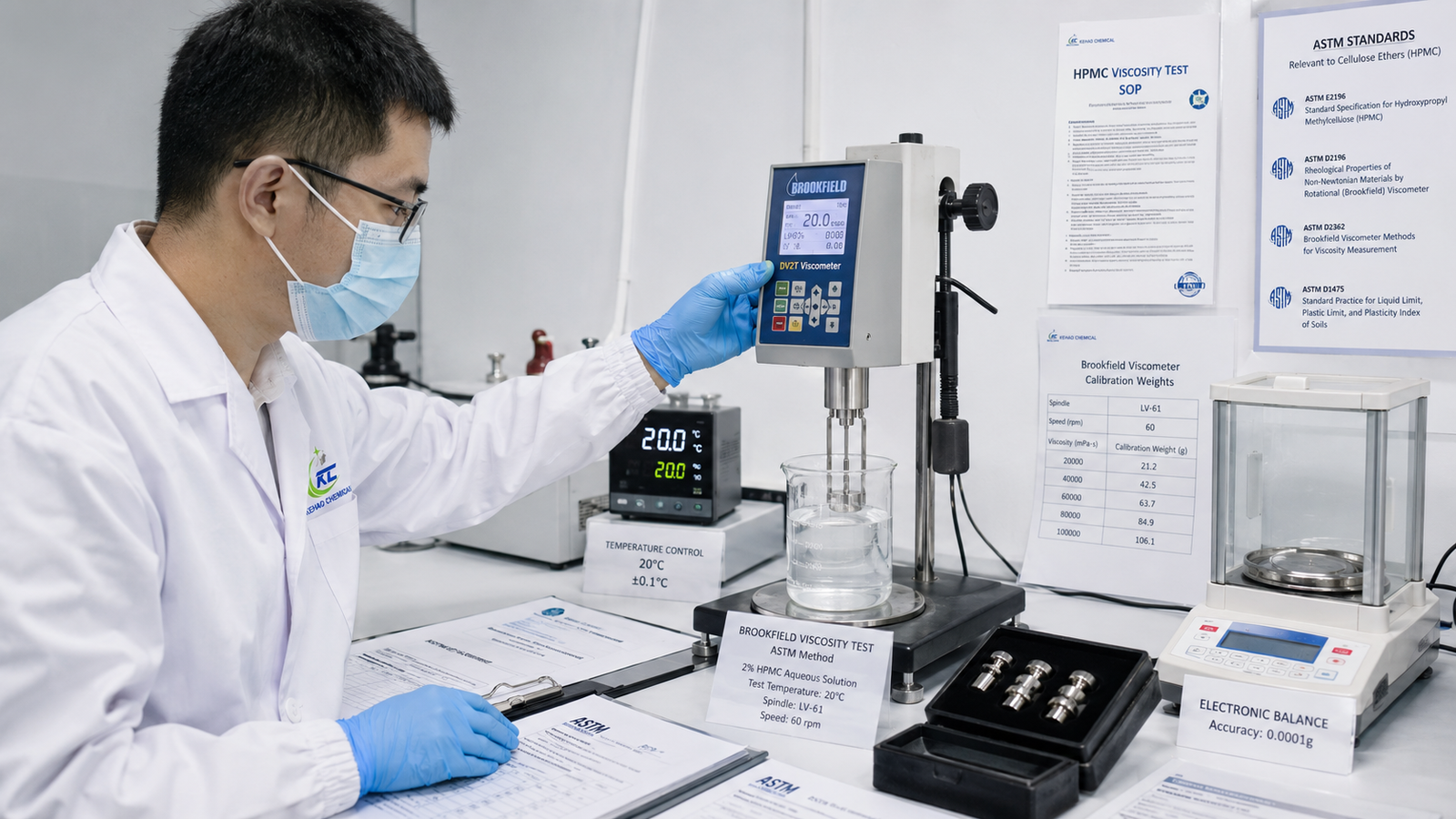
To ensure comparable results, professional manufacturers generally measure viscosity using standardized testing conditions:
- 2% HPMC aqueous solution
- Brookfield rotational viscometer
- Temperature maintained at 20°C
- Standard spindle configuration
- Controlled rotational speed
Using identical testing conditions allows customers to compare products accurately and reduces formulation adjustments when changing production batches.
For construction applications, common viscosity ranges include:
| Application | Typical Viscosity |
|---|---|
| Tile Adhesive | 40,000–75,000 mPa·s |
| Wall Putty | 70,000–100,000 mPa·s |
| Skim Coat | 50,000–80,000 mPa·s |
| EIFS | 75,000–120,000 mPa·s |
Consistent viscosity, combined with controlled substitution and purification, helps ensure predictable field performance and stable product quality.
How to Audit an HPMC Manufacturer
Choosing an HPMC manufacturer requires more than reviewing a product catalog or comparing prices. A reliable supplier should demonstrate consistent manufacturing capability, strict quality management, and the ability to support customers throughout the product lifecycle.
Professional procurement teams typically evaluate four key areas: production facilities, manufacturing processes, laboratory capabilities, and quality management systems.
Modern Manufacturing Facilities
A professional HPMC factory should operate with a high level of automation to minimize human error and maintain stable production conditions.
During a factory audit, buyers should pay attention to:
- Automated DCS production control systems
- Stainless steel etherification reactors
- Closed production processes
- Precision drying and milling equipment
- Automatic packaging lines
- Clean and organized production environment
Automation improves production efficiency while ensuring every batch is manufactured under consistent operating conditions.
Manufacturers with standardized production systems are generally able to deliver more stable product quality over the long term.
Production Capacity and Supply Stability
Production capacity is another important consideration, especially for customers purchasing large volumes.
Questions worth asking include:
- What is the annual production capacity?
- How many production lines are in operation?
- Can the supplier support long-term projects?
- How quickly can production be expanded during peak demand?
- What is the average lead time?
A dependable supplier should not only meet today’s demand but also support future business growth without compromising product consistency.
Inside the Quality Control System
Quality control begins long before the finished product reaches the warehouse.
Leading HPMC manufacturers perform inspections throughout the entire production process, from incoming raw materials to final packaging.
A comprehensive quality control system typically includes:
Raw Material Inspection
Incoming cellulose and chemical raw materials are inspected before entering production to ensure consistent quality and purity.
In-Process Monitoring
During manufacturing, critical process parameters are continuously monitored to maintain stable reaction conditions and reduce batch variation.
Final Product Testing
Before shipment, every production batch is tested against internal quality specifications.
Typical laboratory tests include:
- Brookfield viscosity measurement
- Moisture content
- pH value
- Ash content
- Particle size distribution
- Water retention performance
This multi-stage inspection process helps ensure that customers receive products with consistent performance from batch to batch.
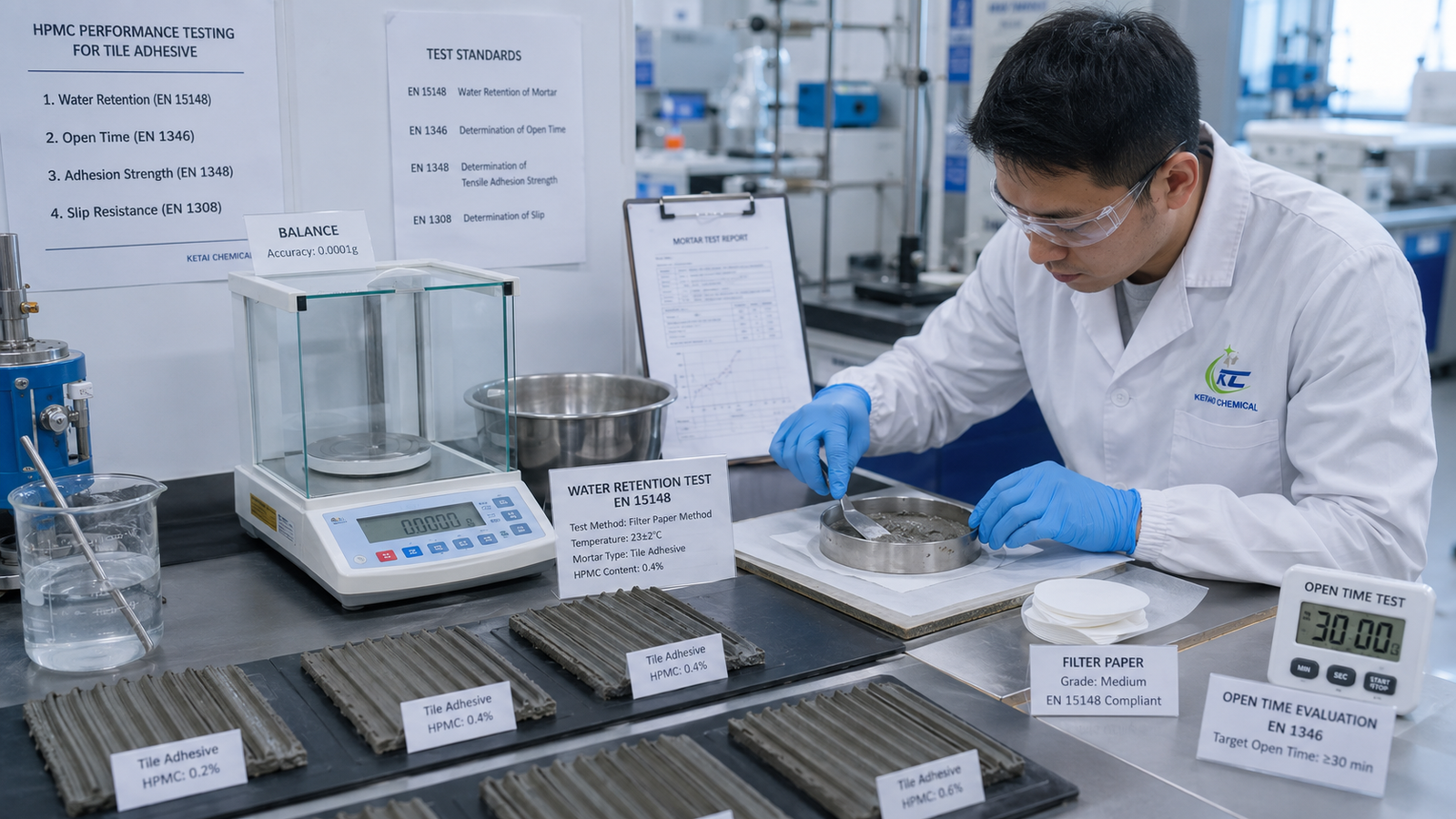
Water Retention Testing
For construction-grade HPMC, water retention is one of the most important performance indicators.
Professional laboratories evaluate water retention using standardized testing methods to determine how effectively HPMC retains water within cement-based materials.
High water retention helps improve:
- Mortar workability
- Open time
- Adhesion
- Cement hydration
- Crack resistance
Stable water retention performance is often a better indicator of manufacturing consistency than viscosity alone.
Batch Traceability and Documentation
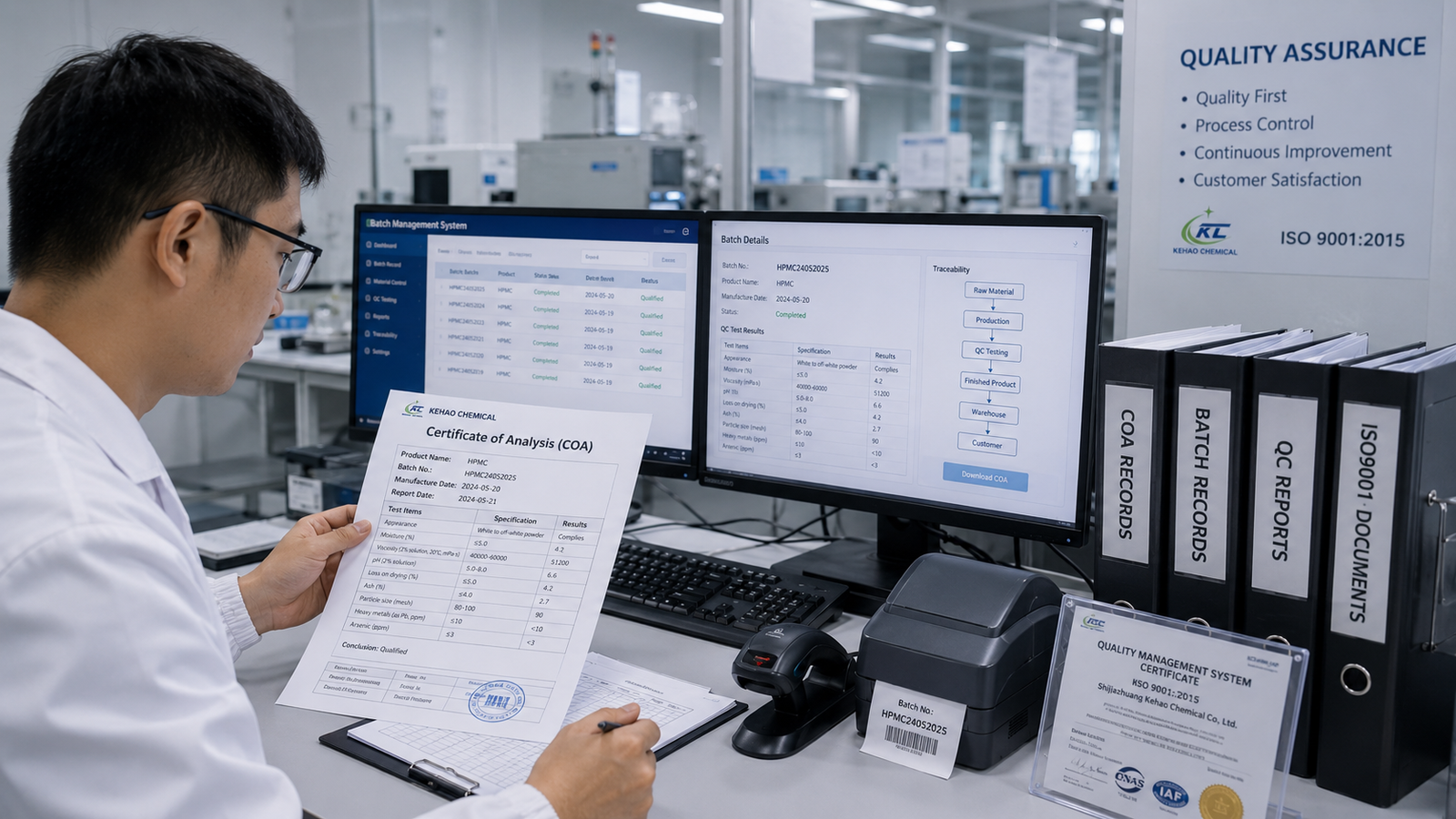
A professional manufacturer should maintain complete production records for every batch.
Comprehensive traceability allows products to be tracked from raw materials through manufacturing, quality inspection, packaging, and shipment.
Standard documentation normally includes:
- Certificate of Analysis (COA)
- Technical Data Sheet (TDS)
- Material Safety Data Sheet (MSDS)
- Batch production records
- Quality inspection reports
Transparent documentation gives customers greater confidence in product quality while simplifying supplier qualification and regulatory compliance.
Technical Support Beyond Product Supply
The best HPMC manufacturers provide more than high-quality products—they also serve as technical partners.
Experienced application engineers help customers optimize formulations based on specific raw materials, climate conditions, and application requirements.
Technical support may include:
- Product selection recommendations
- Formula optimization
- Laboratory testing support
- Performance analysis
- Customized viscosity grades
- Troubleshooting during production
For example, tile adhesive manufacturers operating in tropical climates often require different HPMC characteristics than those producing materials for colder regions. A supplier with application expertise can recommend suitable grades and reduce formulation development time.
Reliable technical support helps customers improve product performance while reducing production risks, making it an important factor when selecting a long-term HPMC manufacturing partner.
Global Supply Chain & Export Capability
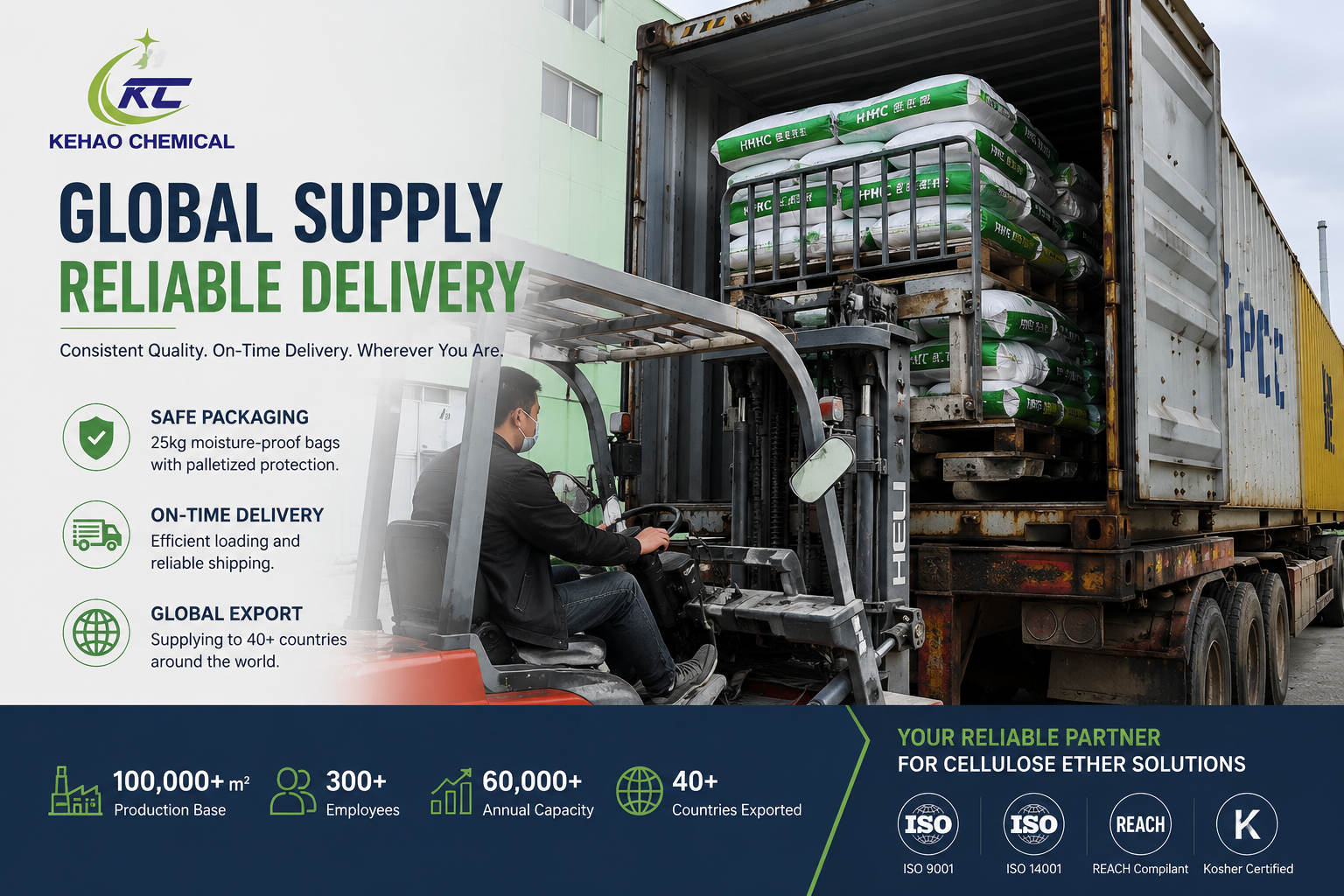
For international buyers, product quality is only part of the purchasing decision. A reliable HPMC manufacturer must also demonstrate the ability to deliver products safely, consistently, and on schedule.
From packaging and warehousing to container loading and export documentation, every step of the logistics process influences product quality and supply reliability.
Secure Packaging for International Transportation
HPMC is highly sensitive to moisture during storage and transportation. Professional manufacturers therefore use moisture-resistant packaging designed to protect product quality throughout long-distance shipping.
Standard export packaging typically includes:
- 25 kg moisture-proof paper bags with PE inner liner
- Heat-sealed packaging for improved protection
- Clear product identification and batch labels
- Stretch-wrapped wooden pallets for container transport
Proper packaging minimizes moisture absorption, reduces handling damage, and helps maintain product stability during ocean freight.
Warehouse Management
An organized warehouse is another indicator of a professional manufacturer.
Finished products should be stored in clean, dry, and well-ventilated facilities before shipment. Modern warehouse management systems allow every pallet to be identified and traced quickly, improving inventory accuracy and delivery efficiency.
Well-managed warehouses also reduce loading errors and ensure first-in, first-out (FIFO) inventory control.
Export Experience Matters
Exporting chemical products involves more than arranging transportation.
Experienced manufacturers understand international documentation requirements and work closely with freight forwarders to ensure smooth customs clearance.
Typical export support includes:
- Commercial Invoice
- Packing List
- Certificate of Origin
- Certificate of Analysis (COA)
- Material Safety Data Sheet (MSDS)
- Customized shipping marks and private labeling
A supplier with extensive export experience can respond more efficiently to changing market requirements and reduce the risk of shipping delays.
Why Choose Kehao Chemical
At Kehao Chemical, quality is built into every stage of the manufacturing process—from raw material selection and automated production to laboratory testing and global delivery.
Our commitment extends beyond supplying HPMC. We work closely with customers to provide stable products, responsive technical support, and reliable supply for long-term business growth.
What We Offer
- Advanced automated HPMC manufacturing facility
- Strict ISO-based quality management system
- Comprehensive laboratory testing for every batch
- Complete batch traceability and documentation
- Professional technical support and formulation guidance
- Stable global supply and on-time delivery
- OEM and customized HPMC grades available
- Fast sampling and responsive customer service
Whether you are producing tile adhesive, wall putty, skim coat, gypsum plaster, EIFS, or self-leveling compounds, our technical team is ready to recommend the most suitable HPMC solution for your application.
If you are looking for a dependable HPMC manufacturer with proven production capability and global export experience, Kehao Chemical is ready to become your long-term partner.
Conclusion
Selecting the right HPMC manufacturer is about much more than comparing viscosity grades or product prices. Long-term product performance depends on consistent manufacturing, reliable quality control, professional technical support, and a stable global supply chain.
By evaluating production facilities, laboratory capabilities, quality management systems, and export experience, buyers can reduce sourcing risks and build stronger, more reliable partnerships.
At Kehao Chemical, we combine advanced manufacturing technology with rigorous quality standards and responsive customer support to help customers achieve consistent results in every project.
Looking for a reliable HPMC supplier?
Contact our technical team today to request a free sample, discuss your formulation requirements, or receive a customized quotation for your next project.
Related technical guides
- The Complete Guide to Cellulose Ether Manufacturers: Quality, Standards, and Selection Criteria
- HPMC
- Dry Mortar Quality Control: Testing Standards & Best Practices
Frequently Asked Questions
What viscosity grade is commonly used for tile adhesive?
Most standard tile adhesives use HPMC with a viscosity between 40,000 and 75,000 mPa·s, although the optimal grade depends on the formulation, cement type, and local construction requirements.
How does Kehao Chemical ensure batch consistency?
Every production batch is monitored through standardized manufacturing procedures and tested in our quality control laboratory before shipment. Batch records and Certificates of Analysis are available for customer review.
Can you customize HPMC grades?
Yes. We provide customized viscosity grades and application-specific solutions based on customer formulations, raw materials, and performance requirements.
Do you support OEM packaging?
Yes. We offer OEM packaging, private labeling, customized bag printing, and personalized shipping marks for international distributors and manufacturers.
Which industries use your HPMC products?
Our HPMC products are widely used in tile adhesive, wall putty, skim coat, cement mortar, gypsum plaster, EIFS, self-leveling compounds, detergents, pharmaceuticals, and other industrial applications.