Choosing between RDP and PVA polymer powder is one of the most frequent — and most misunderstood — decisions in dry-mix mortar formulation. Pick the wrong one, and you face delamination callbacks, failed water-resistance tests, or bloated additive costs that eat your margin. Most of them trace back to one formulation decision - see the 10 most common dry-mix mortar failures for the full diagnostic list. The answer is not which powder is "better" in a vacuum; it is which polymer matches your specific mortar system, substrate, and service environment.
RDP (redispersible polymer powder) and PVA (polyvinyl alcohol, typically PVA 2488) serve different functional roles in dry-mix mortar. RDP redisperses into a polymer film that improves adhesion, flexibility, and water resistance.1 PVA dissolves to boost cohesion, workability, and initial bond strength.2 The right choice depends on your mortar type, exposure conditions, required performance, effective dosage, and validated test results — not price per ton alone.
Below, I walk through the real functional differences, the application logic behind each polymer, cost analysis beyond the price tag, and a practical selection-and-testing framework I use every day when helping mortar manufacturers make this decision. Whether you are a formulator fine-tuning a tile adhesive or an importer deciding what to stock, this guide gives you a structured way to choose — and verify — the right polymer powder.
How Do RDP and PVA Actually Work in Mortar — and Why Does the Mechanism Matter?
Many buyers ask me to compare RDP and PVA on a simple spec sheet: bond strength, viscosity, price. But without understanding how each polymer functions inside a cured mortar matrix, those numbers are misleading. A polymer that looks great on paper can fail catastrophically in the wrong system.
RDP and PVA operate through fundamentally different mechanisms. RDP is a spray-dried copolymer (most commonly VAE — vinyl acetate-ethylene)3 that redisperses into discrete polymer particles when mixed with water, then coalesces into a continuous or semi-continuous film as the mortar dries. PVA 2488 is a water-soluble polymer that dissolves completely, functioning as a film-former, thickener, and protective colloid. These distinct mechanisms produce different performance profiles in adhesion, flexibility, and water resistance.
RDP: Redispersion and Film Coalescence
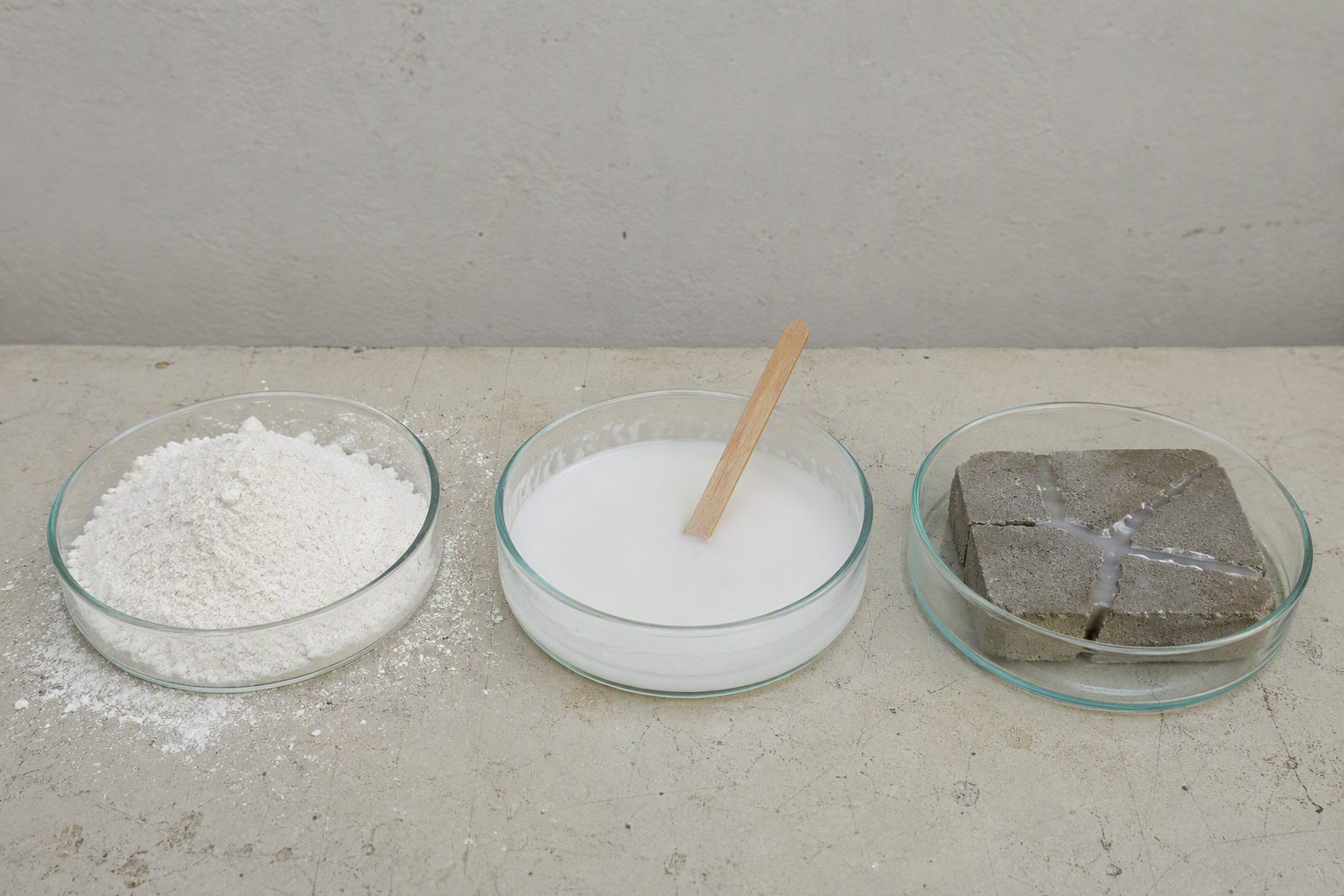
When you add water to a dry-mix mortar containing RDP, the spray-dried polymer particles — typically protected by a PVA shell4 — redisperse back into a latex emulsion. As the mortar hydrates and water evaporates, these latex particles coalesce into a polymer film that:
- Bridges micro-cracks between cement hydration products and aggregate
- Improves adhesion to substrates by increasing the contact area and mechanical interlocking at the interface
- Adds flexibility (deformability), reducing the risk of cracking under thermal or mechanical stress
- Enhances water resistance — the coalesced VAE film is relatively hydrophobic compared to dissolved PVA
The degree of film coalescence depends on temperature, humidity, and the polymer's minimum film-forming temperature (MFFT). According to published research on redispersible powder polymers (e.g., Ohama, Handbook of Polymer-Modified Concrete and Mortars, 1995; Schulze & Killermann, Long-term performance of redispersible powders in mortars, Cement and Concrete Research, 1999), the VAE copolymer film can improve tensile adhesion strength by 0.2–0.8 MPa compared to unmodified mortars5, depending on dosage and the base binder system.
PVA 2488: Dissolution and Cohesion Enhancement
PVA 2488 (polyvinyl alcohol, ~88% hydrolysis, ~2400 degree of polymerization) dissolves in the mixing water and works primarily as:
- A film-former — PVA dries into a water-soluble film that enhances initial dry bond strength
- A thickener and rheology modifier — improving sag resistance and open time
- A protective colloid — it is, in fact, the same type of colloid used to stabilize RDP particles during spray-drying
- A co-binder that increases the cohesive strength of the mortar matrix
PVA's key limitation is that its film is water-resoluble. Once re-wetted, the PVA film softens and can lose a significant portion of its bonding contribution. This is not a defect — it is a characteristic of the polymer chemistry. In applications where the mortar will remain dry or where water resistance is not the critical performance target, PVA can deliver excellent results at a competitive dosage.
Why the Mechanism Matters for Your Decision
| Property | RDP (VAE type) | PVA 2488 |
|---|---|---|
| Mechanism | Redisperses → coalesces into polymer film | Dissolves → dries into water-soluble film |
| Dry adhesion | Significant improvement | Moderate improvement |
| Wet adhesion / water resistance | Good — coalesced film is relatively hydrophobic | Limited — film re-softens when wet |
| Flexibility / deformability | High (VAE copolymer is inherently flexible) | Low to moderate (PVA film is relatively rigid) |
| Workability improvement | Moderate | Good (thickening + lubrication) |
| Typical dosage range | 1–5% of total dry mix (application-dependent) | 0.1–1% of total dry mix (application-dependent) |
| Cost per ton of powder | Higher | Lower |
| Effective cost per formulation | Depends on dosage and performance target | Depends on dosage and performance target |
Note: The dosage ranges above are general references. Actual effective dosages vary with the binder type (cement, gypsum, lime), aggregate system, cellulose ether type and dosage, and the specific performance standard being targeted. I always recommend confirming dosage through sample trials rather than copying a generic formula.
When Should You Choose RDP for Your Mortar System?
If you are producing a mortar that must meet demanding adhesion, flexibility, or water-resistance standards, RDP is likely where your testing should start. But "demanding" needs definition — I have seen customers default to RDP when PVA would have been sufficient, adding unnecessary cost.
Choose RDP when your mortar must deliver high tensile adhesion (especially after water immersion or heat aging), resist cracking under thermal cycling, or bond to difficult substrates like concrete, old tiles, or moisture-exposed surfaces. Common RDP-priority applications include C1/C2 tile adhesives (per EN 12004), EIFS/ETICS adhesive and base-coat mortars, flexible repair mortars, self-leveling compounds requiring abrasion resistance, and exterior renders exposed to rain and freeze-thaw.
Tile Adhesive — The Core RDP Application
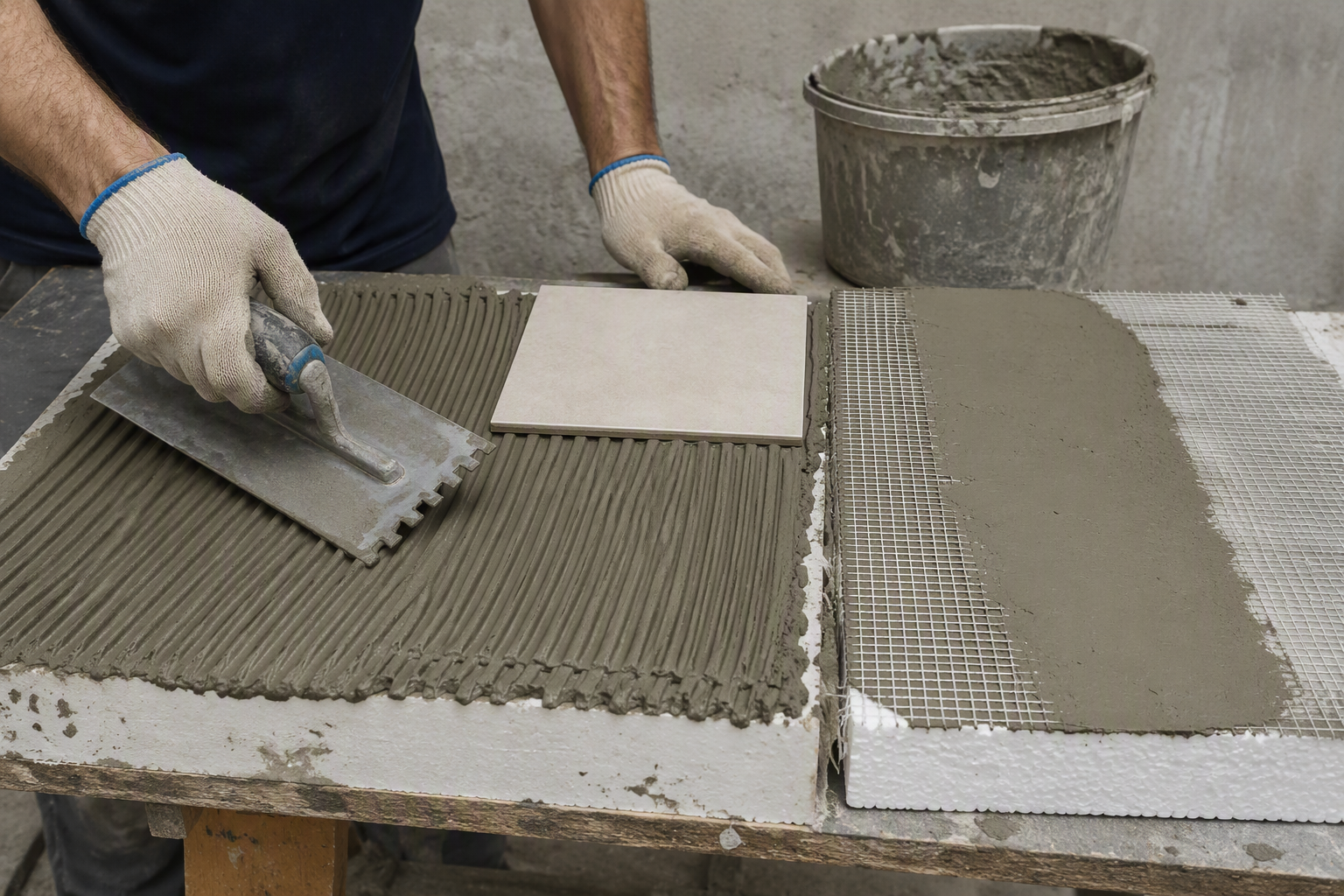
In tile adhesive formulation, RDP is often non-negotiable for C2-class products (improved adhesives per EN 12004). The standard requires ≥1.0 MPa tensile adhesion after water immersion (28 days), after heat aging (70 °C, 14 days), and after freeze-thaw cycling.6 The coalesced VAE film in RDP contributes directly to meeting these aging conditions because it retains its bonding function when wet.
I regularly help customers select between different RDP grades — varying in Tg (glass transition temperature), particle size, and polymer content — for their specific tile adhesive formulations. A customer producing large-format porcelain tile adhesive for exterior façades in the Middle East needs a different RDP specification than one making a standard interior ceramic tile adhesive in Southeast Asia. Which types of RDP suit tile adhesives versus EIFS breaks that choice down by application.
EIFS/ETICS and Exterior Mortars
Exterior insulation systems demand both adhesion and deformability. The adhesive mortar bonding EPS or XPS boards to the substrate, and the base coat embedding the reinforcement mesh, must accommodate thermal movement without cracking. RDP's flexibility (controlled by the VAE copolymer's Tg) is critical here. PVA alone cannot provide the required deformability or water resistance for exterior exposure.7
Where RDP Is Likely Overkill
For interior wall putty in dry environments, basic gypsum-based plasters, or non-structural patching compounds that will be painted over and never exposed to water, the full performance of RDP may be more than you need. In these cases, PVA 2488 — sometimes combined with a small amount of RDP — can achieve the required bond and workability at a lower formulation cost.
When Does PVA 2488 Make Sense — and Where Does It Excel?
PVA often gets dismissed as a "cheap substitute" for RDP. That framing is wrong, and I say this as a supplier of both products. PVA 2488 is a functional polymer with specific strengths that RDP does not replicate as efficiently.
PVA 2488 is well-suited for interior dry-environment applications where workability, sag resistance, initial bond strength, and formulation cost are the primary concerns. It excels in wall putty, gypsum-based plaster, interior skim coats, and as a co-additive alongside cellulose ethers. PVA's dissolution behavior also makes it effective as a thickener and anti-settling agent in powder blends.
Wall Putty — PVA's Strongest Application
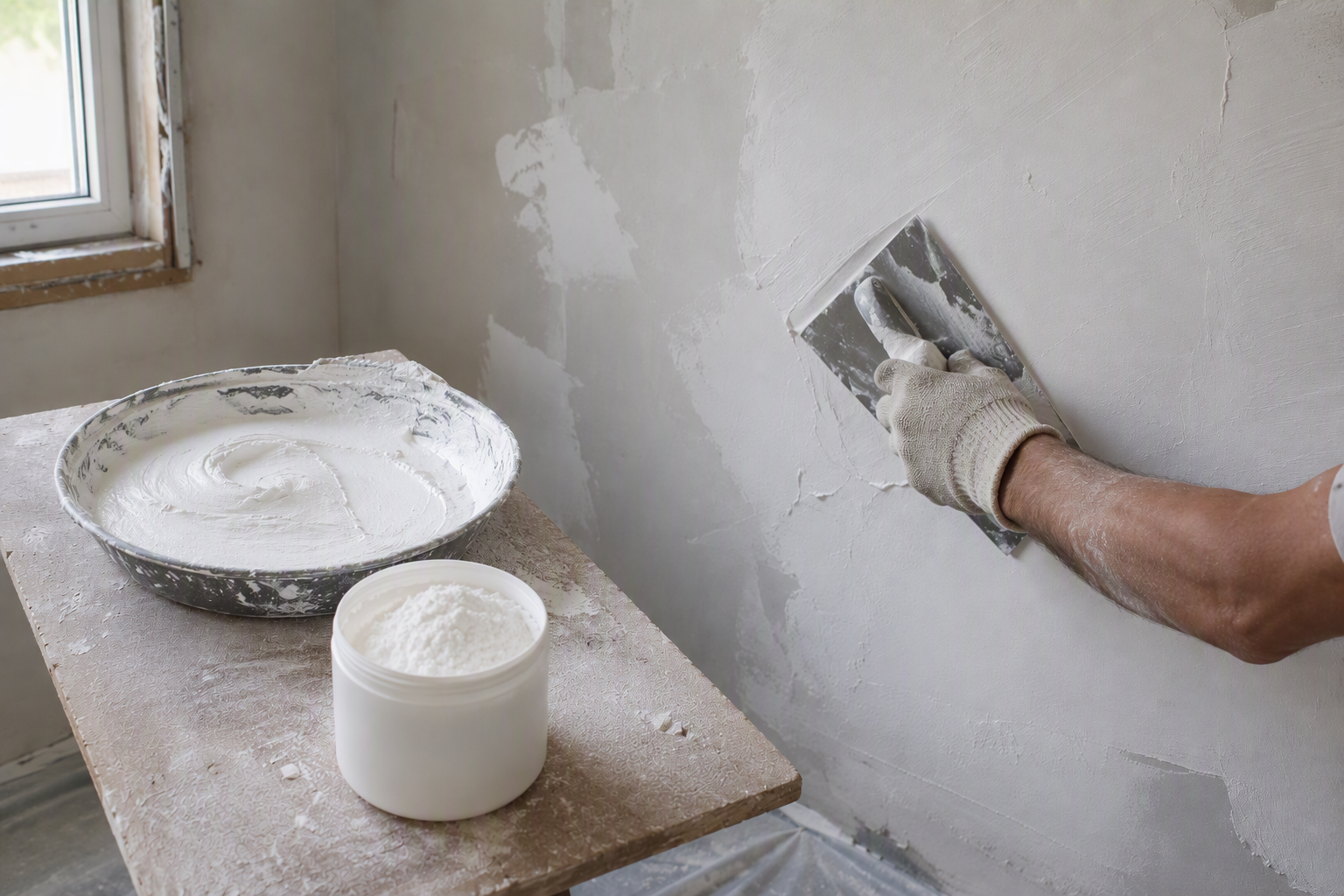
Interior wall putty (also called wall finishing compound or skim coat) is the largest-volume application for PVA 2488 in the dry-mix mortar industry.8 In a typical putty formulation based on calcium carbonate filler, a small amount of cement or lime, and cellulose ether (HPMC or HEMC), PVA 2488 at 0.3–0.8% provides:9
- Improved adhesion to concrete or plastered walls
- Enhanced film hardness and sandability after drying
- Better workability — smoother troweling with less drag
- Reduced dusting of the cured surface
Because interior putty is rarely exposed to sustained moisture, PVA's water re-solubility is not a functional weakness in this context. I have worked with multiple putty manufacturers in South Asia and the Middle East who achieve excellent results with PVA 2488 and HPMC, with no RDP in the formulation. HPMC in wall putty covers the cellulose ether side of that system.
Gypsum-Based Systems
Gypsum plasters and gypsum-based joint compounds typically operate in interior dry environments. PVA 2488 improves surface quality and workability in these systems. Some formulators use a combination of PVA and a low dosage of RDP to achieve a balance of cost and performance — the PVA handles the bulk of the rheology improvement while a small RDP addition contributes film-forming strength.
PVA as a Co-Additive, Not Just a Standalone
An often-overlooked role of PVA 2488 is its function as a co-additive in formulations that also contain RDP. Since RDP particles are themselves protected by a PVA shell (from the spray-drying process), adding a small amount of free PVA can improve the dispersion and redispersion behavior of RDP in the dry mix.10 This is particularly relevant in low-RDP-dosage formulations where every particle needs to redisperse efficiently.
Where PVA Falls Short
Do not specify PVA 2488 as the sole polymer modifier in:
- Exterior mortars exposed to rain, freeze-thaw, or sustained humidity
- Tile adhesives that must meet EN 12004 C2 or ANSI A118.4 requirements for wet adhesion
- Flexible mortars that must accommodate substrate movement
- Below-grade or wet-area applications (swimming pools, bathrooms with direct water exposure)
In these scenarios, PVA's water-soluble film will lose its bonding contribution, and the mortar will underperform or fail.
Is the Cheapest Option Really the Cheapest — How Should You Compare Cost?
This is the question I discuss most often with importers and distributors. RDP costs significantly more per ton than PVA 2488. The reflex is to use PVA wherever possible. But cost comparison at the powder level is misleading without looking at formulation-level economics.
True cost comparison requires evaluating effective dosage, not just price per ton. RDP is used at 1–5% in most mortar formulations, while PVA 2488 is used at 0.1–1%. But when PVA cannot meet the performance target, substituting it for RDP does not save money — it creates failed batches, reformulation costs, and field callbacks that far exceed the raw material savings.
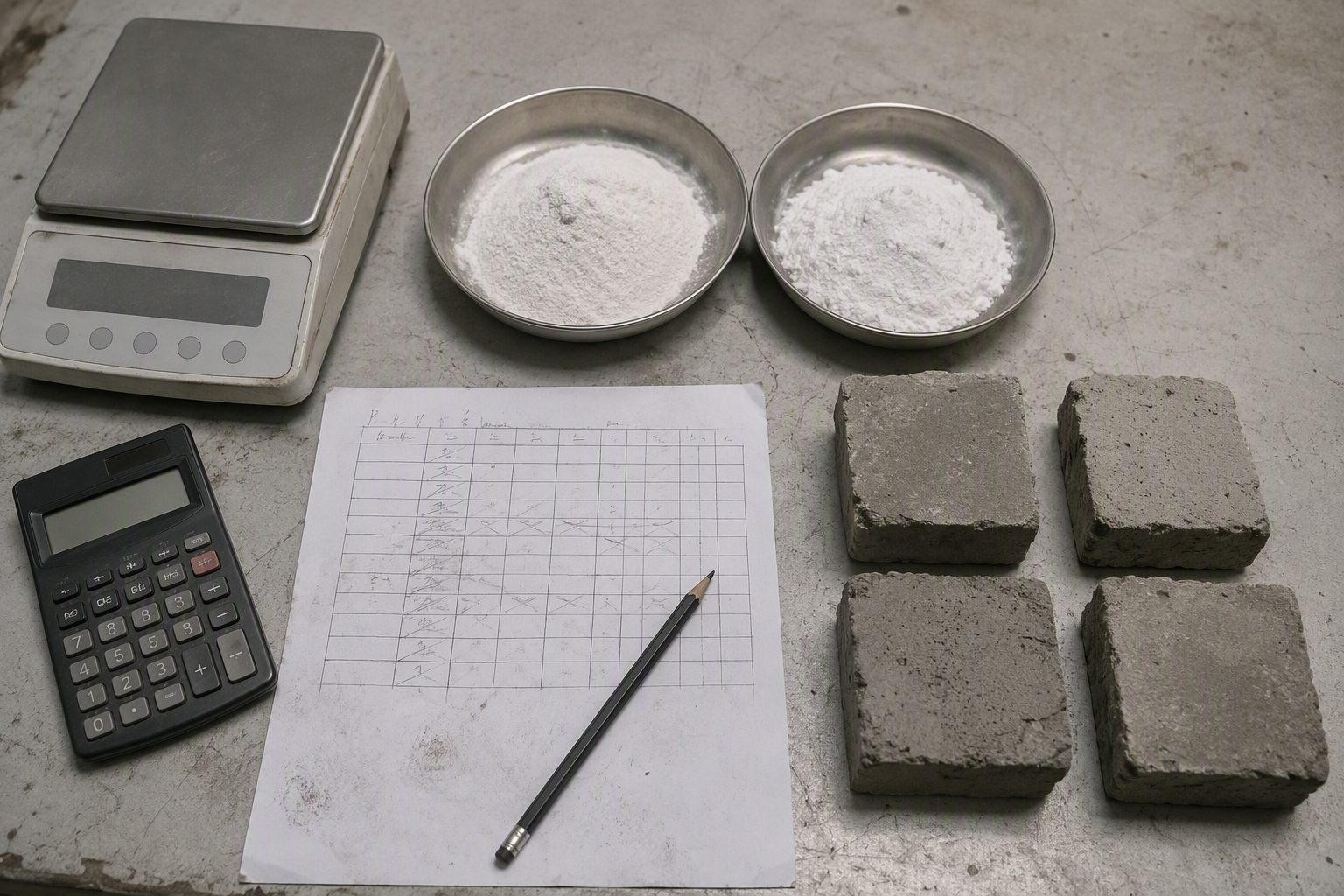
A Practical Cost Framework
Let me walk through a simplified example. Suppose you are formulating a tile adhesive that requires C2 classification:
| Factor | RDP Formulation | PVA-Only Formulation |
|---|---|---|
| Polymer dosage | 2.5% RDP | 0.5% PVA 2488 |
| Polymer cost/ton (indicative) | $2,500–$4,000 | $1,200–$1,800 |
| Polymer cost per ton of mortar | $62.50–$100.00 | $6.00–$9.00 |
| Meets C2 wet adhesion? | Yes (validated) | Very unlikely |
| Callback / failure risk | Low | High |
| Reformulation needed? | No | Yes — add RDP anyway |
The PVA-only formulation looks dramatically cheaper on paper. But if the product fails the wet adhesion test at the job site or in the buyer's quality check, the cost of rework, product returns, and lost customer trust dwarfs the per-ton savings.
When PVA Genuinely Saves Money
For wall putty, interior gypsum plaster, and other dry-environment products, PVA 2488 delivers the required performance at a fraction of the polymer cost.11 In these applications, using RDP would be over-engineering. I have helped customers reduce their formulation cost by 15–25% by switching from an RDP-based interior putty to a PVA 2488 + HPMC system — with no loss in adhesion, workability, or surface quality under their production and field conditions.
The Hidden Costs of Wrong Selection
Beyond raw material price, consider:
- Failed batches — if the polymer does not perform, the entire batch may be downgraded or scrapped
- Reformulation time — R&D and trial costs to fix a formula that should have been right the first time
- Customer callbacks — delamination, cracking, or softening in the field destroys brand reputation
- Inventory risk — stocking a polymer you cannot use across enough products to justify the MOQ
The cheapest polymer powder is the one that meets your performance target at the lowest total formulation cost, including risk.
How Should You Test and Validate Before Committing to a Polymer?
Theory and spec sheets will get you 80% of the way. The last 20% — the part that determines whether the product succeeds or fails in the field — comes from controlled sample testing. I recommend every buyer treat polymer selection as a structured trial process, not a catalog comparison.
Before committing to RDP or PVA 2488 at scale, request samples from your supplier, prepare test formulations with your actual raw materials, and evaluate performance under conditions that simulate your target application. Test adhesion (dry and wet if applicable), workability, open time, sag resistance, and curing behavior. Compare results against your product standard and your competitors' benchmarks. If you need a starting protocol, how to test cellulose ether quality before bulk purchase walks through the incoming-inspection tests you can run in-house.
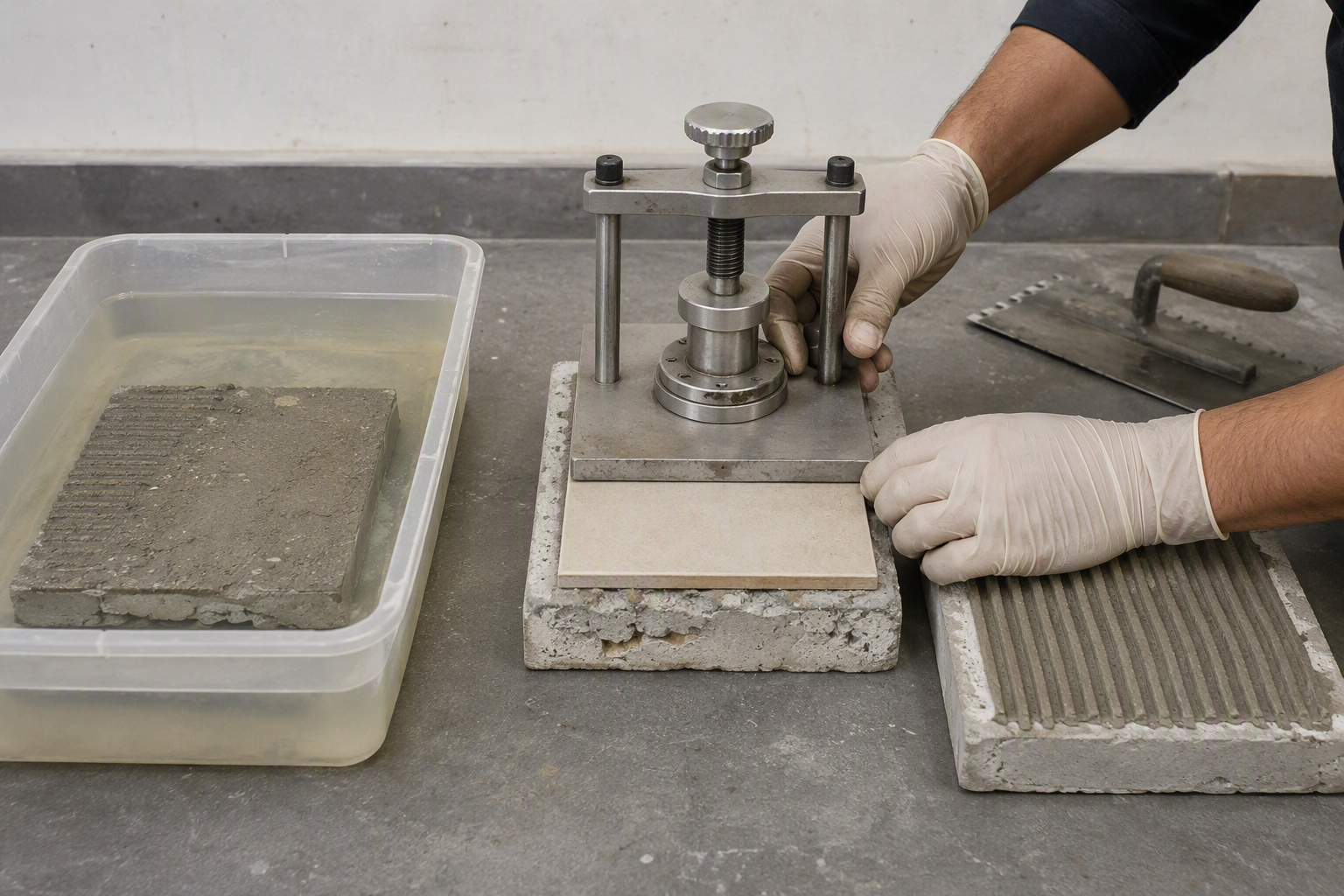
A Step-by-Step Selection and Testing Framework
Here is the diagnostic sequence I walk through with customers:
- Define the mortar type and product standard. What are you making? Tile adhesive (C1 or C2)? Wall putty? Self-leveling compound? What performance standard does it need to meet (EN,
"Redispersible polymer powder modified cementitious tile ...", https://pmc.ncbi.nlm.nih.gov/articles/PMC8606344/. Studies of polymer-modified cement mortars report that redispersible polymer powders form films during drying and can improve adhesion and deformability while altering water transport properties. Evidence role: mechanism; source type: paper. Supports: Research describing redispersion, film formation, and the effects of polymer powders on adhesion, deformation, and water transport in cementitious mortars.. Scope note: The magnitude of improvement depends on polymer type, dosage, curing conditions, and mortar composition. ↩
"Effect of Polyvinyl Alcohol on the Rheological Properties of ...", https://pmc.ncbi.nlm.nih.gov/articles/PMC7037168/. Experimental studies indicate that polyvinyl alcohol can modify the rheology and cohesive behavior of cementitious or gypsum-based mixes and may affect bond-related properties. Evidence role: general_support; source type: paper. Supports: Experimental evidence on the influence of polyvinyl alcohol on rheology, cohesion, and bonding properties of cement- or gypsum-based materials.. Scope note: Results are formulation-specific and do not establish the same benefit for every PVA grade or dry-mix mortar. ↩
"Spray drying of polymer dispersions for redispersible ...", https://www.sciencedirect.com/science/article/pii/S0300944024005617. Technical literature describes redispersible polymer powders as spray-dried dispersions, with vinyl acetate-ethylene copolymers among the commonly used binder chemistries for mortar modification. Evidence role: definition; source type: research. Supports: A technical description of redispersible polymer powders, including spray drying and the widespread use of vinyl acetate-ethylene copolymers.. Scope note: Other polymer chemistries are also used, so VAE is common rather than universal. ↩
"Spray drying of polymer dispersions for redispersible ...", https://www.sciencedirect.com/science/article/pii/S0300944024005617. Research on redispersible latex powders identifies polyvinyl alcohol as a commonly used protective colloid that stabilizes polymer dispersions during spray drying and influences redispersion behavior. Evidence role: mechanism; source type: paper. Supports: Evidence that polyvinyl alcohol and related protective colloids are used to stabilize polymer dispersions and may remain associated with spray-dried redispersible powder particles.. Scope note: The protective-colloid system and its distribution on particles differ among products. ↩
"Redispersible polymer powder modified cementitious tile ...", https://pmc.ncbi.nlm.nih.gov/articles/PMC8606344/. Controlled mortar studies have reported higher tensile adhesion for VAE-polymer-modified formulations than for otherwise comparable unmodified mortars. Evidence role: statistic; source type: paper. Supports: Controlled comparisons reporting the change in tensile adhesion strength of mortars modified with VAE-based redispersible polymer powders.. Scope note: A numerical increase of 0.2–0.8 MPa should be cited only where the source reports comparable substrates, dosage, curing, and test methods. ↩
"Assessment of Cementitious Ceramic Tile Adhesives in ... - PMC", https://pmc.ncbi.nlm.nih.gov/articles/PMC10301792/. The applicable EN 12004 classification specifies tensile-adhesion performance requirements for improved cementitious tile adhesives after defined conditioning regimes, including water immersion, heat ageing, and freeze-thaw cycling. Evidence role: definition; source type: institution. Supports: The C2 tensile adhesion requirements and conditioning procedures in the applicable edition of EN 12004 or its associated test standard.. Scope note: The exact threshold and conditioning details must be checked against the edition of EN 12004 and associated test methods adopted for the relevant market. ↩
"Redispersible Acrylic Ester Polymers - PMC - NIH", https://pmc.ncbi.nlm.nih.gov/articles/PMC11595522/. Research on polymer-modified mortars indicates that exterior durability and deformability depend on the polymer system and its resistance to repeated moisture and temperature exposure. Evidence role: general_support; source type: paper. Supports: Comparative durability or deformability evidence for PVA-modified and redispersible-polymer-modified mortars under exterior moisture exposure.. Scope note: This contextual evidence does not prove that every PVA-only exterior formulation fails; compliance must be established by testing the specific system. ↩
"1788 vs 2488 — Which Grade for Your Mortar Application?", https://www.sdcharing.com/news/pva-selection-guide-1788-vs-2488-mortar.html. Industry consumption data would be required to establish whether wall putty is the largest-volume dry-mix mortar use of PVA 2488. Evidence role: statistic; source type: other. Supports: Independent market or industry data comparing PVA 2488 consumption across dry-mix mortar applications.. Scope note: Application shares can vary materially by country, construction practice, and the PVA grade included in the comparison. ↩
"Experimental Study on PVA-MgO Composite Improvement of ...", https://pmc.ncbi.nlm.nih.gov/articles/PMC9412297/. Wall-putty formulation studies can assess how PVA dosage affects troweling behavior, adhesion, surface hardness, and powdering of the dried layer. Evidence role: general_support; source type: research. Supports: Formulation studies measuring the effects of approximately 0.3–0.8% PVA 2488 on wall-putty workability, adhesion, surface hardness, and dusting.. Scope note: A stated dosage range is only a starting formulation range and cannot predict performance without the accompanying filler, binder, cellulose ether, water demand, and curing conditions. ↩
"Core-Shell Morphology of Redispersible Powders in Polymer ...", https://pmc.ncbi.nlm.nih.gov/articles/PMC6403678/. Evidence for improved redispersion from post-added polyvinyl alcohol should come from formulation-specific measurements of dispersion, rheology, or film development in RDP-containing mortar. Evidence role: mechanism; source type: paper. Supports: Experimental evidence on whether post-added PVA changes the wetting, dispersion, or redispersion of RDP-containing mortar formulations.. Scope note: The use of PVA as a protective colloid during powder manufacture does not by itself demonstrate a benefit from adding free PVA to a finished dry mix. ↩
"Redispersible polymer powder modified cementitious tile ...", https://www.sciencedirect.com/science/article/pii/S2405844021025147. Comparative formulation studies may show that an interior product meeting defined performance criteria can use a lower-cost polymer system than one designed for higher wet-durability or deformability requirements. Evidence role: general_support; source type: paper. Supports: Comparative formulation evidence showing when PVA- and RDP-modified interior products meet defined requirements at different dosages and material costs.. Scope note: Relative cost is time-, region-, grade-, dosage-, and specification-dependent, so it should not be generalized without current local pricing and validation testing. ↩