Why Is HPMC Used in Tile Adhesive?
HPMC in tile adhesive helps manufacturers control water retention, wet-mortar consistency, working time, and application behavior. Without suitable cellulose ether, the mortar can lose water too quickly, become difficult to spread, or provide insufficient adjustment time. A formulation-specific HPMC grade helps balance these properties without acting as the primary bonding agent.
HPMC is used in tile adhesive mainly to retain water and regulate wet-mortar rheology.1 It can improve workable consistency, open time, tile adjustment, and resistance to slip. However, cement and polymer components provide the main bonding contribution. Manufacturers must select the HPMC grade and dosage through trials based on the complete formulation and application conditions.
I often find that buyers begin with a viscosity target because it is easy to compare on a technical data sheet. In practice, the more useful questions concern the formulation, climate, substrate, test method, and desired working behavior. These factors determine which grade deserves a controlled sample trial.
What Does HPMC Do in Tile Adhesive?
Tile adhesive needs enough water for cement hydration and enough body for smooth application. However, porous substrates, hot weather, and long application periods can disturb that balance. HPMC helps manage the water and consistency of the wet mortar so installers can spread and adjust it more predictably.
HPMC performs several supporting functions in cement-based tile adhesive. It reduces premature water loss, modifies consistency, supports open and adjustment time, and can help control tile slip. It does not replace cement or redispersible polymer powder as a bonding component.2 Its main role involves water management and application behavior within the complete formulation.
HPMC manages water inside the fresh mortar
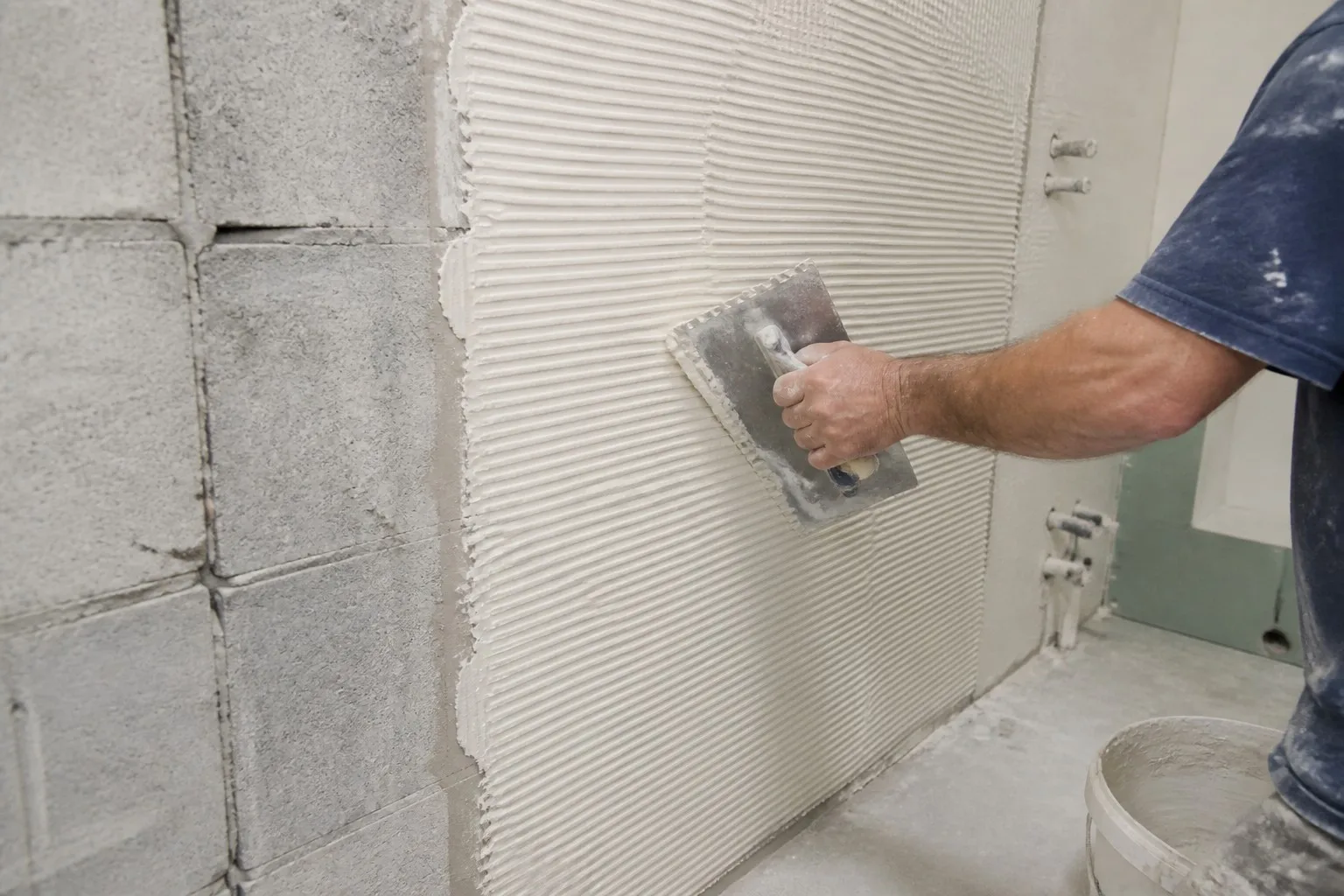
Fresh tile adhesive contains water for several purposes. Water activates cement hydration, allows additives to dissolve or disperse, and gives the installer a workable paste. If the substrate or surrounding air removes this water too quickly, the adhesive can develop a dry surface before the tile is placed.
HPMC increases the mortar's ability to hold water during the working period.3 This function can be especially relevant when the adhesive is applied over absorbent cement render, concrete blocks, screeds, or other porous mineral substrates.
However, I do not treat water retention as an isolated guarantee of bond performance. Several factors still influence the final result:
- The cement type and content affect hydration and strength development.
- The aggregate grading affects packing, water demand, and application feel.
- The polymer type and dosage can affect adhesion, deformability, and water resistance.
- The substrate affects suction, cleanliness, flatness, and moisture transfer.
- The tile type affects contact, wetting, weight, and installation requirements.
- The application method affects coverage, bed thickness, and curing.
HPMC modifies wet-mortar rheology
Rheology describes how the mortar flows and deforms under force.4 A tile adhesive should usually spread under the pressure of a notched trowel, but it should also retain enough structure after the force stops.
HPMC can help create this balance. The correct grade may provide a smoother troweling feel, stable ridges, and better tile positioning. A mismatched grade can make the product feel too heavy, sticky, thin, or slow to wet.
In sample discussions, I have seen nominally similar grades produce noticeable differences in mixing, ridge stability, and adjustment behavior. I treat those observations as formulation-specific, rather than proof that one grade will perform the same way in every tile adhesive.
HPMC is not the main adhesive
Buyers sometimes interpret the phrase "HPMC for tile adhesive" as meaning that HPMC creates the main bond. That interpretation is inaccurate.
In a cement-based system, hydrated cement forms the principal mineral matrix. Redispersible polymer powder, when included, can support adhesion and other performance properties. Fillers, aggregates, fibers, starch ethers, accelerators, retarders, and other additives may also influence the final result.
HPMC supports that system by managing water and wet application properties. It should therefore be evaluated as one interacting component, not as a stand-alone solution for hollowing, cracking, poor coverage, or tile failure.
How Does HPMC in Tile Adhesive Affect Water Retention and Working Time?
Tile adhesive that loses moisture too quickly can become difficult to use before the installer finishes placing tiles. The surface may skin over, while the mortar underneath still appears workable. Suitable HPMC can slow premature water loss and provide a more useful application window.
HPMC in tile adhesive supports water retention by increasing the fresh mortar's resistance to moisture loss. This effect can help preserve workable consistency and extend useful open or adjustment time. The actual improvement depends on the HPMC grade, dosage, cement system, water demand, temperature, humidity, substrate suction, and test conditions.
Open time and adjustment time are related but different
Procurement teams should distinguish several terms that are sometimes grouped under "working time."
| Property | What the property describes | Why buyers evaluate it |
|---|---|---|
| Pot life | Pot life describes how long mixed adhesive remains usable in the container. | It affects batch size and installation planning. |
| Open time | Open time describes how long exposed adhesive can still achieve the required result after spreading. | It affects the area that an installer can spread before placing tile. |
| Adjustment time | Adjustment time describes how long an installed tile can be repositioned acceptably. | It affects alignment and correction during installation. |
| Slip resistance | Slip resistance describes the ability to limit tile movement on a vertical surface. | It affects positioning and installation efficiency. |
| Skinning behavior | Skinning behavior describes surface film formation after spreading. | It can affect wetting and contact with the tile. |
HPMC can influence all these behaviors, but it does not control them alone. For example, a change that increases apparent body may improve vertical positioning while making troweling heavier. Another change may support water retention but introduce more air or alter wetting behavior.
Climate changes the required balance
Hot, dry, or windy conditions can accelerate surface water loss.5 Highly absorbent substrates can also remove water rapidly. In these situations, a tile-adhesive producer may prioritize water retention and open-time stability.
Cool or humid conditions create a different challenge. Excessive retention or a poorly balanced formulation may contribute to slower drying or delayed early strength development. This possibility does not mean that water retention is undesirable. It means that the formulation requires balance.
I ask buyers to provide the expected application environment whenever possible, including:
- The buyer should identify the typical temperature range.
- The buyer should describe the expected relative humidity.
- The buyer should state whether applications are mainly indoor or outdoor.
- The buyer should identify common substrate types and their absorption.
- The buyer should describe the tile format and approximate weight.
- The buyer should state the intended adhesive bed thickness.
Test methods must match the purchasing objective
A hand trial can reveal mixing feel, troweling resistance, ridge formation, and initial slip. However, a hand trial cannot replace a controlled performance test.
Manufacturers may evaluate tile adhesives under standards such as the applicable editions of EN 12004, ISO 13007, or relevant regional requirements. Related test methods may cover open time, slip, tensile adhesion, and other performance characteristics.6 Buyers should verify the current standard edition, laboratory competence, conditioning method, and product classification required in the destination market.
I use application observations to support preliminary grade selection. I do not use them as a substitute for qualified laboratory testing or field validation.
A useful trial records exact quantities, water temperature, mixing time, resting time, remixing procedure, substrate, environmental conditions, and observation intervals. Without these controls, two batches can appear different for reasons unrelated to HPMC.
Why Should Buyers Avoid Selecting HPMC by Viscosity Alone?
Viscosity is easy to place in a purchasing specification, so buyers often treat it as the decisive quality indicator. This approach creates risk because the reported number depends on the test method, concentration, temperature, instrument, and spindle or rotational conditions.7 Similar numbers do not always produce similar mortar behavior.
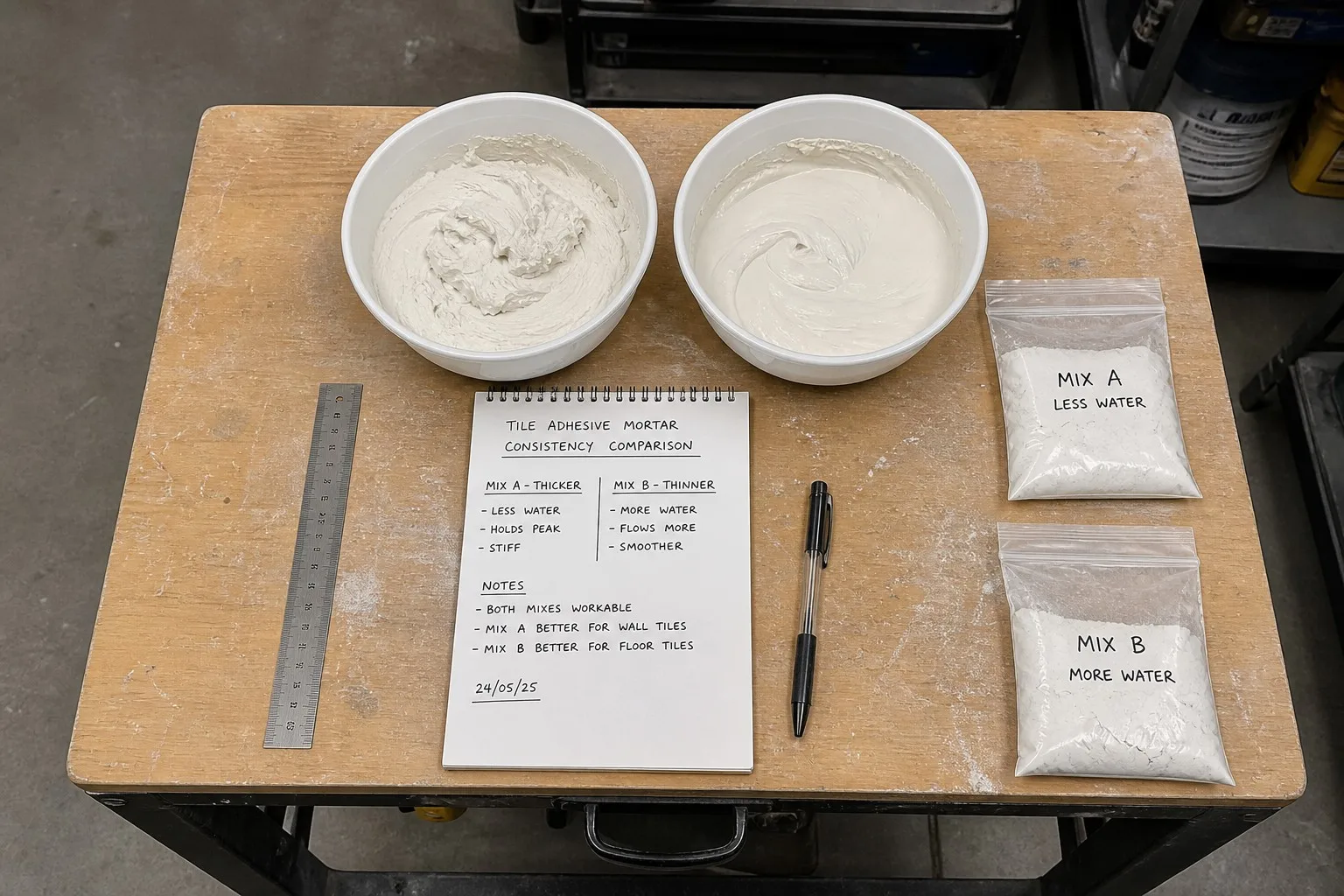
Buyers should not select HPMC for tile adhesive by viscosity alone. Two grades with similar stated viscosity can differ in water retention, dissolution, air entrainment, rheology, and application feel.8 A higher viscosity or dosage does not automatically deliver better performance. Buyers need comparable test methods and side-by-side formulation trials.
Viscosity values require test context
A viscosity value has limited meaning without its measurement conditions. Suppliers may use different solution concentrations, temperatures, preparation procedures, and instruments. For example, a result measured in a 2% aqueous solution should not be compared directly with a result produced under a different concentration or method.
A technical data sheet should state enough information for the buyer to understand the result. I recommend checking the following details:
- The supplier should state the solution concentration.
- The supplier should state the measurement temperature.
- The supplier should identify the instrument or method.
- The supplier should provide the relevant spindle and speed when applicable.
- The supplier should explain whether the value represents a target, typical result, or specification range.
- The supplier should disclose the batch tolerance or agreed acceptance range.
A buyer should also compare results using the same method. Otherwise, a "higher" reported viscosity can simply reflect a different laboratory procedure.
Similar viscosity does not mean identical performance
HPMC grades can differ in characteristics beyond a single viscosity result. These differences may include modification level, particle characteristics, substitution pattern, dissolution behavior, moisture content, and interaction with other raw materials.
During preliminary sample trials, I have observed grades with comparable declared viscosity create different wet consistencies in the same trial formulation. One sample may produce more body, while another may spread more smoothly. A third may show a different adjustment window.
These observations remain bounded by the specific materials and procedures used in the trial. I would not generalize them into a universal ranking. The correct interpretation is that viscosity narrows the candidate list, but application testing decides suitability.
More HPMC is not automatically better
An increased dosage may raise consistency or water retention, but it can also change other properties. Depending on the formulation, excessive dosage may create heavy troweling, unwanted stickiness, altered wetting, increased water demand, or delayed strength development.9
The dosage also has a direct cost effect. A manufacturer that uses more cellulose ether than necessary may increase formulation cost without gaining a useful improvement.
| Selection approach | Main advantage | Main risk |
|---|---|---|
| The buyer selects only by low price. | The buyer may reduce immediate raw-material cost. | The formulation may suffer from inconsistency or poor fit. |
| The buyer selects only by high viscosity. | The buyer uses a simple comparison point. | The grade may create unsuitable rheology or water demand. |
| The buyer increases dosage immediately. | The buyer may see a rapid consistency change. | The product may become heavy or unbalanced. |
| The buyer runs controlled comparative trials. | The buyer measures the properties that matter. | The process requires more time and disciplined records. |
I usually recommend testing several realistic dosages around the current formulation rather than making a large change at once. The formulator should keep other ingredients and procedures constant. This method helps isolate whether the observed difference actually comes from the HPMC sample.
How Should I Evaluate an HPMC Grade for Tile Adhesive?
An HPMC supplier cannot make a reliable recommendation from a viscosity request alone. A grade that works in one economy tile adhesive may not suit a polymer-modified product, a large-format tile application, or a hot-climate formulation. A diagnostic selection process reduces wasted samples and misleading conclusions.
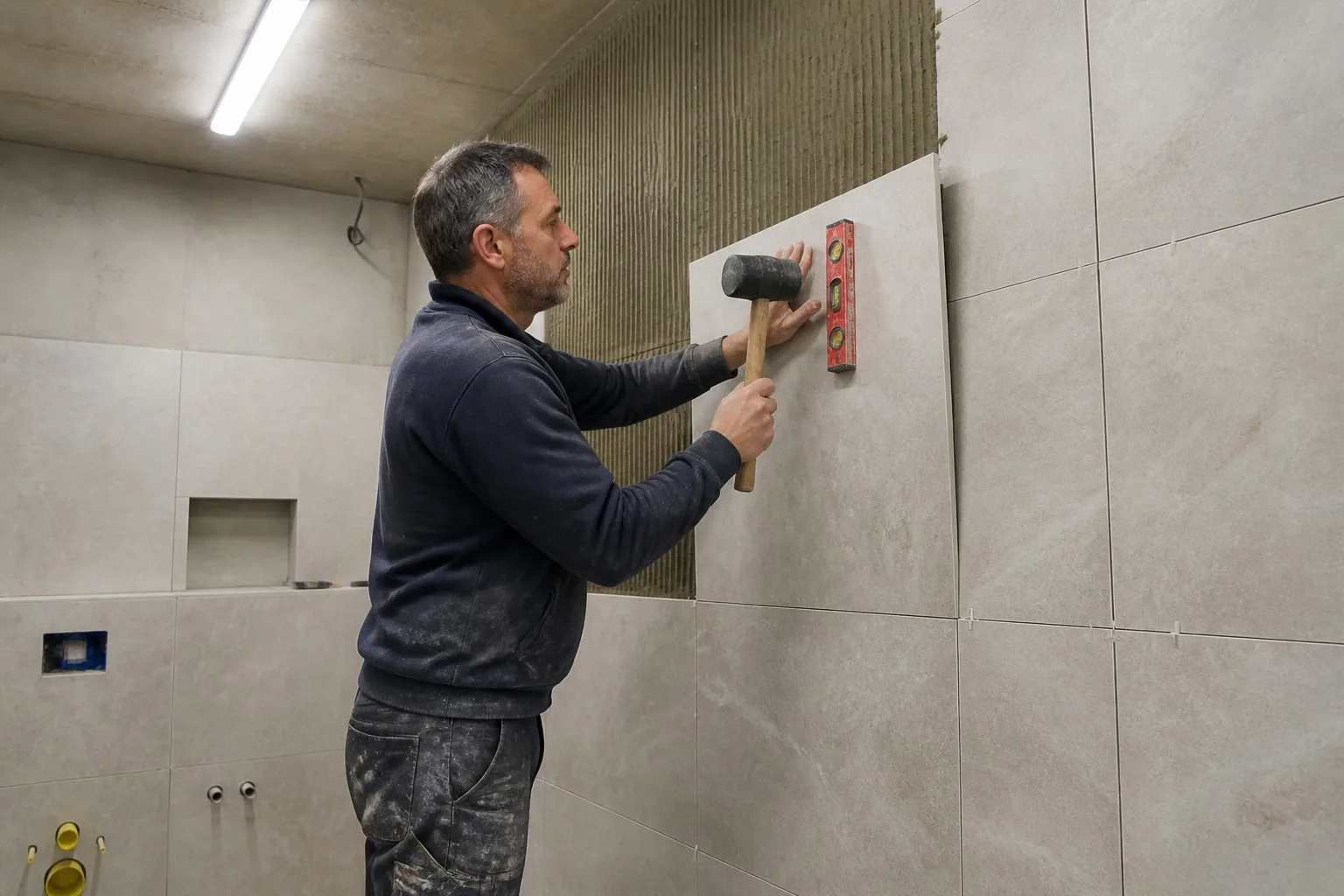
I evaluate an HPMC grade by first defining the full formulation, current product, replacement objective, target performance, climate, substrate, test method, and acceptance criteria. I then compare shortlisted grades under controlled conditions. The final choice should balance consistency, water retention, open time, adjustment, slip, validated bond performance, cost, and batch stability.
Start with the complete formulation
A useful discussion begins with more than the HPMC dosage. The supplier needs to understand the system in which the cellulose ether will operate.
I normally ask for the following information:
- The buyer should provide the formulation type. The formula may be an economy adhesive, a standard polymer-modified product, a deformable adhesive, or another category.
- The buyer should identify the main raw materials. The list should include cement, aggregate, fillers, redispersible polymer powder, starch ether, fibers, and other relevant additives.
- The buyer should state the current cellulose ether grade and dosage. The buyer should also provide the viscosity test method when available.
- The buyer should define the replacement objective. The objective may involve better open time, easier troweling, reduced slip, improved sourcing, cost control, or more consistent batches.
- The buyer should describe the application conditions. The description should include climate, substrate, tile type, and bed thickness.
- The buyer should define the acceptance criteria. The criteria should include measurable limits rather than only descriptions such as "better" or "stronger."
Some formulations are commercially sensitive. In that case, the buyer can provide ranges or relative proportions. Even partial formulation context is more useful than a viscosity number alone.
Use a controlled trial matrix
A good trial changes one main variable at a time. If the formulator changes HPMC, water content, polymer dosage, and mixing procedure together, the result becomes difficult to interpret.
A simple comparison can include:
- The control batch should use the current HPMC grade at the normal dosage.
- The first trial batch should use the candidate grade at an equivalent starting dosage.
- The next batches should use modestly adjusted dosages when justified.
- Every batch should use the same raw-material lots whenever possible.
- Every batch should follow the same mixing, resting, and remixing sequence.
- The evaluator should record results at fixed time intervals.
The evaluation sheet can include powder appearance, mixing behavior, water demand, wet consistency, trowel feel, ridge stability, slip, open time, adjustment behavior, wetting contact, density, and qualified adhesion-test results.
Separate subjective and objective findings
Application feel matters because installers must use the product efficiently. However, terms such as "creamy," "smooth," or "sticky" remain subjective.
I recommend recording subjective observations alongside measurable results. For example, the evaluator can report that a sample felt easier to spread while also recording wet density, slip distance, open-time test results, and adhesion data. This approach gives procurement and technical teams a common basis for discussion.
The manufacturer should also repeat promising trials. One successful batch does not establish production stability.10 Repeated results across raw-material lots and realistic storage conditions provide stronger evidence.
How Can Buyers Assess an HPMC Supplier for Tile Adhesive?
A technically suitable sample can still create purchasing problems if the supplier cannot maintain batch consistency, documentation, packaging, or delivery. At the same time, a polished certificate does not prove that a grade will work in the buyer's formulation. Buyers need to assess both product fit and supply reliability.
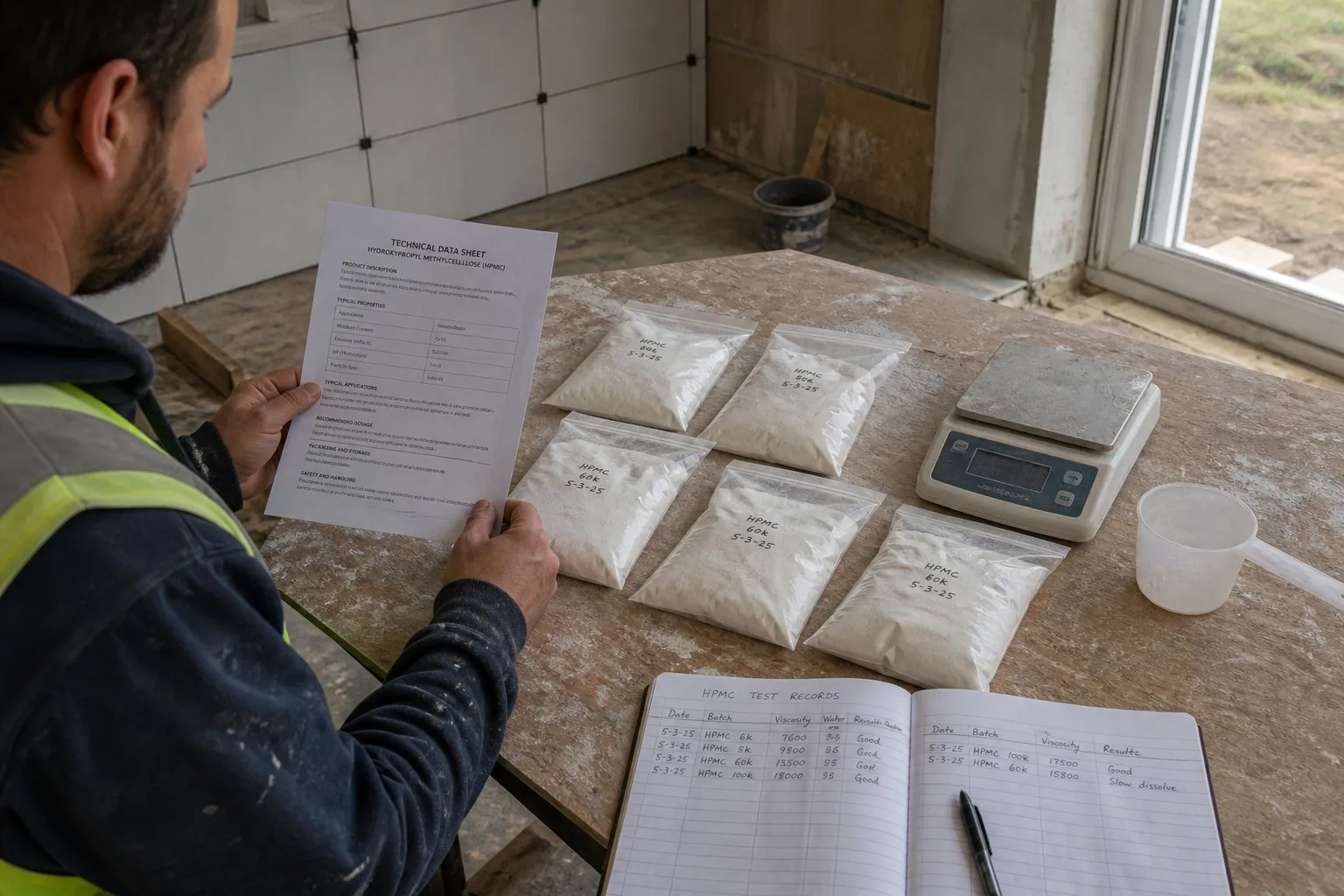
Buyers should assess an HPMC supplier through sample performance, batch-to-batch consistency, traceable quality documents, production capacity, packaging controls, technical communication, and export reliability. Buyers should verify certificates and test reports rather than accepting them at face value. A qualified independent laboratory should confirm application-specific performance when required.
Review documents as evidence, not decoration
An industrial HPMC supplier should provide documents relevant to the product and transaction. Depending on the market and purchase stage, these documents may include:
- The supplier should provide a product technical data sheet.
- The supplier should provide a batch-specific certificate of analysis.
- The supplier should provide a current safety data sheet.
- The supplier should identify the viscosity method and specification range.
- The supplier should provide packaging and storage information.
- The supplier should provide a lot number and production traceability.
- The supplier should provide regulatory or quality-system documents when requested.
Buyers should verify the issuer, document scope, validity dates, product identity, and applicable standard. A general company certificate may not cover every product or manufacturing site. Likewise, a certificate of analysis reports selected batch properties, but it does not prove tile-adhesive performance.11
Evaluate consistency across batches
The first sample often receives extra attention. Long-term procurement success depends on whether normal commercial batches match the approved material.
I suggest that buyers compare pre-shipment or delivered samples against an approved reference. The comparison should use the same incoming inspection method and, when practical, a small standardized mortar test.
Useful incoming checks may include:
| Check | Purchasing purpose |
|---|---|
| The buyer checks lot identification. | The check supports traceability and complaint handling. |
| The buyer checks moisture and appearance. | The check can reveal storage or handling issues. |
| The buyer checks viscosity by an agreed method. | The check supports specification consistency. |
| The buyer runs a standard mortar trial. | The trial detects application differences that solution viscosity may miss. |
| The buyer checks packaging integrity. | The check reduces moisture uptake and contamination risks. |
Ask how the supplier handles deviations
A strong supplier evaluation should include difficult questions. The buyer should ask what happens when a batch falls outside the agreed specification, a shipment becomes wet, or the trial result differs from the reference sample.
I pay attention to whether the supplier can explain its retained-sample procedure, batch records, complaint process, corrective action, and replacement policy. Clear communication does not eliminate technical risk, but it makes the risk easier to manage.
Buyers should also confirm lead times, minimum order quantities, pallet configuration, container loading, labeling, OEM packaging requirements, and document timing. These commercial details matter because an excellent grade cannot support production if it arrives late or in unsuitable packaging.
<h3>Related technical guides</h3> <ul> <li><a href="https://khcel.com/dry-mortar-additive-enhancing-performance-with-polymers/">Dry Mortar Additive: Enhancing Performance with Polymers</a></li> <li><a href="https://khcel.com/hpmc/">HPMC</a></li> <li><a href="https://khcel.com/hpmc-workability-optimizing-mortar-performance-consistency/">HPMC Workability: Optimizing Mortar Performance & Consistency</a></li> </ul>
Frequently Asked Questions
Is HPMC the ingredient that bonds tiles to the substrate?
No. HPMC is not the primary bonding ingredient in cement-based tile adhesive. Cement hydration forms the main mineral matrix, while redispersible polymers may support adhesion and other properties. HPMC mainly manages water retention, consistency, open time, adjustment behavior, and wet-mortar rheology.
Does higher-viscosity HPMC always improve tile adhesive?
No. Higher viscosity does not automatically mean better tile-adhesive performance. It may increase body, but it can also make troweling heavier or change water demand and wetting. Buyers should compare grades under the same test method and confirm performance in their complete formulation.
What HPMC dosage should a tile-adhesive manufacturer use?
No universal dosage suits every formulation. The appropriate level depends on the grade, cement and filler system, polymer content, target consistency, climate, substrate, and required working time. I recommend controlled trials around the current dosage, followed by standardized application and performance testing.
Can HPMC prevent tile hollowing or cracking?
HPMC alone cannot prevent hollowing, cracking, or tile failure. These outcomes also depend on substrate preparation, adhesive coverage, formulation design, tile characteristics, movement, application method, and curing. Qualified technical professionals should evaluate failures and high-risk applications using the complete system.
Which documents should an HPMC buyer request?
A buyer should normally request a technical data sheet, batch-specific certificate of analysis, safety data sheet, agreed test method, packaging information, and traceability details. The buyer should verify any quality or regulatory certificates and use qualified testing when product classification or application-specific compliance is required.
Conclusion
HPMC in tile adhesive is primarily a water-retention and rheology-control additive, not the main source of bonding. A suitable grade can support consistency, open time, adjustment, and tile positioning, but viscosity alone cannot identify the best product. I recommend that buyers define their formulation, environment, test method, and acceptance criteria before comparing samples. If you are evaluating a new HPMC grade, contact our team with your current formulation goals and test requirements so we can help shortlist samples for controlled validation.
"Water Retention Mechanism of HPMC in Cement Mortar - PMC", https://pmc.ncbi.nlm.nih.gov/articles/PMC7372461/. Studies of cellulose ethers in cement-based mortars report that hydroxypropyl methylcellulose can increase water retention and modify fresh-mortar rheology through its effects on the aqueous phase and particle interactions. Evidence role: mechanism; source type: paper. Supports: Research showing that cellulose ethers such as HPMC alter water retention and fresh-state rheological behavior in cement-based mortars.. Scope note: Effects vary with polymer grade, dosage, cement composition, aggregate system, and test conditions. ↩
"Redispersible polymer powder modified cementitious tile ...", https://pmc.ncbi.nlm.nih.gov/articles/PMC8606344/. Cement hydration produces the principal inorganic binding matrix in cementitious mortars, while redispersible polymer powders may form polymer films that contribute to adhesion, flexibility, and water resistance; cellulose ethers are generally used chiefly as fresh-state modifiers. Evidence role: mechanism; source type: paper. Supports: Research explaining the roles of hydrated cement and redispersible polymer powders in the cohesive matrix and adhesion of polymer-modified cement mortars.. Scope note: The relative contribution of each constituent depends on the specific mortar formulation and curing conditions. ↩
"Water Retention Mechanism of HPMC in Cement Mortar - PMC", https://pmc.ncbi.nlm.nih.gov/articles/PMC7372461/. Experimental studies of fresh cement mortars show that cellulose ethers, including HPMC grades, can reduce water loss and increase measured water retention during the period before setting. Evidence role: mechanism; source type: research. Supports: Experimental evidence that HPMC or related cellulose ethers reduce water loss from fresh cement mortars.. Scope note: Measured retention depends on the test method, substrate absorbency, evaporation conditions, polymer chemistry, and dosage. ↩
"Rheology", https://en.wikipedia.org/wiki/Extensional_rheology. Rheology is the branch of physics concerned with the flow and deformation of materials under applied stresses. Evidence role: definition; source type: encyclopedia. Supports: The standard definition of rheology as the study of flow and deformation of matter.. ↩
"Guide for Curing Portland Cement Concrete Pavements, II , August ...", https://www.fhwa.dot.gov/publications/research/infrastructure/pavements/pccp/05038/005.cfm. Guidance on fresh cementitious materials identifies higher temperature, lower relative humidity, and greater wind speed as factors that increase surface evaporation and the risk of rapid moisture loss. Evidence role: mechanism; source type: government. Supports: Authoritative guidance that evaporation from fresh cementitious materials rises with higher temperature, lower relative humidity, and increased wind speed.. Scope note: Evaporation guidance for concrete is contextually applicable to cement-based tile mortars, but the exact loss rate depends on mortar thickness, substrate suction, and site conditions. ↩
"ISO 13007-2:2013 Test Methods for Ceramic Tile Adhesives", https://standards.iteh.ai/catalog/standards/iso/609300cf-03d9-434e-b460-f339f9a0f52e/iso-13007-2-2013?srsltid=AfmBOoqvbt3-pRr9QVWBVjh7e-ziv6OKom_2M2fS2JFQC5IKddBuzBdu. The ISO 13007 test-method series for ceramic tile adhesives includes procedures for evaluating characteristics such as tensile adhesion strength, open time, and slip resistance. Evidence role: general_support; source type: institution. Supports: That recognized ceramic tile-adhesive test standards include methods for open time, slip, and tensile adhesion characteristics.. Scope note: Specific methods and acceptance thresholds depend on the adhesive class, applicable standard edition, and regional adoption. ↩
"[PDF] VISCOSITY AND DENSITY OF ALUMINUM OXIDE NANOLUBRICANT", https://tsapps.nist.gov/publication/get_pdf.cfm?pub_id=907722. For non-Newtonian polymer solutions, reported apparent viscosity is conditional on concentration, temperature, shear rate or rotational speed, and the geometry or spindle used by the measuring instrument. Evidence role: mechanism; source type: education. Supports: Rheological measurement guidance showing that apparent viscosity measurements are conditional on sample preparation, temperature, shear conditions, and instrument configuration.. Scope note: The degree of sensitivity to these variables differs among HPMC grades and analytical methods. ↩
"Water Retention Mechanism of HPMC in Cement Mortar - PMC", https://pmc.ncbi.nlm.nih.gov/articles/PMC7372461/. Research on cellulose ethers in cement mortars indicates that substitution chemistry, molecular characteristics, particle form, and dosage can affect water retention, air entrainment, dissolution, and rheology in addition to nominal solution viscosity. Evidence role: general_support; source type: paper. Supports: Evidence that cellulose-ether chemistry, particle properties, and dosage influence mortar behavior independently of a nominal solution-viscosity grade.. Scope note: A source may establish the general principle without demonstrating every listed effect for every pair of commercially available HPMC grades. ↩
"Effect of Cellulose Ether and Starch Ether on Hydration ... - PMC", https://pmc.ncbi.nlm.nih.gov/articles/PMC9782582/. Studies of cellulose-ether-modified cement mortars report dosage-dependent changes in fresh-state consistency and hydration behavior, with higher additions capable of increasing viscosity or water demand and, in some systems, retarding early strength development. Evidence role: mechanism; source type: paper. Supports: Experimental findings that increased cellulose-ether content can alter fresh-mortar rheology, water demand, hydration kinetics, and early mechanical development.. Scope note: The listed application effects are formulation-dependent and should not be treated as inevitable outcomes of every dosage increase. ↩
"[PDF] 2021-S-0004 Standard Practices for Evaluating Measurement ...", https://www.nist.gov/document/osac-2021-s-0004-standard-practices-evaluating-measurement-uncertainty-quantitative. Process-validation guidance generally requires evidence that a process can repeatedly produce material meeting predetermined specifications; a single conforming batch provides limited evidence of sustained consistency. Evidence role: general_support; source type: government. Supports: Quality-validation principles requiring evidence of repeatability and consistency across repeated production runs rather than reliance on a single result.. Scope note: Formal validation frameworks may originate in regulated industries, but the repeatability principle is broadly applicable to industrial material qualification. ↩
"Q7A Good Manufacturing Practice Guidance for Active ... - FDA", https://www.fda.gov/regulatory-information/search-fda-guidance-documents/q7a-good-manufacturing-practice-guidance-active-pharmaceutical-ingredients. A certificate of analysis records results from specified tests performed on an identified batch and indicates conformance with the stated specifications; it does not independently establish performance in an end user's particular formulation or installation conditions. Evidence role: definition; source type: institution. Supports: The function of a certificate of analysis as documentation of specified analytical results for an identified batch.. Scope note: The second clause is an application-specific inference: additional formulation testing is needed where end-use performance is required. ↩