Choosing a reliable HPMC supplier can be difficult when quotations, grade names, and certificates look similar. A poor decision can lead to higher dosage, unstable production, customer complaints, or urgent replacement orders.1 I recommend evaluating suppliers through application testing, commercial-batch verification, supply assessment, and technical responsiveness rather than price alone.
A reliable HPMC supplier should provide a grade that performs in your actual formulation, reproduce that performance across commercial batches, maintain traceable quality controls, and respond effectively when problems occur. I suggest using staged qualification: test application samples, place a trial order, compare sample and bulk performance, audit supporting documents, and review delivery and complaint-handling capabilities.

I have observed in customer communication that the best-looking specification does not always produce the best application result. The key question is not whether a supplier can send one good sample. The real question is whether that supplier can deliver repeatable performance without creating hidden costs.
What Should You Evaluate in a Reliable HPMC Supplier?
Supplier comparisons often begin with viscosity and price. This approach feels efficient, but it can hide differences in application performance, batch control, production capacity, and service. I prefer to evaluate the complete purchasing risk before approving an HPMC source.
A reliable HPMC supplier should demonstrate application fit, batch consistency, documented quality control, adequate production capacity, realistic lead times, traceability, and responsive technical support. Buyers should verify these points through samples, trial orders, test records, retained-sample procedures, and supplier audits instead of relying only on sales claims or factory photographs.
Start With Application Fit
HPMC is not selected effectively by viscosity alone. A grade that performs well in one tile adhesive may behave differently in wall putty, gypsum plaster, EIFS mortar, or self-leveling compounds.2 The surrounding formulation affects the result.
Important formulation variables can include:
- Cement, gypsum, or other binder type
- Aggregate grading and water demand
- Polymer powder dosage
- Starch ether or other rheology modifiers
- Mixing sequence and mixing time
- Ambient temperature and humidity
- Target open time, water retention, sag resistance, and workability
- Manual or mechanical application conditions
For this reason, I see application-based evaluation as the entry requirement, not the final step.
Review the Supplier as a System
A polished sample can prove that a supplier can make or obtain one suitable product. It does not prove that the same performance will continue across later deliveries. I recommend reviewing five connected areas.
| Evaluation area | What buyers should verify | Why it matters |
|---|---|---|
| Application performance | Results in the buyer’s formulation | Confirms practical suitability |
| Batch consistency | Sample-to-order and batch-to-batch comparisons | Reduces production variation |
| Quality control | Test methods, records, retained samples, traceability | Supports investigation and control |
| Supply capability | Capacity, inventory planning, lead time, shipping route | Reduces interruption risk |
| Technical service | Response process and troubleshooting ability | Limits downtime when issues arise |
A supplier should also ask detailed questions before recommending a grade. In our customer communication, I consider questions about the formulation, production process, application method, and target performance to be positive signs. A universal recommendation made without those details deserves further scrutiny.
I do not treat a large factory, a familiar grade name, or a complete certificate folder as automatic proof of reliability. I treat each item as one part of a wider qualification process.
Why Must You Test an HPMC Supplier in Your Actual Formulation?
A data sheet can narrow the options, but it cannot reproduce every raw-material interaction in your plant. If a buyer skips formulation testing, an unsuitable grade may reach production before its effects become visible. I use controlled sample evaluation to reduce that risk.
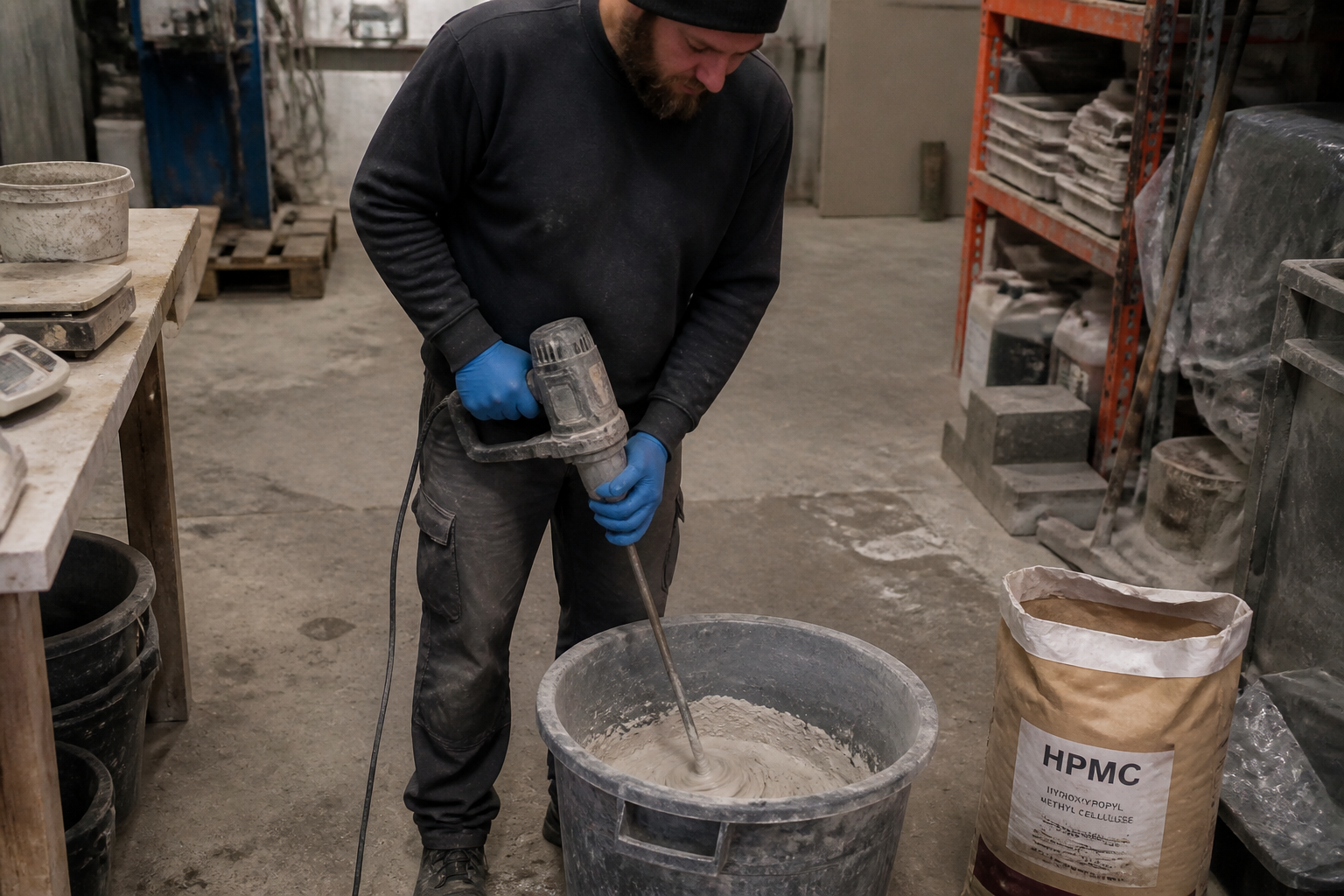
Buyers should test each prospective HPMC supplier using their own raw materials, dosage range, mixing process, and application conditions. The test should compare practical properties such as workability, water retention, open time, sag resistance, surface finish, and consistency. Qualified technical staff should define the final test protocol for the intended application.
Keep the Test Controlled
A useful comparison changes one main variable at a time. If the HPMC grade, water dosage, cement source, mixing time, and polymer dosage all change together, the team may not know what caused the result.
I suggest recording at least the following information:
- Sample identification: supplier, grade, lot number, and receipt date
- Formulation: every raw material and its dosage
- Water addition: both planned and actual water levels
- Mixing conditions: equipment, speed, sequence, and duration
- Environmental conditions: temperature and humidity when relevant
- Application observations: workability, sag, open time, and finishing
- Cured observations: adhesion, cracking, surface quality, or other relevant properties
- Evaluator comments: operator feedback and any abnormal behavior
The testing team should use recognized test methods where available. It should also record method details. For example, a viscosity value is difficult to compare unless both parties use compatible concentration, temperature, instrument, spindle, and measurement procedures.
Do Not Let One Result Decide Everything
I have seen buyers focus on a single visually impressive property, such as a very thick mortar immediately after mixing. However, high apparent consistency does not automatically mean better overall performance. The formulation may also require pumpability, smooth spreading, good wetting, adequate open time, and predictable water demand.
A sound test should answer broader questions:
- Does the material reach the target performance at a practical dosage?
- Does it require extra water or other formulation changes?
- Does the mortar remain workable for the intended period?
- Does it behave consistently after resting and remixing?
- Does it suit local raw materials and job-site conditions?
- Can production operators handle it without major process changes?
HPMC should not be blamed automatically when a formulation fails. Binder variation, aggregate grading, additives, water control, mixing, storage, and application conditions can also affect the result. I recommend asking a qualified formulator or laboratory professional to investigate application-specific failures.
How Can You Verify Batch Consistency From an HPMC Supplier?
One successful sample may create confidence, but production orders create the real test. If commercial batches differ from the approved sample, manufacturers may need to adjust water, dosage, or other additives. I therefore examine how the supplier controls repeatability after sample approval.
To verify an HPMC supplier’s consistency, buyers should compare the approved sample with trial-order and commercial-batch material under the same test conditions. They should also review incoming inspection data, lot traceability, retained-sample policies, change-control procedures, and the supplier’s process for investigating deviations and customer complaints.

Compare the Sample With the Trial Order
I recommend giving the approved sample a clear internal reference code. When the trial shipment arrives, the technical team should test the new lot beside the original sample rather than relying on memory.
The comparison can include:
- Physical appearance and ease of dispersion
- Viscosity under the same method
- Moisture, pH, ash, or other agreed specification items
- Mortar consistency at fixed water addition
- Water demand needed to reach target workability
- Application behavior
- Relevant cured-performance tests
The buyer and supplier should agree on acceptance criteria before a dispute arises. Those criteria should reflect both measurable specifications and application results.
Examine the Supplier’s Quality-Control Process
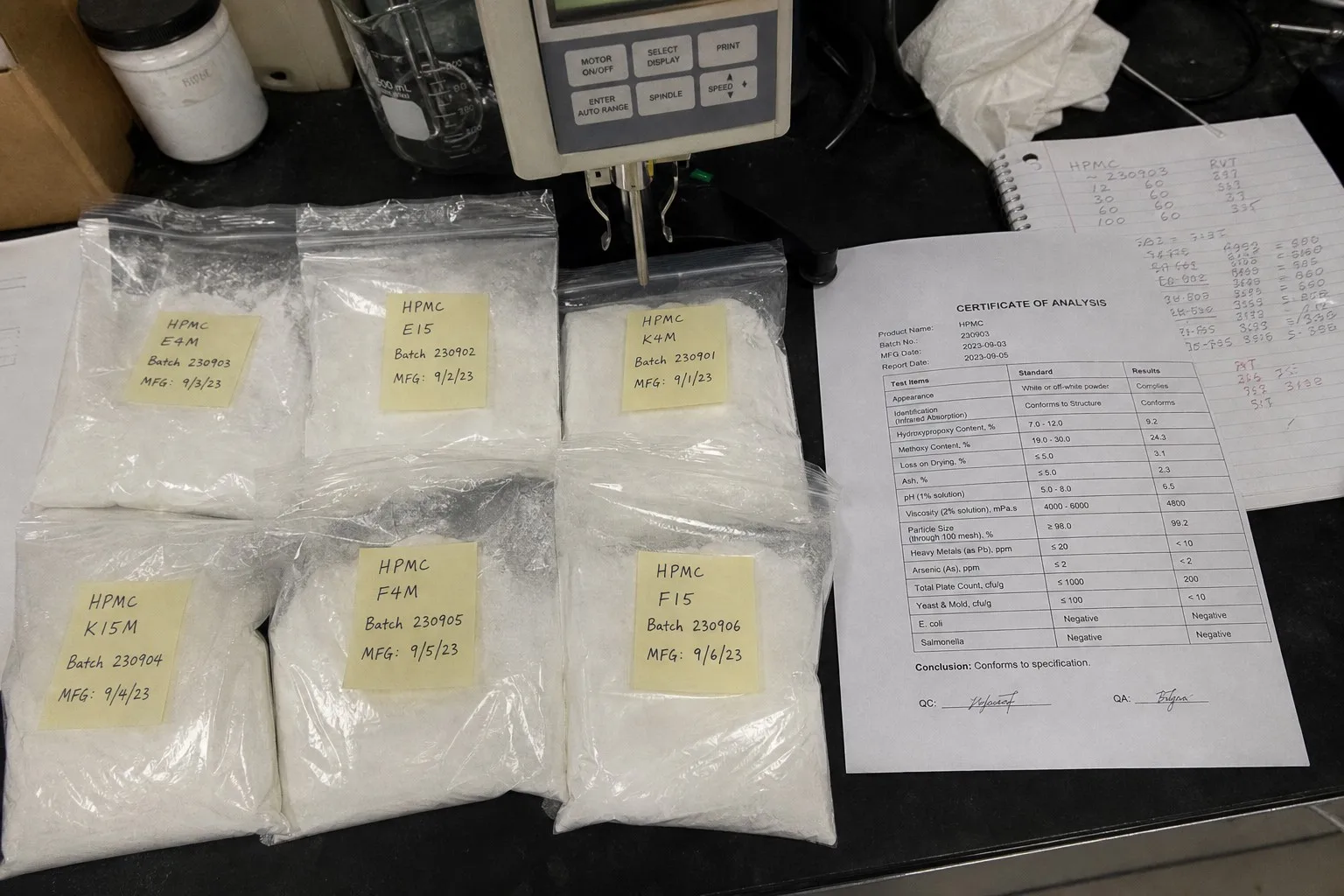
A certificate of analysis, or COA, is useful, but buyers should understand what it represents.3 They should ask whether the values come from the shipped batch, a representative production lot, or standard product data. They should also confirm which test methods apply.
Useful supplier questions include:
- How does the supplier identify each production lot?
- Which raw-material and finished-product tests does the supplier perform?
- How does the supplier control blending or homogenization?
- Does the supplier retain samples from shipped batches?
- How long does the supplier keep records and retained samples?
- How does the supplier communicate significant product or process changes?
- What happens when a batch falls outside an agreed limit?
- How does the complaint team connect a customer sample to production records?
Our own manufacturing context includes automated production lines and a facility covering 100,000 square meters. However, I would still advise a buyer to verify any supplier’s capacity, controls, and records directly. Factory scale can support consistency, but factory size alone does not prove it.4
Use More Than One Delivery to Confirm Reliability
A small trial order gives buyers a better view than a laboratory sample, but it still represents a limited period. Where purchasing risk is high, I prefer staged approval across more than one commercial delivery.
The team can track incoming quality and production behavior by lot. This record helps separate normal formulation variation from a recurring supplier issue. It also gives procurement teams evidence for future supplier reviews.
How Should You Compare the True Cost of an HPMC Supplier?
The lowest price per kilogram is easy to compare, but it may not represent the lowest production cost.5 A lower-priced grade can require a higher dosage, more formulation work, or frequent adjustments. These hidden effects can erase the apparent saving.
Buyers should compare an HPMC supplier by total usage cost, not purchase price alone. The calculation should include effective dosage, formulation changes, production interruptions, rejected material, rework, complaints, emergency purchases, delivery risk, inventory needs, and the time required to investigate or correct inconsistent performance.

Calculate Cost Per Tonne of Finished Product
A simple starting point is to calculate the HPMC cost in one tonne of finished dry mix:
HPMC cost per tonne of dry mix = HPMC dosage per tonne × HPMC price per kilogram
This calculation is more useful than comparing HPMC prices alone. However, buyers should not assume that two products can be substituted at different dosages without new application testing.
A broader commercial comparison can look like this:
| Cost category | Questions to ask |
|---|---|
| Material cost | What is the tested dosage at the target performance? |
| Reformulation cost | Will other additives or water levels need adjustment? |
| Production cost | Will mixing time, throughput, or cleaning requirements change? |
| Quality cost | Could variation create rejected batches or rework? |
| Service cost | How quickly can the supplier investigate a problem? |
| Supply cost | Is extra safety stock needed because of long or uncertain lead times? |
| Customer cost | Could inconsistent application lead to complaints or returns? |
The purchasing team should use its own verified production and financial data. I would not publish a percentage saving or cost reduction unless the buyer has documented the underlying test and accounting method.
Consider the Cost of Troubleshooting
Slow technical support can become expensive when production is waiting. A credible supplier may not solve every issue immediately, but the supplier should collect the right information and follow a structured investigation.
I look for a response process that asks for:
- Batch and delivery identification
- Storage conditions
- Current and previous formulations
- Raw-material changes
- Production records
- Photographs or videos when useful
- Customer-retained and supplier-retained samples
- Side-by-side test results
A supplier that blames the buyer immediately is not helpful. A supplier that automatically blames HPMC without reviewing the complete system is not helpful either. A good investigation considers materials, process, environment, and application together.
What Documents and Supply Capabilities Should a Reliable HPMC Supplier Provide?
Certificates can support due diligence, but documents can be outdated, incomplete, or unrelated to the shipped grade.6 At the same time, good laboratory results have limited value if the supplier cannot deliver on schedule. I review documentation and supply capability as connected purchasing controls.
A reliable HPMC supplier should provide current product specifications, batch documentation, safety information, traceability details, applicable regulatory or test reports, realistic lead times, packaging information, and a clear complaint process. Buyers should verify document scope, issuer, product identity, validity, and relevance rather than treating a certificate logo as sufficient evidence.

Verify Documents Instead of Collecting Them
The required documents depend on the product, application, destination market, and buyer’s quality system. Common documents may include:
- Technical data sheet
- Safety data sheet
- Product specification
- Batch COA
- Test reports
- Regulatory declarations where applicable
- Quality-management certificates
- Packaging and labeling details
- Country-of-origin or shipping documents
- Change-notification procedures
Our company has passed REACH testing, but buyers should still request and review the relevant report. They should confirm that the tested product, legal entity, scope, and date match their purchasing needs. The same principle applies to every supplier and every certification claim.
Pharmaceutical excipient purchases require additional controls beyond typical construction-grade evaluation.7 Buyers in regulated applications should involve qualified regulatory, quality, and pharmaceutical professionals. They should never assume that a general HPMC grade is suitable for pharmaceutical use.
Review Capacity, Lead Time, and Logistics
Production capacity matters only when it supports dependable delivery. Buyers should ask how the supplier plans orders, manages peak demand, sources critical raw materials, and handles maintenance or production interruptions.
I recommend confirming:
- Normal production lead time
- Minimum order quantity
- Standard packaging options
- Monthly or annual capacity relevant to the grade
- Peak-season planning
- Available safety stock
- Loading port and typical transit route
- Container-loading arrangements
- Export-document experience
- Contingency plans for delayed production or shipping
Our regular loading port is Tianjin. We also operate an overseas office and warehouse in Iran for local service. These details may help buyers in certain markets, but each customer should still assess route stability, local import requirements, inventory policy, and delivery terms.
Check Communication Before an Emergency
The sample stage provides an opportunity to test service quality. I pay attention to whether the supplier answers technical questions clearly, records the requested grade, tracks sample lots, and explains what information it still needs.
A reliable response does not always mean an instant answer. A careful supplier may need formulation details, samples, or internal test results before reaching a conclusion. That restraint can be more credible than an unsupported promise.
What Staged Process Should You Use to Approve a Reliable HPMC Supplier?
Approving a supplier too quickly creates scale-up risk, while testing indefinitely delays purchasing. A staged process solves both problems. It lets buyers increase order size only after the supplier has passed clear technical, quality, and commercial checkpoints.
I recommend approving a reliable HPMC supplier in four stages: application sample testing, a small trial order, sample-to-commercial-batch comparison, and monitored commercial deliveries. Buyers should define acceptance criteria, responsibilities, records, and escalation steps before each stage so that approval decisions rely on evidence rather than impressions.

Stage 1: Screen and Test Samples
The buyer should first provide enough application information for meaningful sample selection. The supplier should then recommend one or more candidate grades without claiming that one product works universally.
The technical team should test each sample under controlled conditions. It should record both specification data and application behavior.
Stage 2: Place a Small Trial Order
A trial order tests more than the product. It also tests order accuracy, packaging, production lead time, documentation, shipping coordination, and communication.
The buyer should retain part of the approved sample and compare it directly with the trial material.
Stage 3: Verify the Commercial Batch
The team should confirm that the commercial product reproduces the approved application performance within agreed limits. If it does not, both parties should investigate before increasing the order volume.
This stage should include:
- Incoming inspection
- Controlled formulation testing
- Production-line observation
- Lot-number recording
- COA review
- Retained-sample storage
- Deviation reporting
Stage 4: Monitor Regular Deliveries
Approval should not end after the first order. Procurement and quality teams should review delivery performance, incoming test trends, production feedback, complaint response, and change notifications.
I find that a simple supplier scorecard keeps the review objective.
| Metric | Possible evidence |
|---|---|
| Application consistency | Side-by-side test records |
| Batch compliance | Incoming inspection and COAs |
| Delivery performance | Purchase orders and receipt dates |
| Documentation accuracy | Shipment document review |
| Technical response | Complaint and inquiry records |
| Corrective action | Investigation reports and follow-up checks |
Buyers can set the weighting and acceptance levels according to their own risk profile. A high-volume mortar plant may prioritize consistency and supply continuity. A distributor may place more emphasis on packaging, inventory availability, grade range, and customer support.
<h3>Related technical guides</h3> <ul> <li><a href="https://khcel.com/hpmc-manufacturer-quality-standards-supplier-selection-a-comprehensive-b2b-guide/">HPMC Manufacturer: Quality Standards & Supplier Selection: A Comprehensive B2B Guide</a></li> <li><a href="https://khcel.com/the-complete-guide-to-cellulose-ether-manufacturers-quality-standards-and-selection-criteria/">The Complete Guide to Cellulose Ether Manufacturers: Quality, Standards, and Selection Criteria</a></li> <li><a href="https://khcel.com/hpmc/">HPMC</a></li> </ul>
Frequently Asked Questions
Is viscosity enough to compare HPMC suppliers?
No. Viscosity is an important screening parameter, but results depend on the test method, concentration, temperature, and equipment. Buyers should also evaluate dosage, water demand, workability, open time, sag resistance, water retention, and other application-specific properties in their own formulation.
Should I choose the HPMC supplier with the lowest price?
I recommend comparing total usage cost instead. A low unit price may be offset by higher dosage, formulation adjustments, production delays, rework, complaints, or emergency purchasing. The buyer should calculate cost per tonne of finished product using verified test results.
How many samples should I test before approving an HPMC supplier?
No universal number applies to every purchasing program. I suggest testing enough candidate grades to establish application fit, followed by a trial order and a commercial-batch comparison. Higher-risk applications may require several deliveries before full approval.
Can a COA prove that an HPMC batch will perform correctly?
A COA confirms reported test values, but it cannot fully predict performance in every formulation. Buyers should verify the test methods and compare the shipped batch with the approved sample in controlled application tests.
What should I send a supplier when requesting an HPMC sample?
I recommend sharing the application, approximate formulation, binder type, current dosage, production process, target properties, local conditions, and existing problems. If information is confidential, the buyer can provide a limited technical brief or use an appropriate confidentiality agreement.
Conclusion
Choosing a reliable HPMC supplier requires more than comparing viscosity, grade names, certificates, or prices. I recommend starting with application-based sample testing and then confirming consistency through a trial order and monitored commercial batches. Buyers should also assess traceability, quality controls, total usage cost, capacity, lead times, and complaint handling.
Shijiazhuang Kehao Chemical Co., Ltd. offers HPMC samples, OEM support, and formulation guidance for qualified industrial evaluation. Contact our team to discuss your application and arrange a sample for testing in your own formulation before making a purchasing decision.
"Water retention capacity and working mechanism of methyl ...", https://www.sciencedirect.com/science/article/abs/pii/S0008884613000215. Studies of cellulose ethers in cementitious mortars report that ether chemistry and dosage can materially alter water retention, rheology, workability, and setting-related behavior, making formulation-specific material selection necessary. Evidence role: general_support; source type: paper. Supports: Research showing that cellulose-ether type and dosage affect fresh mortar properties and that unsuitable selection can require formulation adjustment.. Scope note: Such studies support the technical risk of unsuitable selection but do not directly quantify an individual buyer's complaints, replacement orders, or financial losses. ↩
"Water Retention Mechanism of HPMC in Cement Mortar - PMC", https://pmc.ncbi.nlm.nih.gov/articles/PMC7372461/. Reviews of cellulose ethers in construction materials describe application-dependent effects in cementitious and gypsum-based formulations because binder composition, water demand, additives, and placement conditions influence the resulting fresh and hardened properties. Evidence role: general_support; source type: paper. Supports: Evidence that cellulose ethers affect cement- and gypsum-based systems differently depending on binder composition and application requirements.. Scope note: The literature establishes formulation dependence generally; it may not test every application category listed in the article using the same HPMC grade. ↩
"Investigating Out-of-Specification (OOS) Test Results for ...", https://www.fda.gov/media/158416/download. Quality-system guidance describes a certificate of analysis as a document reporting analytical results for a specified material or batch against defined specifications and test methods. Evidence role: definition; source type: government. Supports: An authoritative definition of a certificate of analysis as documentation of test results for a material or lot against specified requirements.. Scope note: A COA reports the tests and limits covered by the document; it does not by itself establish performance in every downstream formulation or use condition. ↩
"Quality Management System Regulation (QMSR)", https://www.fda.gov/medical-devices/postmarket-requirements-devices/quality-management-system-regulation-qmsr. Quality-management standards emphasize controlled processes, documented information, monitoring, and corrective action as the basis for consistent product conformity, rather than production-site size alone. Evidence role: expert_consensus; source type: institution. Supports: Quality-management principles stating that consistent outputs depend on managed and controlled processes, documented information, monitoring, and corrective action.. Scope note: A quality-management standard describes system expectations and does not certify the actual performance of a particular supplier. ↩
"Supply Chain Management | NIST", https://www.nist.gov/mep/supply-chain. Public-procurement guidance on life-cycle costing recognizes that acquisition price may not capture downstream operating, quality, maintenance, disruption, or end-of-life costs relevant to purchasing decisions. Evidence role: general_support; source type: government. Supports: Procurement guidance explaining that supplier decisions can consider lifecycle or total cost in addition to initial purchase price.. Scope note: General life-cycle-costing frameworks do not quantify the cost difference between particular HPMC suppliers or formulations. ↩
"Q7A Good Manufacturing Practice Guidance for Active Pharmaceutical ...", https://www.fda.gov/regulatory-information/search-fda-guidance-documents/q7a-good-manufacturing-practice-guidance-active-pharmaceutical-ingredients. Quality-system and good-manufacturing-practice guidance requires controlled documentation and material traceability so that records can be linked to the correct product, lot, specification, and period of validity. Evidence role: expert_consensus; source type: institution. Supports: Quality-system guidance requiring controlled, current documentation and traceability between materials, records, and batches.. Scope note: These principles establish why verification is necessary but do not show that any particular supplier document is inaccurate. ↩
"TRS 1060 - Annex 3: WHO good manufacturing practices for ...", https://www.who.int/publications/m/item/trs-1060---annex-3--who-good-manufacturing-practices-for-excipients-used-in-pharmaceutical-products. Pharmaceutical GMP and excipient-quality guidance calls for risk-based supplier qualification, defined specifications, traceability, change control, and documentation for excipients used in drug products. Evidence role: expert_consensus; source type: government. Supports: Pharmaceutical quality guidance requiring excipient qualification, supplier oversight, specifications, change control, and risk-based quality management.. Scope note: The applicable controls depend on jurisdiction, dosage form, intended use, and the responsibilities of the pharmaceutical manufacturer. ↩