
HPMC lumps during dry mixing can interrupt production, create inconsistent mortar, and trigger a premature supplier claim. The problem becomes harder when dry agglomerates and wet-mix “fish eyes” receive the same diagnosis. I recommend separating each failure stage first, then using controlled comparisons to identify whether the likely cause involves material, storage, formulation, or plant operation.
HPMC can form lumps because of moisture exposure, powder agglomeration, poor dry-blend distribution, unsuitable dosing order, local water concentration, limited wet-mix shear, or delayed dissolution. A plant should identify when the lumps first appear, compare retained problem and reference samples under identical conditions, inspect screened lumps, and review batch and process records before assigning a root cause.

In my experience reviewing HPMC samples, customer photos, videos, and process records, similar-looking lumps often have different causes. A disciplined investigation can prevent unnecessary production changes while giving QC and procurement teams stronger evidence for supplier discussions.
What Do HPMC Lumps During Dry Mixing Actually Mean?
A plant may report “HPMC lumps” even when the visible particles appear only after water enters the mixer. That wording can send the investigation in the wrong direction. I always ask the team to identify the exact production stage and describe the physical behavior before discussing HPMC quality.
HPMC lumps during dry mixing are visible agglomerates or concentrated particles present in the dry blend before water addition. Wet-mix fish eyes are hydrated outer shells that trap dry powder after water addition.1 Soft agglomerates, fish eyes, and ordinary undispersed particles require different checks because they form through different material and process mechanisms.
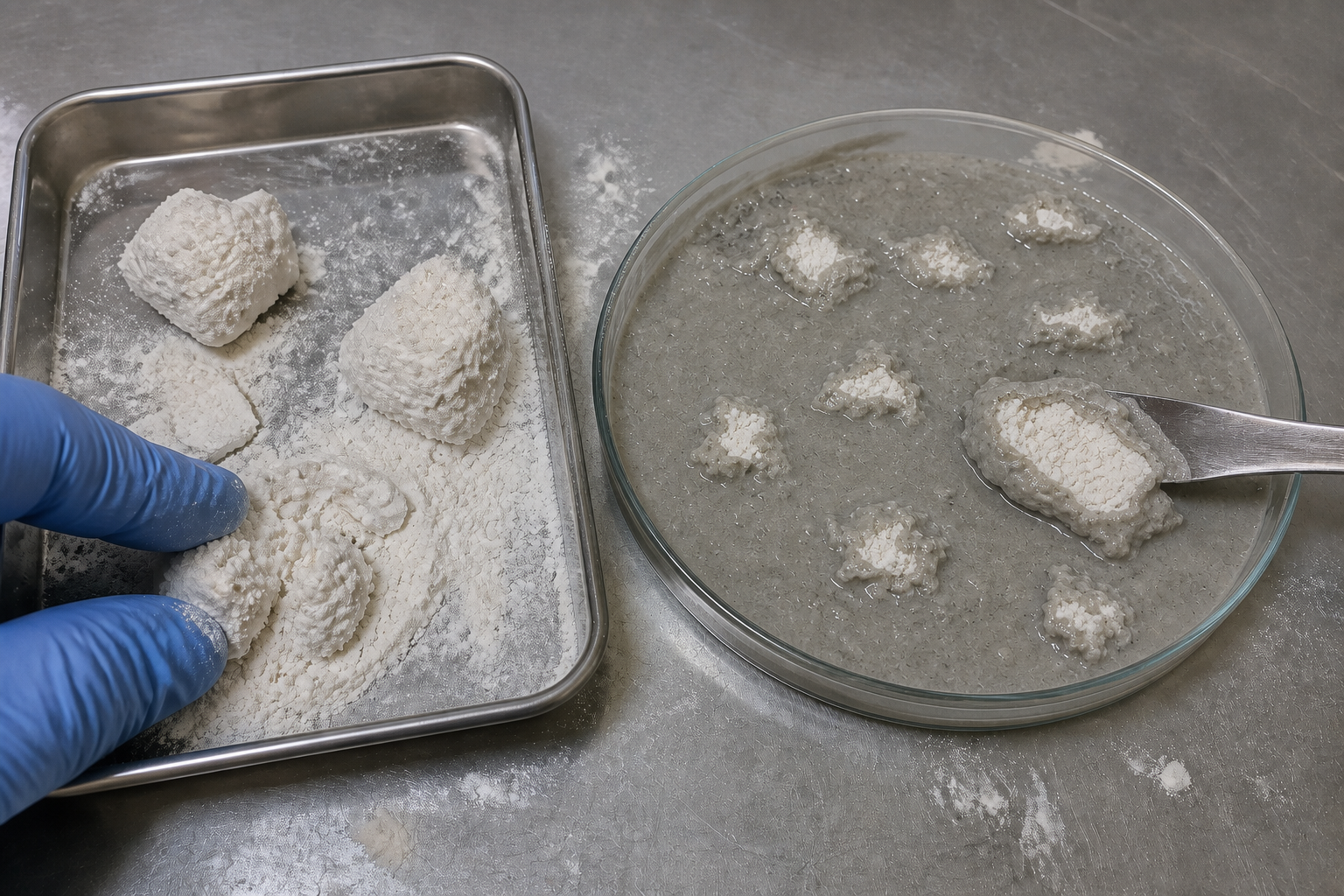
Define the observed defect before testing it
I use the following practical terms when discussing customer cases:
- Soft agglomerate: A loose dry cluster that breaks apart with light finger pressure or gentle screening.
- Hard agglomerate: A compact dry particle that resists gentle pressure and may contain material affected by moisture or compression.
- Fish eye: A wet, gel-coated particle with a hydrated exterior and a dry or partly dry interior.
- Undispersed particle: A visible particle that has not distributed through the mixture but does not necessarily have a gel shell.
- Foreign inclusion: A particle made mainly from another raw material, packaging debris, hardened premix, or contamination.
These terms describe observations. They do not prove a root cause by themselves.
Diagnose the problem by production stage
I recommend dividing the process into four stages:
| Stage | Observation | Initial questions |
|---|---|---|
| Dry mixing | Clusters appear before water addition | Was the HPMC already agglomerated? Was distribution adequate? |
| Water addition | Lumps appear immediately near the water entry point | Did local wetting trap concentrated powder? |
| Wet mixing | Gel particles persist during mixing | Were dosing sequence, shear, and dissolution behavior suitable? |
| Resting or maturation | Lumps become visible after the mix stands | Did delayed hydration reveal poorly dispersed cellulose ether? |
A dry lump can disappear when it receives adequate dispersion. A wet fish eye can remain even when the original HPMC powder passed normal incoming inspection. Therefore, lumping does not automatically mean that HPMC is insoluble2.
I once reviewed a customer video that seemed to show coarse HPMC particles in finished tile adhesive. The team later screened the dry blend before water addition and found no matching particles. The visible defects developed only after water entered one area of the mixer. That evidence changed the investigation from incoming powder quality to wetting distribution and process sequence.
Photos can help, but they rarely show particle composition or the moment of formation. I treat photos and videos as customer-provided evidence, not as conclusive laboratory findings. A qualified plant engineer or formulator should evaluate application-specific mixer performance because my experience is centered on HPMC production, batch QC, and comparative material testing.
Why Does HPMC Form Lumps During Dry Mixing?
A plant can lose time if it searches for one universal explanation. HPMC lumping usually reflects an interaction among powder condition, warehouse exposure, formulation design, and mixing conditions. Viscosity may influence application behavior, but a viscosity number alone cannot explain whether a powder will disperse evenly.
HPMC may form lumps during dry mixing when moisture exposure, damaged packaging, prolonged post-opening storage, powder compression, particle-size differences, static behavior, or inadequate blend distribution allows particles to cluster. Formulation ratios, raw-material feeding order, mixer fill level, and equipment condition can also influence whether concentrated HPMC zones remain in the dry mix.
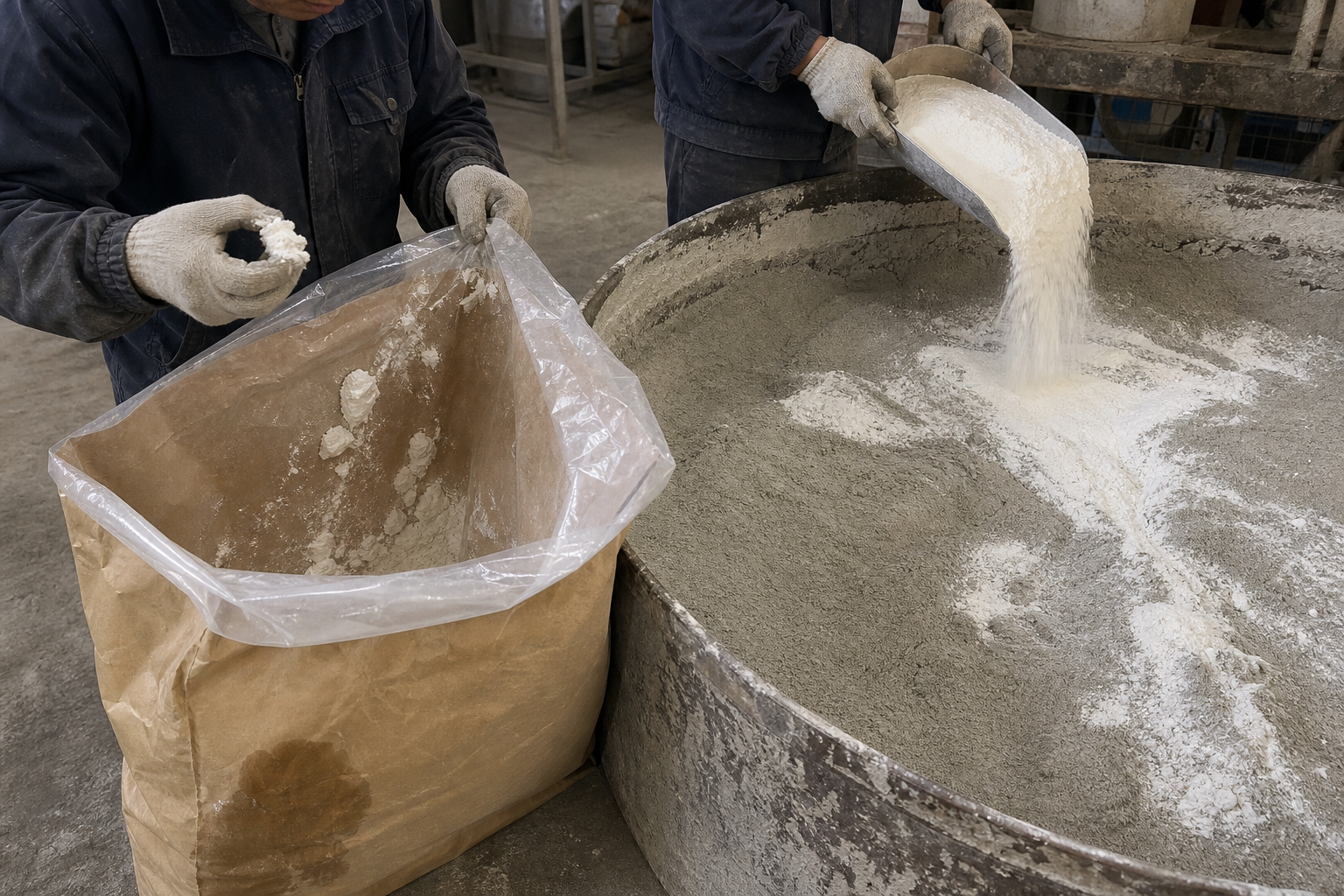
Material and storage variables
HPMC is a fine powder, and its handling behavior depends on more than nominal viscosity. I would review:
- Moisture content
- Package integrity and liner sealing
- Warehouse humidity and temperature records
- Time between opening and use
- Evidence of bag compression or water contact
- Particle-size behavior and sieve residue
- Whether the bag came from a pallet edge, top layer, or damaged area
- Whether the material was transferred into an unsealed day bin
Moisture can encourage particles to adhere or form soft agglomerates.3 However, a plant should verify actual moisture and packaging conditions rather than assume moisture from appearance alone. I do not recommend using an unverified universal humidity or moisture threshold because acceptable limits can depend on the grade, specification, test method, packaging, and application.
Formulation variables
A low-dose additive can distribute poorly when the bulk formula contains powders with very different particle sizes, densities, or flow behavior. HPMC commonly represents a small fraction of a dry-mix mortar formula.4 That low addition rate makes distribution discipline important.
The plant should examine:
- The HPMC dosage and weighing accuracy.
- The amount and type of cement, gypsum, filler, sand, and other additives.
- The particle-size relationship among the ingredients.
- The addition sequence for HPMC and other low-dose materials.
- Whether a carrier or premix step is part of the validated process.
- The possibility of interaction with starch ether, RDP, defoamer, fiber, or other additives.
I do not prescribe a carrier premix for every plant. A premix may improve low-dose distribution in one process, but it can add handling errors in another. The plant should validate the method against its own equipment and formulation.
Mixing and equipment variables
The mixer can create nonuniform zones when its fill level, mixing time, blade condition, discharge residue, or feeding location differs from the validated operating range.5 Longer mixing or higher speed is not automatically better. Excessive mixing can increase energy use, change powder segregation behavior, or create another process problem.
I suggest reviewing:
- Actual batch weight versus rated mixer capacity
- Ingredient feed positions
- Addition timing
- Mixing time records
- Mixer speed, if adjustable
- Blade or paddle wear
- Dead zones and retained material
- Cleaning status
- Variation between shifts or operators
Small laboratory tests can isolate variables, but they cannot automatically predict full-scale mixing.6 A production mixer has different filling, circulation, shear, heat, and feeding conditions. I use bench testing as comparative evidence rather than as proof of full-scale performance.
How Can a Plant Diagnose HPMC Lumps During Dry Mixing?
A plant may feel pressure to stop production or reject a shipment as soon as lumps appear. That decision can be expensive when the evidence is incomplete. I prefer a controlled comparison that keeps the formulation and operating conditions constant while changing only the HPMC sample.
A plant can diagnose HPMC lumps during dry mixing by retaining the problem material, collecting an unopened bag, sampling a normal batch, and testing them under identical conditions. The team should screen the powders and dry blends, observe water behavior, document lump composition, and compare moisture, particle behavior, COAs, storage records, and production parameters.
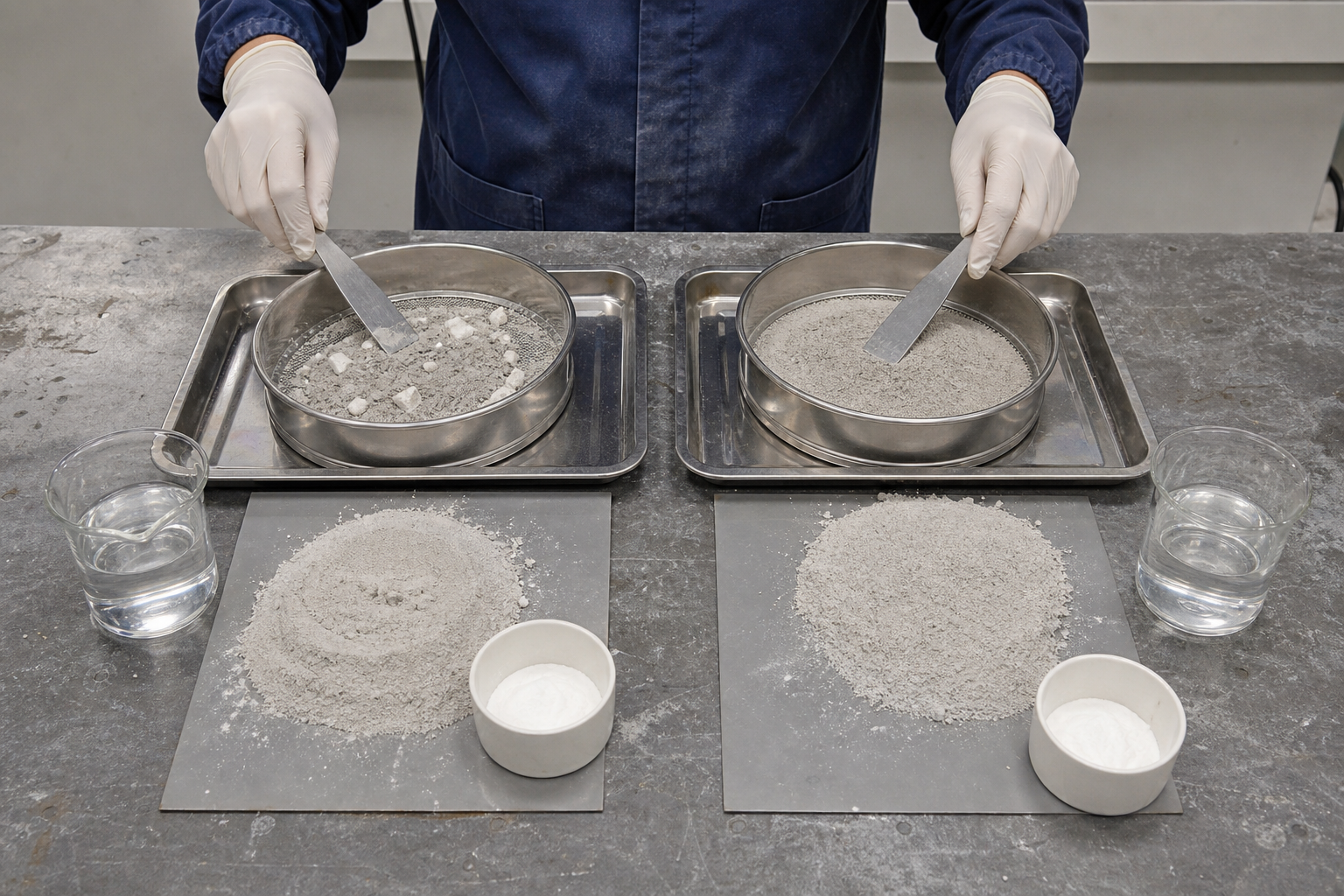
Step 1: Preserve representative evidence
The team should avoid testing only a handful of visible lumps. I recommend retaining:
- A sealed sample from the reported bag
- Several representative lumps
- A sample of the complete dry blend
- An unopened bag from the same HPMC lot
- A retained sample from a previously normal lot
- Packaging photographs, including the batch marking
- The supplier’s COA and internal receiving record
- Warehouse and production timestamps
The sampling point matters. A sample from the top of an opened bag may not represent the whole bag. A sample taken after material enters a day bin may include handling effects that were absent in the original package.
Step 2: Screen the material separately
The team can use a defined sieve method to compare problem and reference samples. The selected mesh and procedure should match the company’s internal specification or an agreed supplier method.
The team should record:
- Initial sample mass
- Sieve size
- Screening time and method
- Residue mass or percentage
- Whether residue is soft, hard, fibrous, or gel-like
- Whether light pressure breaks the agglomerates
- Photographs under consistent lighting
A high residue result can demonstrate a difference, but it does not identify the cause by itself. Moisture exposure, compression, contamination, or normal particle-size variation may produce different residues.
Step 3: Run an identical dry-blend comparison
I recommend making at least two small batches:
- Test A: Retained problem HPMC
- Test B: Previously accepted HPMC or an agreed reference sample
The operator should keep these variables identical:
| Controlled variable | Why it matters |
|---|---|
| Formula and raw-material lots | Different fillers or cement can change dispersion |
| HPMC dosage | Small weighing errors can distort the comparison |
| Addition sequence | Feeding order affects low-dose distribution |
| Mixer and batch size | Different circulation patterns weaken the comparison |
| Mixing time | Unequal time prevents a fair result |
| Water dosage and temperature | Wetting and hydration behavior may change |
| Resting time | Delayed dissolution can alter observations |
| Test operator | Technique can introduce variation |
The team should inspect the blend before water addition. This step confirms whether the reported defect is truly dry agglomeration.
Step 4: Compare transparent water behavior
A transparent vessel test can help the team observe wetting, dispersion, gel-shell formation, and delayed dissolution. The operator should add equal HPMC masses to equal water volumes under the same temperature, stirring, and timing conditions.
The test can show whether one sample forms more persistent fish eyes than another under that specific method. However, the test does not reproduce cement pore solution, salt concentration, alkaline conditions, sand loading, or industrial mixer geometry7. I would not use it as the only basis for accepting or rejecting a production lot.
Step 5: Open and inspect representative lumps
The team should split several lumps and observe their interiors. A dry powder center under a gel shell supports a fish-eye description.8 A uniform, compact dry cluster points toward agglomeration. A grainy or colored center may suggest that other formula materials are involved.
The team should combine these observations with process records before assigning responsibility. That combined evidence is more reliable than viscosity, appearance, or a single photo.
When Should a Plant Suspect the HPMC Batch?
Production teams need a practical point at which they should involve the supplier. If every variable receives equal suspicion forever, the investigation cannot support a decision. Still, I avoid declaring an HPMC batch defective until repeatable evidence distinguishes it from both a normal reference and reasonable process variation.
A plant should suspect the HPMC batch when representative samples from the reported lot repeatedly differ from an accepted reference under identical tests, and the difference remains after storage, formula, dosing, and equipment variables are controlled. Supporting evidence may include abnormal moisture, excessive sieve residue, damaged packaging, inconsistent wetting behavior, or results outside agreed specifications.

Stronger and weaker evidence
| Evidence | Diagnostic strength | Limitation |
|---|---|---|
| Photo of lumps in finished mortar | Low | It does not show composition or formation stage |
| One opened bag with clusters | Low to moderate | Post-opening exposure may be involved |
| Abnormal viscosity alone | Low to moderate | Viscosity does not directly define dispersibility |
| Repeatable sieve difference versus reference | Moderate | The cause of residue still needs investigation |
| Unopened bags from one lot show the same issue | Moderate to high | Sampling and test controls still matter |
| Batch fails an agreed specification method | High | The method and limits must be contractually relevant |
| Supplier and customer reproduce the difference | High | Full-scale process effects may still require evaluation |
Viscosity is not a complete dispersibility test
I often see buyers compare only the viscosity value on two COAs. Viscosity is important for water retention, consistency, sag resistance, and application performance.9 However, the reported viscosity also depends on concentration, temperature, instrument, spindle, speed, solution preparation, and test method10.
Two HPMC products with a similar viscosity result may differ in particle-size distribution, surface treatment, moisture, substitution characteristics, or application behavior.11 Conversely, a viscosity difference does not prove that the higher- or lower-viscosity product caused the lumps.
The buyer should confirm that the supplier and plant use comparable test methods. The buyer should also review moisture, ash content, sieve behavior, and application results where relevant.
When a supplier quality claim is reasonable
I consider a claim technically stronger when the buyer provides:
- Product name, lot number, and bag numbers
- Purchase and delivery dates
- Photos of packaging and pallet condition
- Storage and post-opening history
- HPMC dosage and complete formula
- Mixing sequence and actual batch size
- Screened residue data
- Side-by-side test records
- Videos showing the stage at which lumps appear
- Retained material for joint testing
The supplier can then compare the customer sample with its retained production sample and original batch records. At KEHAO Chemical, our stated production controls include batch testing for viscosity, water retention, moisture, and ash content. Buyers should still verify the relevant COA, specification, sampling method, and any REACH-related documentation12 for their market and intended use.
I view a COA as one part of the evidence. I do not view it as a substitute for representative sampling and application testing.
How Should Buyers Respond to Repeated HPMC Lumping?
Repeated HPMC lumping can affect output, customer complaints, and raw-material purchasing decisions. A quick switch to another grade may hide the original cause or introduce new performance changes. I recommend that procurement, QC, production, and formulation teams review the evidence together before changing the product or process.
Buyers should respond to repeated HPMC lumping by quarantining the affected material when necessary, preserving representative samples, running controlled comparisons, and contacting the supplier with documented evidence. Any change to HPMC grade, dosage, feeding order, storage practice, or mixing parameters should receive validation in both laboratory and production-scale trials.
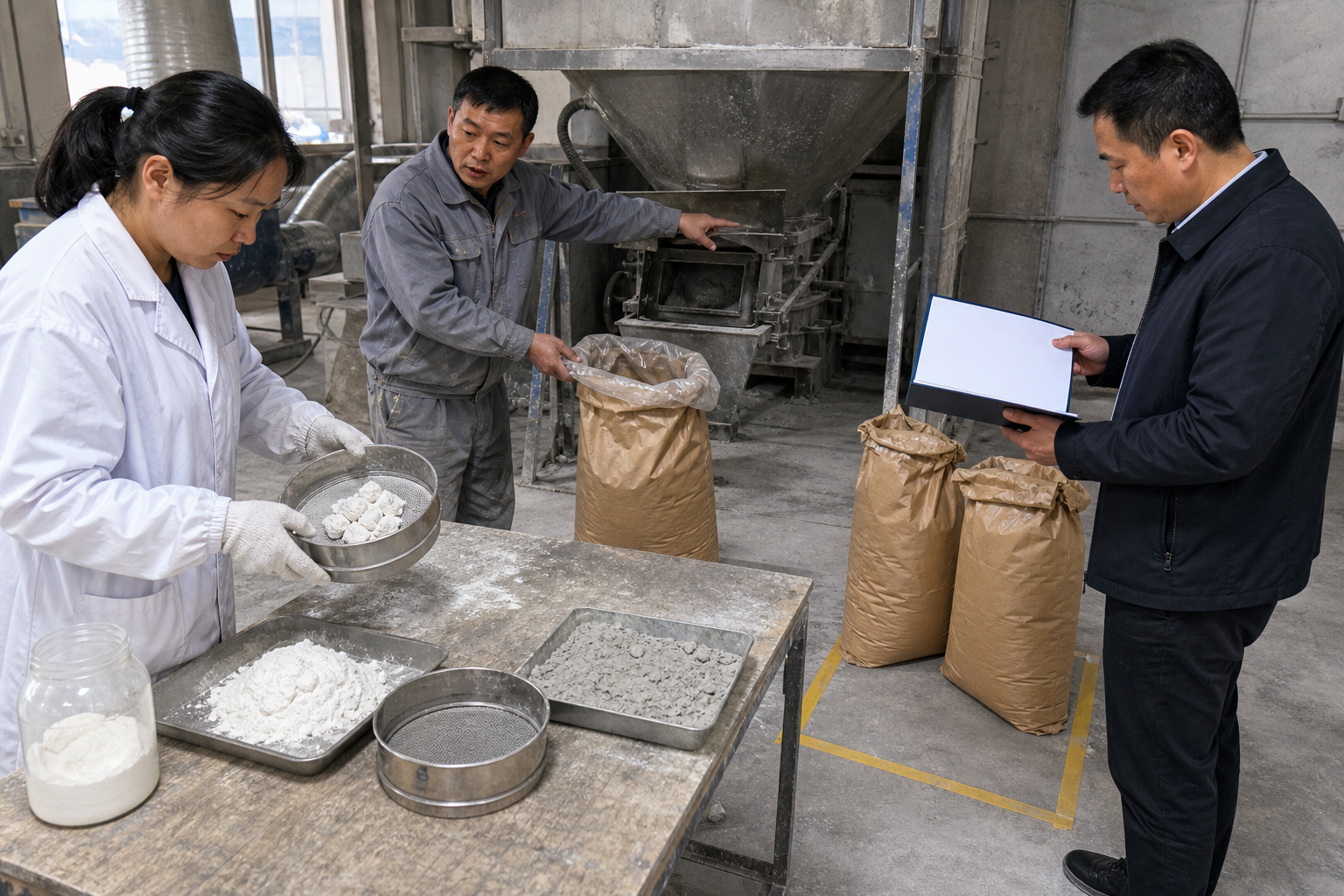
Use a staged decision process
I suggest the following sequence:
-
Confirm the failure stage.
The team should establish whether agglomerates exist in the bag, dry blend, initial wet mix, final wet mix, or rested mortar. -
Protect production traceability.
The team should record which finished batches used the suspected HPMC lot. -
Quarantine selectively.
The plant should follow its internal quality procedures rather than automatically reject every related shipment. -
Run comparative testing.
The team should compare the suspected lot, an unopened same-lot bag, and a normal reference. -
Review storage and handling.
The team should inspect liner sealing, warehouse exposure, opened-bag practices, and transfer bins. -
Review formula and operation.
The formulator and production manager should examine dosage, sequence, fill level, mixer condition, water distribution, and resting time. -
Submit evidence to the supplier.
Procurement should request a retained-sample review and a written technical response. -
Validate corrective action.
The plant should confirm any change at appropriate scale before routine adoption.
Compare suppliers on more than price and viscosity
A sourcing decision should include the supplier’s ability to investigate problems. I recommend evaluating:
- Batch traceability
- Retained-sample practices
- COA consistency
- Agreed viscosity test method
- Moisture and ash controls
- Application testing capability
- Sample availability
- Technical response time
- Packaging quality
- Production capacity and lead time
- Export documentation
- Change-notification practices
KEHAO Chemical manufactures HPMC and other dry-mix additives at its facility in Jinzhou City, Hebei Province. Based on our business information, our plant uses automated production lines and an in-house laboratory for batch testing. We also provide free samples with a COA, viscosity-grade selection support, OEM service, and formulation guidance.
Buyers should independently verify supplier claims, quality documents, and regulatory records. A qualified formulator should also approve application-specific decisions. I can help interpret comparative HPMC results, but I do not replace the plant’s equipment engineer, accredited laboratory, or local compliance professional.
Frequently Asked Questions
Are HPMC lumps proof that the product is insoluble?
No. HPMC lumps may be soft dry agglomerates, concentrated additive zones, wet fish eyes, or particles involving other formula materials. A gel-coated fish eye can contain dry HPMC even though the polymer itself is soluble under suitable preparation conditions. The plant should inspect the lump and identify when it formed.
Can high HPMC viscosity cause lumping?
Viscosity may affect hydration and application behavior, but it cannot explain lumping by itself. The plant should also compare moisture, particle behavior, sieve residue, dosage, feeding sequence, water distribution, shear, and storage history. The viscosity test method must remain consistent when the team compares batches or suppliers.
Should a plant simply increase mixing time or mixer speed?
No universal increase is appropriate. More time or speed may improve distribution in one process but fail or create other issues in another. The plant should first locate the failure stage and run controlled trials. A qualified equipment or process specialist should assess changes to full-scale mixer operation.
How can a plant tell a fish eye from a dry HPMC agglomerate?
A fish eye usually has a hydrated or gel-like outer shell and a dry or partly dry interior. A dry agglomerate exists before water addition and may break under light pressure or screening. The team should inspect the dry blend before wetting and split representative wet lumps to examine their centers.
What information should a buyer send with an HPMC quality complaint?
The buyer should send the lot number, bag photographs, storage history, formula, HPMC dosage, mixing sequence, batch size, process timeline, videos, sieve results, and side-by-side test data. The buyer should also preserve samples from the suspected bag, an unopened same-lot bag, and a previously accepted lot.
Conclusion
HPMC lumps during dry mixing require a staged diagnosis rather than an immediate quality judgment. I recommend separating dry agglomeration from wet fish eyes, then comparing problem and reference materials under identical formulation, dosing, mixing, and environmental conditions. Moisture, sieve behavior, packaging, storage, particle distribution, water addition, and process records should all support the final conclusion.
If your plant is investigating HPMC lumping, KEHAO Chemical can provide samples, COAs, grade-selection support, and comparative application guidance. Contact us at kehao@kehaohpmc.com or via WhatsApp at +86 157 3315 6958 to discuss your formulation and test plan.
"Hydroxypropyl Methylcellulose—A Key Excipient in ... - PMC", https://pmc.ncbi.nlm.nih.gov/articles/PMC12196896/. Studies of water-soluble polymer dissolution describe how rapid surface hydration can produce a gel layer that impedes penetration of water into the particle core, a mechanism consistent with fish-eye formation. Evidence role: mechanism; source type: paper. Supports: The source should explain that rapid surface hydration of water-soluble polymers can form a gel layer that retards wetting and dissolution of powder within a particle.. Scope note: The source may address polymer dissolution generally rather than the exact mortar formulation or mixer used by a plant. ↩
"Hydroxypropyl Methylcellulose—A Key Excipient in ... - PMC", https://pmc.ncbi.nlm.nih.gov/articles/PMC12196896/. Hydroxypropyl methylcellulose is generally described as a water-soluble cellulose ether; consequently, visible lumps alone do not establish chemical insolubility. Evidence role: definition; source type: encyclopedia. Supports: The source should confirm that hydroxypropyl methylcellulose is a water-soluble cellulose derivative under appropriate preparation conditions.. Scope note: Water solubility does not guarantee rapid dissolution under every temperature, concentration, mixing, or formulation condition. ↩
"A concise summary of powder processing methodologies for ...", https://pmc.ncbi.nlm.nih.gov/articles/PMC10245010/. Powder-science research shows that adsorbed moisture and liquid bridges can increase interparticle cohesion and promote agglomeration in fine powders. Evidence role: mechanism; source type: research. Supports: The source should explain that moisture can create liquid bridges and increase cohesive forces between powder particles, promoting agglomeration.. Scope note: The extent of moisture-related agglomeration depends on particle properties, moisture level, storage duration, and the specific material. ↩
"Water Retention Mechanism of HPMC in Cement Mortar - PMC", https://pmc.ncbi.nlm.nih.gov/articles/PMC7372461/. Reviews of cellulose ethers in cementitious mortars report their use at low dosage relative to the bulk mineral constituents, making uniform incorporation an important formulation consideration. Evidence role: general_support; source type: paper. Supports: The source should report typical cellulose-ether dosage ranges in cementitious dry-mix mortars and show that they are minor fractions of the total dry formulation.. Scope note: Typical dosage ranges vary by mortar class, cellulose-ether grade, performance target, and local formulation practice. ↩
"Blend Segregation in Tablets Manufacturing and Its Effect on ...", https://pmc.ncbi.nlm.nih.gov/articles/PMC8620778/. Powder-mixing research identifies equipment geometry, fill level, ingredient feed location, mixing duration, and stagnant regions as factors that can affect blend homogeneity. Evidence role: mechanism; source type: research. Supports: The source should document that mixer design, fill level, feed position, operating time, and dead zones influence powder blend homogeneity.. Scope note: The relative importance of each factor must be established for the specific mixer, formulation, and operating conditions. ↩
"Scale-Up Strategy in Quality by Design Approach for ... - PMC", https://pmc.ncbi.nlm.nih.gov/articles/PMC6632066/. Literature on powder-mixing scale-up notes that differences in vessel geometry, fill level, circulation patterns, and mixing mechanisms can prevent laboratory results from directly predicting production-scale uniformity. Evidence role: general_support; source type: paper. Supports: The source should discuss why changes in mixer size, fill, flow patterns, shear, and operating conditions complicate extrapolation from laboratory to production scale.. Scope note: Comparative bench testing remains useful for screening variables when its scope is not treated as full-scale validation. ↩
"Water Retention Mechanism of HPMC in Cement Mortar - PMC", https://pmc.ncbi.nlm.nih.gov/articles/PMC7372461/. Cement-hydration literature characterizes pore solution as highly alkaline and compositionally distinct from pure water, while mortar also introduces substantial mineral-solid loading; these conditions limit direct equivalence with a transparent-water dispersion test. Evidence role: mechanism; source type: paper. Supports: The source should establish that cement pore solutions are highly alkaline and chemically distinct from pure water, and that cementitious mixtures contain substantial solid loading.. Scope note: This contextual evidence does not quantify the performance difference for a particular HPMC grade or mortar formula. ↩
"Microporous, fast response cellulose ether hydrogel ...", https://pubmed.ncbi.nlm.nih.gov/15542324/. Polymer-dissolution studies use the term fish eye for a particle in which a hydrated outer layer surrounds incompletely wetted material, making a dry or partly dry core diagnostically consistent with that description. Evidence role: definition; source type: paper. Supports: The source should define fish eyes as particles whose hydrated or gelled surface delays wetting and dissolution of an internal dry core.. Scope note: Visual inspection alone cannot identify the chemical composition of the core without additional analysis. ↩
"Water Retention Mechanism of HPMC in Cement Mortar - PMC", https://pmc.ncbi.nlm.nih.gov/articles/PMC7372461/. Research on cellulose ethers in cementitious mortars links their rheological and water-retention effects to polymer characteristics, including viscosity-related behavior, with consequences for workability and application performance. Evidence role: general_support; source type: paper. Supports: The source should describe how cellulose-ether molecular characteristics and solution viscosity relate to water retention and rheological behavior in cementitious mortars.. Scope note: Viscosity is only one relevant property and does not independently predict performance across all grades, test methods, and mortar formulations. ↩
"shear rate conversion, correction factors, and applicability ...", https://arxiv.org/html/2606.27524v1. Rotational-viscometry guidance specifies that reported viscosity is conditional on controlled measurement parameters such as temperature, spindle or geometry, rotational speed, and sample preparation. Evidence role: mechanism; source type: institution. Supports: The source should state that rotational-viscometer results are conditional on specified temperature, spindle or geometry, rotational speed, sample preparation, and test procedure.. Scope note: Comparable instrument settings improve comparability but do not by themselves establish equivalence between different laboratories or solution-preparation procedures. ↩
"Hydroxypropyl Methylcellulose—A Key Excipient in ... - PMC", https://pmc.ncbi.nlm.nih.gov/articles/PMC12196896/. Technical literature on hydroxypropyl methylcellulose recognizes that substitution characteristics, particle properties, and other physical attributes may vary independently of a single reported viscosity value and can affect use behavior. Evidence role: general_support; source type: paper. Supports: The source should show that HPMC properties beyond solution viscosity, such as substitution pattern, particle characteristics, and moisture-related properties, can influence hydration or application behavior.. Scope note: A general property comparison cannot determine whether any particular difference caused lumping in a specific batch. ↩
"EU REACH", https://www.trade.gov/eu-reach. The European Chemicals Agency describes REACH as the European Union framework governing registration, evaluation, authorization, and restriction of chemicals, with documentation obligations determined by the substance, supply role, and intended market. Evidence role: historical_context; source type: government. Supports: The source should describe the European Union REACH framework and the circumstances in which manufacturers, importers, and downstream users must provide or evaluate regulatory information.. Scope note: REACH applicability and documentation requirements depend on the product’s legal status, composition, tonnage, supply chain role, and market; this is not legal advice. ↩