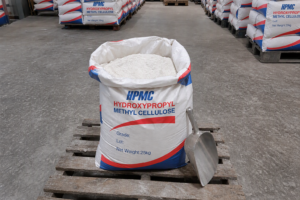
Direct answer. For a self-leveling mortar producer, pinholes and craters are a formulation and production question before a site question. Air is folded in by the mixer, held by the cellulose ether network, and released only if the defoamer reaches it and the binder system leaves the surface live long enough. So convert the complaint into measurable targets, screen HPMC, defoamer and dispersant candidates at fixed water and at fixed flow, then reproduce the result on a pilot batch with retained samples. Site data confirms or excludes a formula decision; it never replaces one.
How Do You Convert a Pinhole Complaint Into Measurable Formulation Targets?
Problem. A complaint arrives as a description — “bubbles”, “small holes”, “the surface will not close” — and the response is a formula change made against that description. Because the words are undefined, two people can look at the same defect field and still measure different things.
Agitation / Answer: The complaint must be restated as a defect class plus a number. Split it into pinholes, craters or fisheyes, trapped bubble pits and additive spots, then attach a count, a depth judgement and a fresh-state measurement to each. Only then can a batch be judged better or worse instead of “still bad”.
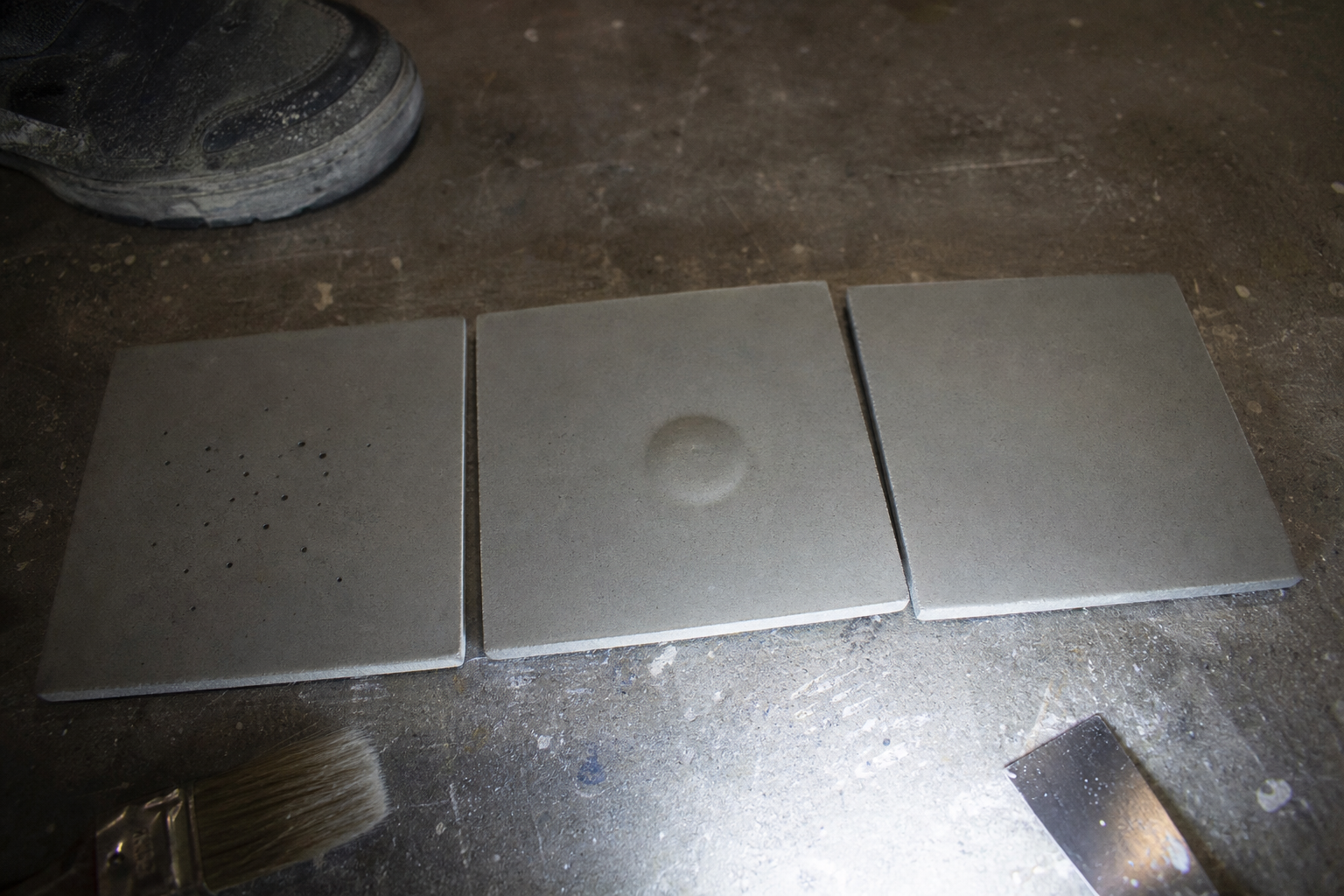
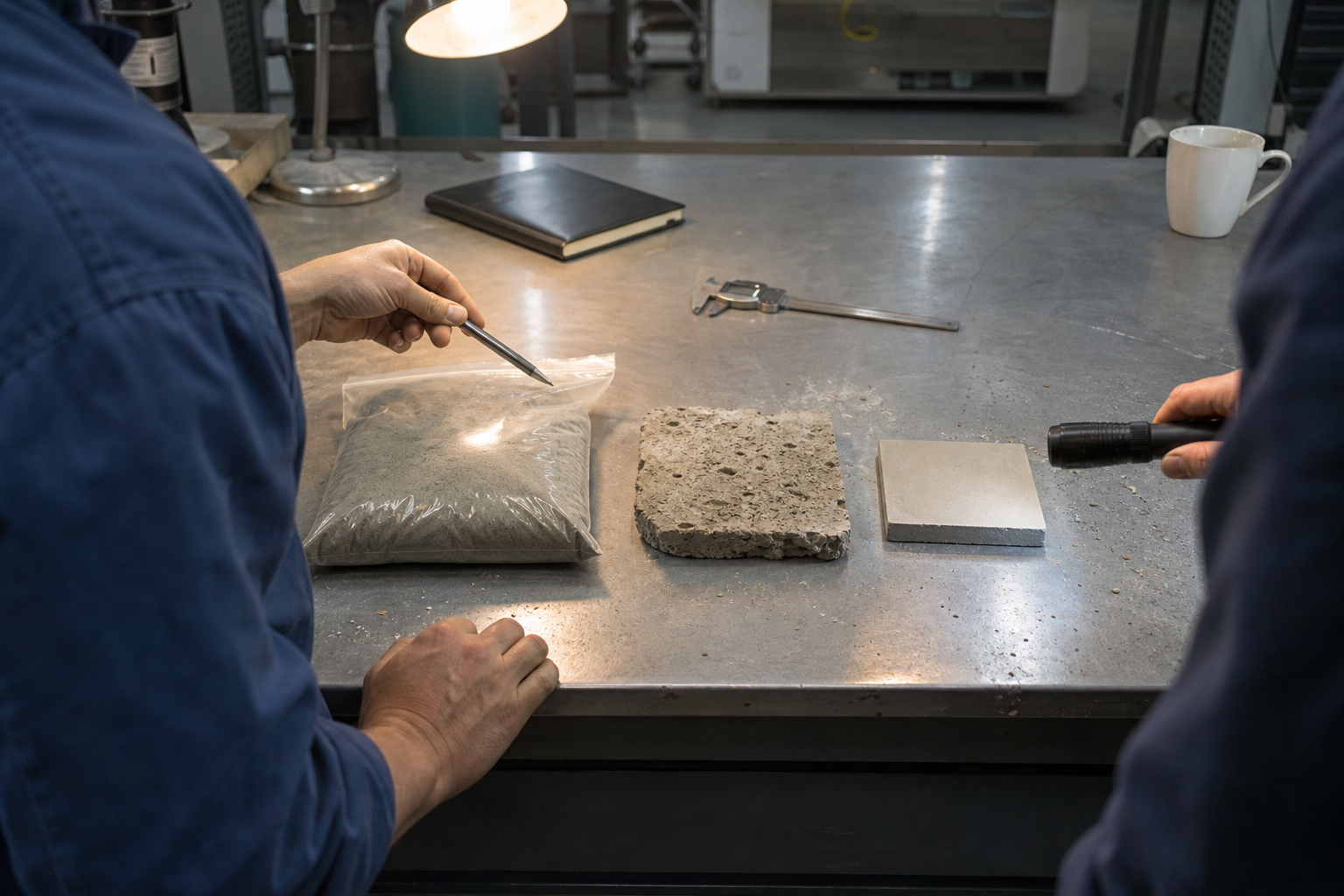
Solution. I start with physical evidence: a cured plaque is cleaned, lit almost parallel with a torch and photographed from two directions. A pinhole is a narrow vent with no rim, a crater a shallow dish with a raised rim, a trapped pit a torn roof just under the skin, and an additive spot an oily halo unrelated to the substrate.
The class then picks the number: a pinhole cluster points at air, so record wet density against the formula target, air content, and whether air can still leave during a still, covered rest; a crater field points at dispersion, so count defects per unit area and check whether spots sit where an undispersed particle would; torn pits point at the setting window, so record retained flow and how long the surface stays able to close. The logic in dry-mix mortar failures is the same: describe evidence before naming a cause.
Making that number repeatable matters more than making it precise. I fix the torch angle and distance, mark the same counting area on every plaque, and have two people count the same field; a count only one technician can reproduce is an opinion, not a specification. Depth is judged by how the defect throws a shadow under raking light, not by a fingernail, because touching changes what is measured.
I also record when the defect appears: while the mortar is still wet and closing, after the wet edge has gone, or only once the board has set. Timing decides which control owns the complaint and usually separates an air problem from a skinning problem before raw materials are discussed. Frequency is recorded per board and per batch, so one bad corner cannot outvote a clean run, and the batch is poured twice to see whether the pattern repeats.
| Complaint wording | Defect class | Measurable target | Owning control |
|---|---|---|---|
| “Small holes all over” | Pinhole cluster, no rim | Wet density, air content, air after rest | Mixing energy, defoamer dispersion, HPMC dose |
| “Shallow rings” | Crater with raised rim | Defect count per area, spot map | Defoamer carrier, dispersant, contamination |
| “Surface broke open” | Trapped pit, torn edge | Retained flow, time to skinning | Binder kinetics, retarder, water demand |
| “Oily halo” | Additive spot | Undispersed particle count | Blend time, addition order |
How Do HPMC, Defoamer, Superplasticizer and the Binder System Interact?
Problem. A second source of HPMC is approved at the same declared viscosity, or a defoamer lot changes carrier, and pinholes appear two weeks later. The instinct is to raise the defoamer, which treats one of four interacting families as the only one, and usually moves the defect from pinholes to fisheyes.
Agitation / Answer: Cellulose ether sets how long air is trapped; defoamer sets whether it can be released; superplasticizer sets the water demand at which the system flows; the binder system sets how long the surface can still close. Changing one shifts the other three, so compatibility is screened as a set before any dose is discussed.
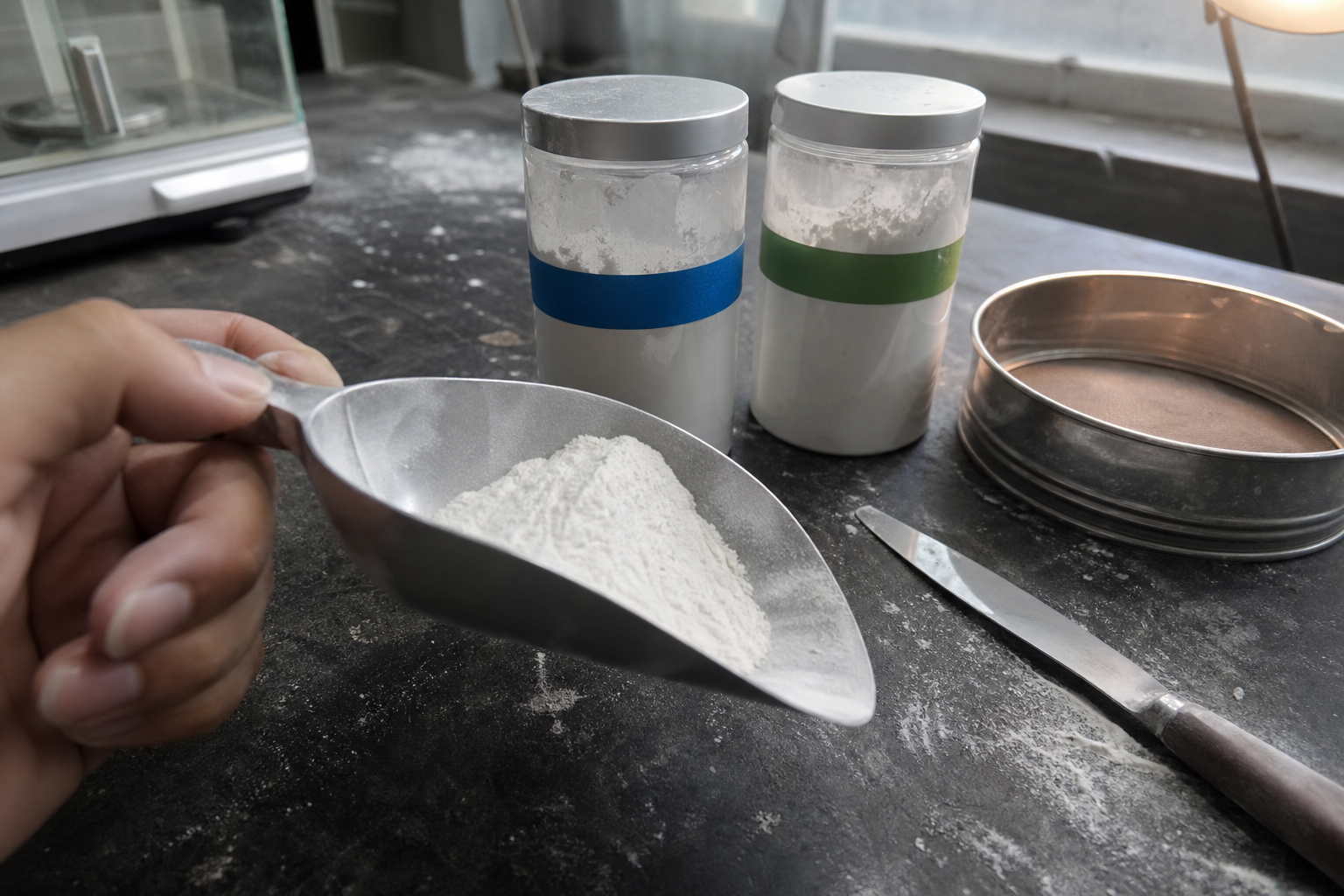
Solution. HPMC is a rheology decision with an air consequence: grade, substitution and particle size set water retention, cohesion and yield of the liquid phase, and the same network that holds water slows bubble rise. The question is whether the grade leaves enough open time for air to escape before the surface loses its wet edge, which is why buyers comparing sources read the main functions of HPMC in a dry-mix mortar and how HPMC affects dry-mix workability first.
Defoamer behaviour is delivery as much as chemistry: a powder defoamer on a mineral carrier must release its active into an already thick system, and locked in undispersed particles it does nothing in the bulk while leaving localised spots. The dispersant trades water demand against stability, so a change of superplasticizer type at the same flow changes the water needed and a dispersant trial is read on density and bleeding, not spread alone. The binder combination closes the window: faster set shortens the time a bubble has to reach a surface that can still flow.
Because the four families pull against each other, I screen them in a fixed order rather than all at once. The binder and aggregate are held; HPMC candidates are compared at fixed water first, because a grade that changes air retention changes every reading taken after it. The best two ethers then carry the defoamer comparison, and the dispersant is judged last, since it moves the water demand that both earlier steps were normalised against. A candidate that only performs when another family is also changed has not been proven; it has been co-selected. Trials stay narrow — one variable, same board — and our HPMC air-content test guide is directly reusable.
| Family | Changes in the fresh system | Signature when weak | Record | Cannot prove |
|---|---|---|---|---|
| HPMC grade and dose | Viscosity, retention, bubble rise | Pinhole clusters, long air retention | Wet density, air after rest, flow | That the grade is off-spec |
| Defoamer chemistry and carrier | Release of active into thick slurry | Fisheyes, oily halos | Spot count, undispersed particles | That a higher dose would help |
| Superplasticizer or dispersant | Water demand, yield stress, bleeding | Bleeding, density gradient | Water at fixed flow, bleed ring | That the polymer is at fault |
| Binder combination | Setting rate and open time | Torn pits, early skinning | Retained flow, time to skinning | That the site was too warm |
Should You Screen at Fixed Water or at Fixed Flow?
Problem. Two laboratories test the same formula and reach opposite conclusions: one holds water constant, the other adds water until flow meets specification. Fixed water hides water demand, fixed flow hides air, because the water needed for the target spread is itself a variable.
Agitation / Answer: Run both arms on the same day. Fixed water shows what the formulation does to air and rheology at constant solids; fixed flow shows what the customer will see, at the cost of letting water absorb part of the effect. Against a control, the pair identifies whether the defect follows water demand or follows air.
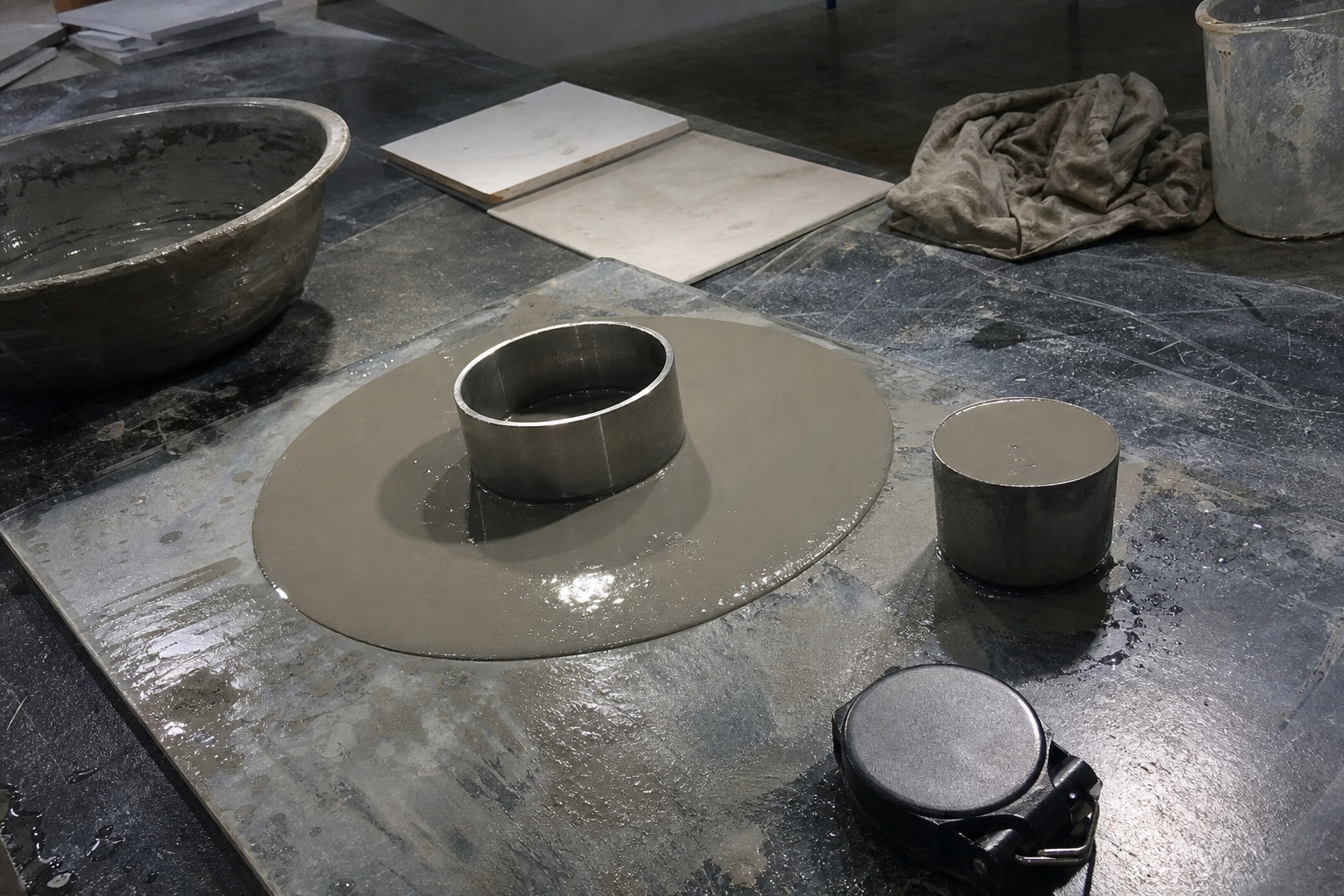
Solution. One base blend is split, one variable changed, each variant mixed on the same mixer at the same setting for the same time. Arm one pours at the data-sheet water quantity; arm two adds water until initial flow meets specification and records how much that took, which is itself a result: a shift in water demand at constant flow is the earliest signal that a source has changed.
Both arms are poured the same day, by the same operator, on boards from the same stack, because a pinhole count taken in the morning and compared with one taken after the boards have stood overnight is not a comparison. I keep the resting step identical as well: covered or open, still or remixed, and for how long, since a covered rest lets air rise while an open one lets a skin form. Retained flow is taken at the same interval in both arms, so the closing behaviour of the surface is compared on equal terms rather than on convenience.
Both arms are read on the matrix below. Footnote [2] is why density and air are read as a pair: air content is influenced by many factors other than any one ingredient, so it locates a problem without naming a culprit. Footnote [3] is why every flow figure carries its water basis.
The rules are bench-simple: a defect at fixed water but not fixed flow means water demand, so look at dispersant or filler grading; a defect in both arms implicates air and defoamer; a defect in neither, but on the plant’s board, means production was not reproduced, so the pilot batch is next.
| Candidate | Water basis | Initial flow | Retained flow | Wet density and air | Bleed and segregation | Defect count | Setting window | Verdict |
|---|---|---|---|---|---|---|---|---|
| Control, retained reference | Fixed water and fixed flow | Record | Record | Record | Record | Record | Record | Baseline |
| HPMC candidate A | Both arms | Record | Record | Record | Record | Record | Record | Keep or reject on the pair |
| HPMC candidate B | Both arms | Record | Record | Record | Record | Record | Record | Compare with control only |
| Defoamer candidate 1 | Fixed water | Record | Record | Record | Record | Record | Record | Isolates air release |
| Defoamer candidate 2 | Fixed water | Record | Record | Record | Record | Record | Record | Watch for fisheyes |
| Dispersant variant | Fixed flow | Record | Record | Record | Record | Record | Record | Reads water demand shift |
Cells carry the laboratory’s own values in its specification units; pass limits stay in-house, as acceptable count, density and window depend on product class.
What Changes When the Formula Moves From a Lab Mix to a Pilot Batch?
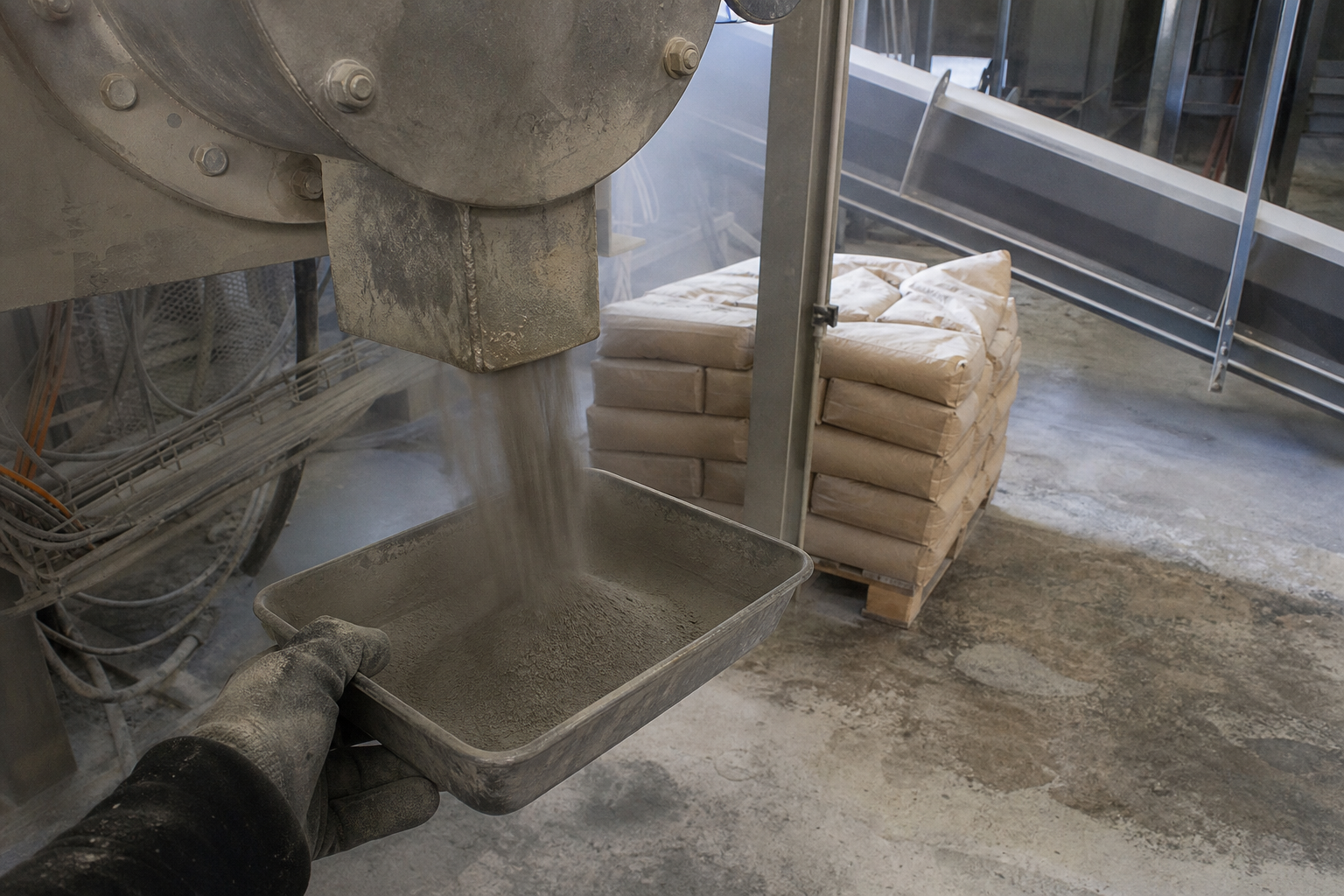
Problem. A formula clean at laboratory scale is not the same material at plant batch size. The mixer adds air rather than folding it in, powder is dropped rather than dispersed, the defoamer is added where it coats particles, and the sample tested comes from the top of the batch.
Agitation / Answer: Scale-up changes four things at once — mixing energy, addition order, powder dispersion and sampling position. Each is recorded on the pilot batch sheet, because each can produce the same pinhole pattern alone, and a batch that was not sampled properly cannot be judged at all.
Solution. Mixing energy comes first: mixer type, fill level, tool speed and mixing time as actually set. A high-shear tool in a low-fill batch whips in air faster than any defoamer can compensate.
Addition order comes second. HPMC pre-blended into a filler stream disperses differently from HPMC dropped in at the end, showing up as slow-wetting lumps and localised viscosity that never develops; the notes on improving HPMC solubility and on lumps formed during dry mixing cover why. The defoamer entry point belongs there too: added early it disperses, added late it coats particles and does nothing.
Sampling position is where pilot batches are most often lost. Samples from the top, middle and end of the discharge plus the retained bag are each mixed with the same water and poured on the same board; if the count differs, the batch is inhomogeneous. Every batch keeps a sealed retain and every delivery its own, sized and stored per company SOP, so a later complaint can be traced to a lot or excluded from it. Wet density of plant slurry against laboratory closes the loop: a gap at the same water and flow means the mixer is the air source, not the formula.
Before the trial I write down what the pilot batch is meant to prove, because a run that changes mixer, batch size and addition order together can only produce a story. One change per run, the same operator where possible, and the laboratory board poured again beside the plant board on the same day, so both surfaces are read under the same light by the same pair of eyes.
How Do You Use Primer and Site Information to Confirm a Formula Decision?
Problem. Site information is the loudest input and the least controlled: photographs, temperatures taken hours later, a primer described as “the usual one”. Used as a starting point it sends a plant into unplanned formula changes; ignored entirely it lets an interface problem be carried by the product.
Agitation / Answer: Site data has one job — to reproduce or fail to reproduce the defect on a known-good formula. If a retained sample that passed in the laboratory also pits on that slab and primer, the interface is implicated. If it is clean on a prepared patch beside it, the batch or material lot becomes the question.
Solution. I ask for a fixed record, not a narrative: primer type and dilution, actual open time, slab condition and suction, slab and air temperature at the pour, water used on site, batch number and any retained sample. Then the three-way comparison runs the same day: a cut-out plaque from the complaint, a plaque poured on site from the retain, and a plaque from the same retain poured in the laboratory, all under the same light. That separates “this formula on this interface” from “this batch anywhere”.
The comparison only works if the site plaque and the laboratory plaque are poured at the same consistency, so I ask how the crew judged water on site and whether that judged consistency can be reproduced at the bench. A primer applied unevenly, or a slab that was still damp, pulls water from the mortar at a different rate across the floor, and the defect then follows the patch rather than the batch. That patch pattern is itself evidence, and it is the reason I ask for photographs of the whole room and not only of the worst area.
One boundary holds: ASTM C1708/C1708M-25 states results are not intended to represent field performance [1], so the laboratory ranks candidates and the site confirms or excludes.
What I will not do is accept a site conclusion as a formula verdict on its own. Primer, suction, temperature and application timing are variables the plant does not control, and a complaint that cannot be reproduced with a retained sample stays an interface question until the visit produces better evidence. If the retain pits in the laboratory as well, the batch or the grade becomes the subject, and the supplier discussion starts from a sample rather than a photograph.
FAQ 1: Why do two HPMC grades with the same declared viscosity behave differently in our mortar?
Declared viscosity is measured in a defined solution, not in a self-leveling slurry. Substitution, particle size, dissolution behaviour and dispersant interaction all change retention, bubble rise and open time at the same nominal figure, so equivalent grades need a plaque comparison before a source change.
FAQ 2: Can we solve pinholes by changing only the defoamer?
Only if the air is still mobile and the defoamer is compatible and well dispersed. If mixing loads the batch with air or the binder closes the surface early, a defoamer change relocates the defect; screen defoamer and polymer together at fixed water.
FAQ 3: Should our specification be written at fixed water or fixed flow?
Write the product specification at fixed flow, because that is what the customer buys, and the screening protocol at fixed water, because that isolates the variable. Treat the water needed to reach flow as a reported result, not an adjustment.
FAQ 4: The laboratory plaques are clean but the plant and the site both show pinholes. Where do we start?
At the pilot batch: compare plant slurry wet density against laboratory slurry at the same water and flow, then samples from top, middle and end of the discharge. If a density gap is there, mixer and addition order are the subject; if not, the retain goes to the site patch test.
FAQ 5: What should we ask a raw material supplier for before running a trial?
The data sheet with the method behind each figure: viscosity grade and test method, substitution, particle size, gel temperature, moisture and sieve residue for the ether; chemistry class and carrier for the defoamer; lot numbers and a retained sample for both.
CTA — Send us the formula range and the batch record, not only the photo. Share your base formula range and binder system, the HPMC, defoamer and superplasticizer types, water quantity and mixing program, initial and retained flow, wet density and air content, defect images, and batch numbers with retains. We can match raw materials to that profile and set up a small side-by-side trial at fixed water and fixed flow. Contact our technical team.
References
- ASTM International, ASTM C1708/C1708M-25, Standard Test Methods for Self-leveling Mortars Containing Hydraulic Cements. Section 4.2 states results are for comparative purposes, not for field performance. Back
- ASTM International, ASTM C185-20, Standard Test Method for Air Content of Hydraulic Cement Mortar. Note 5.1 records that air content is influenced by many factors other than the cement’s air-entraining potential. Back
- ASTM International, ASTM C1437-20, Standard Test Method for Flow of Hydraulic Cement Mortar. Flow is widely used where a test requires mortar water content giving a specified flow level. Back