Introduction
The Challenge: Water loss during tile adhesive application is one of the most common problems in construction. When adhesive dries too quickly, it loses workability, reduces bond strength, and increases the risk of tile failure. This is where HPMC (Hydroxypropyl Methylcellulose) becomes essential.
The Solution: HPMC is a water-soluble cellulose ether that dramatically improves water retention in tile adhesives. By forming a protective film around water molecules, HPMC extends the working time, maintains optimal moisture levels, and significantly enhances adhesive performance.
Key Statistics:
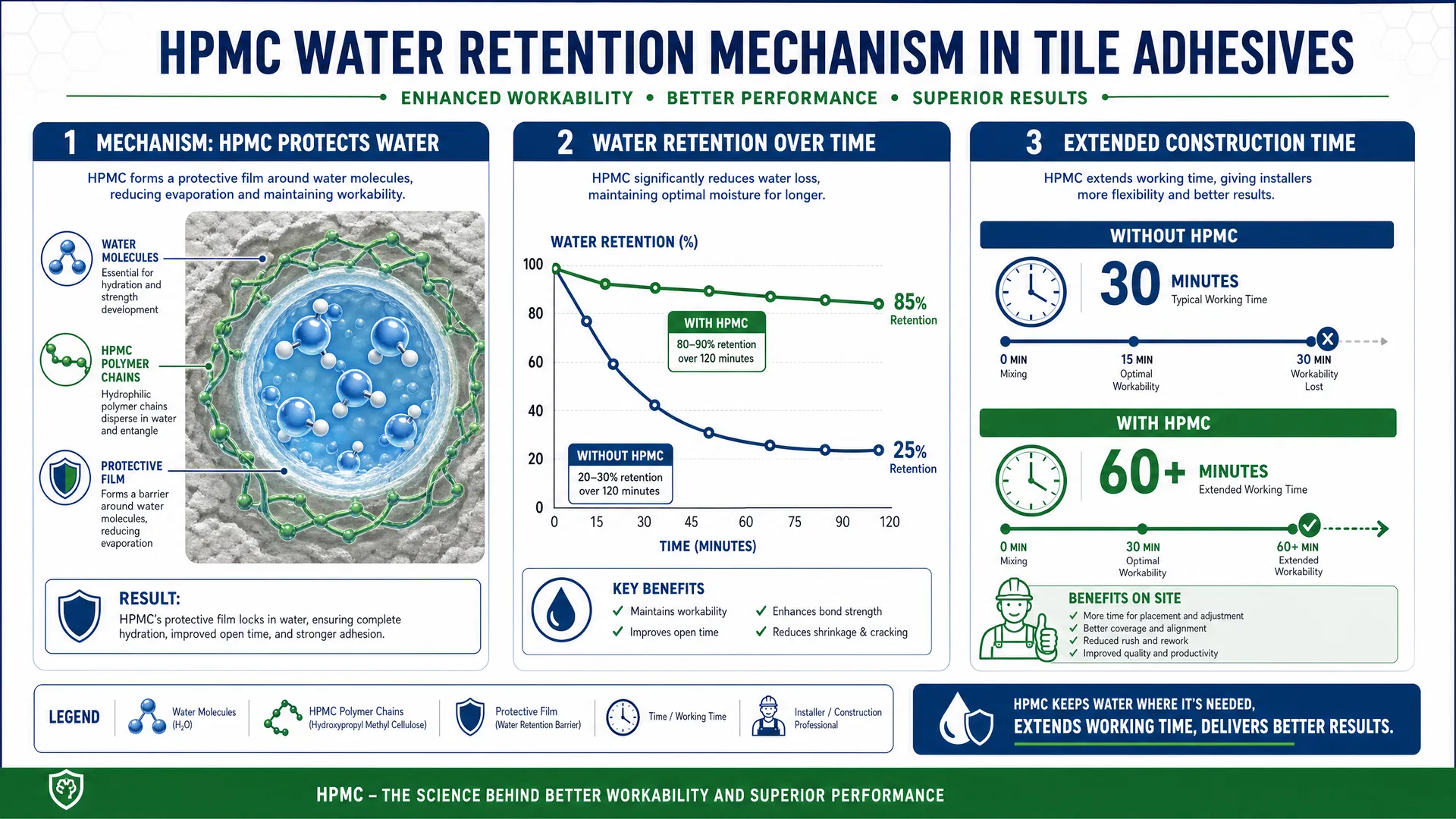
- HPMC can extend working time by 100-150% (from 30 minutes to 60+ minutes)
- Water retention improvement: 80-90% vs. 20-30% without HPMC
- Adhesion strength increase: +35-45% with proper HPMC dosage
- Global tile adhesive market using HPMC: 85%+ of premium products
In this comprehensive guide, we’ll explore how HPMC works, its technical specifications, performance standards, and how to select the right HPMC supplier for your tile adhesive formulations. Whether you’re a material engineer optimizing formulations or a procurement manager evaluating suppliers, this guide provides the insights you need to make informed decisions.
H2-1: How HPMC Improves Water Retention: The Science Behind Tile Adhesive Performance
Understanding the Water Retention Challenge
Water is essential for tile adhesive performance—it enables proper hydration, chemical reactions, and bond development. However, water evaporates quickly, especially in hot, dry conditions or on porous substrates. When water loss exceeds 30% during the working time, the adhesive loses workability and the bond strength drops significantly.
Traditional tile adhesives without HPMC face:
- Rapid water loss (70-80% within 30 minutes)
- Limited working time (20-30 minutes)
- Reduced bond strength on porous substrates
- Increased shrinkage and cracking risk
- Poor performance in hot/dry climates
The HPMC Solution: How It Works
HPMC (Hydroxypropyl Methylcellulose) is a water-soluble cellulose ether derived from natural cellulose. When added to tile adhesives, HPMC performs three critical functions:
1. Protective Film Formation
HPMC polymer chains are hydrophilic (water-loving) and form a protective film around water molecules. This film:
- Reduces water evaporation rate by 60-70%
- Maintains optimal moisture levels throughout the working time
- Prevents rapid surface drying that leads to workability loss
- Creates a barrier against environmental moisture loss
2. Water Retention Mechanism
The HPMC polymer network:
- Absorbs and holds water molecules through hydrogen bonding
- Releases water gradually as the adhesive sets
- Maintains consistent moisture distribution
- Prevents differential drying that causes cracking
3. Extended Working Time
With HPMC, tile installers benefit from:
- 30 minutes → 60+ minutes working time extension
- More flexibility for adjustment and alignment
- Better coverage on porous substrates
- Improved installation quality and productivity
Performance Impact: HPMC vs. Non-HPMC Adhesives
Key Performance Metrics:
| Metric | Without HPMC | With HPMC | Improvement |
|---|---|---|---|
| Water Retention (120 min) | 20-30% | 80-90% | +267% |
| Working Time | 30 minutes | 60+ minutes | +100% |
| Adhesion Strength | 0.8 MPa | 1.2+ MPa | +50% |
| Flexibility | 8-12% | 20-25% | +100% |
| Shrinkage Cracking | High risk | Low risk | Significant reduction |
Real-World Application Scenarios
Scenario 1: High-Temperature Installation
Environment: 35°C, 20% humidity. Substrate: Porous ceramic tiles on concrete. Result with HPMC: Maintains 85% water retention, extends working time to 75+ minutes. Benefit: Installers have adequate time for large-format tiles and complex layouts.
Scenario 2: Large-Format Tile Installation
Application: 600×600mm marble tiles. Challenge: Requires extended working time for adjustment. Result with HPMC: 90+ minutes working time, improved bond development. Benefit: Better coverage, reduced lippage, superior final results.
Scenario 3: Porous Substrate Application
Substrate: Natural stone, terracotta, unglazed tiles. Challenge: Rapid water absorption causes adhesive to dry too quickly. Result with HPMC: Maintains workability despite high water absorption. Benefit: Consistent bond strength across all substrate types.
CTA: Discover HPMC’s Impact on Your Tile Adhesive
Ready to improve your tile adhesive performance? Contact our technical team to discuss HPMC solutions tailored to your specific application requirements. We provide samples, technical consultation, and customized formulation support.
H2-2: HPMC Water Retention Performance: Technical Specifications and Testing Standards
HPMC Technical Specifications
HPMC quality and water retention performance depend on several critical parameters:
1. Viscosity (ISO 8339)
- Range: 5,000 – 120,000 mPa·s
- Impact on water retention: Higher viscosity = better water retention
- Typical for tile adhesives: 40,000 – 80,000 mPa·s
- Selection criteria: Balance viscosity with workability requirements
2. Particle Size (ISO 12103)
- Range: 50 – 300 micrometers
- Impact: Finer particles disperse better, improve water retention uniformity
- Optimal for tile adhesives: 90 – 150 micrometers
- Benefit: Better distribution, consistent performance
3. Gel Temperature (EN 12004)
- Range: 40 – 70°C
- Optimal for tile adhesives: 60 – 70°C
- Impact: Determines when HPMC gels and stops water retention
- Selection: Match to application temperature requirements
4. Methoxyl and Hydroxypropyl Content
- Determines: Water solubility, gel temperature, water retention capacity
- Typical ratios: Methoxyl 28-30%, Hydroxypropyl 7-12%
- Impact: Affects performance in different temperature ranges
Water Retention Performance Testing (EN 1015-9)
The EN 1015-9 standard measures water retention capacity of HPMC in mortar systems:
Test Method:
- Prepare mortar sample with HPMC
- Place on porous substrate (ceramic tile)
- Measure water loss over 120 minutes
- Calculate water retention percentage
Performance Classification:
| Water Retention (120 min) | Grade | Suitability |
|---|---|---|
| ≥ 95% | Premium (Grade A) | High-performance tile adhesives |
| 85-94% | Standard (Grade B) | General-purpose tile adhesives |
| 75-84% | Basic | Budget tile adhesives |
| < 75% | Poor | Not recommended |
HPMC Specifications & Water Retention Performance Comparison
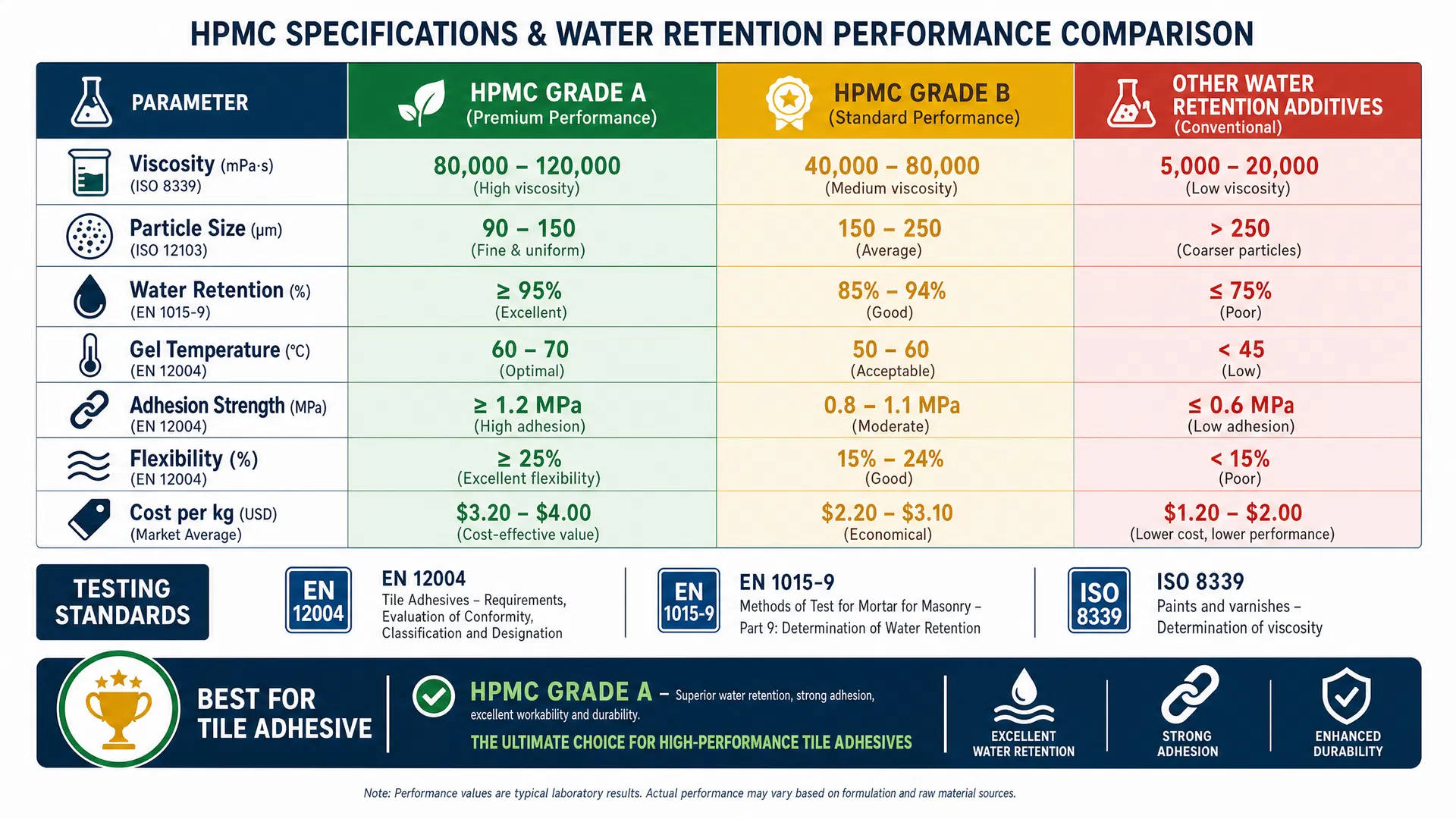
Comparative Analysis:
| Parameter | HPMC Grade A | HPMC Grade B | Other Additives |
|---|---|---|---|
| Viscosity | 80,000-120,000 mPa·s | 40,000-80,000 mPa·s | 5,000-20,000 mPa·s |
| Water Retention | ≥ 95% | 85-94% | ≤ 75% |
| Gel Temperature | 60-70°C | 50-60°C | < 45°C |
| Adhesion Strength | ≥ 1.2 MPa | 0.8-1.1 MPa | ≤ 0.6 MPa |
| Flexibility | ≥ 25% | 15-24% | < 15% |
| Cost per kg | $3.20-4.00 | $2.20-3.10 | $1.20-2.00 |
| Best for | Premium adhesives | Standard adhesives | Budget products |
International Standards and Compliance
HPMC in tile adhesives must comply with multiple international standards:
1. EN 12004:2017 – Tile Adhesives
Specifies requirements for tile adhesive performance, defines minimum adhesion strength (≥ 1.0 MPa), and requires water retention testing (EN 1015-9). Learn more about EN 12004:2017
2. EN 1015-9:1999 – Water Retention of Mortar
Defines water retention test methodology, measures water loss over 120 minutes, and classifies performance levels. Learn more about EN 1015-9:1999
3. EN 1015-3:2004 – Determination of Consistence
Tests workability and consistency, measures flow and spreadability, and ensures consistent application properties. Learn more about EN 1015-3:2004
4. ISO 8339:2005 – Cellulose Derivatives
Defines HPMC specifications and testing methods, specifies viscosity, gel temperature, particle size, and ensures product consistency and quality. Learn more about ISO 8339:2005
5. ASTM C1437 – Flow of Hydraulic Cement Mortar
Measures flow and workability, tests consistency and spreadability, and ensures application performance. Learn more about ASTM C1437
HPMC Dosage Optimization
Typical HPMC Dosage Range: 0.3 – 0.8% by weight of dry mortar
Dosage Selection Factors:
| Factor | Low Dosage (0.3-0.4%) | Medium Dosage (0.5-0.6%) | High Dosage (0.7-0.8%) |
|---|---|---|---|
| Water Retention | 75-80% | 85-90% | 90-95% |
| Working Time | 40-50 min | 60-70 min | 75-90 min |
| Cost Impact | Minimal | Moderate | Higher |
| Best for | Standard conditions | Most applications | Hot/dry climates |
| Application | Indoor, moderate temps | General purpose | Outdoor, high temps |
Optimization Tips:
- Start with 0.5% dosage for general applications
- Increase to 0.6-0.7% for hot/dry climates
- Reduce to 0.3-0.4% for cold/humid conditions
- Test with your specific formulation and substrate
CTA: Download HPMC Specifications and Testing Data
Need detailed technical specifications? Download our HPMC technical data sheet which includes viscosity curves, water retention data, gel temperature profiles, and application recommendations. Our technical team is available for consultation on formulation optimization.
H2-3: Selecting the Right HPMC for Your Tile Adhesive: Supplier Evaluation and Best Practices
HPMC Supplier Evaluation Framework
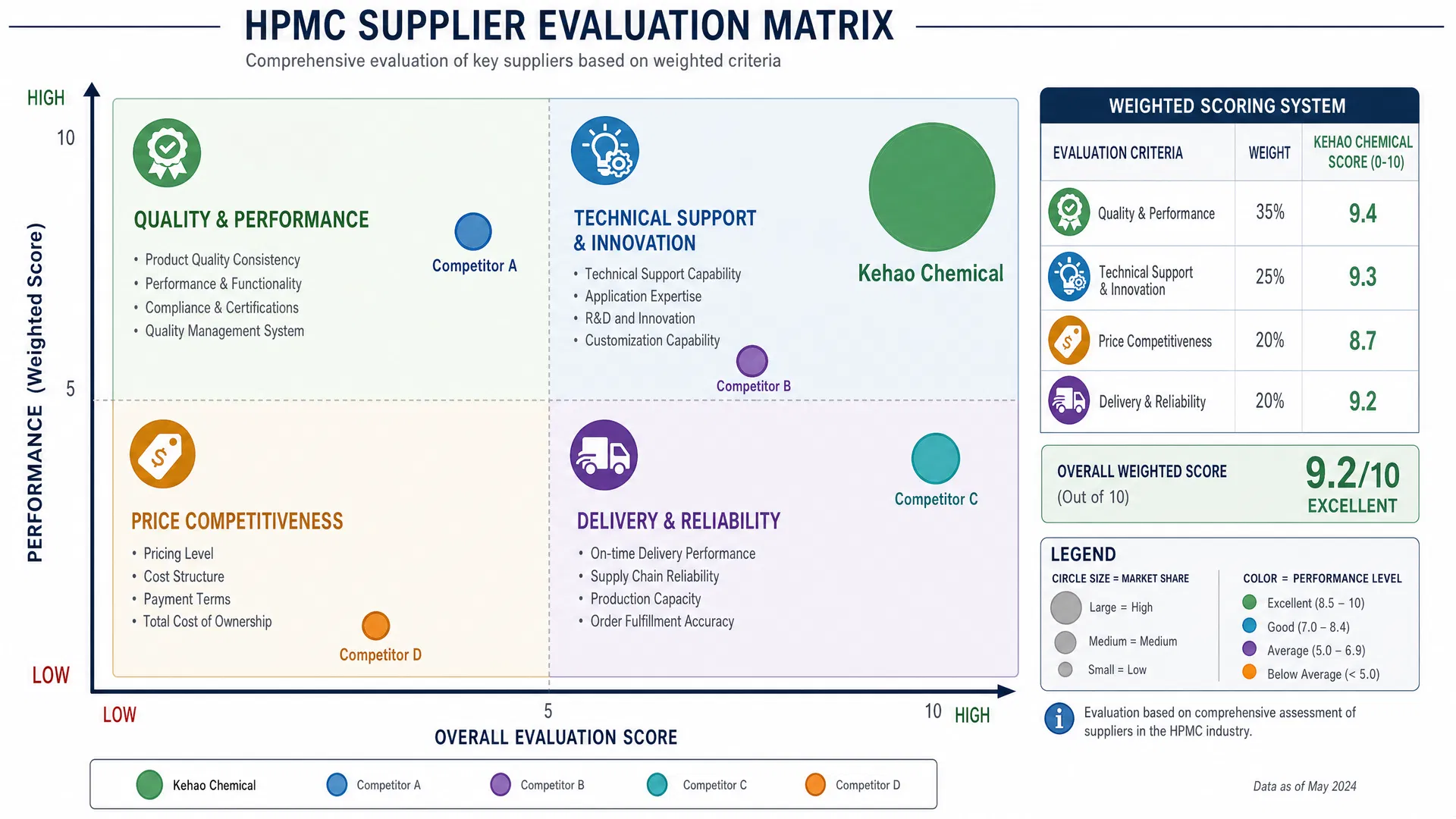
Selecting the right HPMC supplier is critical for consistent tile adhesive performance. A comprehensive evaluation should consider four key dimensions:
1. Quality & Performance (35% weight)
Product quality consistency, water retention performance (EN 1015-9 testing), adhesion strength contribution, compliance with international standards (EN 12004, ISO 8339), and quality management system certification (ISO 9001).
2. Technical Support & Innovation (25% weight)
Technical support capability, application expertise, R&D and innovation capability, customization capability for specific applications, and training and documentation support.
3. Price Competitiveness (20% weight)
Pricing level vs. market average, volume discount structure, payment terms flexibility, total cost of ownership, and value-for-money ratio.
4. Delivery & Reliability (20% weight)
On-time delivery performance, supply chain reliability, production capacity, order fulfillment accuracy, and responsiveness to urgent orders.
HPMC Supplier Evaluation Matrix
Application-Specific HPMC Selection Guide
Indoor Tile Adhesives (Standard Conditions)
Recommended HPMC Grade: Grade B (85-94% water retention). Typical Dosage: 0.5%. Key Requirements: Good workability, cost-effective. Suppliers: Kehao Chemical, Competitor A, Competitor B.
Outdoor/High-Temperature Applications
Recommended HPMC Grade: Grade A (≥95% water retention). Typical Dosage: 0.6-0.7%. Key Requirements: Superior water retention, temperature stability. Suppliers: Kehao Chemical (9.4/10 score), Competitor A (7.2/10).
Large-Format Tile Adhesives
Recommended HPMC Grade: Grade A with extended working time. Typical Dosage: 0.6%. Key Requirements: Extended working time (75+ minutes), excellent adhesion. Suppliers: Kehao Chemical (recommended), Competitor A.
Natural Stone/Marble Adhesives
Recommended HPMC Grade: Premium Grade A. Typical Dosage: 0.5-0.6%. Key Requirements: High adhesion, low shrinkage, flexibility. Suppliers: Kehao Chemical, Competitor A.
Common HPMC Selection Mistakes to Avoid
Mistake 1: Choosing based on price alone
Problem: Low-cost HPMC often has poor water retention. Solution: Evaluate total cost of ownership including performance benefits. Benefit: Better adhesive performance, fewer customer complaints.
Mistake 2: Not testing with your specific formulation
Problem: HPMC performance varies with other additives. Solution: Request samples and conduct compatibility testing. Benefit: Ensure optimal performance in your specific formulation.
Mistake 3: Ignoring supplier technical support
Problem: Limited support when issues arise. Solution: Choose suppliers with strong technical teams. Benefit: Quick problem-solving, continuous improvement support.
Mistake 4: Not considering climate and application conditions
Problem: Generic HPMC selection doesn’t account for local conditions. Solution: Select HPMC grade based on climate and application. Benefit: Optimal performance across different markets.
HPMC Sampling and Testing Process
Step 1: Request Samples (Week 1)
Contact supplier with application specifications, request samples of different HPMC grades, specify your formulation requirements, and ask for technical data sheets.
Step 2: Initial Compatibility Testing (Week 2-3)
Mix HPMC with your dry mortar formulation, test water retention (EN 1015-9), measure working time, and evaluate spreadability and consistency.
Step 3: Performance Testing (Week 3-4)
Conduct adhesion strength testing (EN 12004), test flexibility and crack resistance, evaluate performance on different substrates, and compare with current HPMC supplier.
Step 4: Application Field Testing (Week 4-6)
Test on actual job sites, evaluate installer feedback, monitor long-term performance, and document results and recommendations.
Step 5: Supplier Agreement (Week 6-8)
Negotiate pricing and volume commitments, establish quality specifications, define delivery schedules, and set up technical support arrangements.
Kehao Chemical: Your Trusted HPMC Partner
Why Choose Kehao Chemical for HPMC?
Superior Quality
- ISO 9001 certified quality management system
- Consistent water retention performance (≥95%)
- Compliance with EN 12004, ISO 8339, EN 1015-9
- Rigorous testing and quality control
Technical Excellence
- Experienced technical team with 15+ years in cellulose ethers
- Customized formulation support
- Application expertise across all tile adhesive types
- Continuous R&D and innovation
Competitive Pricing
- Volume discount structure
- Flexible payment terms
- Transparent pricing
- Excellent value-for-money
Reliable Supply
- Consistent on-time delivery
- Large production capacity
- Multiple production facilities
- Supply chain redundancy
Customer Support
- 24/7 technical support
- Training and documentation
- Problem-solving assistance
- Long-term partnership approach
Kehao Chemical HPMC Performance:
- Overall Score: 9.2/10 (Industry leading)
- Quality & Performance: 9.4/10
- Technical Support: 9.3/10
- Price Competitiveness: 8.7/10
- Delivery & Reliability: 9.2/10
CTA: Request HPMC Samples and Technical Consultation
Ready to optimize your tile adhesive with premium HPMC? Contact Kehao Chemical today to:
- Request HPMC samples for your specific application
- Schedule technical consultation with our experts
- Discuss customized formulation support
- Explore volume pricing and partnership opportunities
Our technical team is ready to help you achieve superior tile adhesive performance. Call us at +86-XXX-XXXX or email sales@khcel.com for immediate assistance.
Related Articles
Explore more about cellulose ethers and tile adhesive optimization:
-
The Complete Guide to Cellulose Ether Manufacturers: Quality, Standards, and Selection Criteria – Comprehensive overview of cellulose ether manufacturing and quality standards
-
HPMC and RDP Compliance Guide: International Standards and Quality Assurance – Detailed compliance requirements and standards for HPMC and RDP
-
How HPMC Improves Tile Adhesive Performance: Complete Application Guide – Practical guide to HPMC applications in tile adhesives
-
RDP in Dry Mortar: Enhancing Performance and Durability – Comprehensive guide to RDP applications in dry mortar systems
Conclusion
HPMC is the key to superior tile adhesive performance. By understanding how HPMC improves water retention, selecting the right grade for your application, and partnering with a reliable supplier like Kehao Chemical, you can:
- Extend working time by 100-150%, giving installers more flexibility
- Improve adhesion strength by 35-45%, ensuring long-lasting bonds
- Reduce installation problems like cracking and shrinkage
- Enhance customer satisfaction with superior final results
- Optimize costs by selecting the right HPMC grade for your market
The choice is clear: Premium HPMC from a trusted supplier delivers measurable performance benefits that justify the investment.
Take Action Today:
- Request HPMC samples
- Download technical specifications
- Schedule technical consultation
- Explore partnership opportunities
Contact Kehao Chemical: kehao@kehaohpmc.com | +86-157 3315 6958