HPMC in gypsum plaster often receives the blame when cracks appear, but changing the cellulose ether too quickly can create new problems. Higher viscosity may reduce workability without addressing the real cause. I recommend diagnosing the crack pattern, formulation, substrate, application thickness, and drying conditions before adjusting the HPMC grade or dosage.
HPMC can support water retention, consistency, adhesion, and workable application in gypsum plaster1, but it cannot prevent every crack. To fix cracking, I first identify when and where cracks developed. I then review the complete formulation, substrate absorption, plaster thickness, and drying environment before comparing HPMC grades or dosages under controlled conditions.
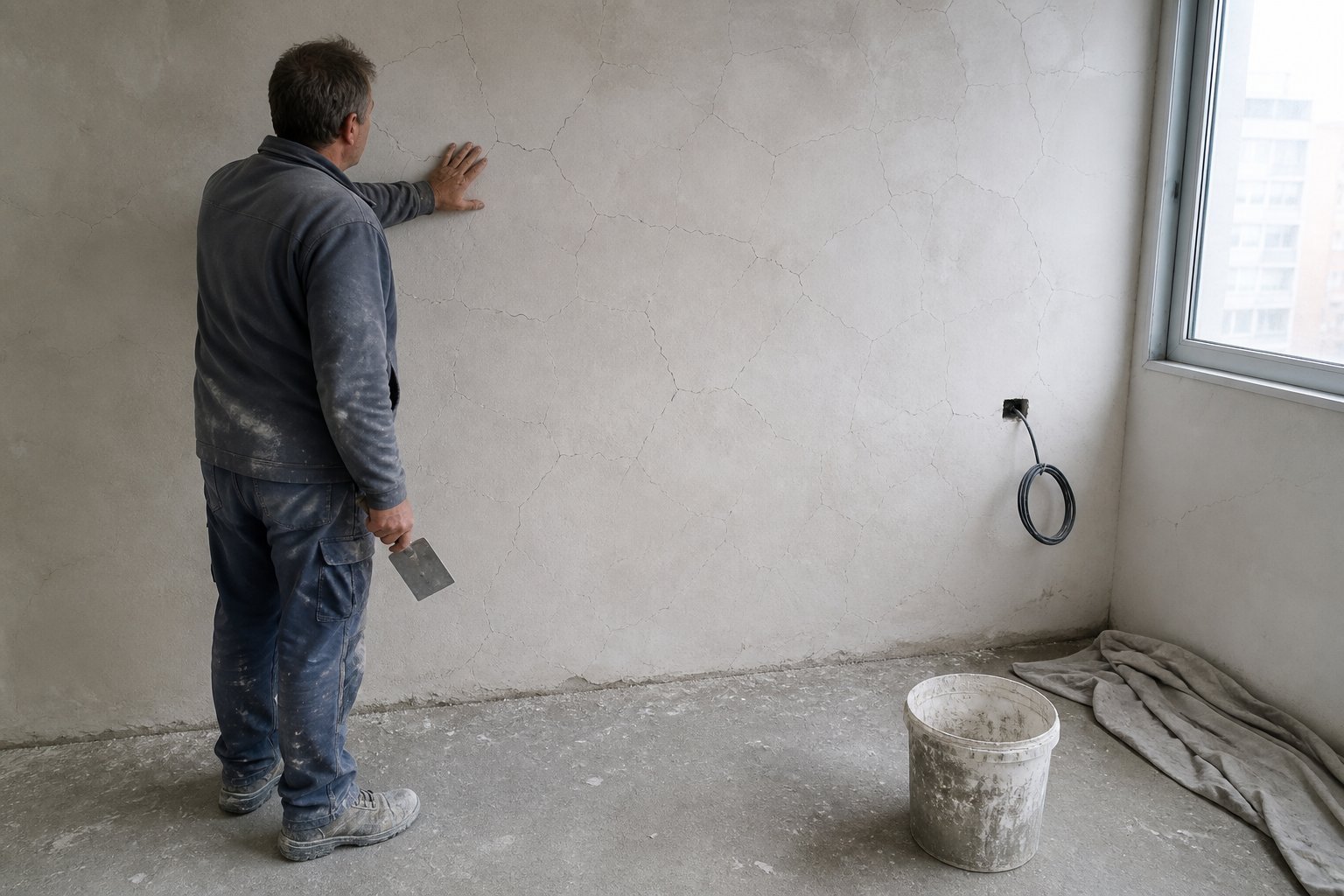
In formulation consultations, I often begin with three questions: When did the cracks appear, what do they look like, and where are they concentrated? Those answers usually provide more useful direction than the original HPMC viscosity number. A structured investigation also reduces the cost of repeated, unverified formulation changes.
How Should I Diagnose Cracks Before Changing HPMC in Gypsum Plaster?
A cracked surface creates pressure to change the formulation immediately. However, a quick increase in HPMC can hide the original problem or damage application performance. I prefer to document the timing, shape, depth, and distribution of cracks before deciding whether the first investigation should focus on materials, application, substrate, or drying.
I diagnose gypsum plaster cracks by recording when they appeared, whether they are superficial or deep, and where they are concentrated. I then compare those observations with batch records, substrate conditions, application thickness, and weather data. This sequence helps me decide whether HPMC suitability should be tested or another variable should be corrected first.

Start With the Timing
Crack timing can narrow the investigation, although it does not prove a single cause. I ask the applicator to photograph the same area at several stages:
- Immediately after application
- During initial setting
- Several hours after application
- After one day
- After the plaster has reached its expected dry condition
Cracks that appear while the material is still being worked require a different investigation from cracks that become visible after rapid drying. Likewise, cracks that return along a substrate joint may point toward movement or substrate preparation rather than cellulose ether selection.
Record the Crack Pattern
I use the following observations as diagnostic leads, not final conclusions:
| Observation | First areas I investigate | Why I check them |
|---|---|---|
| Fine, widespread surface cracking | Drying speed, water demand, layer thickness, substrate absorption | The surface may be losing moisture too quickly or experiencing uneven drying2 |
| Cracks near corners or openings | Substrate movement, reinforcement details, thickness variation | Stress can concentrate around transitions and openings |
| Cracks over joints | Joint treatment, substrate movement, mesh or reinforcement design | A formulation adjustment may not accommodate structural movement |
| Local cracks on highly absorbent areas | Primer coverage, substrate moisture, local thickness | Uneven suction can create inconsistent setting and drying |
| Deep cracks through the plaster layer | Excessive thickness, substrate condition, application practice, system design | The issue may extend beyond surface water retention |
| Cracking limited to one production batch | Raw material variation, dosing accuracy, mixing sequence | Batch-specific differences deserve review |
I also ask whether the affected plaster was hand-applied or machine-sprayed. Machine application introduces equipment settings, hose time, mixing consistency, and interruptions as additional variables.
Build a Useful Case Record
A photograph alone rarely gives me enough information. I recommend recording:
- Gypsum source and batch number
- Filler type and particle-size information
- HPMC grade, batch, and actual dosage
- Retarder, accelerator, starch ether, air-entraining agent, and other additive dosages
- Water-to-dry-mix ratio
- Mixing time and resting time
- Application method
- Nominal and measured plaster thickness
- Substrate type and pretreatment
- Ambient temperature and relative humidity
- Ventilation, sunlight, heating, and airflow
- Time between application and first visible cracking
I have seen customer cases improve after better substrate pretreatment, while other cases improved after changing the HPMC grade under a comparable formulation. In several projects, customers changed both the cellulose ether and other additives. I treat those results as practical customer observations, not controlled proof that HPMC alone caused the improvement.
What Does HPMC in Gypsum Plaster Actually Do?
Manufacturers sometimes expect one additive to control setting, water retention, sag resistance, adhesion, and cracking. That expectation creates formulation risk. I view HPMC as one functional component in a gypsum system. Its performance depends on the gypsum, fillers, other additives, water demand, mixing process, substrate, and application conditions.
HPMC in gypsum plaster primarily helps manage water retention, consistency, workability, and application behavior. The appropriate balance can give the plaster enough workable time and support more uniform application. However, higher viscosity or a larger dosage does not automatically provide better crack resistance because every formulation responds differently.
Water Retention Must Match the System
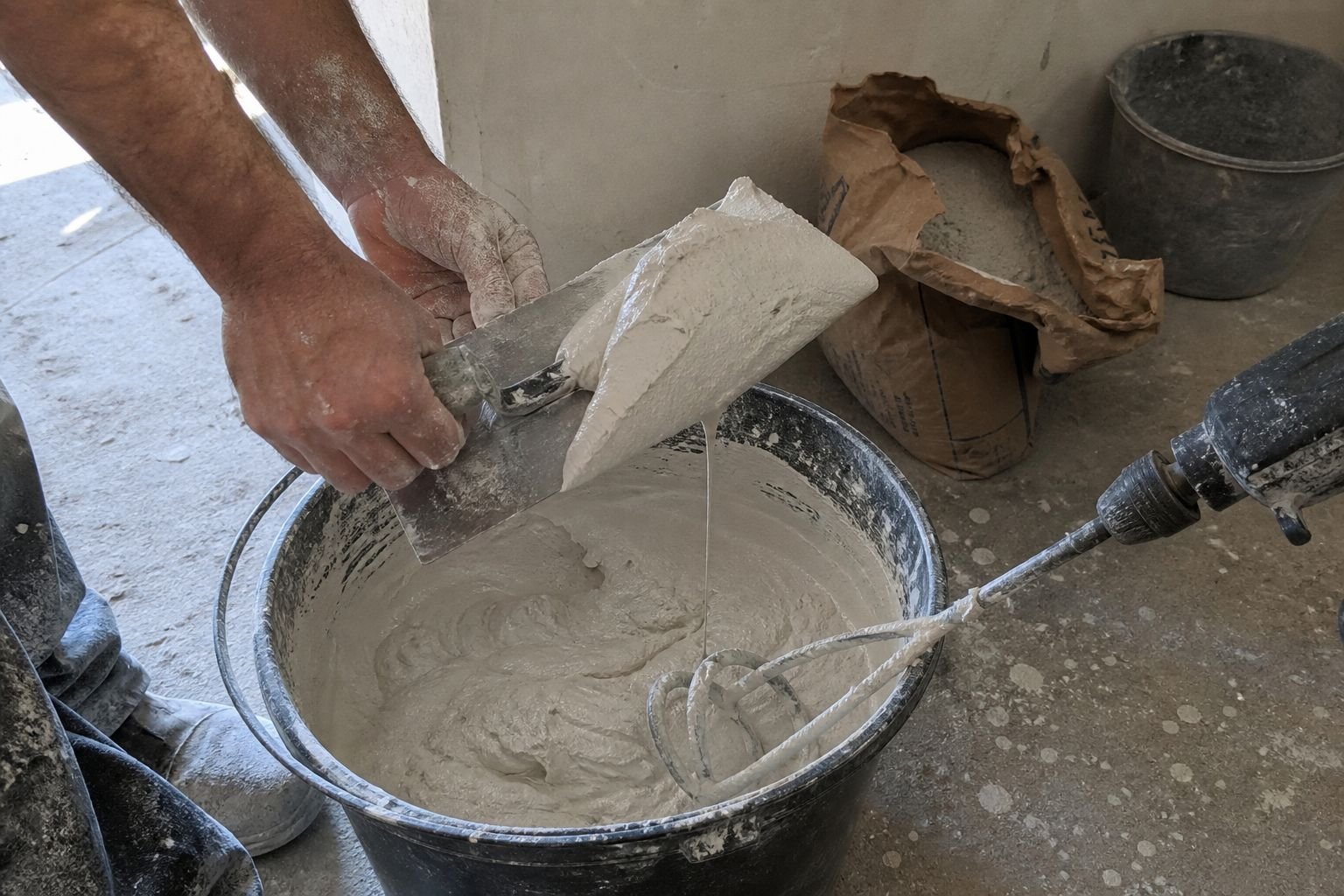
Gypsum plaster needs water for mixing, application, and hydration. A highly absorbent substrate or strong airflow can remove water unevenly. A suitable cellulose ether can help the wet mortar retain water, but I do not treat maximum water retention as a universal target.
Excessive water retention may change setting behavior, surface finishing, drying time, or the interaction with other additives. The practical target should come from application testing and the product’s intended use.
I therefore ask buyers to compare:
- Water retention under a defined test method
- Wet consistency at equal water addition
- Water demand at a defined consistency
- Open and finishing time
- Sag or slump behavior
- Surface condition after drying
- Adhesion or bond results under the applicable standard
- Crack development under repeatable application conditions
Test methods matter. A water-retention percentage has limited procurement value when the supplier does not state the substrate, specimen thickness, pressure, duration, temperature, or calculation method.
Viscosity Is Not a Standalone Quality Score
Viscosity labels can be misleading because test values depend on the solution concentration, temperature, spindle, rotational speed, instrument, and preparation method.3 I recommend comparing viscosity only when suppliers use the same stated test conditions.
A higher viscosity grade can increase perceived body or improve certain application properties. However, it can also affect:
- Mixing speed
- Pumpability
- Trowel drag
- Leveling
- Wet density
- Air entrainment
- Water demand
- Surface finishing
The best choice is not necessarily the highest number. It is the grade that provides a workable balance within the buyer’s actual formulation.
Workability Has Several Parts
When a customer says that gypsum plaster has “good workability,” I ask for a clearer description. The phrase may refer to easy mixing, low trowel resistance, good wet adhesion, smooth finishing, sag control, or sufficient working time.
A grade that improves one property may weaken another. For example, stronger thickening may support build on a vertical surface but make fine finishing more difficult. I therefore evaluate HPMC in gypsum plaster as part of a performance profile, not as a single viscosity result.
Which Formulation Factors Affect HPMC in Gypsum Plaster?
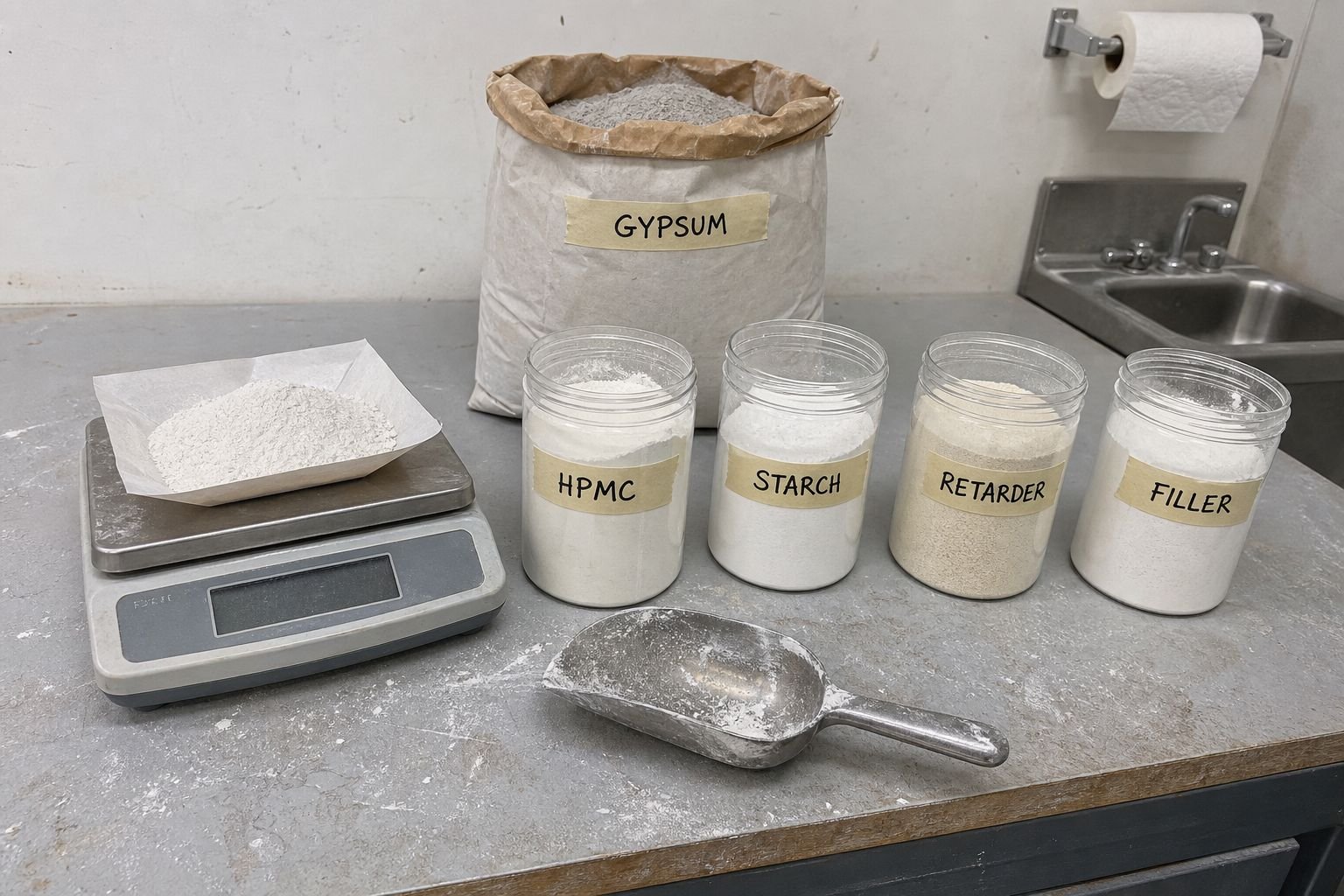
A gypsum formulation can crack even when the cellulose ether meets its specification. Different gypsum sources, fillers, retarders, starch ethers, and air-entraining components can change water demand and application behavior. I review the complete recipe because changing one additive without understanding its interactions often leads to misleading trial results.
The performance of HPMC in gypsum plaster depends on gypsum reactivity, particle grading, filler content, water ratio, setting-control additives, starch ether, air entrainment, and mixing conditions. I change one variable at a time whenever possible. This method shows whether an HPMC adjustment improves cracking without sacrificing consistency, finishability, setting, or application efficiency.
Review the Gypsum and Fillers First
Gypsum raw materials can differ in purity, fineness, phase composition, storage history, and reactivity.4 These differences may affect water demand and setting behavior. Fillers also influence packing, consistency, and the amount of water needed to achieve a workable mix.
I recommend keeping retain samples from incoming raw materials. When a production problem appears, the manufacturer can compare:
- The affected gypsum batch with a previous accepted batch
- Particle-size or fineness results
- Standard consistency or water demand
- Initial and final setting measurements
- Bulk density and moisture
- Supplier certificates of analysis
- Internal application panels
I treat certificates as supporting documents rather than substitutes for incoming inspection. Buyers should verify which methods were used and whether the reported data correspond to the delivered batch.
Check Every Additive Dosage
Small-dose additives deserve careful control because weighing errors or poor dispersion can cause large batch-to-batch differences.5 I often review the following components alongside HPMC:
- Retarders: These control working and setting time but can interact with gypsum chemistry.
- Accelerators: These can shorten setting and reduce the available finishing window.
- Starch ether: This may influence sag resistance, creaminess, and trowel behavior.
- Air-entraining components: These may affect wet density, yield, strength, and application feel.
- Redispersible polymer powder: This can alter adhesion, flexibility, and water demand, depending on the system.
- Defoamers or wetting agents: These can influence pore structure and surface appearance.
The mixing order also matters. Poorly dispersed cellulose ether can form agglomerates or produce inconsistent local thickening.6 I ask manufacturers to document the dry-blending sequence, mixer fill level, mixing duration, and dosing accuracy.
Avoid Changing Several Variables at Once
One customer case involved adjustments to the HPMC grade, retarder level, and water ratio during the same production trial. The plaster later showed fewer visible surface cracks. However, I could not attribute the result to the cellulose ether because three important variables had changed.
A more reliable trial sequence would be:
- Establish a repeatable control formulation.
- Confirm raw material and application conditions.
- Change one HPMC property or dosage.
- Keep water addition controlled, or clearly document any adjustment.
- Apply equal-thickness panels to comparable substrates.
- Record wet behavior, setting, finishing, and dried results.
- Repeat the promising trial before scaling up.
This process takes more time than an immediate dosage increase, but it provides information that purchasing and technical teams can use.
How Do Substrate and Drying Conditions Affect HPMC in Gypsum Plaster?
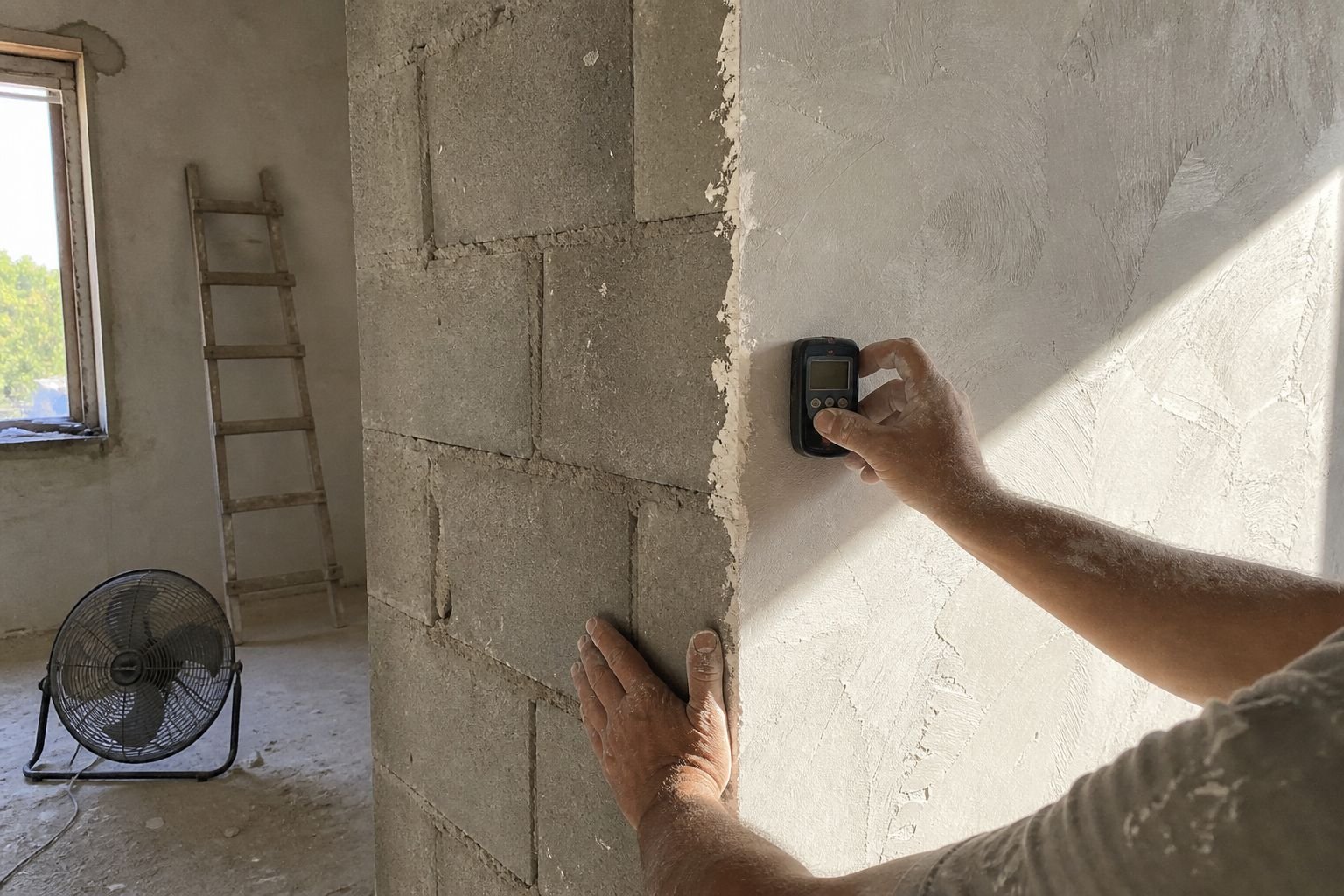
A laboratory mix can perform well and still crack on a construction site. Absorbent masonry, dusty concrete, uneven primer coverage, thick application, sunlight, heating, and strong airflow can change moisture loss.7 I therefore investigate site conditions before asking a manufacturer to redesign a formulation that may already perform correctly under controlled conditions.
Substrate absorption and drying conditions can overpower the benefits expected from HPMC in gypsum plaster. I check whether the substrate is clean, stable, evenly prepared, and compatible with the plaster. I also record thickness, temperature, humidity, sunlight, heating, and ventilation because rapid or uneven moisture loss can contribute to cracking.
Inspect the Substrate Systematically
I ask applicators to divide the wall into zones and note whether cracks correspond with:
- Different substrate materials
- Concrete-to-masonry transitions
- Electrical chases or repaired areas
- Joints, corners, windows, and doors
- Missing or uneven primer
- Dust, oil, curing compounds, or loose particles
- Smooth concrete with limited mechanical key
- Damp patches or water leakage
- Areas exposed to direct sun or airflow
A stable formulation cannot correct a moving substrate, an untreated joint, or contaminated concrete.8 These conditions may require an appropriate primer, bonding treatment, reinforcement detail, or professional building assessment.
I recommend that buyers follow the plaster system supplier’s written substrate and thickness instructions. A qualified construction professional should evaluate structural movement, recurring deep cracks, moisture ingress, and safety-critical failures.
Measure Thickness Instead of Estimating It
Plaster thickness often varies around corners, wall deviations, embedded services, and repair zones. A worker may describe a layer as uniform even when local sections are much thicker.
I recommend measuring the applied layer at several marked points. The acceptable thickness depends on the product design, substrate, application method, and local standard. I do not prescribe one universal thickness because a thin finishing plaster and a base-coat gypsum plaster have different requirements.
Where thicker correction is necessary, the system may require multiple layers, reinforcement, different curing conditions, or another product. The manufacturer’s technical data and qualified site guidance should determine the method.
Record the Drying Environment
Terms such as “hot,” “dry,” and “well ventilated” are too subjective for a useful investigation. I prefer actual measurements and time-stamped observations:
| Site variable | Information to record |
|---|---|
| Air temperature | Measurements during mixing, application, setting, and early drying |
| Relative humidity | Measurements near the wall, not only from a distant weather report |
| Air movement | Open windows, fans, HVAC outlets, or cross-ventilation |
| Heat exposure | Direct sunlight, heaters, hot substrate, or radiant heat |
| Substrate condition | Temperature, visible moisture, and pretreatment status |
| Plaster thickness | Multiple measured points across the test area |
| Crack timing | First appearance and later development |
In one follow-up, a customer reported improvement after reducing strong ventilation during early drying and improving primer consistency. The customer did not run a controlled scientific study, so I present this as a bounded field observation. The case still illustrates why site controls should be reviewed before HPMC is blamed.
How Should I Test HPMC Grades and Dosages for Gypsum Plaster?
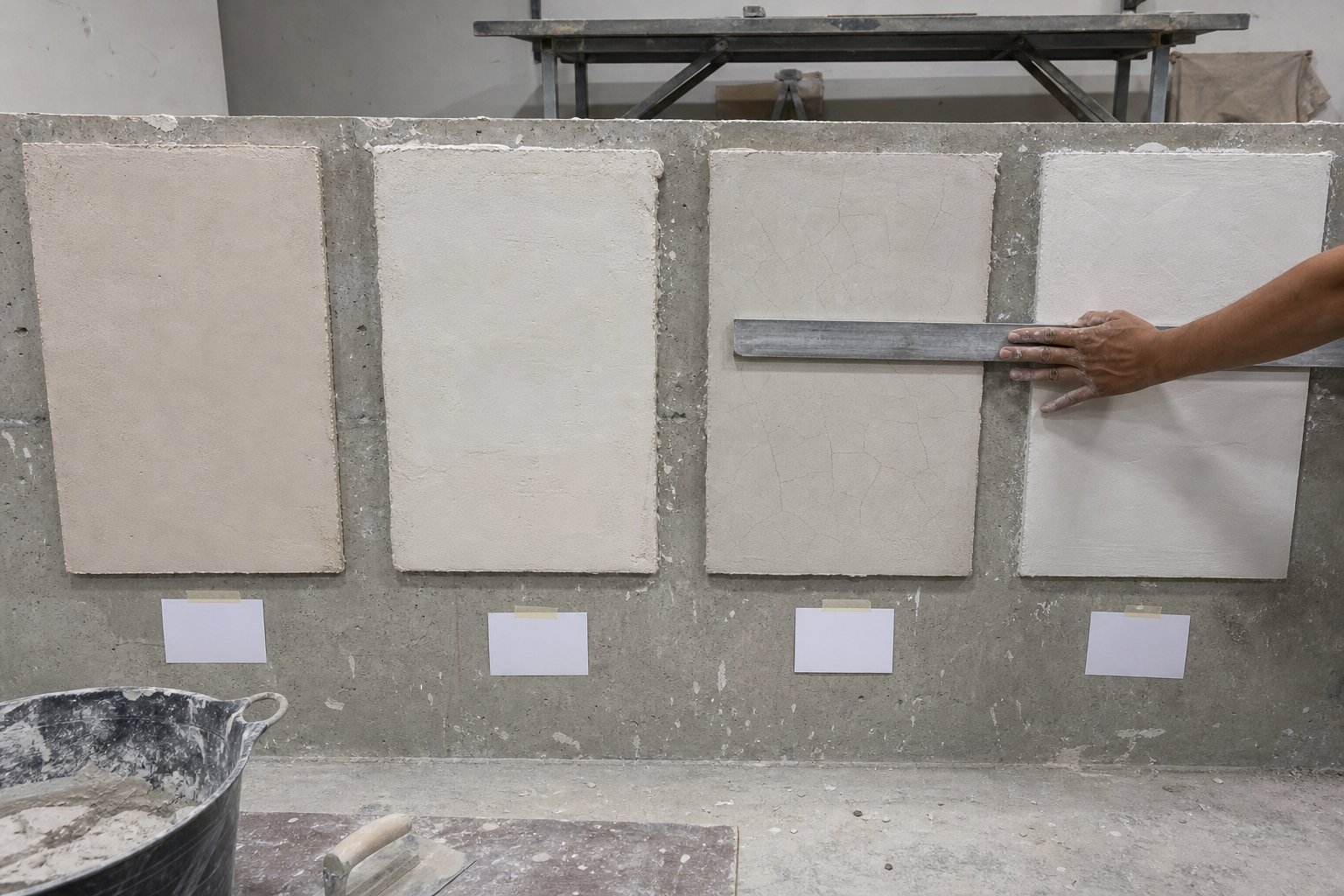
Once the formulation, substrate, and environment have been reviewed, a cellulose ether comparison becomes more meaningful. The main risk is testing several grades under different water ratios or application conditions. I prefer a documented control, one-variable changes, repeat panels, and predefined acceptance criteria that reflect production and site requirements.
I test HPMC in gypsum plaster by establishing a control batch and changing one grade characteristic or dosage at a time. I keep raw materials, water, mixing, substrate, thickness, and drying conditions as consistent as practical. I then compare workability, setting, wet adhesion, finishing, cracking, and relevant mechanical results.
Define the Acceptance Criteria First
A trial can produce attractive plaster but still fail commercially. Before testing, I ask the manufacturer to define what success means.
Useful criteria may include:
- Dry-mix flow and production handling
- Mixing time and lump formation
- Target consistency
- Water demand
- Wet density
- Working and finishing time
- Trowel drag
- Sag resistance
- Pumping or spraying behavior
- Surface smoothness
- Crack number, width, depth, and location
- Adhesion, hardness, or strength under the relevant method
- Packaging stability and storage performance
I also recommend checking whether the test method reflects actual use. A very thin laboratory panel on a low-absorption board may not represent a thick site application on masonry.9
Use a Controlled Trial Matrix
The exact viscosity range and dosage must be selected for the specific formulation. However, buyers can use a general trial structure without assuming that one grade is universally best.
| Trial | HPMC variable | Other variables | Purpose |
|---|---|---|---|
| Control | Current grade and dosage | Held constant | Establish baseline performance |
| Trial A | Alternative grade | Held constant | Compare grade behavior |
| Trial B | Current grade, adjusted dosage | Held constant | Measure dosage response |
| Trial C | Promising grade at refined dosage | Held constant | Balance performance and cost |
| Repeat | Best candidate | Same documented conditions | Check repeatability |
If water must be changed to reach the same target consistency, I document both the original and adjusted water levels. Otherwise, the team may mistake a water-ratio effect for an HPMC effect.
Evaluate the Supplier as Well as the Sample
A good sample does not guarantee stable commercial deliveries. When I help buyers assess a cellulose ether supplier, I suggest reviewing:
- Batch-to-batch viscosity consistency under a stated method
- Moisture and ash specifications
- Substitution or performance data where relevant
- Water-retention test method
- Production capacity and quality-control process
- Batch traceability and retained-sample policy
- Technical support for formulation trials
- Change-notification procedures
- Packaging and moisture protection
- Lead time, loading port, and supply continuity
- Regulatory and test documentation
At Shijiazhuang Kehao Chemical Co., Ltd., we manufacture HPMC and other dry-mix additives on automated production lines at our facility in Hebei Province. We offer sample support, OEM service, and formulation guidance. We can also discuss shipments through Tianjin and local availability through our Iran office and warehouse.
We have passed REACH testing, but I still advise every buyer to request the current report, confirm the tested product identity, check the issuing laboratory, and verify whether the documentation fits the destination market and intended use. Pharmaceutical excipient or regulated applications require additional qualification and professional review.
<h3>Related technical guides</h3> <ul> <li><a href="https://khcel.com/dry-mortar-additive-enhancing-performance-with-polymers/">Dry Mortar Additive: Enhancing Performance with Polymers</a></li> <li><a href="https://khcel.com/hpmc/">HPMC</a></li> <li><a href="https://khcel.com/hpmc-workability-optimizing-mortar-performance-consistency/">HPMC Workability: Optimizing Mortar Performance & Consistency</a></li> </ul>
Frequently Asked Questions
Can Adding More HPMC Stop Gypsum Plaster From Cracking?
Adding more HPMC may improve water retention or consistency in some formulations, but it cannot correct every cause of cracking. Excess dosage may increase water demand, trowel drag, air entrainment, or drying time.10 I recommend checking the crack pattern, substrate, layer thickness, drying environment, and complete formulation before increasing dosage.
Does Higher-Viscosity HPMC Provide Better Crack Resistance?
Higher viscosity does not automatically provide better crack resistance. It may improve body or sag control, but it can also reduce leveling, pumpability, or finishability. I compare grades using the same viscosity test method and evaluate them in the complete plaster formulation under repeatable application conditions.
How Can I Tell Whether HPMC Is Causing the Problem?
I compare the affected batch with a stable control while keeping gypsum, additives, water, mixing, substrate, thickness, and drying conditions consistent. I then change only the HPMC grade or dosage. Even this comparison shows correlation within the tested system rather than universal proof of causation.
Should I Test HPMC With My Actual Gypsum Raw Material?
Yes. I recommend testing HPMC with the buyer’s actual gypsum, fillers, additives, water quality, and application method. A grade that works in one plaster system may behave differently in another because gypsum reactivity, particle grading, retarders, and water demand can vary.11
What Information Should I Send an HPMC Supplier About Cracking?
I suggest sending the complete formulation, additive dosages, gypsum data, HPMC grade and batch, water ratio, mixing process, application thickness, substrate details, temperature, humidity, ventilation, crack timing, and clear photographs. This information allows the supplier to recommend focused trials instead of guessing from viscosity alone.
Conclusion
HPMC in gypsum plaster should be selected through diagnosis rather than assumption. I begin by documenting when, where, and how cracks appear. I then review the gypsum system, additive dosages, substrate preparation, application thickness, and drying conditions before comparing grades or dosages. This approach reduces unnecessary formulation changes and protects workability.
If you need to evaluate a current HPMC grade, contact our team at Shijiazhuang Kehao Chemical Co., Ltd. We can review your formulation information, arrange free samples, and help you design a controlled gypsum plaster trial.
"The Influence of Hydrated Lime and Cellulose Ether ... - PMC", https://pmc.ncbi.nlm.nih.gov/articles/PMC8509617/. Studies of cellulose-ether-modified gypsum mortars report that HPMC can increase water retention and modify fresh-state rheology, which may affect workability and adhesion-related application behavior. Evidence role: mechanism; source type: paper. Supports: Experimental or review evidence that cellulose ethers, including HPMC, alter water retention and fresh-state rheological or application properties of gypsum-based mortars.. Scope note: The magnitude and direction of effects depend on polymer grade, dosage, gypsum composition, water ratio, and test method. ↩
"The Effect of Harsh Environmental Conditions on Concrete ...", https://pmc.ncbi.nlm.nih.gov/articles/PMC9740496/. Materials research shows that rapid or spatially uneven water loss can produce differential shrinkage stresses in fresh or early-age mineral mortars, contributing to surface cracking. Evidence role: mechanism; source type: paper. Supports: Research on cementitious and gypsum-like plaster materials showing that rapid evaporation or non-uniform drying can create shrinkage stresses and increase cracking risk.. Scope note: The relevant drying threshold and crack response vary with binder chemistry, layer thickness, restraint, substrate absorption, and environmental conditions. ↩
"A Study on the Impact of Hydroxypropyl Methylcellulose ... - PMC", https://pmc.ncbi.nlm.nih.gov/articles/PMC4370968/. Standard viscosity procedures for hypromellose specify solution preparation, concentration, temperature, and instrument conditions because measured viscosity depends on the defined test method. Evidence role: definition; source type: institution. Supports: Pharmacopeial or standards-based descriptions showing that polymer-solution viscosity is measured under specified concentration, temperature, apparatus, and operating conditions.. Scope note: A standard method improves comparability but does not establish that products tested by different methods have equivalent application performance. ↩
"Effect of Industrial Byproduct Gypsum on the Mechanical ...", https://pmc.ncbi.nlm.nih.gov/articles/PMC11396579/. Research on gypsum binders indicates that phase composition, particle characteristics, impurities, and storage conditions can influence hydration reactivity, water demand, and setting behavior. Evidence role: mechanism; source type: paper. Supports: Research showing that gypsum binder mineralogy, particle size, impurities, and storage-related changes influence hydration, water demand, and setting behavior.. Scope note: The effects of any individual raw-material characteristic depend on the specific gypsum source and formulation. ↩
"Blend Segregation in Tablets Manufacturing and Its Effect on ...", https://pmc.ncbi.nlm.nih.gov/articles/PMC8620778/. Powder-processing guidance identifies accurate dispensing and adequate blending as necessary controls for achieving uniform distribution of low-level ingredients within production batches. Evidence role: general_support; source type: government. Supports: Manufacturing guidance or powder-blending research establishing that low-concentration ingredients require control of weighing and blending to achieve content uniformity.. Scope note: The degree of variability caused by an error depends on additive concentration, particle properties, mixer design, and blend time. ↩
"Effect of Cellulose Ether and Starch Ether on Hydration ... - PMC", https://pmc.ncbi.nlm.nih.gov/articles/PMC9782582/. Studies of cellulose-ether hydration describe how inadequate wetting or dispersion can promote lump formation and non-uniform polymer distribution, affecting local rheology. Evidence role: mechanism; source type: paper. Supports: Research describing the hydration and dissolution behavior of cellulose-ether powders and the potential for lumping or non-uniform rheology when dispersion is inadequate.. Scope note: Observed agglomeration depends on powder properties, addition sequence, mixing energy, water temperature, and the broader dry-mix formulation. ↩
"The Effects of Temperature Curing on the Strength ... - PMC", https://pmc.ncbi.nlm.nih.gov/articles/PMC7766353/. Building-materials research identifies substrate suction, ambient temperature, air movement, and radiant heat as factors that can alter moisture transport and drying rates in fresh mortar layers. Evidence role: mechanism; source type: research. Supports: Building-material research showing that environmental exposure and substrate water absorption influence moisture transport and drying of fresh mortars or plasters.. Scope note: Site effects should be assessed through local measurements because individual factors can act together and vary over time. ↩
"Adhesion, Thermal Conductivity, and Impact on Indoor Air ...", https://pmc.ncbi.nlm.nih.gov/articles/PMC12898068/. Professional plastering guidance treats substrate stability, clean and sound surfaces, and correctly detailed joints as prerequisites for durable plaster-system performance. Evidence role: expert_consensus; source type: institution. Supports: Professional guidance stating that substrate stability, cleanliness, joint treatment, and compatibility are prerequisites for reliable plaster or render performance.. Scope note: Appropriate remediation depends on the substrate, specified plaster system, defect severity, and applicable building requirements. ↩
"Determination of Mortar Strength in Historical Brick Masonry ...", https://pmc.ncbi.nlm.nih.gov/articles/PMC7345265/. Experimental studies show that mortar behavior can vary with substrate absorbency and applied thickness, so test panels should be selected to reflect intended application conditions. Evidence role: general_support; source type: paper. Supports: Experimental research demonstrating that substrate absorbency and specimen thickness affect mortar water transfer, setting, and measured performance.. Scope note: Laboratory testing remains useful for controlled comparisons, but it cannot reproduce every site variable. ↩
"Effect of Cellulose Ether and Starch Ether on Hydration ... - PMC", https://pmc.ncbi.nlm.nih.gov/articles/PMC9782582/. Experimental mortar studies report that cellulose-ether content can alter rheology, water requirement, entrained-air characteristics, and drying behavior. Evidence role: mechanism; source type: paper. Supports: Experimental evidence that cellulose-ether dosage affects mortar rheology, water requirement, entrained air, and moisture-release behavior.. Scope note: These effects are formulation-specific and should not be interpreted as proof that every increase in HPMC dosage produces all listed outcomes. ↩
"Effect of Cellulose Ether and Starch Ether on Hydration ... - PMC", https://pmc.ncbi.nlm.nih.gov/articles/PMC9782582/. Research on polymer-modified mineral mortars indicates that cellulose-ether performance is context-dependent, with binder reactivity, particle characteristics, admixtures, and water demand influencing the resulting fresh and hardened properties. Evidence role: general_support; source type: research. Supports: Review or laboratory evidence that cellulose-ether performance in mineral mortars is affected by binder chemistry, aggregate or filler properties, admixtures, and water demand.. Scope note: This evidence supports the need for system-specific testing rather than identifying a universally optimal HPMC grade. ↩