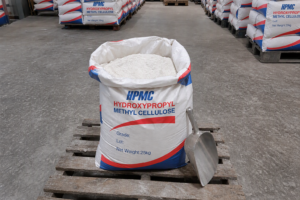
Problem: A dry-mix mortar can feel smooth and stable in a laboratory bowl, then become sticky, short, lumpy, or inconsistent after the same formula enters a production mixer. Teams often respond by changing water or blaming HPMC before proving what changed.
Agitation: That reaction can hide the real scale-up mechanism. It also creates a moving target for operators, quality teams, suppliers, and customers. A formula copied by percentage is not yet a reproduced process when mixer geometry, filling, material condition, waiting time, and sampling all differ.
Solution: I treat this as a process-comparability investigation. We lock the formula, map laboratory and plant histories, use one defined fresh-mortar method, and retain representative material. This approach complements the broader dry-mix mortar failure guide without reducing every workability shift to one additive.
1. How Do Mixing Energy and Mixer Scale Change the Mortar?
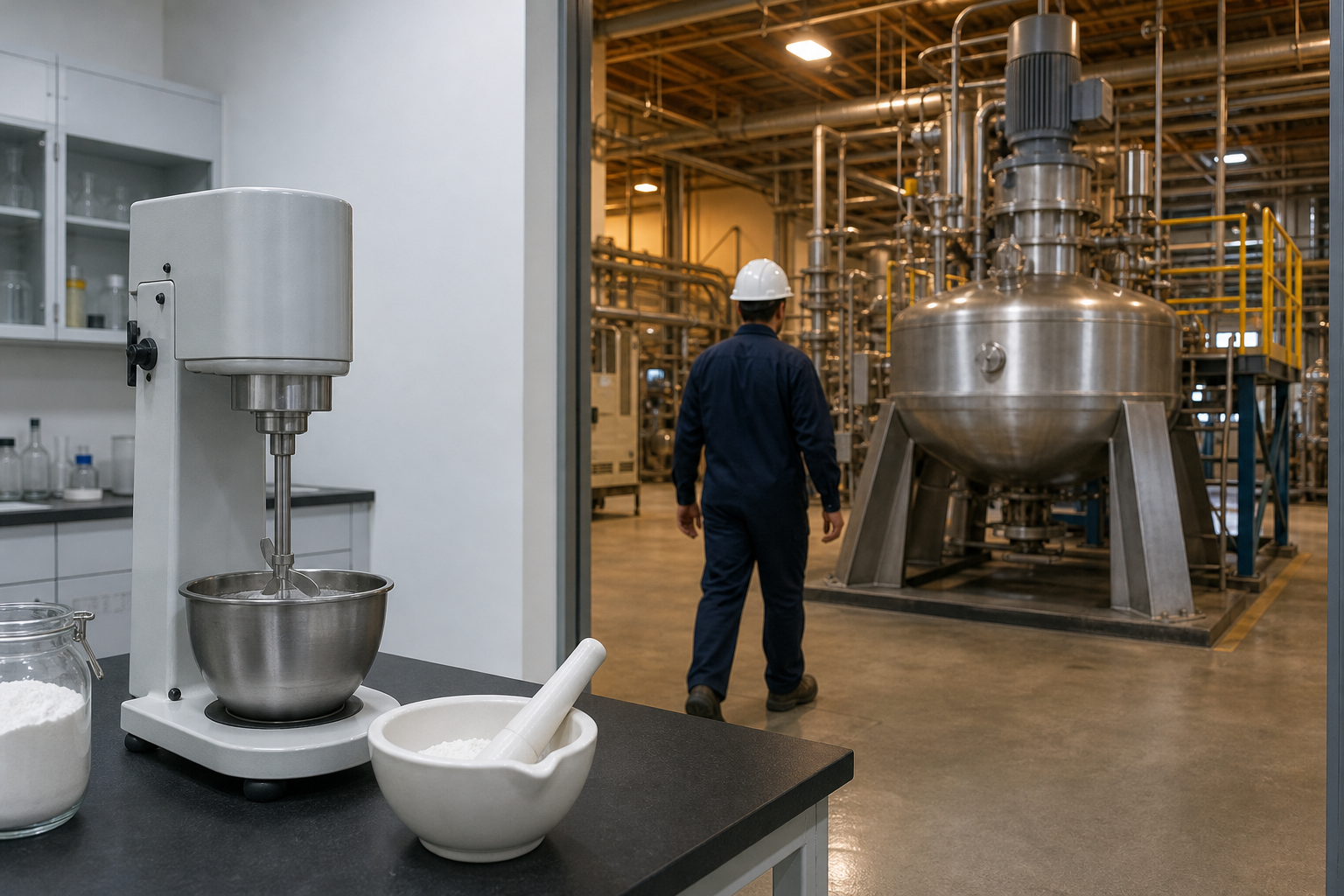
Problem: A laboratory paddle and an industrial mixer do not expose powder to the same circulation, shear field, wall contact, dead zones, or discharge pattern. Matching only the clock time therefore does not establish equivalent mixing.
Agitation / Answer: A lab formula can lose workability at production scale because mixer geometry, delivered power, shear distribution, fill level, and discharge history change powder wetting and additive distribution. I compare the complete mixing process—not nominal minutes—and use one standardized mortar preparation and flow method before deciding that the formulation itself has failed.
Solution: I first freeze the formulation and water basis. Then I map how material travels through each mixer: where the bulk bed moves, where fine powder may remain, how walls are cleared, and whether discharge creates segregation. A small bowl may repeatedly sweep every particle through an active zone; a plant mixer can contain both high-action and low-action regions.
Fill level belongs in the same review. An underfilled or overfilled production mixer may circulate material differently from its normal operating window, while a larger batch can change residence distribution even when the recipe percentages remain identical. I do not prescribe a universal fill rate or mixing duration because equipment design and product rheology determine the validated setting.
For laboratory comparisons, ASTM C305 provides a recognized mechanical-mixing framework for hydraulic cement pastes and plastic mortars.1 It does not simulate every production mixer; it helps us keep laboratory preparation consistent. Where suitable, ASTM C1437 gives a common flow method.2 The plant and laboratory must use the same sample conditioning, water addition, timing, and endpoint definition.
Scale-up comparison checklist:
- Record mixer type, usable capacity, actual batch mass, and observed circulation state.
- Document charge, dry mixing, wet preparation, scraping or intervention, and discharge as separate stages.
- Compare more than one location or discharge interval when segregation is plausible.
- Review flow together with density, visual homogeneity, and application feel.
For related test planning, I use KH-CEL’s dry-mortar quality-control guide as a broader framework.
2. Why Do Charging Sequence and Dispersion Matter More in a Plant?
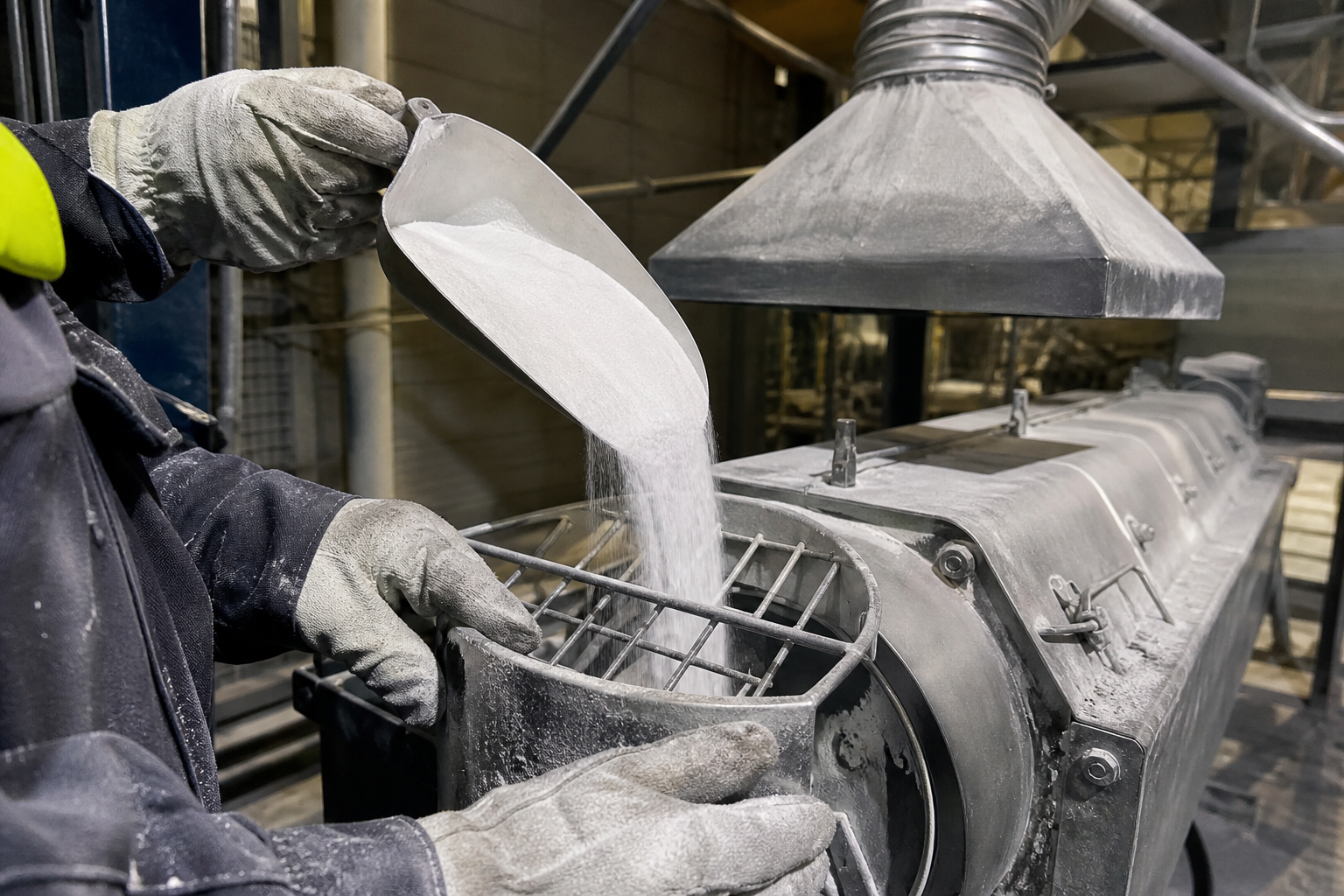
Problem: Minor additives can enter a production line through bags, feeders, screws, or premixes. If a fine powder meets moisture, a concentrated liquid zone, or an unsuitable carrier too early, local agglomerates can survive the nominal mixing cycle.
Agitation / Answer: Production charging sequence determines when fine additives meet cement, aggregate, other powders, and water. Poor distribution can create local overdosing or protected lumps even when the batch total is correct. I audit feeder location, premixing, screw transfer, charging overlap, and wetting order before changing the HPMC grade or dosage.
Solution: I build a sequence map from silo or bag opening to final discharge. It identifies each addition point, transfer device, overlap between streams, and the first moment a minor additive can disperse into a much larger carrier bed. This is especially important for white or off-white ultrafine HPMC powder, which must be distinguished from granules, contamination, or damp agglomerates.
The investigation asks whether the additive enters a moving, sufficiently distributed dry phase or lands as a concentrated pocket. Screw conveyors can move material while also allowing fines to adhere, separate, or arrive in pulses. A premix can improve distribution only when its carrier, preparation, storage, and addition are controlled. More mixing cannot always repair a lump whose surface has already hydrated around dry material.
I compare plant observations with the practical mechanisms in why HPMC forms lumps during dry mixing and the separate guidance on improving HPMC solubility. Those resources help diagnose dispersion, but they do not prove HPMC is the sole cause of a plant-scale workability shift.
Sequence audit list:
- Trace each ingredient from storage to the active mixing zone.
- Note simultaneous charges, feeder pulsing, dust extraction, and material left in transfer equipment.
- Inspect whether any wet surface or humid return stream contacts fine powder prematurely.
- Compare early, middle, and late discharge samples for visible uniformity.
- Trial one controlled sequence change at a time while keeping formula, water, and test timing fixed.
This isolates process effects without inventing a new recipe to compensate for an unknown distribution problem.
3. How Do Aggregate Moisture, Temperature, Batch Size, and Fill Level Interact?
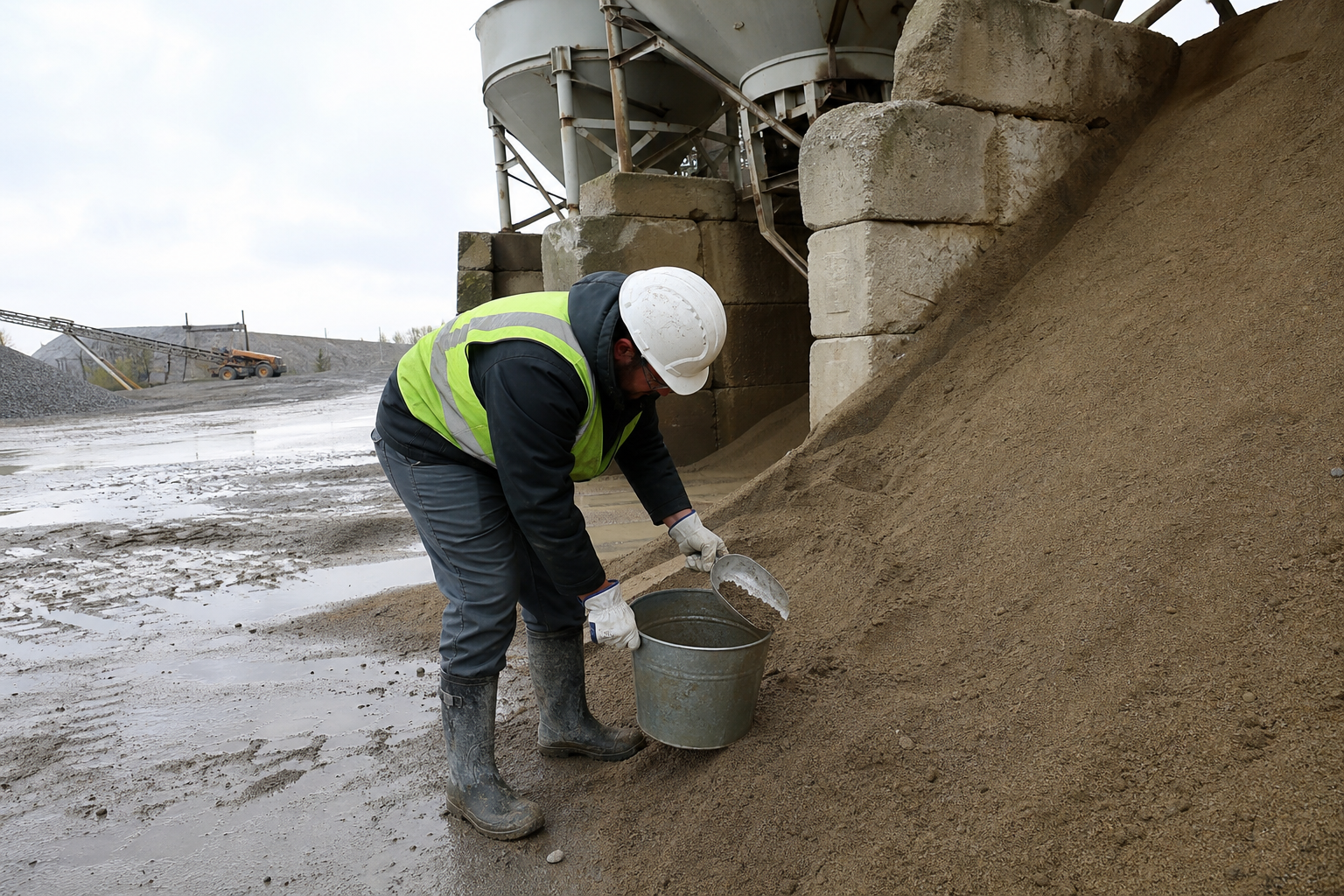
Problem: Production aggregates arrive with variable surface moisture and temperature, while laboratory materials are often smaller, conditioned portions. Unmeasured carried water or a different thermal state changes effective water demand and the rate at which fresh mortar develops structure.
Agitation / Answer: Aggregate moisture and material temperature can shift effective water, wetting, hydration, and viscosity during production scale-up. Batch size and mixer fill then influence how evenly those conditions are distributed. I correct water on a measured moisture basis, record material condition, and compare representative samples rather than blaming one additive.
Solution: I begin at aggregate storage, not at the wet-mortar bench. Moisture can vary between deliveries, silo zones, or weather-exposed stock, and one grab from an easy access point may miss that pattern. Outdoor wet-sand sampling should therefore follow a defined plan that identifies source, time, location, and handling before analysis.
The formulation sheet must state whether aggregate masses are treated on a dry or as-received basis. If carried water is ignored, the effective water level changes even when the operator adds the same amount. Temperature also matters: raw materials, process water, equipment, and the test room can create different wetting and viscosity histories. I record these conditions without imposing a universal acceptable temperature range.
Batch size and fill level can amplify nonuniformity. A larger bed may receive unevenly conditioned aggregate from several feeds, while mixer loading affects circulation and heat exchange. That is why a scale-up trial should compare realistic production loading with the laboratory reference rather than a convenient partial batch alone.
Material-condition control table:
| Variable | Record at source | Verify during comparison |
|---|---|---|
| Aggregate moisture | Sampling location and condition | Water correction basis |
| Material temperature | Aggregate, binder, water | Same timing before mixing |
| Batch size | Actual charged mass | Relation to equipment fill |
| Weather/storage | Exposure and transfer history | Potential moisture gradients |
The tile-adhesive plant raw-material guide helps teams map the wider input system. When HPMC quality is still questioned, supplier sample evaluation should follow controlled process checks, not replace them.
4. What Happens Between Discharge, Packaging, Re-Mixing, and Application?
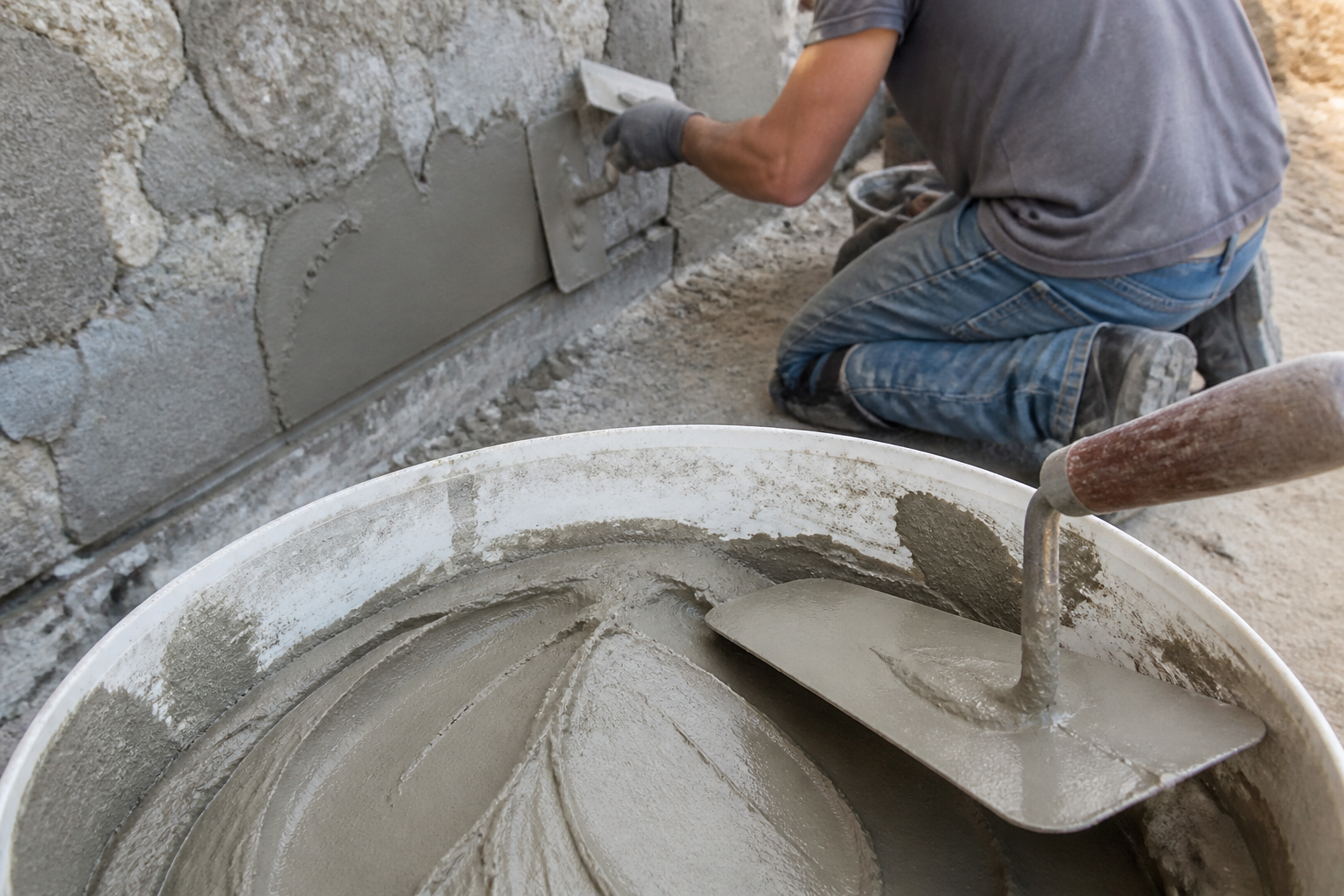
Problem: Plant quality control may test mortar immediately, while packed product waits before use and mixed mortar waits in a bucket before troweling. Comparing those different ages can make stable material appear inconsistent or hide a real hold-time drift.
Agitation / Answer: Workability is time-dependent, so a result has meaning only when the clock starts and each observation point are defined. I align discharge, packaging, storage, water contact, resting, remixing, and application times, then compare mortar at equivalent ages instead of treating an immediate plant test as field performance.
Solution: I draw a timeline from production-mixer discharge to the worker’s final application pass. For dry product, that includes conveying, packaging, warehouse exposure, transport, and storage. For fresh mortar, it includes water contact, mechanical mixing, any prescribed rest or remix, transfer to the bucket, and trowel or pump application.
A vague statement such as “tested after mixing” is not enough. The team must define the clock origin, observation sequence, container condition, and whether the mortar is disturbed between readings. Evaporation, ongoing wetting, hydration, polymer dissolution, air redistribution, and structural rebuilding can all change measured flow and subjective feel. The purpose is not to invent a universal hold time but to reproduce the product’s declared use window and the customer’s realistic workflow.
The method should also separate dry-product storage effects from fresh-mortar ageing. If packed material has experienced heat or moisture, test it against an appropriately stored retain using the same fresh-mortar procedure. If only the bucket changes over time, keep the dry sample constant and observe defined fresh ages.
Workflow checkpoints:
- Dry mixer discharge and transfer to packaging
- Package conditioning and storage history
- Water addition and end of mechanical mixing
- Any specified rest and remix event
- First application and later in-use observation
For interpreting a suspected additive effect, HPMC’s main functions in dry-mix mortar provides useful context, while the mortar air-content test guide explains why timing, density, flow, and application observations should be read together. Equivalent-age comparisons prevent a logistics difference from being misreported as a formulation failure.
5. How Should Representative Sampling and Supplier Communication Be Organized?
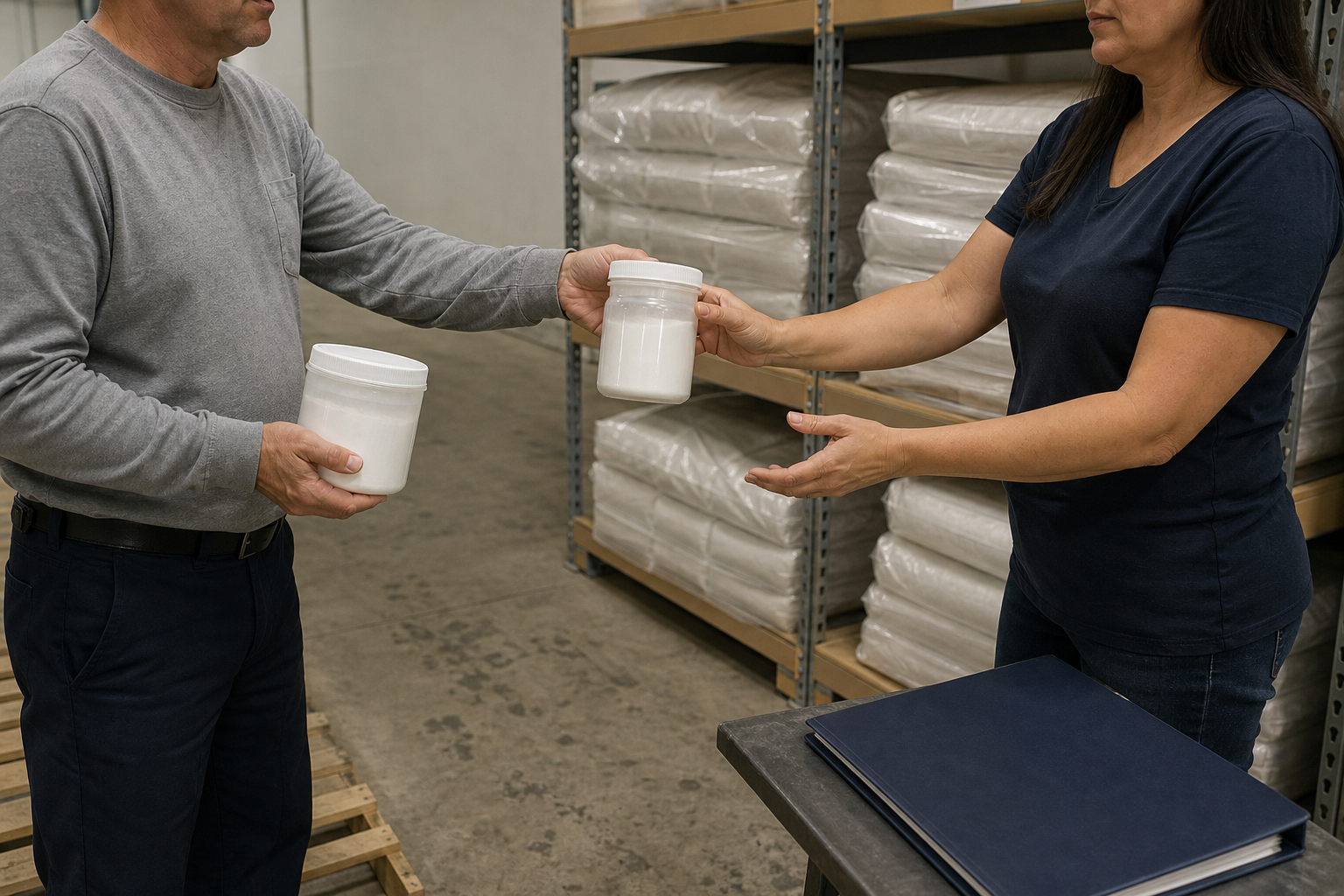
Problem: A single scoop from the top of a bin cannot represent every feed stream, mixer zone, or discharge stage. Without traceable retains and shared process records, the plant and supplier may test different material and reach incompatible conclusions.
Agitation / Answer: Representative sampling connects the workability complaint to the material and process that produced it. I use a written sampling plan, collect across relevant discharge or packaging points, preserve sealed retains, and send suppliers matched samples plus factual process data. This turns a vague complaint into a reproducible joint investigation.
Solution: I define the sampling question before collecting powder. If the concern is mixer uniformity, samples should cover relevant spatial or discharge positions. If the concern is packaged consistency, the plan should cover appropriate points in the packaging run. Composite and individual samples answer different questions, so the record must say which was used and why.
Each retained sample needs secure closure, protected storage, and traceability to the source, sampling point, date, and process record. I avoid inventing batch identifiers in an article; the plant should use its own controlled system. A matched retain allows the plant, laboratory, and supplier to test the same material using an agreed preparation and timing protocol.
Supplier communication should include the fixed formulation version, raw-material condition, equipment type, batch loading context, charging sequence, water basis, mixing stages, fresh-mortar timeline, test method, and observed symptom. It should distinguish facts from hypotheses. “Short after a defined hold” is actionable; “bad HPMC” is not.
Anonymous workflow case: A mortar producer noticed a lab-to-plant feel difference. The team froze the recipe, mapped feeder and discharge stages, collected separate discharge and package samples, sealed matched retains, and shared the same method sheet with the additive supplier. The case documents workflow only; no invented result or acceptance claim is implied.
Investigation handoff pack:
- Process map and formula revision
- Raw-material moisture and temperature records
- Sampling locations and retain inventory
- Laboratory and plant preparation methods
- Time-stamped observations and deviations
For incoming comparisons, KH-CEL’s guide to testing cellulose ether before bulk purchase supports a disciplined supplier conversation.
FAQ 1: Is HPMC always the reason production mortar loses workability?
No. HPMC influences water retention, viscosity, air behavior, and handling, but mixer action, dispersion, aggregate condition, effective water, temperature, hold time, and sampling can produce similar symptoms. I change the additive only after the controlled comparison shows that the difference follows the material rather than the process.
FAQ 2: Can we match the laboratory by using the same mixing time?
Not reliably. Equal time does not mean equal energy, shear distribution, circulation, or fill condition. Use a consistent laboratory method, document the plant mixer and loading state, and compare fresh-mortar endpoints at equivalent ages. Any plant setting must be validated on the actual equipment and product.
FAQ 3: Which workability method should our teams use?
Choose a method appropriate to the mortar and market, then keep preparation, water basis, timing, equipment, and reporting identical. ASTM C1437 addresses flow of hydraulic cement mortar; EN 1015-3 addresses fresh-mortar consistency by flow table.23 Neither number should be treated as a universal field-performance specification.
FAQ 4: Should a plant send one sample to the supplier?
One unplanned grab may miss segregation or discharge variation. Agree on the investigation question, sample at relevant points, identify individual versus composite material, and keep matched sealed retains. Send the supplier the sample map and process history so both parties compare equivalent material under the same method.
FAQ 5: What should we do before changing the formula?
Freeze the current formula, verify effective water, map the charging and mixing sequence, record aggregate moisture and temperatures, align hold times, and take representative retains. Then change one controlled variable at a time. This preserves evidence and prevents a dosage adjustment from masking an equipment or handling problem.
CTA — Build a plant-scale troubleshooting plan with KH-CEL. Share your mortar type, laboratory method, production-mixer type, charging sequence, raw-material condition records, fresh-mortar timeline, and representative retained sample plan. We can help structure a supplier discussion and controlled scale-up comparison without guessing a universal recipe or acceptance limit.
References
- ASTM International, ASTM C305-20: Standard Practice for Mechanical Mixing of Hydraulic Cement Pastes and Mortars of Plastic Consistency.
- ASTM International, ASTM C1437-20: Standard Test Method for Flow of Hydraulic Cement Mortar.
- BSI, BS EN 1015-3:1999—Determination of Consistence of Fresh Mortar (by Flow Table), including amendments where applicable.
- BSI, BS EN 1015-2:1999—Bulk Sampling of Mortars and Preparation of Test Mortars, including amendments where applicable.
- ASTM C305 standardizes laboratory mechanical mixing within its stated scope; it does not establish equivalence to a particular production mixer.
- ASTM C1437 provides a defined hydraulic-cement-mortar flow procedure. Method suitability and internal limits remain product- and application-specific.
- EN 1015-3 provides a flow-table consistency method for fresh masonry mortar; the applicable edition and amendments should be confirmed for the target market.
- EN 1015-2 is relevant to bulk sampling and test-mortar preparation; a plant still needs a documented site-specific sampling plan.