Free HPMC samples can reduce sourcing risk, but an uncontrolled test can create false confidence. A promising result may disappear when the formula, substrate, climate, or production scale changes. I use a staged evaluation process to determine whether a sample fits the actual mortar system and whether the supplier can reproduce its performance.
I test free HPMC samples by comparing them under identical laboratory conditions, followed by application testing, a production trial, and repeat batch checks. I evaluate water retention together with workability, consistency, sag resistance, open time, and relevant strength or bond properties. I never treat one water-retention result as sufficient evidence for bulk approval.
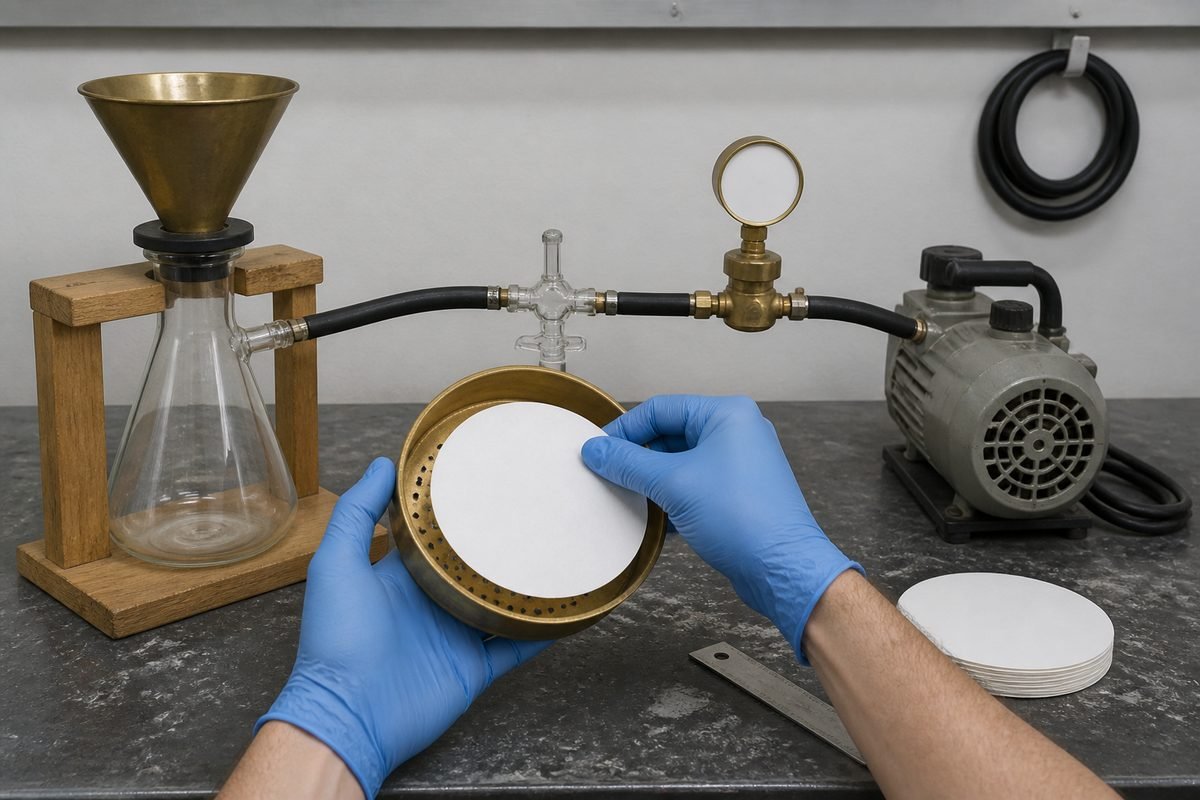
The important question is not which sample produces the highest isolated number. The better question is whether a defined HPMC grade performs reliably in the buyer’s real formulation. The following framework shows how I control the comparison, interpret the results, and connect sample approval with purchasing acceptance.
How Should Free HPMC Samples Be Compared Under Controlled Conditions?
A comparison becomes unreliable when operators change the water dosage, mixing time, resting period, or substrate between tests. Small differences can influence fresh mortar behavior and hide the real effect of the cellulose ether.1 I therefore begin every evaluation by fixing the formula, equipment, procedure, and environment.
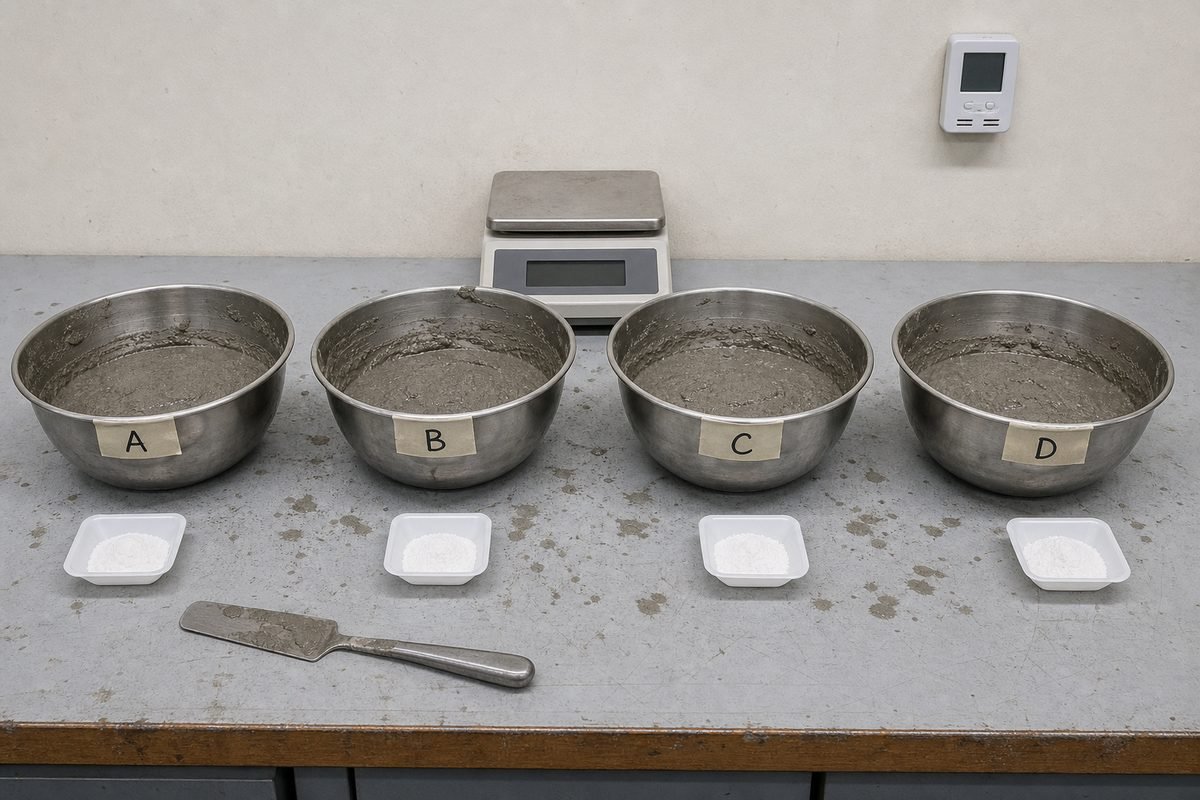
I compare free HPMC samples at the same active dosage in one reference formulation. I keep the raw materials, water addition, mixer, mixing sequence, resting time, test temperature, humidity, and absorbent substrate consistent. I also randomize or blind sample identities when practical to reduce operator expectations and visual bias.
<h3>Related technical guides</h3> <ul> <li><a href="https://khcel.com/hpmc/">HPMC</a></li> <li><a href="https://khcel.com/what-is-hpmc-and-how-is-it-used-in-construction-materials/">What is HPMC and How is it Used in Construction Materials?</a></li> <li><a href="https://khcel.com/what-are-the-main-uses-of-hpmc/">What Are the Main Uses of HPMC?</a></li> </ul>
I define the reference formulation first
I do not begin by testing HPMC only in water. A pure-water viscosity measurement can help confirm identity or specification compliance, but it does not reproduce the interactions inside tile adhesive, wall putty, gypsum plaster, or another dry-mix product.
Cement type, mineral fillers, aggregate grading, starch ether, redispersible polymer powder, air entrainment, and water demand can all change application performance.2 The same HPMC may therefore behave differently in two formulas.
In our sample-comparison work, I first select one stable reference formula that represents the intended commercial product. I record:
- The supplier and batch of every raw material
- The dry formulation in mass percentages
- The HPMC dosage on a dry-mix basis
- The water-to-dry-mix ratio
- The batch size and mixing equipment
- The mixing speed and sequence
- The initial mixing and resting periods
- The remixed condition, if the method requires remixing
- The room and material temperature
- The relative humidity
- The substrate type, absorption, age, and conditioning
- The elapsed time between mixing and each measurement
This record allows me to investigate an unexpected result instead of simply repeating the test without understanding the cause.
I use equal dosage, not equal expectations
Free HPMC samples may carry different nominal viscosity labels. However, suppliers can use different viscosity instruments, solution concentrations, temperatures, spindle settings, or reporting conventions. Two products labeled with the same viscosity can still produce different mortar behavior.3
I initially compare candidate grades at an equal active dosage when the objective is product screening. I then optimize dosage separately if a grade shows suitable performance. This distinction matters because an optimized formulation comparison answers a different purchasing question from an equal-dose material comparison.
| Comparison type | What I keep equal | What the comparison can show |
|---|---|---|
| Initial screening | Formula, active HPMC dosage, water, procedure | Relative behavior under one controlled setup |
| Dosage optimization | Target application properties | The practical dosage range for each candidate |
| Cost-in-use study | Required performance level | Approximate additive cost per ton of finished mortar |
| Batch consistency check | Approved formula and method | Whether later batches remain within agreed limits |
I control the substrate and environment
Water-retention results are sensitive to suction and evaporation.4 I avoid comparing one sample on a highly absorbent board and another on a less absorbent surface. I also avoid testing one sample in a cool laboratory and another during a hot, dry afternoon.
For each test series, I condition the materials and use equivalent substrate pieces or the specified apparatus. I document environmental conditions rather than assuming they are stable. If the end market includes hot-weather construction, I add a separate climate-relevant application test after the baseline comparison.
This controlled approach does not make the laboratory identical to a jobsite. It does, however, make the differences between free HPMC samples more meaningful.
Which Method Should I Use to Test Water Retention in Free HPMC Samples?
A water-retention percentage can look precise while still being unsuitable for procurement. Different standards, apparatus, preparation steps, and calculations may produce results that cannot be compared directly. I therefore select the method before testing and place its full identification in the test plan and purchasing specification.
I use a published method that applies to the product category and purchasing market, then I verify the standard number, edition, apparatus, specimen preparation, conditioning, timing, calculation, and reporting rules. I treat the exact standard reference, detailed values, and acceptance threshold as pending verification until qualified personnel confirm them for the application.

I select the method according to the mortar system
Possible references may include standards for determining the water retention or water retentivity of fresh mortar. For example, a team may review ASTM C15065 for hydraulic cement-based mortars and plasters or an applicable EN mortar test method. However, the current designation, edition, scope, regional adoption, and suitability must be checked before publication or contractual use. At the time of writing, ASTM lists C1506-24 as the active version and marks C1506-17 as historical. ASTM also notes that C1506 reports a water retention value based on mortar flow, while ASTM C1922 determines it via direct water loss — so two laboratories citing "water retention" may not be measuring it the same way.
Verification note: The standard number, current version, apparatus dimensions, conditioning requirements, test duration, equations, repeatability rules, and acceptance limits are pending verification. A qualified laboratory or standards professional should confirm them for the specific product and market. Standard designations and editions change; always confirm the current status on the issuing body's own catalogue, such as the ASTM standards catalogue.
I do not relabel an internal paper, suction, or substrate test as a universal standard. An internal method can still be useful for routine quality control, but the report should identify it as an internal procedure. Buyers and suppliers should also agree on how that procedure relates to application performance.
I build a traceable test procedure
Once the applicable method has been confirmed, I prepare a controlled worksheet. The worksheet generally includes the following stages:
- I identify the materials. I record the HPMC grade, supplier, sample code, batch or lot number, production date if available, and storage condition.
- I condition the test system. I bring the materials, water, apparatus, and relevant substrate or absorbent media to the required conditions.
- I prepare one defined mortar. I weigh the materials with calibrated equipment and follow the fixed mixing sequence.
- I conduct the measurement. I follow the verified standard or documented internal method without changing its timing or apparatus between candidates.
- I calculate the result. I use the specified equation and units from the verified procedure.
- I run replicates. I investigate excessive spread rather than selecting the most favorable individual result.
- I report deviations. I document every departure from the method because deviations can affect comparability.
I do not provide universal timings, specimen masses, filter-paper counts, suction conditions, or acceptance percentages here. Those values depend on the verified method and the mortar category. Inventing a convenient threshold would create false precision.
I interpret the result within the test setup
A measured water-retention result applies to that formulation and that test setup.6 It does not prove that the same grade will provide adequate performance in every cement system, climate, or substrate condition.
Higher water retention is also not automatically better.7 A formulation may already retain sufficient water. Additional thickening or delayed drying can alter troweling, wetting, setting, or surface behavior. The practical target should reflect the product’s application requirements, validated formulation window, and relevant specification.
I usually compare three types of evidence:
| Evidence | Main purpose | Important limitation |
|---|---|---|
| Published-method result | Standardized or contractually defined comparison | It may not reproduce the buyer’s full application |
| Internal QC result | Fast routine monitoring | It is not automatically comparable across companies |
| Application test | Formulation and use validation | It can be operator- and environment-sensitive |
This combination gives free HPMC samples more context than an isolated laboratory number can provide.
Why Should Free HPMC Samples Be Evaluated Beyond Water Retention?
A candidate can perform well in a retention test and still create poor application properties.8 It may feel sticky, produce excessive consistency, reduce wetting, or provide an unsuitable open-time profile. I therefore treat water retention as one screening parameter within a broader application-performance test.
I evaluate free HPMC samples for mixing behavior, consistency, workability, sag resistance, open time or surface drying, and relevant bond or strength results. I define the test set according to the finished product. I only advance a sample when its complete performance profile fits the formulation and target use.
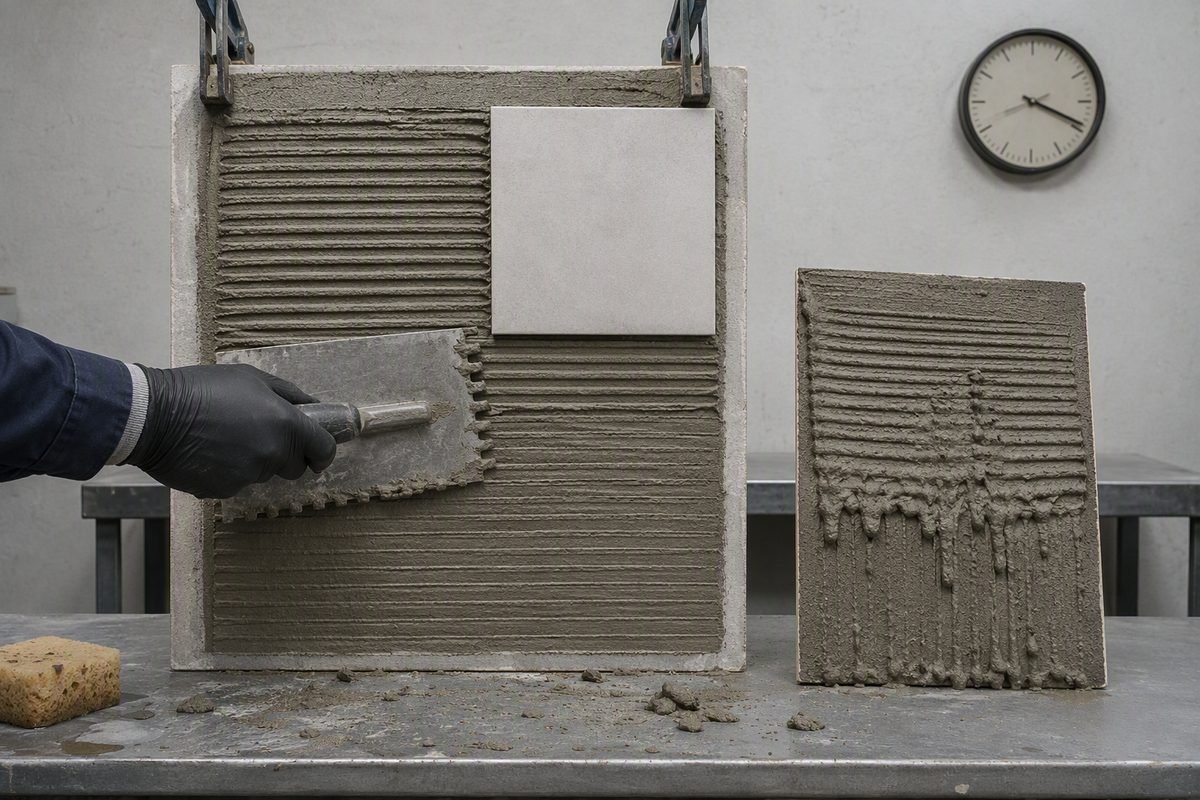
I match the test matrix to the application
Different dry-mix products need different performance priorities. A single universal HPMC ranking can mislead a buyer because the “best” grade depends on the formulation and use conditions.
| Application | Properties I commonly evaluate |
|---|---|
| Tile adhesive | Water retention, consistency, trowelability, wetting, sag resistance, open time, relevant bond strength |
| Wall putty | Water demand, smoothness, workability, surface drying, sanding behavior, cracking tendency |
| Gypsum plaster | Workability, water retention, consistency, setting interaction, surface quality |
| Cement plaster or render | Pumpability or application feel, water retention, sag, finishing, curing behavior |
| Self-leveling compound | Flow, flow retention, segregation, bleeding, surface condition, strength development |
| EIFS basecoat | Workability, board wetting, sag, open time, reinforcement-mesh embedment, relevant adhesion |
| Repair mortar | Workability, build, sag, substrate wetting, shrinkage-related observations, relevant strength |
Qualified technical personnel should select the final tests and acceptance criteria. The product standard, customer specification, substrate, climate, and application method should guide that selection.
I observe the entire working cycle
I start observing when the dry mix contacts water. I note lump formation, wetting speed, and the energy needed to reach a uniform mortar. I then assess consistency after the defined resting and remixing stages.
During application, I look for:
- Smooth or dragging trowel movement
- Cohesion without excessive stickiness
- Edge stability and sag behavior
- Uniform ridge formation in tile adhesive
- Surface skinning or premature drying
- Wetting transfer to the tile or substrate
- Workability changes over the intended pot-life interval
- Abnormal air entrainment or visible segregation
I use the same operator and test technique where practical. If several people perform the work, I use a written rating scale and include objective measurements whenever possible.
I separate fresh-mortar convenience from final performance
A mortar can feel excellent during application but fail a relevant bond or strength requirement.9 The opposite can also happen: a strong cured specimen may be impractical to mix, spread, or finish.
I therefore keep fresh and hardened properties in separate groups. I examine both before approval. For tile adhesive, for example, the evaluation may include a verified open-time procedure and applicable bond-strength testing after the specified conditioning regimes. The precise standards, curing durations, and thresholds remain pending verification for the product classification and target market.
In my experience, the most useful comparison table does not rank every result from “highest” to “lowest.” It marks each result as:
- Within the required range
- Borderline and requiring confirmation
- Outside the required range
- Not tested
- Invalid because of a procedural deviation
This approach prevents a high water-retention value from outweighing several application failures. It also gives purchasing and R&D teams a shared basis for deciding whether free HPMC samples should proceed to pilot production.
How Can I Turn a Successful HPMC Sample Test Into a Bulk-Order Decision?
A successful laboratory sample is encouraging, but it does not prove that the same performance will appear in production or future deliveries. Scale, mixing efficiency, raw-material variation, and batch consistency can change the result.10 I use defined approval gates to connect technical testing with supplier qualification and purchasing control.
I move from controlled laboratory comparison to actual-formula validation, a production trial, repeat-batch testing, and documented bulk acceptance. I link every approved sample to a grade specification, batch identity, COA, agreed test methods, and retention sample. This process reduces the risk of approving an excellent sample that suppliers cannot reproduce.
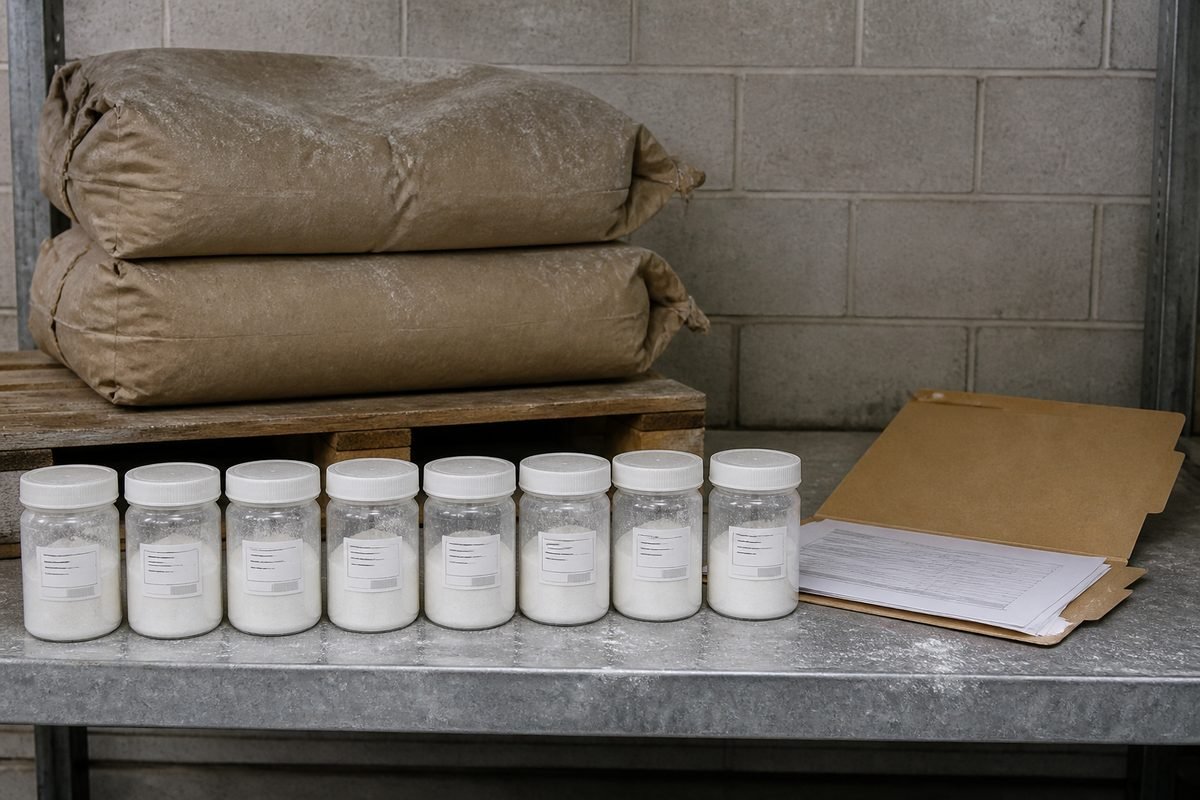
I use a five-gate approval process
I recommend the following sequence for industrial buyers:
-
Controlled laboratory comparison
I screen candidate grades at equal dosage in one stable reference formula. -
Actual-formula application test
I test the leading candidates in the buyer’s intended commercial formulation, including relevant application and hardened-property checks. -
Production-scale trial
I run the candidate through representative weighing, dry blending, packaging, storage, and application conditions. -
Repeat testing across batches
I examine more than one identifiable production batch when risk, order size, or qualification policy justifies it. -
Bulk-order acceptance
I compare incoming material and finished-mortar performance against the agreed specification and acceptance plan.
Each gate answers a different question. Laboratory screening asks whether a candidate deserves more testing. The production trial asks whether the result survives scale-up. Repeat-batch testing asks whether the supplier can maintain acceptable consistency. Incoming inspection asks whether the delivered material matches what the buyer approved.
I connect the sample to documentation
Free HPMC samples should arrive with enough information to remain traceable. I ask for:
- Manufacturer and production-site identity
- Product name and grade code
- Batch or lot number
- Manufacturing or release date where available
- Declared viscosity and its complete test method
- Moisture and ash information where specified
- Certificate of Analysis for the supplied batch
- Safety Data Sheet and Technical Data Sheet
- Packaging and storage recommendations
- Regulatory documents required by the destination market
- A statement of whether the sample is from routine production or a specially prepared lot
I treat certificates and regulatory files as documents to verify. A document’s presence does not by itself confirm its scope, validity, issuing entity, or applicability to the exact grade and destination.11
At KEHAO Chemical, we provide samples with a COA and support viscosity-grade and formulation selection. Our in-house laboratory tests every batch for parameters such as viscosity, water retention, moisture, and ash content — the same batch-control logic described in our HPMC manufacturer quality standards and supplier selection guide. You can also review the full HPMC product specifications when defining a grade. However, I still recommend that each buyer conducts independent application validation. Manufacturer QC and buyer acceptance serve different purposes.
I define the purchasing specification before the first bulk shipment
A grade name alone is not a complete procurement specification. I prefer a written agreement that identifies the test methods, units, tolerances, sampling procedure, and action for an out-of-specification result.
The specification may cover:
- Viscosity range and exact measurement method
- Moisture and ash limits
- Water-retention method and agreed range
- Appearance and packaging
- Application-specific control results
- COA requirements
- Batch traceability
- Retention-sample period
- Change-notification expectations
- Complaint investigation and replacement procedures
All exact limits should come from verified product requirements and qualification data. I do not copy an acceptance range from another formulation because a suitable result for tile adhesive may not suit putty, gypsum plaster, or self-leveling mortar.
I also retain the approved sample and production-trial material under controlled storage. These references help my team investigate future differences. They do not remain chemically unchanged forever, so I record storage duration and condition.
This staged system turns free HPMC samples into evidence within a supplier-qualification process rather than treating them as proof of future bulk quality.
Frequently Asked Questions
How much HPMC sample do I need for testing?
I calculate the quantity from the number of formulas, dosage levels, replicates, application panels, and planned pilot work. A small sample may support initial laboratory screening, but it may not cover full validation. I request enough material from one identified batch to complete the agreed test matrix without mixing sample lots.
Can I compare HPMC grades only by their viscosity?
I do not recommend that approach. Nominal viscosity depends on the test method, solution concentration, temperature, and instrument settings. Viscosity also does not fully predict water retention, workability, sag resistance, open time, or compatibility with the buyer’s raw materials. I compare grades in the intended dry-mix formula.
Does the highest water-retention result indicate the best HPMC?
No. I select a grade that meets the required retention range while supporting the complete application profile. Excessive thickening or unsuitable surface behavior can make a high-result sample impractical. The correct target depends on the mortar type, formulation, substrate, climate, and verified test method.
Should I test more than one HPMC batch before ordering?
I recommend repeat-batch evaluation when the order value, qualification policy, or supply risk supports it. One sample only demonstrates the performance of that material under the tested conditions.12 Multiple identifiable batches provide stronger evidence about manufacturing consistency, although ongoing incoming inspection remains necessary.
Does a COA replace my incoming quality-control test?
No. I use the COA as part of batch documentation, but I verify critical parameters according to the buyer’s acceptance plan. I also confirm that the COA refers to the delivered batch and uses understood methods. Application testing may remain necessary because routine certificate values cannot represent every finished-mortar interaction.
Conclusion
Free HPMC samples are most valuable when I treat them as the first stage of a controlled sourcing decision. I keep test variables constant, use a verified method, assess complete application performance, and confirm results through production and repeat-batch trials. I also connect the approved material to clear specifications and traceable documents. If water retention is the property you are screening for, our guide on how HPMC improves water retention in tile adhesives explains the underlying mechanism in more detail. Buyers can contact KEHAO Chemical at kehao@kehaohpmc.com or WhatsApp +86 157 3315 6958 to request a sample with COA and discuss grade selection for laboratory validation.
Experimental studies of cellulose-ether-modified cement mortars report that water dosage and mixing conditions affect fresh-state rheology and workability, so these variables must be controlled when comparing additives. Evidence role: mechanism; source type: paper. Supports: Experimental evidence that water content, mixing procedure, and related test conditions affect the rheology, workability, and measured fresh properties of cementitious mortars containing cellulose ethers.. Scope note: The magnitude of each variable's effect depends on the mortar formulation, cellulose ether type, and test method. ↩
"Redispersible polymer powder modified cementitious tile ...", https://pmc.ncbi.nlm.nih.gov/articles/PMC8606344/. Studies of dry-mix cementitious mortars show that binder composition, fillers, aggregate grading, polymeric additives, entrained air, and water demand jointly influence workability and application-related performance. Evidence role: general_support; source type: paper. Supports: Research showing that cement type, fillers, aggregate characteristics, polymers, air entrainment, and water demand interact to influence fresh and applied mortar properties.. Scope note: A general formulation review cannot establish the effect of every listed component in a particular commercial mortar. ↩
"Water Retention Mechanism of HPMC in Cement Mortar - PMC", https://pmc.ncbi.nlm.nih.gov/articles/PMC7372461/. Research on cellulose ethers in cementitious materials indicates that solution viscosity alone does not fully determine mortar behavior, because molecular structure and substitution characteristics also affect rheology and water retention. Evidence role: mechanism; source type: paper. Supports: Research indicating that cellulose ether chemistry and molecular characteristics beyond nominal solution viscosity influence water retention, rheology, and mortar performance.. Scope note: The evidence supports the general principle; equivalence or non-equivalence of two named commercial grades still requires formulation-specific testing. ↩
"Water Retention Mechanism of HPMC in Cement Mortar - PMC", https://pmc.ncbi.nlm.nih.gov/articles/PMC7372461/. Fresh-mortar studies identify capillary suction by absorbent substrates and evaporation to the environment as mechanisms of water loss that influence measured water retention. Evidence role: mechanism; source type: paper. Supports: Evidence that water transfer to absorbent substrates and evaporation contribute to water loss from fresh mortars and influence water-retention behavior.. Scope note: The relative contribution of suction and evaporation varies with substrate properties, ambient conditions, mortar composition, and exposure duration. ↩
ASTM C1506 specifies a test method for water retention of hydraulic cement-based mortars and plasters; the applicable edition and contractual use should be confirmed through the current ASTM publication. Evidence role: definition; source type: institution. Supports: The official title, scope, and status of ASTM C1506 as a test method concerning water retention of hydraulic cement-based mortars and plasters.. Scope note: An ASTM scope statement does not by itself establish that the method is suitable for every product class, regional market, or buyer specification. ↩
"Effect of Cellulose Ether and Starch Ether on Hydration ... - PMC", https://pmc.ncbi.nlm.nih.gov/articles/PMC9782582/. Published mortar research shows that water-retention measurements depend on composition and test conditions, meaning that a result obtained in one formulation is not direct proof of performance in all formulations or field environments. Evidence role: general_support; source type: research. Supports: Evidence that measured water retention in cementitious mortars changes with formulation variables and test conditions, limiting direct extrapolation across systems.. Scope note: This contextual evidence does not invalidate standardized testing; it limits extrapolation beyond the tested system. ↩
"Effect of Cellulose Ether and Starch Ether on Hydration ... - PMC", https://pmc.ncbi.nlm.nih.gov/articles/PMC9782582/. Studies of cellulose-ether-modified mortars report performance trade-offs: increased water retention may coincide with changes in rheology, setting behavior, and application characteristics, so the highest retention value is not necessarily the optimum. Evidence role: mechanism; source type: paper. Supports: Research documenting that cellulose ether modification can improve water retention while also affecting rheology, setting, and other performance characteristics.. Scope note: Whether a given change is beneficial depends on the product specification and intended use. ↩
"Effect of Cellulose Ether and Starch Ether on Hydration ... - PMC", https://pmc.ncbi.nlm.nih.gov/articles/PMC9782582/. Experimental evaluations of cellulose-ether-modified mortars assess water retention alongside rheology, workability, open time, and adhesion, demonstrating that retention alone is not a complete measure of application performance. Evidence role: general_support; source type: paper. Supports: Evidence that water retention is only one measured property and that workability, sag, wetting, open time, and bond-related outcomes can vary independently.. Scope note: The source should be used to support multidimensional evaluation, not to imply that all water-retention tests lack practical value. ↩
"Effect of Cellulose Ether and Starch Ether on Hydration ... - PMC", https://pmc.ncbi.nlm.nih.gov/articles/PMC9782582/. Cementitious-mortar research treats fresh workability and hardened mechanical or bond performance as separate response properties, each requiring direct measurement rather than inference from the other. Evidence role: general_support; source type: paper. Supports: Research showing that fresh-state rheology or workability and hardened strength or adhesion are distinct properties requiring separate assessment.. Scope note: A general distinction between fresh and hardened properties does not predict the bond strength of a particular formulation. ↩
"Process intensification of pharmaceutical powder blending at ...", https://pmc.ncbi.nlm.nih.gov/articles/PMC11262166/. Manufacturing and materials research recognizes that blending conditions, raw-material variation, and batch-to-batch process variation can alter the consistency of powder-based cementitious products when moving from laboratory to production scale. Evidence role: general_support; source type: research. Supports: Evidence that powder blending, process scale, raw-material variability, and batch-to-batch variation can affect consistency of manufactured cementitious products.. Scope note: The extent of scale-up risk must be established through the buyer's own equipment, process controls, and representative trials. ↩
Chemical-safety and conformity-assessment guidance requires product documentation to identify the responsible entity and relevant product information, so the mere existence of a certificate or safety document does not establish its applicability to a specific delivered grade or market. Evidence role: general_support; source type: government. Supports: Regulatory or conformity-assessment guidance requiring identification of the responsible supplier, product-specific documentation, and verification of applicable documentation.. Scope note: The exact documents and verification duties vary by jurisdiction, product classification, and contractual arrangement. ↩
Statistical quality-control guidance explains that results from a single sample provide limited evidence about a lot or production process; confidence in consistency requires an appropriate sampling and acceptance plan. Evidence role: expert_consensus; source type: government. Supports: Recognized quality-control guidance that a limited sample provides limited inference about lot or process conformity and that sampling plans are needed for ongoing assurance.. Scope note: The appropriate number of batches and samples depends on risk, variability, contractual requirements, and the selected sampling plan. ↩