
Problem. Your tile adhesive has been running on one HPMC grade for a long time. Purchasing wants a second source approved — for supply security, for freight timing, or simply for a second quote — and the first sample arrives with a certificate that prints the same viscosity label as the incumbent. Someone in the meeting says the obvious thing: same viscosity, same chemistry family, so let us run it. Then the pilot batch mixes wetter, or sags on a vertical wall, or drags under the notched trowel, and the whole discussion collapses back to staying with the current supplier.
That is not a chemistry failure. It is a qualification-process failure. A viscosity label is one number on a datasheet; the behaviour of a dry-mixed adhesive is the sum of substitution balance, particle size and dissolution, interaction with cement, fillers and redispersible powder, mixing energy on your line, and the way the mortar is cured on the site where it is installed. None of that is carried by a single figure.
So the job is not to find an “equivalent grade”. Second-source HPMC qualification is a documentation exercise before it is a testing exercise: write down what your approved formula already does, and then prove — through a fixed sequence of gates — that the candidate reproduces it. What follows is that sequence: what to freeze, what to compare, what to trial, and what the release record has to say so two sources can coexist without drift. Each section below is built to be answered before the next one is opened.
Why Doesn’t a Matching Viscosity Number Predict How a Candidate Grade Will Behave?
Problem. Two datasheets can print the same viscosity and still describe two different powders. Approvals stall here because the first comparison made is the one number that cannot answer the question, and a single disappointing pilot batch is then treated as proof that no second source is possible.
Agitation / Answer: Viscosity describes one solution measured one way on one day. It says nothing about substitution balance, molecular weight distribution, particle size, dissolution speed or gel behaviour, and those are what your mixer and your trowel actually respond to. Treat a viscosity match as permission to sample, never as evidence of equivalence.
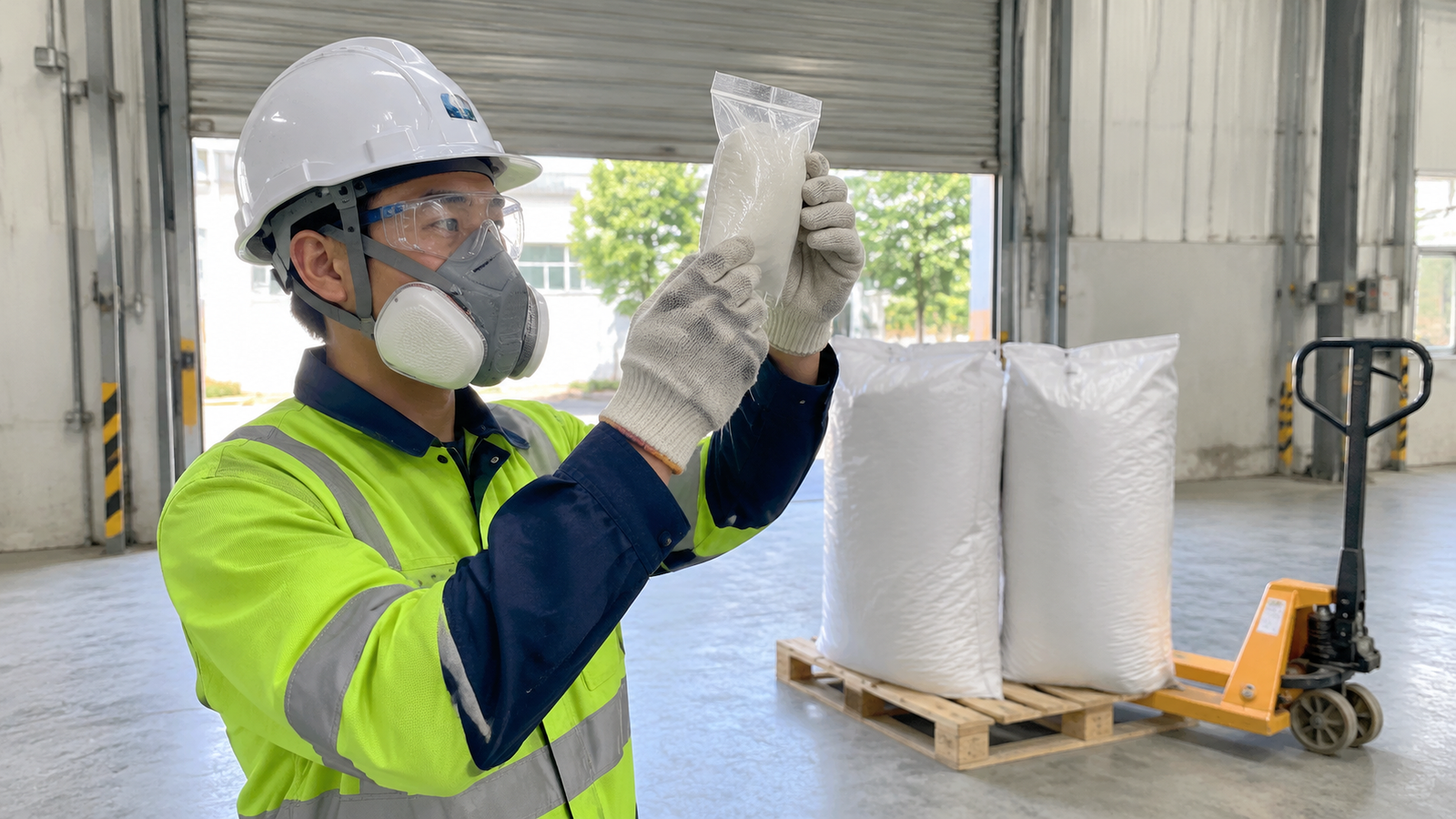
Solution. Viscosity is a property of a solution measured under a defined method, and it tells you how thick that solution was when it was tested. It does not tell you the degree of substitution, the balance between hydroxypropyl and methyl groups, the molecular weight distribution, the particle size and surface character of the powder, or the temperature at which the ether begins to gel. Two products can sit inside the same labelled band and differ on every one of those points at once.
What a plant actually feels is the sum of those differences. A finer, faster-dissolving powder builds viscosity earlier in the mixing cycle, which can look like stronger water retention in the bucket and like lumping or over-thickening on the line. A grade with a different substitution balance can hold water well and still shear thin too far under a notched trowel, so the ribs slump.
This is why the first move in supplier reviews is to separate the datasheet question from the performance question. The datasheet is a screen: it tells you whether the candidate belongs to the same chemistry family and is worth sampling. It also helps to describe the approved product in the vocabulary of the tile adhesive standards rather than a supplier’s own sheet, because a specification written that way can be read by both sources and by your customer [1]. The chemistry territory itself is worth mapping properly — our HPMC product page sets out how substitution and physical form differ across grades, and the HPMC versus HEC comparison explains why two water-soluble ethers rarely behave alike in the same mortar. In second-source HPMC qualification, viscosity parity is the entry ticket to a trial, not the justification for approval.
How Do You Freeze the Approved Formula as a Comparison Baseline?
Problem. Most plants believe they have a baseline because they have a formula sheet. But the sheet records a recipe, not a behaviour, and a second source has to be judged against behaviour. Without a fixed reference, every trial becomes an argument about memory.
Agitation / Answer: Freeze the baseline as a physical and documentary pair: sealed retained samples of the incumbent ether and of finished adhesive from a lot whose field performance you trust, plus a written record of formula version, lot identities, mixing sequence, actual water demand and observed workability. Refresh it whenever the formula or a major raw material changes.

Solution. Before a candidate can be judged, “approved” has to be described in a form that does not move. In qualification work the baseline is built twice, once as material and once as record, because either one alone is easy to argue with.
Physically, retain a sealed sample of the incumbent ether grade and a sealed sample of finished adhesive made on the approved formula, both drawn from lots whose site performance you are satisfied with. Store them the way you store any reference material — closed, labelled with lot and date, protected from moisture and heat — and replace them deliberately rather than topping up casually.
Documentarily, record the formula version, the identity of every raw material lot used in the reference batch, the dosing and mixing sequence, the mixing energy the plant actually applies, the water demand the operator actually used rather than the figure printed on the sheet, and the batch records from the run the retained sample came from. Add photographs of the fresh mortar and of the cured adhesive in the state you consider acceptable.
Then write down what the approved material does in plain operational language: how the powder wets out, how the paste feels on the trowel, whether the ribs hold their shape, how quickly a skin forms, how the mortar behaves when combed and left standing. These notes feel unscientific and are the earliest reliable signal that a candidate is different. Keep the whole baseline under change control. If filler grading or cement source moves, the old baseline stops being the right comparator, and the qualification should pause until it is refreshed. Stored adhesive also drifts, which is why bagged product loses strength over time and why an old retained bag is evidence of history, not of current performance.
What Should a Bench-Scale Trial Compare Beyond Water Retention?
Problem. Retention is the attribute everyone measures and the one that most often passes. A candidate can match retention and still fail on sag, skinning, trowel drag or bond development, so a retention-only trial approves powders your applicators will reject.
Agitation / Answer: Run the candidate at the incumbent addition level first, changing nothing else, then compare the whole behaviour set: wet-out, consistency, sag under combed ribs, skinning and open time as you observe them, and bond development under your own curing. Judge coded samples blind, and tie every observation to a decision rather than to a discussion.
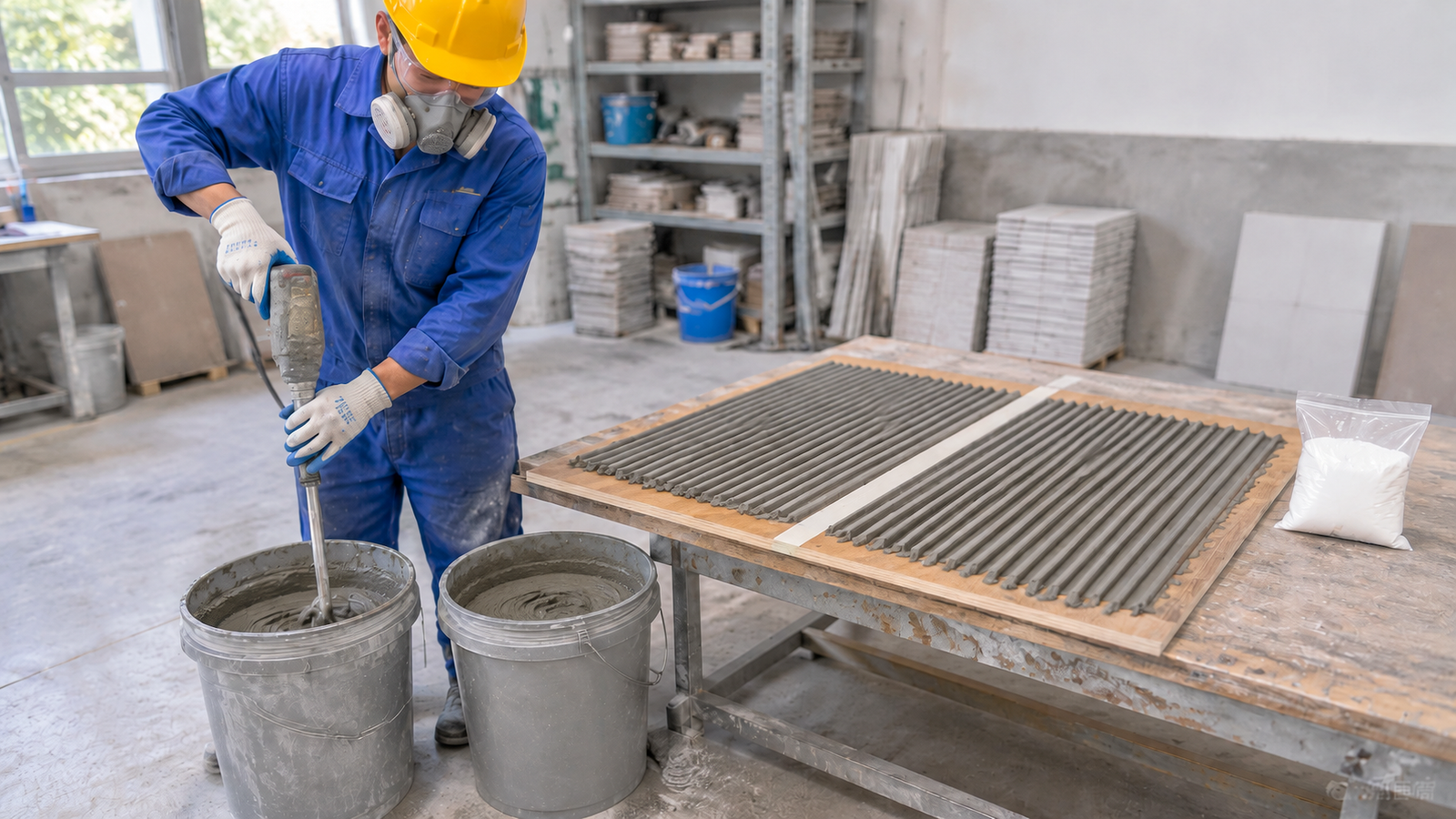
Solution. Bench work has one job: eliminate candidates cheaply, before anything reaches a production silo. Start with a single-variable comparison — the approved formula, the candidate at the same addition level as the incumbent, everything else untouched. That is the only configuration that tells you whether the two ethers are interchangeable or merely similar.
Then compare across every behaviour the formula depends on, not just retention. Retention has its own standardised test route [2], and it is still only one line on the comparison sheet. The sheet below is the one we work from in supplier reviews; the right-hand column is the important part, because it forces each observation to end in a decision.
| Attribute to compare | How it is observed in the plant’s own trial | Decision it supports |
|---|---|---|
| Wet-out and dispersion | Time and mixing energy needed before the powder is fully dispersed, presence of fish eyes or lumps | Whether the candidate suits the existing charging and mixing sequence |
| Fresh consistency and water demand | Water needed to reach the operator’s usual workable consistency | Whether the addition level can stay unchanged |
| Anti-sag under combed ribs | Ribs combed on a vertical or inclined test panel and observed for slump | Whether the grade suits wall application or only floor work |
| Skinning and working window | Surface skin formation and trowel behaviour as the mortar stands | Whether site working practice would have to change |
| Bond development | Specimens cured under the plant’s normal conditions and assessed by the plant’s own method | Whether the candidate can carry the declared performance |
| Batch-to-batch consistency | Two or more candidate lots compared with each other, not only with the incumbent | Whether the supplier’s process is repeatable enough to release |
Three disciplines make the comparison worth reading. Prepare both mixes with the same water, mixer, sequence and operator, and randomise the order so the second mix is not favoured by a warmed-up mixer. Judge blind wherever possible, with coded buckets and no labels, because expectation is a real bias when the assessor knows which sample is new. Photograph the combed ribs and the failed areas instead of describing them from memory a week later.
Where the candidate passes some attributes and not others, resist averaging. A grade that matches retention but sags is not “mostly equivalent”; on a wall it is a different product. Record the mismatch, keep the sample, and classify the gap: a dosing question belongs to a formula change, a chemistry question belongs to the candidate.
What Must a Controlled Production Run Prove Before the Candidate Is Released?
Problem. Bench results have never predicted feeding behaviour. A powder that mixes beautifully in a bucket can dust, bridge, rat-hole or fail to disperse in an enclosed dosing line, and the first evidence of that is usually a rejected pallet.
Agitation / Answer: Run the candidate as a controlled event on a cleaned line, ideally alongside an incumbent batch on the same day. Watch feeding, dusting, flow and dispersion, sample from the line at defined points, retain finished bags, and confirm by your own method that the packed product still performs after handling and storage.

Solution. A production trial answers what the bench cannot: how the powder behaves in enclosed feeding, whether it fluidises and dusts, whether it disperses at the plant’s real mixing energy, and whether the bagged product still behaves after handling, palletising and storage. System-level behaviour has recognised evaluation routes at installation scale [3]; at plant scale the same principle holds — judge the material as a system, not as a powder.
Plan it as a controlled event on a cleaned line, run as close in time to an incumbent batch as the schedule allows, so ambient conditions, operators and equipment state are shared. Record the dosing order and the exact point at which the candidate entered the batch, and station someone at the feeding station to watch for dusting, caking and rat-holing — the usual first signs that physical form differs even when chemistry is close. If lumps appear during dry mixing, stop and diagnose rather than extending the cycle, because longer mixing hides the symptom and changes the mortar; the diagnosis sequence for HPMC lumps in dry mixing is the better starting point.
Sample from the mixer at the start, middle and end of the batch, and from the bagging spout across the run, so you can see whether the ether is distributed evenly rather than merely present. Retain trial bags in the packing store beside a retained bag of incumbent production and open them later as a pair. Where the plant can, place a small panel with the applicator team and record what they see with the trowel. Release only on a written comparison against the frozen baseline: if the trial cannot be summarised as matches here, differs there, and here is why that difference is acceptable, it is not a release decision yet.
How Do You Release the Second Source and Keep Two Suppliers From Drifting?
Problem. Approval is usually recorded as a sentence in an email. A year later nobody can say which source was approved against which formula version, what evidence supported it, or what should trigger a re-check — so drift is discovered by a customer, not by the plant.
Agitation / Answer: Release on a controlled document that names the approved source, the formula version it was approved against, the evidence it rests on and the events that void it. Then hold both sources to one incoming specification, one retained-sample regime and one deviation route, so a failing lot is handled as a deviation rather than a silent formula rewrite.

Solution. Approval is not the end of the work; it starts a two-source regime that must stay stable long after the trial report is filed. The release document is what keeps it stable, and it should be short enough for a new QC engineer to read in one sitting.
It should state which source and grade are approved, which formula version the approval applies to, which evidence supports it, and — most usefully — what would invalidate it: a change in the supplier’s process or plant, a change of grade designation or physical form, a move in filler grading or cement source on your side, or a persistent complaint pattern.
Then hold both sources to the same standing controls. One incoming specification, applied identically to incumbent and candidate, with the certificate read against it rather than filed. One retained-sample regime, so the current lot can always be put beside the baseline. One periodic side-by-side check in the plant’s own formula, on a schedule you set, so drift is caught as a trend rather than a failure.
Deviations need a route that does not quietly become a reformulation. A lot that misses an incoming check is a deviation with a recorded decision: reject, hold, or accept with justification and a defined use. If the candidate only performs at a different addition level, that is a formula change with its own approval, not a like-for-like substitution.
| Change-record field | What it must contain |
|---|---|
| Approved source and grade | Supplier, plant, grade designation, physical form as purchased |
| Formula version | The exact approved formula the qualification applies to |
| Evidence basis | Trial report reference, retained sample IDs, dates, test methods used |
| Scope and limits | Applications and product lines covered, and those explicitly excluded |
| Invalidating triggers | Events that require re-qualification rather than a new lot check |
| Deviation route | Who decides, what is recorded, what cannot be accepted informally |
| Review point | When the next side-by-side check is due and who owns it |
Two habits protect the arrangement. Keep the ether specification attached to the product family rather than to one supplier’s datasheet, so the second source is measured against your requirement and not the incumbent’s habits, and refresh the baseline deliberately whenever the formula changes. Our company background explains how we work with dry-mix manufacturers, and which dry-mix additives a plant should buy first covers the wider procurement sequence.
Frequently asked questions
Can we skip the production trial if the bench comparison matches?
No. Bench work cannot show feeding, dusting, distribution through the batch or what the packed bag does after storage. The production run is where those are observed, and it is the stage most likely to uncover a physical-form difference that a bench mix conceals.
Is a certificate of analysis enough to release an incoming lot?
A certificate is a supplier statement against a specification, and it is necessary but not sufficient. Review it against your own incoming specification, keep a retained sample, and confirm that the lot sits inside the same range as the material your baseline was built from.
What if the candidate only matches performance at a different addition level?
Then it is not a like-for-like substitution. A dosage change alters the formula, and the formula change needs its own approval, its own trial evidence and its own record. Approving it informally is how two sources start drifting apart.
How long should retained samples be kept?
Set the period from your own quality system, the product’s declared shelf life and the project specifications you supply into; we would not impose a fixed number here. What matters is that the retention period is written down and that samples are stored in conditions that keep them comparable.
Does the second source need re-qualifying if the supplier changes its own process?
Yes. A process, plant or grade-designation change on the supplier side can alter particle size, dissolution or substitution balance without any change to the datasheet. Treat it as new material and re-run the comparison against the baseline rather than accepting it on continuity of name.
Ready to build the comparison sheet for your own formula? Send us the approved formula version you are working from and the grade you are considering, and our technical team will help you structure the baseline, the bench comparison and the release record so a second source is approved once and stays approved. Start at our contact page, and see how our HPMC grades, MHEC, HEC and RDP/VAE products are specified for dry-mix systems, or browse the full construction chemical additives range and our technical blog for related qualification and troubleshooting notes.
Footnotes
[1] International Organization for Standardization. ISO 13007-1:2014 — Ceramic tiles — Grouts and adhesives — Part 1: Terms, definitions and specifications for adhesives. ISO standard page, confirmed current. https://www.iso.org/standard/60880.html ↩
[2] ASTM International. ASTM C1506-24 — Standard Test Method for Water Retention of Hydraulic Cement-Based Mortars and Plasters. ASTM standard page. https://www.astm.org/standards/c1506 ↩
[3] ASTM International. ASTM C627-18(2024) — Standard Test Method for Evaluating Ceramic Floor Tile Installation Systems Using the Robinson-Type Floor Tester. ASTM standard page, including its stated use for establishing the influence of minor changes in an installation method. https://www.astm.org/standards/c627 ↩