
Problem. A tile adhesive has run unchanged for two years. Purchasing finds a closer sand pit or a cheaper limestone, the change is signed off because the certificate matches the old one, and a few weeks later the same formula loses bond on a site sample or starts to feel short under the trowel. The first move in almost every plant is to add redispersible polymer powder.
Agitation. That move usually works, which is the problem. Each small increase is easy to justify on its own, but nobody can say afterwards how much of it was genuinely needed and how much was covering for a sand that no longer packs the way it used to. The formula drifts upward revision after revision, margin leaks away quietly, and the next filler change starts from a mix design that no one can defend.
Solution direction. In most of the cases we are asked about, the polymer powder did not change and the filler was not defective. What changed was the geometry of the system: how much surface the paste has to wet, how much void it has to fill, and therefore how far each gram of polymer solids has to stretch before the film at the bond line becomes continuous.
Short answer. RDP is not consumed by filler. What moves is distribution. Finer, more porous or badly packed minerals raise the wetted area and the void volume, so the same polymer solids end up spread over more surface at a lower film thickness. Performance falls, the plant reads that as higher demand, and the loading is raised to restore it. That is a real change in the formula balance — but it originates in the aggregate package, not in the powder.
What Does “RDP Demand” Actually Mean in a Dry-Mix Formula?
Problem. In most plants “RDP demand” is shorthand for the percentage written in the formula. When a batch fails, the percentage goes up, the batch passes, and the new number is carried into the next revision as though it were a property of the powder. It is not a property of the powder.
Agitation / Answer. Demand is the polymer solids a given formula needs before the film at its load-bearing points is continuous enough to carry the required stress. It is set by wetted surface, water content, entrained air and curing, not by the powder alone. Two plants running the same RDP can need different loadings on the same filler.
RDP arrives as a spray-dried powder that has to redisperse in the mixing water, then coalesce into a film as that water leaves the paste. The film does not sit in the pores as a filler does; it bridges. In the polymer-modified systems described in the tile adhesive literature, the polymer phase and the hydrated cement phase interpenetrate, and the film is what connects cement particles and filler grains into a load-transferring network [4]. That is why the useful question is never “how much polymer is in the bag” but “how much continuous film is left at the interfaces that carry the stress”.
Three things follow from that, and they explain most of the confusion on a plant floor. First, the target is performance, not a number: ISO 13007-1 defines the performance requirements a cementitious adhesive has to meet, including tensile adhesion under stated conditioning [1], so “enough RDP” only has a meaning relative to that requirement and that curing regime. Second, polymer that ends up spread thin over a large mineral surface is not lost — it is present but discontinuous, which is why a bond failure can appear while the mix still contains the full loading on paper. Third, anything that raises water demand also raises capillary porosity, and a more porous matrix gives the film more empty space to span before it can bridge two surfaces.
We therefore treat demand as a ratio rather than a dose: polymer solids against wetted surface and paste volume. When a plant tells us its RDP consumption rose after a raw material change, we ask for the sieve analysis, the water figure at fixed flow and the retained sample before we discuss the powder at all.
| What the plant observes | What it is usually called | What has actually changed |
|---|---|---|
| Bond failure on a site sample, same formula | “RDP demand went up” | Film thickness at the interface dropped as filler surface grew |
| Mix feels stiff, trowel drags | “We need more water” | Water demand of the filler or sand fraction moved |
| Same loading, worse flexibility | “The RDP is weaker” | Polymer spread over more surface, matrix more porous |
| Batch passes only after a top-up | “Our formula needs more polymer” | Void volume in the aggregate package increased |
| Product behaves differently plant to plant | “Supplier inconsistency” | Mixing energy, water setting and cement differ |
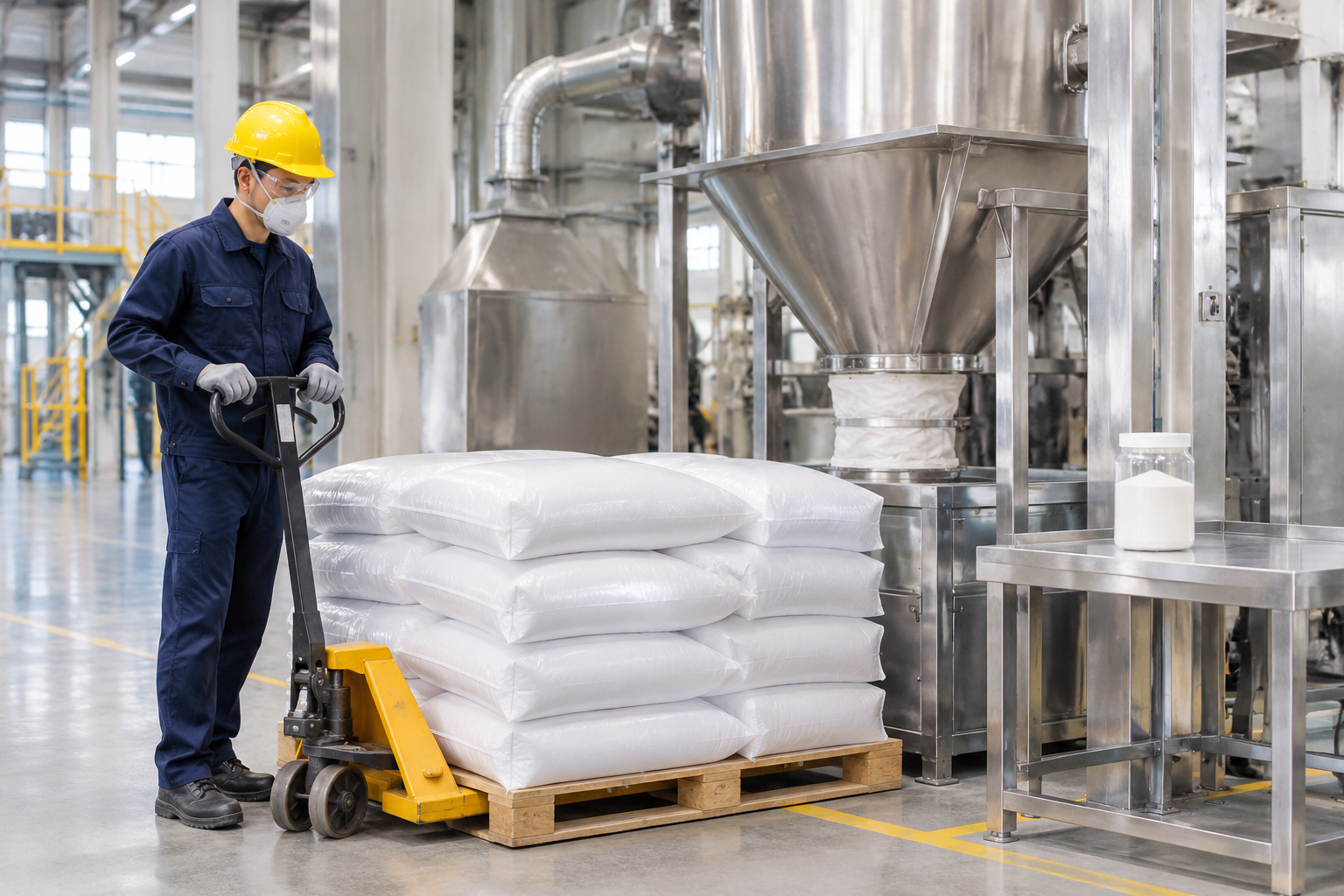
How Does Filler Surface Area Change Where the Polymer Ends Up?
Problem. A plant swaps a coarse, dense filler for a finer grade or a porous light filler at the same mass per batch. The certificate looks equivalent, the mixer sounds the same, and the wet mortar looks the same. Two weeks later the pull-off values on a wall mock-up are short.
Agitation / Answer. Finer, angular or porous filler multiplies the area the paste has to wet, so the same polymer solids are spread over more surface and the films at the contact points become thinner. The mix can look and feel completely normal while the bond line is starved. That is the failure mode that fools a plant most often.
The mechanism is easier to see in terms of what the water does first. Every square metre of mineral surface has to be wet before the paste is workable, and porous light or recycled fillers take water into the particle itself, where it no longer keeps the paste fluid. The plant’s response is to add water, and that is where the second half of the problem starts: more water means a higher water-to-binder ratio, a more open capillary structure after drying, and less polymer solids per unit of pore volume.
Particle shape matters as much as fineness. Crushed, angular filler increases inter-particle friction, so a fixed flow target needs more water, while rounded filler of the same fineness can reach the same flow with less. Plate-like or highly porous minerals behave worse than their sieve data suggests, because the sieve sees the outside of the particle and the water sees the inside.
There is a limit to how far this should be pushed. We do not claim that RDP is adsorbed onto filler and chemically used up; the honest description is that surface area, porosity and shape change the water demand and the interfacial area over which a fixed amount of polymer must form continuous film. That is enough to move the required loading, and it is measurable.
What we check on a new filler: fineness and particle size distribution, shape under a microscope, water demand at a fixed flow rather than a fixed water addition, and a wet-out observation on a glass plate. ASTM C1437 is useful because it frames flow testing around a water content that produces a specified flow level [3], which puts two fillers on the same basis.

How Do Sand Gradation and Packing Change Water Demand and Polymer Distribution?
Problem. Sand is usually bought on fineness modulus, colour and price. A new source can match the fineness modulus of the old one and still change how the mix behaves, because the modulus is an average and averages hide a missing middle fraction.
Agitation / Answer. Gradation sets void volume and total surface in a single move. A gap-graded or dust-heavy sand leaves more voids that paste must fill and more surface that must be wetted, so water goes up, the paste volume goes up, and the polymer is spread through a larger and more porous matrix at a lower concentration per unit of surface.
When packing gets worse, the plant does not simply use more water; it uses more paste. Voids between grains have to be filled, and that something is cement, filler, water and polymer together. So a sand that packs badly pulls the whole binder package upward per cubic metre of mortar, and the polymer loading that was adequate in the old packing is now diluted across a bigger paste volume. Bond at the tile interface shows it first, because the paste is thinnest there. This is the most common reason a plant reports rising RDP use after a sand change: the polymer is not consumed, it is spread thinner through a paste that grew.
The gradation standards give the right mental model even when written for another product. ASTM C144 requires masonry mortar aggregate to be graded within prescribed limits, and it treats manufactured sand as a product processed to ensure suitable gradation rather than whatever comes off the crusher [2]. Gradation is a specification, not a by-product of where the sand was dug.
Two traps repeat. The first is trusting fineness modulus alone; two sands with the same modulus can differ badly in the middle fractions, and the middle fractions carry the packing. The second is ignoring crusher dust and clay: dust adds surface without adding packing, and clay adds a water-hungry, swelling phase that interferes with wetting. A methylene blue check on the fines is cheap insurance.
We also look at the coarse end. A sand that has lost its coarser fraction can still pass a fineness check while leaving a skeleton that cannot interlock, so the paste carries more load and the polymer holds a less stable matrix.
Which Plant-Side Checks Show That Demand Has Really Shifted?
Problem. Most “RDP problems” arrive as one failed result with three variables already moving: a new sand delivery, a different mixer operator, and a water setting that someone adjusted. Adding polymer covers the symptom, and the cause stays in the silo for the next batch.
Agitation / Answer. Put a retained sample of the old filler back through the same formula, at the same water for a fixed flow, with the same mixing energy, and test against the same requirement. If the old filler still passes, the shift is real and belongs to the filler. If it does not, the cause sits upstream of the filler.
Order matters here, because the cheap checks eliminate most of the expensive explanations. Retained samples come first: if the plant keeps a sealed portion of each filler delivery, a comparison run takes an afternoon and settles the question of whether the material moved at all. Sieve analysis comes next, by fraction rather than as a single modulus, so a missing middle band is visible. Water demand at fixed flow follows, because that is the variable the plant usually changed without recording it. Fresh density and air content show whether the paste volume shifted, and a film continuity check on a non-porous sheet shows whether the polymer is still closing over the surface.
Only then is it worth running the performance test. ISO 13007-1 sets out the performance requirements for cementitious adhesives together with the conditioning under which they apply [1], and the conditioning is half the answer: a result taken outside the specified cure tells you about the specimen, not about the formula. We ask plants to record the curing room temperature and age alongside the result, and to keep the failed specimen rather than the number.
Change control is the part that usually gets skipped. A filler or sand change should be a documented change with a named approver, a reference formula, a retained sample of both materials, and a defined set of checks that must pass before the silo is released. The plants that recover fastest from a bad change are the ones that can rebuild the old formula from retained material.
| Check | What it proves | What it does not prove |
|---|---|---|
| Retained old filler through the same formula | Whether the material change is the cause | Why the new material behaves differently |
| Sieve analysis by fraction | Whether packing and surface moved | Whether water or mixing also moved |
| Water demand at fixed flow | Whether the paste was made wetter | Whether the polymer film is continuous |
| Fresh density and air content | Whether paste volume changed | Whether bond at the interface changed |
| Film continuity on release sheet | Whether polymer still closes over | Field performance on a real substrate |
| Tensile adhesion at specified cure | Whether the requirement is still met | Which raw material is responsible |
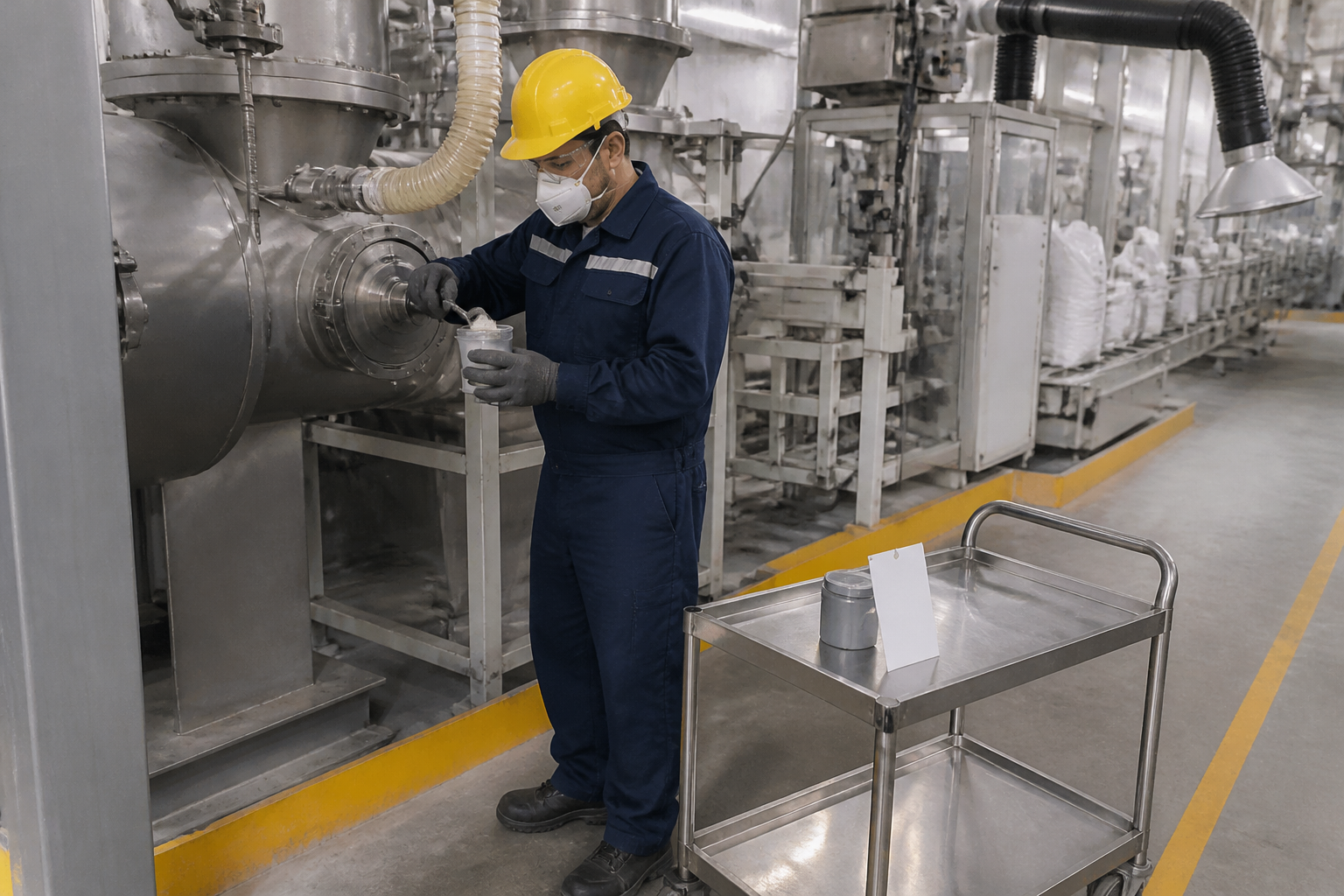
How Should We Trial a Filler Change Without Over-Dosing Polymer?
Problem. The default response is to step the polymer up until the failure disappears, then lock that level into the formula. The product passes, the extra cost is permanent, and nobody can say afterwards how much of the increase was actually required.
Agitation / Answer. Change one variable at a time. Hold filler and water constant and step polymer to find the new minimum; then hold polymer constant and blend fillers to restore packing. Judge against the required performance at the specified cure, not against how the mortar feels on the trowel.
A workable trial has three short series and one reference. The reference is the approved formula with the retained old filler, run on the same day, by the same operator, on the same mixer. Series one runs the new filler at the existing polymer loading with water set to the same flow; the gap to the reference is the size of the problem, worth knowing before any dosing decision. Series two steps the polymer at the new filler, still at fixed flow, to find where the requirement is met and where more polymer stops adding anything. Series three keeps that level and blends the aggregate package — coarse with fine, old sand with new — to see whether restoring packing removes the need for the increase. The third series usually decides the formula, because it attacks the cause instead of compensating for it.
Keep the series small and paired, not wide and unpaired. A few loadings tested against a same-day reference tell you more than a broad ladder run across different days with different operators and different water. Blind the evaluation where you can: pats coded by someone else, so the person judging film continuity does not know which loading they see.
Record what will be asked later: sieve fractions, water at fixed flow, fresh density, mixing sequence and time, curing condition and age at test, and retained sample identity. Release against the standard requirement, not the reference; the reference is only a baseline.
Finally, be honest about what the trial is for. Restoring performance and restoring cost are different objectives, and a cheaper filler that needs more polymer can consume the saving before the batch is packed. The trial should give you the minimum loading that holds the requirement; the commercial decision comes after.
Frequently asked questions
Does the filler consume RDP?
No. The polymer is not used up by the mineral. It is redistributed: the same solids end up spread over more surface or through a larger paste volume, so the film at the bond line is thinner or interrupted even though the loading on paper has not changed.
Can we simply raise RDP whenever the sand source changes?
Only after the sand and the water have been ruled out. The RDP demand filler gradation link is real, but a top-up will often restore the test result while hiding a packing or water problem that keeps costing money and reappears at the next change.
Why does the same filler behave differently in two plants?
Because demand depends on the whole paste, not on the filler alone. Cement source, mixing energy, water setting, entrained air and curing condition all shift the point at which the film becomes continuous, so the same mineral can sit on either side of the requirement in two different plants.
Does a finer filler always increase polymer demand?
Not always. Finer filler can improve packing and reduce voids up to a point, which is why ground limestone is used at all. The problem starts when fineness adds surface faster than it adds packing, or when the filler is porous and takes water into the particle.
How long should a filler-change trial run before release?
Long enough to test at the cure specified for the performance requirement, and long enough to include a retained reference run on the same day. We would rather see a narrow trial tested properly at the specified age than a wide one judged on how the mortar felt when it was mixed.
Talk to us before you change the polymer
If you are re-balancing a formula after a filler or sand change, send us the current mix design, the sieve data for both aggregates and the result that failed. We will tell you whether the gap looks like a packing problem, a surface area problem or a water problem before anyone touches the polymer loading — and if a trial is the right next step, we will help you design one that gives a defensible number instead of a guess. You can see the polymer and cellulose ether grades we supply on our product range page, and the RDP/VAE range specifically on the RDP page.
References
- ISO 13007-1:2014, Ceramic tiles — Grouts and adhesives — Part 1: Terms, definitions and specifications for adhesives. ISO. Applies to ceramic tile adhesives for internal and external installations on walls and floors and specifies the performance requirements for cementitious, dispersion and reaction resin adhesives. https://www.iso.org/standard/60880.html
- ASTM C144-18, Standard Specification for Aggregate for Masonry Mortar. ASTM International. Covers natural and manufactured sand for masonry mortar, requires the aggregate to be graded within prescribed limits, and treats manufactured sand as a product processed to ensure suitable gradation. https://www.astm.org/c0144-18.html
- ASTM C1437-20, Standard Test Method for Flow of Hydraulic Cement Mortar. ASTM International. Section 4.2 notes that flow is commonly used in standard tests that require the mortar to have a water content providing a specified flow level. https://www.astm.org/c1437-20.html
- M. Bin Mobarak, M. S. Hossain, M. Mahmud, S. Ahmed, “Redispersible polymer powder modified cementitious tile adhesive as an alternative to ordinary cement-sand grout,” Heliyon, vol. 7, no. 11, e08411, 2021. Describes the polymer film forming as water evaporates and interconnecting cement particles and fillers, and notes that aggregate composition, size and shape affect the mix. https://pmc.ncbi.nlm.nih.gov/articles/PMC8606344/
Further reading on our site: how RDP and PVA powder differ in a dry-mix formula, what a tile adhesive plant actually buys, which additives to qualify first, how to test cellulose ether before a bulk order, why HPMC forms lumps during dry mixing, and how to keep RDP from caking in storage. The HPMC grade overview is the place to start if the cellulose ether side of the formula is also being reviewed.